


















Gjør som tusenvis av andre bokelskere
Abonner på vårt nyhetsbrev og få rabatter og inspirasjon til din neste leseopplevelse.
Ved å abonnere godtar du vår personvernerklæring.Du kan når som helst melde deg av våre nyhetsbrev.

"Also available as an ebook" -- Verso title page.
The phenomenal growth of Pentecostalism and evangelicalism around the world in recent decades has forced us to rethink what it means to be religious and what it means to be global. The success of these religious movements has revealed tensions and resonances between the public and the private, the religious and the cultural, and the local and the global. This volume provides a wide ranging and accessible, as well as ethnographically rich, perspective on what has become a truly global religious trend, one that is challenging conventional analytical categories within the social sciences. This book informs students and seasoned scholars alike about the character of Pentecostalism and evangelicalism not only as they have spread across the globe, but also as they have become global movements. Adopting a broadly anthropological approach, the chapters synthesize the existing literature on Pentecostalism and evangelicalism even as they offer new analyses and critiques. They show how the study of Pentecostalism and evangelicalism provides a fresh way to approach classic anthropological themes; they contest the frequent characterization of these movements as conservative religious, social, and political forces; and they argue that Pentecostalism and evangelicalism are significant not least because they encourage us to reflect on the intersections of politics, materiality, morality and law. Ultimately, the volume leaves us with a clear sense of the cultural and social power, as well as the theoretical significance, of forms of Christianity that we can no longer afford to ignore.
"Also available as an ebook"--Title page verso.
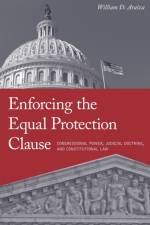
For over a century, Congress¿s power to enforce the Fourteenth Amendment¿s guarantee of ¿the equal protection of the laws¿ has presented judges and scholars with a puzzle. What does it mean for Congress to ¿enforce¿ such a wide-ranging, open-ended provision when the Supreme Court has insisted on its own superiority in interpreting the Fourteenth Amendment? In Enforcing the Equal Protection Clause, William D. Araiza offers a unique understanding of Congress¿s enforcement power and its relationship to the Court¿s claim to supremacy when interpreting the Constitution.Drawing on the history of American thinking about equality in the decades before and after the Civil War, Araiza argues that congressional enforcement and judicial supremacy can co-exist, but only if the Court limits its role to ensuring that enforcement legislation reasonably promotes the core meaning of the Equal Protection Clause. Much of the Court¿s equal protection jurisprudence stops short of stating such core meaning, thus leaving Congress free (subject to appropriate judicial checks) to enforce the full scope of the constitutional guarantee. Araizäs thesis reconciles the Supreme Court¿s ultimate role in interpreting the Constitution with Congress¿s superior capacity to transform the Fourteenth Amendment¿s majestic principles into living reality.The Fourteenth Amendment¿s Enforcement Clause raises difficult issues of separation of powers, federalism, and constitutional rights. Araiza illuminates each of these in this scholarly, timely work that is both intellectually rigorous but also accessible to non-specialist readers.
Cambodia. Rwanda. Armenia. Nazi Germany. History remembers these places as the sites of unspeakable crimes against humanity, and indisputably, of genocide. Yet, throughout the twentieth century, the world has seen many instances of violence committed by states against certain groups within their borders¿from the colonial ethnic cleansing the Germans committed against the Herero tribe in Africa, to the Katyn Forest Massacre, in which the Soviets shot over 20,000 Poles, to anti-communist mass murders in 1960s Indonesia. Are mass crimes against humanity like these still genocide? And how can an understanding of crime and criminals shed new light on how genocide¿the ¿crime of all crimes¿¿transpires? In The Crime of All Crimes, criminologist Nicole Rafter takes an innovative approach to the study of genocide by comparing eight diverse genocides--large-scale and small; well-known and obscure¿through the lens of criminal behavior. Rafter explores different models of genocidal activity, reflecting on the popular use of the Holocaust as a model for genocide and ways in which other genocides conform to different patterns. For instance, Rafter questions the assumption that only ethnic groups are targeted for genocidal ¿cleansing," and she also urges that actions such as genocidal rape be considered alongside traditional instances of genocidal violence. Further, by examining the causes of genocide on different levels, Rafter is able to construct profiles of typical victims and perpetrators and discuss means of preventing genocide, in addition to delving into the social psychology of genocidal behavior and the ways in which genocides are brought to an end. A sweeping and innovative investigation into the most tragic of events in the modern world, The Crime of All Crimes will fundamentally change how we think about genocide in the present day.
Ken Gormley is President and Professor of Law at Duquesne University in Pittsburgh.He is the award-winning author of the New York Times best seller The Death of American Virtue: Clinton vs. Starr, and Archibald Cox: Conscience of a Nation.
Abonner på vårt nyhetsbrev og få rabatter og inspirasjon til din neste leseopplevelse.
Ved å abonnere godtar du vår personvernerklæring.