























Gjør som tusenvis av andre bokelskere
Abonner på vårt nyhetsbrev og få rabatter og inspirasjon til din neste leseopplevelse.
Ved å abonnere godtar du vår personvernerklæring.Du kan når som helst melde deg av våre nyhetsbrev.

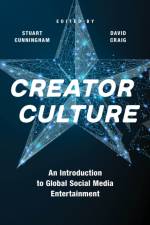
Explores new perspectives on social media entertainmentThere is a new class of cultural producers¿YouTube vloggers, Twitch gameplayers, Instagram influencers, TikTokers, Chinese wanghong, and others¿who are part of a rapidly emerging and highly disruptive industry of monetized ¿user-generated¿ content. As this new wave of native social media entrepreneurs emerge, so do new formations of culture and the ways they are studied.In this volume, contributors draw on scholarship in media and communication studies, science and technology studies, and social media, Internet, and platform studies, in order to define this new field of study and the emergence of creator culture. Creator Culture introduces readers to new paradigms of social media entertainment from critical perspectives, demonstrating both relations to and differentiations from the well-established media forms and institutions traditionally within the scope of media studies.This volume does not seek to impose a uniform perspective; rather, the goal is to stimulate in-depth, globally-focused engagement with this burgeoning industry and establish a dynamic research agenda for scholars, teachers, and students, as well as creators and professionals across the media, communication, creative, and social media industries.Contributors include: Jean Burgess, Zoë Glatt, Sarah Banet-Weiser, Brent Luvaas, Carlos A. Scolari, Damián Fraticelli, José M. Tomasena, Junyi Lv, Hector Postigo, Brooke Erin Duffy, Megan Sawey, Jarrod Walzcer, Sangeet Kumar, Sriram Mohan, Aswin Punathambekar, Mohamed El Marzouki, Elaine Jing Zhao, Arturo Arriagada, Jeremy Shtern, Stephanie Hill
Leading scholars examine China's global strategic plans, from Hong Kong to military power, to economic dominanceOver the past few decades, China has increasingly challenged the global influence of the United States. In China's Grand Strategy, David B. H. Denoon brings together a group of eminent scholars to explain China's rapid ascendance on the world stage, as well as its future implications for global politics. Contributors address the military, economic, diplomatic, and internal political factors shaping China's strategy, in addition to highlighting Beijing's objectives in different parts of the world, such as Central Asia, Africa, and the Middle East. Ultimately, they explore the promise and perils of China's rapidly changing political ambitions, showing how the country has made its mark on the twenty-first century. China's Grand Strategy provides insight into China's quest to become a global leader, particularly at a time when the future of both China and the US remain uncertain in the context of current crises like the coronavirus pandemic, the ongoing protests in Hong Kong, and escalating tension between top leaders and officials. This book cannot predict the future for China or the US, but the insights offered can help make sense of where we have been and where we are going.
Explores the influence of Kabbalah in shaping America's religious identity In 1688, a leading Quaker thinker and activist in what is now New Jersey penned a letter to one of his closest disciples concerning Kabbalah, or what he called the mystical theology of the Jews. Around that same time, one of the leading Puritan ministers developed a messianic theology based in part on the mystical conversion of the Jews. This led to the actual conversion of a Jew in Boston a few decades later, an event that directly produced the first kabbalistic book conceived of and published in America. That book was read by an eventual president of Yale College, who went on to engage in a deep study of Kabbalah that would prod him to involve the likes of Benjamin Franklin, and to give a public oration at Yale in 1781 calling for an infusion of Kabbalah and Jewish thought into the Protestant colleges of America. Kabbalah and the Founding of America traces the influence of Kabbalah on early Christian Americans. It offers a new picture of Jewish-Christian intellectual exchange in pre-Revolutionary America, and illuminates how Kabbalah helped to shape early American religious sensibilities. The volume demonstrates that key figures, including the well-known Puritan ministers Cotton Mather and Increase Mather and Yale University President Ezra Stiles, developed theological ideas that were deeply influenced by Kabbalah. Some of them set out to create a more universal Kabbalah, developing their ideas during a crucial time of national myth building, laying down precedents for developing notions of American exceptionalism. This book illustrates how, through fascinating and often surprising events, this unlikely inter-religious influence helped shape the United States and American identity.
"Creator Culture introduces readers to "ways of seeing" social media entertainment from perspectives that critically assess claims for its relation to, yet differentiation from, well-established media forms and institutions within scope for cultural and media studies, including emerging platform and social media studies"--
Abonner på vårt nyhetsbrev og få rabatter og inspirasjon til din neste leseopplevelse.
Ved å abonnere godtar du vår personvernerklæring.