
Gjør som tusenvis av andre bokelskere
Abonner på vårt nyhetsbrev og få rabatter og inspirasjon til din neste leseopplevelse.
Ved å abonnere godtar du vår personvernerklæring.Du kan når som helst melde deg av våre nyhetsbrev.

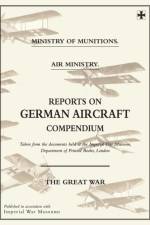
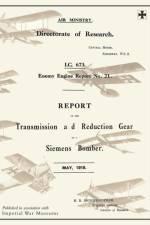
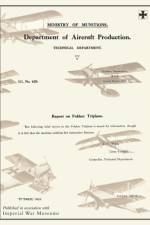
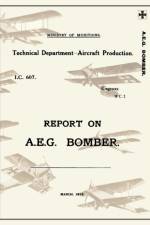
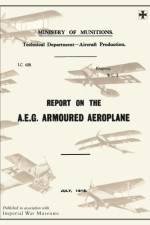
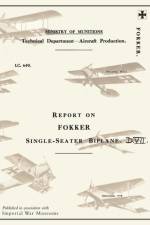
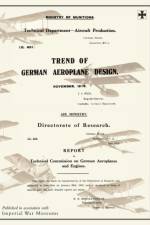
This compendium contains the following reports.TREND OF GERMAN AEROPLANE DESIGN: November 1918 REPORT BY TECHNICAL COMISSION ON GERMAN AEROPLANES AND ENGINES: June 1919REPORT ON THE A.E.G. ARMOURED AEROPLANE: July 1918DEVELOPMENT OF D.F.W GIANT AEROPLANE: April 1919REPORT ON THE FOKKER SINGLE-SEATER BIPLANE D.VII: September 1918REPORT ON FOKKER TRIPLANE, March 1918REPORT ON A.E.G. BOMBER, March 1918REPORTS ON THE FRIEDRICHSHAFEN BOMBER, March 1918REPORT ON THE GOTHA BOMBER. WITH NOTES ON GIANT AEROPLANES, September 1918REDUCTION GEARS USED ON FIVE-ENGINED GIANT GOTHA BOMBER (ENEMY ENGINE REPORT NO.16), June 1919REPORT ON THE HALBERSTADT FIGHTER, September 1918 and October 1918REPORT ON THE HALBERSTADT FIGHTER TYPE C. L. IV., October 1918REPORT ON THE HANNOVERANER BIPLANE, July 1918REPORT ON THE JUNKER ALL-METAL ARMOURED BIPLANE TYPE J.I., July 1919REPORT ON THE JUNKER ALL-METAL SINGLE-SEATER MONOPLANE TYPE D.1., July 1919REPORT ON THE L.V.G. TWO-SEATER BIPLANES, September 1918REPORT ON THE PFALZ SINGLE-SEATER, July 1918REPORT ON THE PFALZ TYPE D.XII SINGLE-SEATER FIGHTER, October 1918REPORT ON THE PFALZ BIPLANE, TYPE D.XV., February 1920REPORT ON THE TWO-SEATER RUMPLER, G. 117., July 1918REPORT ON THE TRANSMISSION AND REDUCTION GEAR OF A SIEMENS BOMBER, May 1919
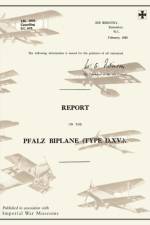
The D.XV was last of the series of biplane fighters and notably different from their earlier aircraft, with both mainplanes clear of the fuselage and without flying wires. The lower wing was the smaller of the two both in span and chord and had elliptical tips. The upper wing was square tipped and fitted with ailerons. Both were single piece from tip to tip. Outward leaning N-form struts defined the D.XV as a single bay biplane; groups of short struts from the mid and upper fuselage joined it to the upper wing and similar groups attached the lower plane.The D.XV had a 185 hp (138 kW) 6-cylinder water-cooled inline engine BMW IIIa with a rectangular radiator filling the upper nose above the drive-shaft of the two blade propeller. Aft, the fuselage was rounded in cross-section with the single open cockpit behind the upper wing's trailing edge. The horizontal tail was mounted at mid-fuselage, D-shaped in plan and with balanced elevators. The fin was triangular and carried a short, curved, balanced rudder. The D.XV's fixed conventional undercarriage was of the fixed axle type, the axle ends supported on pairs of V-struts and wire cross-braced; there was a tall tail skid. Armament, twin Spandau machine-guns.The D.XV was developed over the summer of 1918 and versions with unbalanced ailerons (D.XVf) and overhung, balanced ailerons (D.XV (Spezial). The 180 hp (134 kW) Daimler DIIIa engine was also considered. The Pfalz took part in the third D-type, held in October 1918. It was judged to have high performance and manoeuvrability though tail heavy and hard to land. It was one of the last German fighters accepted for production, getting its type approval on 4 November 1918, just a few days before the Armistice. Because it was approved for production so late, the Pfalz XV never reached operational status. Nonetheless, several were built and finished, and there were 74 completed fuselages in the Pfalz works when these were inspected by the Allies in the autumn of 1919.
The Junkers D.I (factory designation J 9) was a fighter aircraft produced in Germany late in World War I, significant for becoming the first all-metal fighter to enter service.What really set the Junker D.I apart from any previous aircraft was it's cantilevered low-wing design and corrugated duralumin skin. Duralumin, the same metal used for Zeppelin construction, was light yet strong. The Junkers monoplane was rigid, fast, and agile. The D.I was every fighter pilots' dream. The design was a decade ahead of its time.The prototype, a private venture by Junkers designated the J 7, first flew on 17 September 1917. Demonstrated to the Idflieg early the following year, it proved impressive enough to result in an order for three additional aircraft for trials. However, the changes made by Junkers were significant enough for the firm to redesignate the next example the J 9, which was supplied to the Idflieg instead of the three J 7s ordered.During tests, the J 9 was felt to lack the manoeuvrability necessary for a front-line fighter, but was judged fit for a naval fighter, and a batch of 12 was ordered. These were to have been supplied to a naval unit by September 1918, but instead equipped the same unit redeployed to the Eastern Front after the Armistice. One survives in a French Museum.
The Hannover CL.III was a two-seat multi-role aircraft, primarily used as a ground attack machine. Like the other Hannover "light-C-class", or "CL" designated aircraft designed by Hermann Dorner, it included an unusual biplane tail, allowing for a greater firing arc for the tail gunner. Until the introduction of the aircraft, such tails had only been used on larger aircraft.Compared to the preceding CL.II, the CL.III had redesigned ailerons with aerodynamic balance areas that overhung the wingtips, a modification that provided greater maneuverability, especially at the low levels that the CL.III was expected to be operating at in its new ground-attack role as the Schutzstaffeln (escort squadrons) were reassigned as Schlactstaffeln (battle squadrons). It was also intended that it should use the excellent Mercedes D.III engine, but the Idflieg gave priority for these engines to fighter production, and most CL.IIIs were produced with the same Argus engine that the CL.II had used. The Argus engined variant was designated CL.IIIa.
The Fokker D.VII is widely regarded as the best German aircraft of the war. Its development was championed by Manfred von Richthofen. In January 1918, Richthofen tested the D.VII in the trials at Adlershof but never had an opportunity to fly it in combat. He was killed just days before it entered service. When introduced, the D.VII was not without problems. On occasion its wing ribs would fracture in a dive or high temperatures would cause the gas tank to explode. Even so, the D.VII proved to be durable and easy to fly. As noted by one authority, it had "an apparent ability to to make a good pilot out of mediocre material.". When equipped with the BMW engine, the D.VII could out climb any Allied opponent it encountered in combat. Highly manoeuvrable at all speeds and altitudes, it proved to be more than a match for any of the British or French fighter planes of 1918.
Abonner på vårt nyhetsbrev og få rabatter og inspirasjon til din neste leseopplevelse.
Ved å abonnere godtar du vår personvernerklæring.