Gjør som tusenvis av andre bokelskere
Abonner på vårt nyhetsbrev og få rabatter og inspirasjon til din neste leseopplevelse.
Ved å abonnere godtar du vår personvernerklæring.Du kan når som helst melde deg av våre nyhetsbrev.

The War Diaries for the Great War, held under WO95, represent one of the most popular record collections held at the National Archives, Kew, London. For researchers and family historians, the War Diaries contain a wealth of information of far greater interest than the army could ever have predicted. They provide unrivalled insight into daily events on the front line and are packed with fascinating detail. They contain no modern editing, opinions or poorly judged comments, just the war day by day, written by the men who fought this 'War to end all Wars. They are without question, the most important source of information available on the war on the Western Front.Full colour facsimile of each page with specially created chronological index.What is a War Diary?The headquarters of each unit and formation of the British Army in the field was ordered to maintain a record of its location, movements and activities. For the most part, these details were recorded on a standard army form headed 'War diary or intelligence summary'.What details are given?Details given vary greatly, depending on the nature of the unit, what it was doing and, to some extent, the style of the man writing it. The entries vary from very simple and repetitive statements like 'Training' up to many pages of description when a unit was in battle. Production of the diary was the responsibility of the Adjutant of the headquarters concerned.Is there any other information or documents with the diaries?Some diaries have other documentation attached, such as maps, operational orders and after-action reports.
The War Diaries for the Great War, held under WO95, represent one of the most popular record collections held at the National Archives, Kew, London. For researchers and family historians, the War Diaries contain a wealth of information of far greater interest than the army could ever have predicted. They provide unrivalled insight into daily events on the front line and are packed with fascinating detail. They contain no modern editing, opinions or poorly judged comments, just the war day by day, written by the men who fought this 'War to end all Wars. They are without question, the most important source of information available on the war on the Western Front.Full colour facsimile of each page with specially created chronological index.What is a War Diary?The headquarters of each unit and formation of the British Army in the field was ordered to maintain a record of its location, movements and activities. For the most part, these details were recorded on a standard army form headed 'War diary or intelligence summary'.What details are given?Details given vary greatly, depending on the nature of the unit, what it was doing and, to some extent, the style of the man writing it. The entries vary from very simple and repetitive statements like 'Training' up to many pages of description when a unit was in battle. Production of the diary was the responsibility of the Adjutant of the headquarters concerned.Is there any other information or documents with the diaries?Some diaries have other documentation attached, such as maps, operational orders and after-action reports.
The War Diaries for the Great War, held under WO95, represent one of the most popular record collections held at the National Archives, Kew, London. For researchers and family historians, the War Diaries contain a wealth of information of far greater interest than the army could ever have predicted. They provide unrivalled insight into daily events on the front line and are packed with fascinating detail. They contain no modern editing, opinions or poorly judged comments, just the war day by day, written by the men who fought this 'War to end all Wars. They are without question, the most important source of information available on the war on the Western Front.Full colour facsimile of each page with specially created chronological index.What is a War Diary?The headquarters of each unit and formation of the British Army in the field was ordered to maintain a record of its location, movements and activities. For the most part, these details were recorded on a standard army form headed 'War diary or intelligence summary'.What details are given?Details given vary greatly, depending on the nature of the unit, what it was doing and, to some extent, the style of the man writing it. The entries vary from very simple and repetitive statements like 'Training' up to many pages of description when a unit was in battle. Production of the diary was the responsibility of the Adjutant of the headquarters concerned.Is there any other information or documents with the diaries?Some diaries have other documentation attached, such as maps, operational orders and after-action reports.
The War Diaries for the Great War, held under WO95, represent one of the most popular record collections held at the National Archives, Kew, London. For researchers and family historians, the War Diaries contain a wealth of information of far greater interest than the army could ever have predicted. They provide unrivalled insight into daily events on the front line and are packed with fascinating detail. They contain no modern editing, opinions or poorly judged comments, just the war day by day, written by the men who fought this 'War to end all Wars. They are without question, the most important source of information available on the war on the Western Front.Full colour facsimile of each page with specially created chronological index.What is a War Diary?The headquarters of each unit and formation of the British Army in the field was ordered to maintain a record of its location, movements and activities. For the most part, these details were recorded on a standard army form headed 'War diary or intelligence summary'.What details are given?Details given vary greatly, depending on the nature of the unit, what it was doing and, to some extent, the style of the man writing it. The entries vary from very simple and repetitive statements like 'Training' up to many pages of description when a unit was in battle. Production of the diary was the responsibility of the Adjutant of the headquarters concerned.Is there any other information or documents with the diaries?Some diaries have other documentation attached, such as maps, operational orders and after-action reports.
The War Diaries for the Great War, held under WO95, represent one of the most popular record collections held at the National Archives, Kew, London. For researchers and family historians, the War Diaries contain a wealth of information of far greater interest than the army could ever have predicted. They provide unrivalled insight into daily events on the front line and are packed with fascinating detail. They contain no modern editing, opinions or poorly judged comments, just the war day by day, written by the men who fought this 'War to end all Wars. They are without question, the most important source of information available on the war on the Western Front.Full colour facsimile of each page with specially created chronological index.What is a War Diary?The headquarters of each unit and formation of the British Army in the field was ordered to maintain a record of its location, movements and activities. For the most part, these details were recorded on a standard army form headed 'War diary or intelligence summary'.What details are given?Details given vary greatly, depending on the nature of the unit, what it was doing and, to some extent, the style of the man writing it. The entries vary from very simple and repetitive statements like 'Training' up to many pages of description when a unit was in battle. Production of the diary was the responsibility of the Adjutant of the headquarters concerned.Is there any other information or documents with the diaries?Some diaries have other documentation attached, such as maps, operational orders and after-action reports.
The War Diaries for the Great War, held under WO95, represent one of the most popular record collections held at the National Archives, Kew, London. For researchers and family historians, the War Diaries contain a wealth of information of far greater interest than the army could ever have predicted. They provide unrivalled insight into daily events on the front line and are packed with fascinating detail. They contain no modern editing, opinions or poorly judged comments, just the war day by day, written by the men who fought this 'War to end all Wars. They are without question, the most important source of information available on the war on the Western Front.Full colour facsimile of each page with specially created chronological index.What is a War Diary?The headquarters of each unit and formation of the British Army in the field was ordered to maintain a record of its location, movements and activities. For the most part, these details were recorded on a standard army form headed 'War diary or intelligence summary'.What details are given?Details given vary greatly, depending on the nature of the unit, what it was doing and, to some extent, the style of the man writing it. The entries vary from very simple and repetitive statements like 'Training' up to many pages of description when a unit was in battle. Production of the diary was the responsibility of the Adjutant of the headquarters concerned.Is there any other information or documents with the diaries?Some diaries have other documentation attached, such as maps, operational orders and after-action reports.
The War Diaries for the Great War, held under WO95, represent one of the most popular record collections held at the National Archives, Kew, London. For researchers and family historians, the War Diaries contain a wealth of information of far greater interest than the army could ever have predicted. They provide unrivalled insight into daily events on the front line and are packed with fascinating detail. They contain no modern editing, opinions or poorly judged comments, just the war day by day, written by the men who fought this 'War to end all Wars. They are without question, the most important source of information available on the war on the Western Front.Full colour facsimile of each page with specially created chronological index.What is a War Diary?The headquarters of each unit and formation of the British Army in the field was ordered to maintain a record of its location, movements and activities. For the most part, these details were recorded on a standard army form headed 'War diary or intelligence summary'.What details are given?Details given vary greatly, depending on the nature of the unit, what it was doing and, to some extent, the style of the man writing it. The entries vary from very simple and repetitive statements like 'Training' up to many pages of description when a unit was in battle. Production of the diary was the responsibility of the Adjutant of the headquarters concerned.Is there any other information or documents with the diaries?Some diaries have other documentation attached, such as maps, operational orders and after-action reports.
The War Diaries for the Great War, held under WO95, represent one of the most popular record collections held at the National Archives, Kew, London. For researchers and family historians, the War Diaries contain a wealth of information of far greater interest than the army could ever have predicted. They provide unrivalled insight into daily events on the front line and are packed with fascinating detail. They contain no modern editing, opinions or poorly judged comments, just the war day by day, written by the men who fought this 'War to end all Wars. They are without question, the most important source of information available on the war on the Western Front.Full colour facsimile of each page with specially created chronological index.What is a War Diary?The headquarters of each unit and formation of the British Army in the field was ordered to maintain a record of its location, movements and activities. For the most part, these details were recorded on a standard army form headed 'War diary or intelligence summary'.What details are given?Details given vary greatly, depending on the nature of the unit, what it was doing and, to some extent, the style of the man writing it. The entries vary from very simple and repetitive statements like 'Training' up to many pages of description when a unit was in battle. Production of the diary was the responsibility of the Adjutant of the headquarters concerned.Is there any other information or documents with the diaries?Some diaries have other documentation attached, such as maps, operational orders and after-action reports.
The War Diaries for the Great War, held under WO95, represent one of the most popular record collections held at the National Archives, Kew, London. For researchers and family historians, the War Diaries contain a wealth of information of far greater interest than the army could ever have predicted. They provide unrivalled insight into daily events on the front line and are packed with fascinating detail. They contain no modern editing, opinions or poorly judged comments, just the war day by day, written by the men who fought this 'War to end all Wars. They are without question, the most important source of information available on the war on the Western Front.Full colour facsimile of each page with specially created chronological index.What is a War Diary?The headquarters of each unit and formation of the British Army in the field was ordered to maintain a record of its location, movements and activities. For the most part, these details were recorded on a standard army form headed 'War diary or intelligence summary'.What details are given?Details given vary greatly, depending on the nature of the unit, what it was doing and, to some extent, the style of the man writing it. The entries vary from very simple and repetitive statements like 'Training' up to many pages of description when a unit was in battle. Production of the diary was the responsibility of the Adjutant of the headquarters concerned.Is there any other information or documents with the diaries?Some diaries have other documentation attached, such as maps, operational orders and after-action reports.
The War Diaries for the Great War, held under WO95, represent one of the most popular record collections held at the National Archives, Kew, London. For researchers and family historians, the War Diaries contain a wealth of information of far greater interest than the army could ever have predicted. They provide unrivalled insight into daily events on the front line and are packed with fascinating detail. They contain no modern editing, opinions or poorly judged comments, just the war day by day, written by the men who fought this 'War to end all Wars. They are without question, the most important source of information available on the war on the Western Front.Full colour facsimile of each page with specially created chronological index.What is a War Diary?The headquarters of each unit and formation of the British Army in the field was ordered to maintain a record of its location, movements and activities. For the most part, these details were recorded on a standard army form headed 'War diary or intelligence summary'.What details are given?Details given vary greatly, depending on the nature of the unit, what it was doing and, to some extent, the style of the man writing it. The entries vary from very simple and repetitive statements like 'Training' up to many pages of description when a unit was in battle. Production of the diary was the responsibility of the Adjutant of the headquarters concerned.Is there any other information or documents with the diaries?Some diaries have other documentation attached, such as maps, operational orders and after-action reports.
The War Diaries for the Great War, held under WO95, represent one of the most popular record collections held at the National Archives, Kew, London. For researchers and family historians, the War Diaries contain a wealth of information of far greater interest than the army could ever have predicted. They provide unrivalled insight into daily events on the front line and are packed with fascinating detail. They contain no modern editing, opinions or poorly judged comments, just the war day by day, written by the men who fought this 'War to end all Wars. They are without question, the most important source of information available on the war on the Western Front.Full colour facsimile of each page with specially created chronological index.What is a War Diary?The headquarters of each unit and formation of the British Army in the field was ordered to maintain a record of its location, movements and activities. For the most part, these details were recorded on a standard army form headed 'War diary or intelligence summary'.What details are given?Details given vary greatly, depending on the nature of the unit, what it was doing and, to some extent, the style of the man writing it. The entries vary from very simple and repetitive statements like 'Training' up to many pages of description when a unit was in battle. Production of the diary was the responsibility of the Adjutant of the headquarters concerned.Is there any other information or documents with the diaries?Some diaries have other documentation attached, such as maps, operational orders and after-action reports.
The War Diaries for the Great War, held under WO95, represent one of the most popular record collections held at the National Archives, Kew, London. For researchers and family historians, the War Diaries contain a wealth of information of far greater interest than the army could ever have predicted. They provide unrivalled insight into daily events on the front line and are packed with fascinating detail. They contain no modern editing, opinions or poorly judged comments, just the war day by day, written by the men who fought this 'War to end all Wars. They are without question, the most important source of information available on the war on the Western Front.Full colour facsimile of each page with specially created chronological index.What is a War Diary?The headquarters of each unit and formation of the British Army in the field was ordered to maintain a record of its location, movements and activities. For the most part, these details were recorded on a standard army form headed 'War diary or intelligence summary'.What details are given?Details given vary greatly, depending on the nature of the unit, what it was doing and, to some extent, the style of the man writing it. The entries vary from very simple and repetitive statements like 'Training' up to many pages of description when a unit was in battle. Production of the diary was the responsibility of the Adjutant of the headquarters concerned.Is there any other information or documents with the diaries?Some diaries have other documentation attached, such as maps, operational orders and after-action reports.
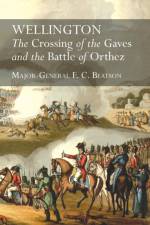
Originally published in 1925, this is a rare volume in the author’s multi-volume study of Wellington’s life and campaigns. The book deals with the final phase of the Peninsular War when the Iron Duke chased the fleeing French across the Pyrenees into France itself, defeating them in the Battle of Orthez, and crossing the River Gaves. Illustrated with early 20th century photographs of the battlefields and significant sites, the book recounts Welllington’s campaign plans and includes his battlefield orders.
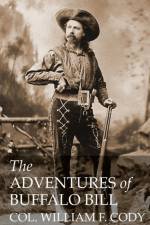
∩╗┐William F. Cody, aka ‘Buffalo Bill’ was the man who almost single-handedly created the legend of the Wild West. Starting his career at the tender age of 11, he was successively a rodeo rider, Pony Express courier, a US Army Scout in both the American Civil and Indian wars, a Buffalo/Bison hunter, and finally a master showman who in the 1880s–90s took his Wild West Show featuring cowboys, Indians and other components of the legend, on hugely successful tours across America and Europe. This charming period piece of a book, first published in 1904, recounts his adventures fighting the Sioux Plains Indians who later became a popular feature of his travelling shows.
The War Diaries for the Great War, held under WO95, represent one of the most popular record collections held at the National Archives, Kew, London. For researchers and family historians, the War Diaries contain a wealth of information of far greater interest than the army could ever have predicted. They provide unrivalled insight into daily events on the front line and are packed with fascinating detail. They contain no modern editing, opinions or poorly judged comments, just the war day by day, written by the men who fought this 'War to end all Wars. They are without question, the most important source of information available on the war on the Western Front. Full colour facsimile of each page with specially created chronological index. What is a War Diary? The headquarters of each unit and formation of the British Army in the field was ordered to maintain a record of its location, movements and activities. For the most part, these details were recorded on a standard army form headed 'War diary or intelligence summary'. What details are given? Details given vary greatly, depending on the nature of the unit, what it was doing and, to some extent, the style of the man writing it. The entries vary from very simple and repetitive statements like 'Training' up to many pages of description when a unit was in battle. Production of the diary was the responsibility of the Adjutant of the headquarters concerned. Is there any other information or documents with the diaries? Some diaries have other documentation attached, such as maps, operational orders and after-action reports.
The War Diaries for the Great War, held under WO95, represent one of the most popular record collections held at the National Archives, Kew, London. For researchers and family historians, the War Diaries contain a wealth of information of far greater interest than the army could ever have predicted. They provide unrivalled insight into daily events on the front line and are packed with fascinating detail. They contain no modern editing, opinions or poorly judged comments, just the war day by day, written by the men who fought this 'War to end all Wars. They are without question, the most important source of information available on the war on the Western Front.Full colour facsimile of each page with specially created chronological index.What is a War Diary?The headquarters of each unit and formation of the British Army in the field was ordered to maintain a record of its location, movements and activities. For the most part, these details were recorded on a standard army form headed 'War diary or intelligence summary'.What details are given?Details given vary greatly, depending on the nature of the unit, what it was doing and, to some extent, the style of the man writing it. The entries vary from very simple and repetitive statements like 'Training' up to many pages of description when a unit was in battle. Production of the diary was the responsibility of the Adjutant of the headquarters concerned.Is there any other information or documents with the diaries?Some diaries have other documentation attached, such as maps, operational orders and after-action reports.
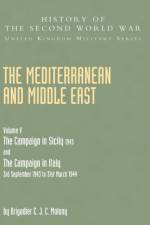
The fifth and largest volume of the eight books in the 18-volume official British History of the Second World War describing the war in the Mediterranean and Middle East, this narrates the campaigns in Sicily and Italy from July 1943 to March 1944. The Allies, under General Alexander, selected the harsh mountain terrain of Sicily as the site of their return to Europe after being chased from the continent in 1940/1. The July landings were successful and within a month the Germans had evacuated the island. The allies were now faced with the tough prospect of clearing the Germans from the whole Italian peninsula. In September they landed at Salerno, and despite determined counter-attacks, consolidated their beachhead. In October 1943, after the Badoglio Government, which had overthrown Mussolini in July, surrendered, Hitler ordered the occupation and in-depth defence of Italy. This tied down large numbers of German trooops, but made for a protracted and bitter winter campaign, characterised by set-piece Allied attacks against a series of strong German defensive positions along the Bernhardt and Gustav Lines and the Sangro, Garigliano and Rapido rivers. In January 1944 the Allies attempted to outflank the Germans and rush to Rome with another seaborne landing at Anzio. Although the landing was successful, German defence was stubborn, solidifying around the monastery of Monte Cassino, which held out against repeated Allied attacks. With 6 appendices, 43 maps and diagrams and 46 photographs.
A magnificent book, written with great attention to detail and a model of what a good regimental history should be. The narrative is divided in two parts. The first was written by Haywood and covers the evolution of the WAFF up to 1919, with very full coverage of WW1 operations in East Africa. The second was written by Clarke and covers the period 1920 1960.A Roll of Honour (European only) Honours & Awards with citations for VC's, Note on campaign medals, Orders of Battle and Dress Regulations 1903, complete this fine Regimental History.This definitive volume covers all the campaigns of the WAFF from 1900 and the fighting in Nigeria through the Great War, much on the campaign against Col. von Lettow-Vorbeck in East Africa, then action in the Second World War, Italian East Africa, & Abyssinia etc. Later in WW2 it formed part of the 81st Division and saw action in Burma and the Arakan.
The 6th Battalion of the DLI was formed in the Boer War, serving in South Africa from 1900-02. In the first year of the Great War the battalion raised enough volunteers to form first and second line battalions, and to start a third one. The 1/6th Battalion suffered heavy casualties at the second battle of Ypres in April 1915 (the 1/8th alone lost 19 officers and 574 other ranks) - that they were forced to amalgamate, becoming the 6/8th Battalion. The 2/6th Battalion was formed in September 1914 and was employed in home defence duties as part of the 190th (2nd Durham Light Infantry) Brigade of the 63rd (2nd Northumbrian) Division. Reassigned, it landed in France on 6 May 1918 as the Garrison Guards Battalion, part of the 177th Brigade of the 59th (2nd North Midland) Division. It dropped 'Garrison Guard' by 16th July and entered the line on the 15th, fighting in the autumn during the 100 days offensive. Appendices show Officers killed or died and Decorations.
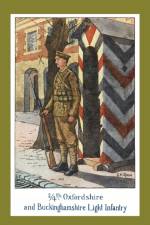
The 2nd Ox and Bucks Light Infantry was originally raised at Aylesbury in Buckinghamshire by Lt. Col H.M. Williams, and was officially recognised on 26th September 1914. On February 1st the 2nd Bucks moved to Northampton, joining the South Midland Reserve Brigade, afterwards the 184th Infantry Brigade. Employed on Home Defence, the battalion performed duties including trench digging around Epping and Chelmsford. On 6th August, a year after the declaration of war, the battalion was inspected by Lord Kitchener himself. In May 1916, after being inspected by HM King George V, the battalion embarked for France, lading at Le Havre on May 25th and going into the trenches around Laventie. On July 19th the battalion took part in a disastrous diversionary attack near Estaires, designed to distract German attention from the ongoing battle of the Somme. The attack was a complete failure and all officers of the three attacking companies were killed or wounded. After new drafts of troops and fresh officers arrived, the battalion retrained in a quiet area before taking up front line positions again at the Butte de Warlencourt on the Somme just as the great battle was ending. The following year the battalion took part in the battle of Passchendaele (Third Ypres) again suffering heavy casualties. The battalion helped stem the German offensives in Spring 1918, before being amalgamated with other units which had suffered heavier losses. This complete history has tables of awards and a Roll of Honour.
Abonner på vårt nyhetsbrev og få rabatter og inspirasjon til din neste leseopplevelse.
Ved å abonnere godtar du vår personvernerklæring.