



















Gjør som tusenvis av andre bokelskere
Abonner på vårt nyhetsbrev og få rabatter og inspirasjon til din neste leseopplevelse.
Ved å abonnere godtar du vår personvernerklæring.Du kan når som helst melde deg av våre nyhetsbrev.

The Politics of Care in Habermas and Derrida provides a penetrating analysis of the tensions and possibilities that animate the dialogue between two of the most significant frameworks of moral philosophy in the contemporary Continental tradition. The dispute between Habermasian discourse ethics and Derridean deconstruction is the backdrop for the book's excursus on the problem of care for the 'otherness of the other'_a question with profound implications at the level of both ethics and politics. In addressing this problem, the study reaches beyond the idioms of Habermas and Derrida and considers care from a number of divergent vantage points, including feminist theory, ecological ethics, the recognition theory of Axel Honneth, and the perspectives of Frankfurt School writers such as Max Horkheimer and Theodor Adorno. In its concluding chapter, the book offers an innovative reconstruction of Habermas's discourse-ethical model, which affirms the latter's overarching commitment to the tradition of moral universalism even as it accords due weight to the contravening standpoint of Derrida and kindred exponents of the ethics of care. This book will be of interest to students and scholars of contemporary moral and ethical philosophy, especially those concerned with the work of Habermas and Derrida_both as individual thinkers and as philosophical interlocutors.
Filipe Carreira da Silva addresses the basic questions 'How should we read Mead?' and 'Why should we read Mead today' by showing that the history of ideas and theory-building are closely-related endeavors. Following a contextualist approach in exploring the meaning of Mead's writings, Carreira da Silva reads the entire corpus of Mead's published and unpublished writings in light of the context in which they were originally produced, from concrete events like the American involvement in World War I to more general debates like that of the nature of modernity. Mead and Modernity attests to the relevance of Mead's ideas by assessing the relative merits of his responses to three fundamental modern problematics: science, selfhood, and democratic politics. The outcome is an innovative intellectual portrait of Mead as a seminal thinker whose contributions extend beyond his well-known social theory of the self and include important insights into the philosophy of science and radical democratic theory.
Democratic Anxieties: Same-Sex Marriage, Death, and Citizenship proceeds from the surprising parallels between straight and gay opponents of same-sex marriage. With their apocalyptic rhetoric they inadvertently point to a frequently neglected, existential dimension of democratic citizenship. Democratic Anxieties argues that we must pay attention to the existential significance of democratic citizenship, because otherwise we end up with anxious democracy-a democracy that cannot fully embrace pluralism, especially when the connections between sex, death, and citizenship are at stake. This book pursues a less anxious conception of democratic citizenship in chapters on Jean-Jacques Rousseau, Hannah Arendt, and Friedrich Nietzsche. Feit reveals how Rousseau diminishes democratic citizenship by linking it to existential consolation via sexual reproduction. He interprets Arendt as a queer theorist, because she rejects the heteronormative pursuit of reproductive immortality. Yet, the hope for immortality persists within Arendt's conception of political action, which delimits its democratic potential. Feit argues that Nietzsche resists both Rousseau's political idealization of heterosexuality and Arendt's anxious alternative. Calling for an affirmation of death, Nietzsche, creatively reimagines sexual as well as cultural reproduction, that is, pluralizes democratic citizenship. The resulting, more existentially aware democratic politics not only contributes to lesbian and gay equality, but is also critical in a post-September 11 world.
This book shows the results of my doctoral thesis in Social Sciences about the construction of Muslim identities in So Paulo, the state which receives more Muslim immigrants in Brazil. The issue of construction of identities of this religious minority was undertaken in relation to: a) the pressures of Brazilian society, characterized by the strong presence of Catholicism, the growth of Protestantism, the fundamentally Western culture, the secular state, the dependency of the USA and the tradition of welcoming immigrants and absorbing them in a process of Brazilianization; b) the impact of globalization over this minority group, both in the sense of the propagation of negative stereotypes in relation to Islam and its faithful, as a consequence of the influence of the Orientalist media and academia, as well as the sense of strengthening of the bonds of the diaspora with the rest of the Muslim world; c) the internal negotiations between immigrants and converts and between men and women for the definition of what is a Muslim; and d) the possible appearance of different Islamic practices and discourses generated by diversified occupations, ethnicities and spatial distributions, through the comparative study of the Muslim communities of Campinas and So Paulo city. Besides illustrating the variety of values, conceptions and beliefs Muslims have in Brazil, this work intends to facilitate the perception of what is a product of the national and cultural context and what is a product of global tendencies that influence Muslim minorities throughout the world, presenting a comparative research between the Muslim communities in Brazil and the Netherlands.
In Ethnic Identity and Minority Protection: Designation, Discrimination, and Brutalization, Thomas W. Simon examines a new framework for considering ethnic conflicts. In contrast to the more traditional theories of justice, Simon's theory of injustice shifts focus away from group identity toward group harms, effectively making many problems, such as how to define minorities in international law, dramatically more manageable. Simon argues that instead of promoting legislative devices like proportional representation for minorities, it is more fruitful to seek adjudicative solutions to racial and ethnic-related conflicts. For example, resources could be shifted to quasi-judicial human-rights treaty bodies that have adopted an injustice approach. This injustice approach provides the foundation for Kosovo's case for remedial secession, and helps to sort out the competing entitlement claims of Malays in different countries.Indeed, the priority of Thomas W. Simon's Ethnic Identity and Minority Protection is to ensure the tales of designation and discrimination told at the beginning of the work do not become the stories of brutalization told at the end. In short, the challenge tackled in this text is to assure that reason reigns over hate.
Healthcare in the U.S. faces two interpenetrating certainties. First, with over 66 racial and ethnic groupings, our ';American Mosaic' of worldviews and values unavoidably generates clashes in hospitals and clinics. Second, our public increasingly mistrusts our healthcare system and delivery. One certainty fuels the other. Conflicts in the clinical encounter, particularly with patients from other cultures, often challenge dominant assumptions of morally appropriate principles and behavior. In turn, lack of understanding, misinterpretation, stereotyping, and outright discrimination result in poor health outcomes, compounding further mistrust.To address these cultural fault lines, healthcare institutions have initiated efforts to ensure ';cultural competence.' Yet, these efforts become institutional window-dressing without tackling deeper issues, issues having to do with attitudes, understanding, and, most importantly, ways we communicate with patients. These deeper issues reflect a fundamental, original fault line: the ever-widening gap between serving our own interests while disregarding the concerns of more vulnerable patients, those on the margins, those Others who remain disenfranchised because they are Other. This book examines this and how we must become the voice for these Others whose vulnerability and suffering are palpable. The author argues that, as a vital and necessary condition for cultural competency, we must learn to cultivate the virtue of Presence - of genuinely being there with our patients. Cultural competency is less a matter of acquiring knowledge of other cultures. Cultural competency demands as a prerequisite for all patients, not just for those who seem different, genuine embodied Presence.Genuine, interpersonal, embodied presence is especially crucial in our screen-centric and Facebook world where interaction is mediated through technologies rather than through authentic face-to-face engagement. This is sadly apparent in healthcare, where we have replaced interpersonal care with technological intervention. Indeed, we are all potential patients. When we become ill, we too will most likely assume roles of vulnerability. We too may feel as invisible as those on the margins. These are not armchair reflections. Brannigan's incisive analysis comes from his scholarship in healthcare and intercultural ethics, along with his longstanding clinical experience in numerous healthcare settings with patients, their families, and healthcare professionals.
Critical Issues in Peace and Conflict Studies: Theory, Practice, and Pedagogy, edited by Thomas Maty-k, Jessica Senehi, and Sean Byrne, discusses critical issues in the emerging field of Peace and Conflict Studies, and suggests a framework for the future development of the field and the education of its practitioners and academics. Contributors to the book are recognized scholars and practitioners in their respective fields. The authors take an holistic approach to the study, analysis, and resolution of conflict at the micro, meso, macro, and mega levels.
Political Action in Vaclav Havel's Thought: The Responsibility of Resistance, by Delia Popescu, examines resistance to oppression and individual responsibility in political action, all in the context of Vaclav Havel's political philosophy. The famous anti-communist dissident, acclaimed playwright, former President of the Czech Republic, and eminent political thinker argues that there is a certain tendency in modern humanity towards the creation, or at least toleration, of a political system that is invasive and controlling. Not unlike Tocqueville and Arendt, Havel claims that modern liberal democracy contains potential tendencies toward a new form of despotism that capitalizes on modern alienation and social atomization. Political Action in Vaclav Havel's Thought suggests that Havel's theory of individual opposition can be used to secure political freedom under the conditions of modernity. Popescu demonstrates that Havel's idea of attaining true political participation and freedom requires a strong connection between an individually constructed ethics and the realm of politics. On this basis she reveals that a thick notion of morality can be usefully integrated into an account of both private and public accountability. Vaclav Havel's essays, plays, speeches, and letters can therefore be integrated into a coherent political theory which contributes significantly to some of the central debates in modern political thought. Delia Popescu concludes that Havel's theory of individual opposition to totalitarianism may also serve as the foundation for a conception of responsible participation in modern liberal democracies.
For more than four decades, free market economists and right-wing politicians have touted Hong Kong as a model of capitalism and a market economy success story. Social Security Policy in Hong Kong: From British Colony to Special Administrative Region of China, by Chak Kwan Chan, argues that Hong Kongs capitalism is not the result of democratic choice but the consequence of an administrative-led polity that has had suppressed democracy, limited trade unions activities, and manipulated traditional Chinese welfare ideologies to maintain a small government. Social Security Policy in Hong Kong is the first book that systematically analyzes the dynamic relationships between Hong Kongs polity, Chinese welfare ideologies, and social security provisions from British colonial rule to Chinas special administrative region.
David E. Toohey's Borderlands Media: Cinema and Literature as Opposition to the Oppression of Immigrants is an in-depth analysis which explores the immigrant experience using a mixture of cinema, literary, and other artistic media spanning from 1958 onward. Toohey begins with Orson Welles's 1958 Touch of Evil, which triggered a wave of protest resulting in Chicana/o filmmakers acting out against the racism against immigrant and diaspora communities. The study then adds policy documents and social science scholarship to the mix, both to clarify and oppose undesirable elements in these forms of thought. Through extensive analysis and explication, Toohey uncovers a history of power ranging from lingual and visual to more widely recognized class and racial divisions. These divisions are analyzed both with an emphasis on how they oppress, but also how cinematic political thought can challenge them, with special attention to the philosophy of Gilles Deleuze. David E. Toohey's Borderlands Media is an essential text for scholars and students engaged in questions regarding the effect of media on the oppression of immigrants and diaspora communities.
Politics of the European Union in Bosnia-Herzegovina: Between Conflict and Democracy, by Doga Ulas Eralp, evaluates the European Unions ability to transform the escalating political tensions at a period where the postconflict balance of the Dayton Peace Agreement is turning increasingly unsustainable. Eralp questions whether reforms integral to the EU membership process and existing European crisis management mechanisms can liberate Bosnian politics from the help of ethno-nationalism and plant the seeds for a successful liberal democracy.Eralps text captures the tools and history of the EUs accession strategy for Bosnia-Herzegovina and the challenges of the Dayton system as two interrelated narratives, both exploring the realities of Bosnian politics and analyzing the overall quality of Bosnian democracy. Bosnias consociational system, the role of the international community, and the intervention of the European Union are all put under the spotlight as the institutional and political factors behind Bosnias stagnation. The text concludes with a discussion of factors that impact the effectiveness of the European Union as an important transformative actor in Bosnia.
The New Minorities of Europe: Social Cohesion in the European Union argues that while the EU currently faces economic issues, it is pressed with larger questions and potential problems due to the backlash against those who move freely inside the union. It uses the intra-EU migrants, particularly the Polish community who moved post-2004 into Britain and to a lesser extent Ireland, as the case through which to examine these issues. The book argues that the traditional definitions of minorities and migrants are no longer valid in the EU and we should look at all groups collectively through a continuum of social cohesion based on their ability to access rights. The book traces the development of free movement in the EU, the movement of the intra-EU migrants, and the challenges and growing chilly climate they and other non-EU immigrants face across Europe. The book concludes with a proposal for the development of a High Commission on Social Cohesion in the European Union similar to the OSCE High Commissioner on National Minorities who could use Quiet Diplomacy to try to work with minority groups in all their forms and the EU member states to address these issues.
While most studies of the FBI focus on the long tenure of Director J. Edgar Hoover (1924-1972), The Dangers of Dissent shifts the ground to the recent past. The book examines FBI practices in the domestic security field through the prism of 'political policing.' The monitoring of dissent is exposed, as are the Bureau's controversial 'counterintelligence' operations designed to disrupt political activity. This book reveals that attacks on civil liberties focus on a wide range of domestic critics on both the Left and the Right. This book traces the evolution of FBI spying from 1965 to the present through the eyes of those under investigation, as well as through numerous FBI documents, never used before in scholarly writing, that were recently declassified using the Freedom of Information Act or released during litigation (Greenberg v. FBI). Ivan Greenberg considers the diverse ways that government spying has crossed the line between legal intelligence-gathering to criminal action. While a number of studies focus on government policies under George W. Bush's 'War on Terror,' Greenberg is one of the few to situate the primary role of the FBI as it shaped and was reshaped by the historical context of the new American Surveillance Society.
Nicholas Rescher's book Axiogenesis: An Essay in Metaphysical Optimalism is a detailed exposition of axiogenerts: the philosophical theory seeking to explain the world's facts on the basis of evaluative considerations. In classical antiquity, this theory was espoused by Plato (in the Timaeus) and neo-Platonic tradition; in early modern times, it was revived by Leibniz and continued to find favor in the development of rational mechanics from Maupertuis to William Hamilton. However, since then the principles behind axiogenesis and similar theories have fallen out of fashion. This book is therefore unique in that it argues in detail that this metaphysical approach still has traction and endeavors to formulate the theory in a manner that makes it available as a live option for contemporary thinkers. Advanced students of philosophy and professionals in this field, as well as anyone interested in the issue of speculative metaphysics, will find Rescher's contemporary refashioning of axiogenesis a distinctly compelling read.
If we are to distinguish mere non-being from that which is not, yet may be, from that which was not, yet could have been, or from that which will not be, yet could become, we are committed in some way to grant being to possibilities. The possible is not actual; yet it is not nothing. What then could it be? What ontological status could it possess? In Contingency, Time, and Possibility: An Essay on Aristotle and Duns Scotus, Pascal Massie opens these questions by combining two approaches: First, an original inquiry that analyses the notions of chance, fate, event, contradiction, and so forth, and suggests that the distinction between potency and act arises from a confrontation with the impossible. Second, a historical inquiry that focuses on Aristotle and Duns Scotus, two key figures contributing to a fundamental transformation in the history of Western ontology; namely, the transition from a metaphysics of nature (Aristotle) to a metaphysics of the will (Scotus). In doing so, this book departs from the prevailing interpretation of the history of modal logic according to which Scotus rejected the principle of plenitude attributed to Aristotle and replaced the ancient diachronic theory of possibilities with a synchronic one, thereby contributing to a Opossible worldOs semantics.O Rather, Massie argues that in its proper ontological import, the question of possibility concerns the limit between being and non-being and that this limit must be thought in terms of temporality. With Scotus, however, a radical shift occurs. Possibilities are understood in terms of will, creation, omnipotence, and transcending freedom. As such, they belong to the realm of what is supremely actual (i.e., superabundant activity). What used to be understood as a lesser degree of being (the quasi non-being of uninformed matter and mere possibilities) becomes the mark of omnipotence.
Globalisation and neo-liberalism have been impacting the nation-state and leading the full citizenship concept into crisis, not only in Turkey but also in the world. While one reason for this crisis is the decline of the welfare state, another reason stems from the fluidity of borders that distorts the classical patterns of the nation-state such as meta-identity. The existing Turkish citizenship inherited a strong state idea with passive citizenship tradition from the Ottoman Empire. However, this understanding is no longer sustainable for Turkish society. The definition of citizenship through state-led nationalism, secularism, and a free market economy creates societal crises in politics and society. The aim of this book is to find out the answer of what should be the ideal citizenship regime for Turkey. Various scholars dealing with Turkish socio-politics analyze different aspects and problems of Turkish citizenship regime that should be tackled for finding a recipe for ideal citizenship in Turkey.
In Gauchos and Foreigners: Glossing Culture and Identity in the Argentine Countryside Ariana Huberman discusses the relationship between the gaucho figure and the 'foreigner' in Argentine rural literature. The narratives of William Henry Hudson, Benito Lynch and Alberto Gerchunoff present English scientists and travelers, as well as Jewish and Italian immigrants, in direct contact with the gaucho in the Argentine and Uruguayan countryside. The book shows how the intent to define and translate terms from the national glossary the gaucho, his lifestyle and habitat and from 'foreign' cultures, ultimately questions these terms' capacity to represent a specific culture. It traces a series of writing practices that challenge the concepts of 'native' and 'foreign' as stable categories of representation by conveying identity and culture across multiple linguistic, social and cultural registers. The reading of these unique practices of translation hopes to offer a fresh approach to the multicultural scope of Argentine literature.
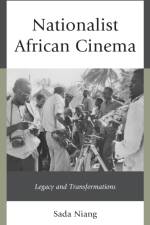
In the last decade, a certain discomfort, at times even impatience emerged among critics of African cinema. The onset of such uneasiness can be traced back to the demise of the liberationist discourse, to the questioning of the monolithic expression ';African cinema', and finally to the critical exploration of various forms of visual narratives developing at a fast speed on the continent. Nationalist African Cinema: Legacy and Transformations reexamines African cinema of the nationalist era within the context of contemporary major Euro-American film trends. It argues that the aesthetic diversification of African cinema can be traced as far back as the nationalist era.
When the Letter Betrays the Spirit examines the wide latitude provided to the executive branch and to the Supreme Court by the text of the Voting Rights Act of 1965. Drawing from government enforcement data, legislative history, Supreme Court rulings, the 2006 reauthorization debate on the VRA, and from the 2007 scandal involving the firing of U.S. attorneys under the Bush Administration, the book examines when, why, and how executive and judicial discretion facilitates violation of voting rights. Connecting Johnson to Obama, the book outlines why the executive-centered model of voting rights enforcement relegates Congress to the sidelines, and outlines why a Congress-centered approach provides the best protection against the effects of the law enforcement axiom: the law is neither self-executing nor self-interpreting. The book also examines 2008 survey results about public support for a Jim Crow-era election reform policy that would require voters to read a passage of the Constitution. Describing the civic literacy dimensions of voting rights law from Shaw v. Reno (1993) to Northwest Austin Utility v. Holder (2009), the book highlights the complicated nature of the post-racial rhetoric surrounding the 2008 election cycle and surrounding the upcoming post-2010 census redistricting cycles.
To date, scholars in higher education have examined the ways in which students' experiences in the classroom and the human capital they attain impact social class inequalities. In this book, Jenny Stuber argues that the experiential core of college life-the social and extra-curricular worlds of higher education-operates as a setting in which social class inequalities manifest and get reproduced. As college students form friendships and get involved in activities like Greek life, study abroad, and student government, they acquire the social and cultural resources that give them access to valuable social and occupational opportunities beyond the college gates. Yet students' social class backgrounds also impact how they experience the experiential core of college life, structuring their abilities to navigate their campus's social and extra-curricular worlds. Stuber shows that upper-middle-class students typically arrive on campus with sophisticated maps and navigational devices to guide their journeys-while working-class students are typically less well equipped for the journey. She demonstrates, as well, that students' social interactions, friendships, and extra-curricular involvements also shape-and are shaped by-their social class worldviews-the ideas they have about their own and others' class identities and their beliefs about where they and others fit within the class system. By focusing on student' social class worldviews, this book provides insight into how identities and consciousness are shaped within educational settings. Ultimately, this examination of what happens inside the college gates shows how which higher education serves as an avenue for social reproduction, while also providing opportunities for the contestation of class inequalities.
An American Political Scientist in Israel recounts the author's meetings with some of Israel's political and intellectual leaders after he immigrated to Israel in 1976. His book reveals, for the first time, the flawed mentality of these elites and how this affects their foreign policy. As a political scientist and student of the America's Founding Fathers, he provides a professional critique of Israel's ideological and institutional flaws. Eidelberg also provides a detailed account of Israel's economic and technological contribution to the United States. Contrary to conventional opinion, dollar for dollar, the United States receives more from Israel than Israel receives from the United States! Finally, Eidelberg offers a remedy for Israel's woes. He first shows that although Israel, is a democracy from a sociological perspective, it is not a democracy from a political-institutional perspective. Not only does Israel lack a written Constitution with institutional checks and balances, but members of the legislature are not individually accountable to the voters in constituency elections. Operating in Israel is not representative government so much as multi-party cabinet government dominated by the prime minister. Eidelberg has therefore drafted a Constitution that empowers the people and is consistent with basic Judaic principles.
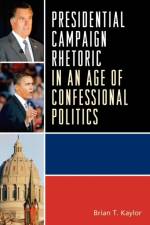
When a Bible-quoting Sunday School teacher, Jimmy Carter, won the 1976 presidential election, it marked the start of a new era of presidential campaign discourse. The successful candidates since then have followed Carter's lead in publicly testifying about their personal religious beliefs and invoking God to justify their public policy positions and their political visions. With this new confessional political style, the candidates have repudiated the former perspective of a civil-religious contract that kept political leaders from being too religious and religious leaders from being too political. Presidential Campaign Rhetoric in the Age of Confessional Politics analyzes the religious-political discourse used by presidential nominees from 1976-2008, and then describes key characteristics of their confessional rhetoric that represent a substantial shift from the tenets of the civil-religious contract. This new confessional political style is characterized by religious-political rhetoric that is testimonial, partisan, sectarian, and liturgical in nature. In order to understand why candidates have radically adjusted their God talk on the campaign trail, important religious-political shifts in American society since the 1950s are examined, which demonstrate the rhetorical demands evangelical religious leaders have placed upon our would-be national leaders. Brian T. Kaylor utilizes Michel Foucault's work on the confession_with theoretical adjustments_to critique the significant problems of the confessional political era. With clear analyses and unsettling relevance, Kaylor's critique of contemporary political discourse will rouse the interest and concern of engaged citizens everywhere.
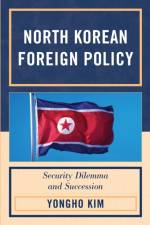
North Korean Foreign Policy: Security Dilemma and Succession, by Yongho Kim, starts from the point of view that North Korea's provocations have been motivated more by fear than by her in-born provocative nature. Kim argues that North Korea's provocative foreign policy reflects its threat perception stemming from various security dilemma, and a very real concern regarding another father-to-son succession. This volume views North Korea's external and domestic threats as causes and its provocative foreign policy as an effect of the causes. The security dilemma has impelled North Korea to generate and thus portray to the world provocative signals, and the ever-pressing issue of Kim Jong-il's succession has driven him to prioritize his own political survival over that of North Korea's state survival. Unless Kim Jong-il's political survival is guaranteed, North Korea will not be interested in full-scale introduction of capitalist way of economic reform and economic package promised by the United States and South Korea in return for the abandonment of their nuclear program. North Korean Foreign Policy suggests that an effective policy for countries relating to North Korea, whether dovish or hawkish, should deal directly with Kim Jong-il's political survival, and not with Pyongyang's failed economy.
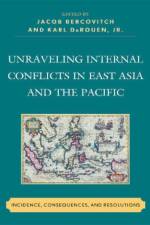
Civil wars and internal conflicts pose the greatest threat to international peace and security in the twenty-first century. Nowhere is this problem more acute than in East Asia and the Pacific, which has far more of its share of such conflicts. Unraveling Internal Conflicts in East Asia and the Pacific: Incidence, Consequences, and Resolution, edited by Jacob Bercovitch and Karl DeRouen, Jr., is a book of originally commissioned essays on civil wars which provide a compelling area of inquiry. Many of the Asia-Pacific region's wars are very long (such as in Myanmar), some tend to recur (also in Myanmar); some involve religion (Philippines, Thailand), and some (Aceh, Bougainville, East Timor) of the longest have ended in the last few years. In short, the region presents a variety of interesting dynamics that merit close attention in one volume.
European identity has always been in a state of construction. With the creation of the European Union, however, this construction now takes place within an institutional framework, introducing a number of new variables. Selcen .ner's Turkey and the European Union: The Question of European Identity is an in-depth analysis of the influence of these two entities on each others' identity as Europeans in a society of increasing social, political, and cultural connectedness. The mutual influence between Turks and Europeans gained significant momentum in 1999, when the European Union granted official candidate status to Turkey at that year's Helsinki Summit. Turkey's Europeanness is still being debated, despite the official stance that fulfilling the Copenhagen criteria and adopting the EU acquis are enough for being a full member of the EU. These debates have even lead to arguments between political elites of the European Union about their 'privileged partnership' with Turkey. When comparing the attitudes of the European Union towards Turkey versus those towards Central and Eastern Europe, one could argue that that 'return to Europe' discourse has accelerated the membership of the latter, but not the former. Currently Turkey is neither considered an 'other,' nor a member of the 'family.' Rather, Turkey is commonly relegated to the role of 'crucial neighbor' or 'strategic partner' by the political elites of the EU. .ner's study analyzes a series of interviews conducted with several members of the European Parliament and sheds serious light on the fact that discussions on Turkey's membership in terms of her Europeanness reveal countless ambiguities in defining European identity. It is clear that there is no common understanding or definition of European identity, even amongst political leaders in the EU who challenge Turkey's authenticity as a member of European society. Thus, Selcen .ner's Turkey and the European Union: The Question of European Identity argues that the position of Turkey vis-^-vis the European Union will set a compelling benchmark for European identity construction in the future.
This book presents a historical study of the phenomenon of Holy Land tourism among American Protestants during the second half of the nineteenth century and the early twentieth century. During this period, overseas travel was newly available to the Protestant middle class due to the invention and steady popularization of steamship travel. Protestants 'at home' in America consumed vast quantities of printed literature via the popular medium of Holy Land pilgrimage narratives. A new mental geography resulted, in which Americans forged a fresh awareness of the Middle East and began to focus millennial hopes upon the political and social concept of a Jewish remnant of the last days in a Protestant theological and historical framework. Protestant support for Zionism was born. What surfaces from the study of hundreds of pilgrimage narratives from this period is the emergence of Palestine as an iconic place for American Protestants. Through pilgrimage narratives, American Protestant's understanding of Palestinians, biblical authority, the power of the Protestant press, the historicity of the Christian faith, an millennial expectations were formed as the meaning of the Holy Land was constructed. Findings from the pilgrimage narratives also indicate the importance of Palestine among Protestants as a 'fifth gospel written in stone.' The pilgrim's eastward gaze drew a distant biblical past into sharper focus and fueled the fires of premillenialism, a movement that would leave an enduring stamp upon American religion and politics.
At the turn of the millennium, international youth culture is dominated by mainly two types of aesthetics: the African American cool, which, propelled by Hip-Hop music, has become the world's favorite youth culture; and the Japanese aesthetics of kawaii or cute, that is distributed internationally by Japan's powerful anime industry. The USA and Japan are cultural superpowers and global trendsetters because they make use of two particular concepts that hide complex structures under their simple surfaces and are difficult to define, but continue to fascinate the world: cool and kawaii. The Cool-Kawaii: Afro-Japanese Aesthetics and New World Modernity, by Thorsten Botz-Bornstein, analyzes these attitudes and explains the intrinsic powers that are leading to a fusion of both aesthetics. Cool and kawaii are expressions set against the oppressive homogenizations that occur within official modern cultures, but they are also catalysts of modernity. Cool and kawaii do not refer us back to a pre-modern ethnic past. Just like the cool African American man has almost no relationship with traditional African ideas about masculinity, the kawaii shTjo is not the personification of the traditional Japanese ideal of the feminine, but signifies an ideological institution of women based on Japanese modernity in the Meiji period, that is, a feminine image based on westernization. At the same time, cool and kawaii do not transport us into a futuristic, impersonal world of hypermodernity based on assumptions of constant modernization. Cool and kawaii stand for another type of modernity, which is not technocratic, but rather 'Dandyist' and closely related to the search for human dignity and liberation.
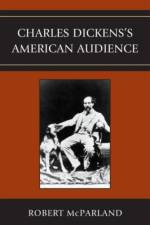
From 1837 to 1912, Charles Dickens was by far the most popular writer for American readers. Through several sources including statistics, literary biography, newspapers, memoirs, diaries, letters, and interviews, Robert McParland examines a historical time and an emerging national consciousness that defined the American identity before and after the Civil War. American voices present their views, tastes, emotional reactions and identifications, and deep attachment and love for Dickens's characters, stories, themes, and sensibilities as well as for the man himself. Bringing together contemporary reactions to Dickens and his works, this book paints a portrait of the American people and of American society and culture from 1837 to the turn of the twentieth century. It is in this view of nineteenth-century America_its people and their values, their reading habits and cultural views, the scenarios of their everyday lives even in the face of the drastic changes of the emerging nation_that Charles Dickens's American Audience makes its greatest impact.
What makes a candidate viable in the eyes of the voters? What makes someone qualified to run for office? Why do voters tend to opt for certain types of people and not others? How much are such tendencies rooted in broad characteristics-racial or ethnic group, gender, etc.-versus more idiosyncratic traits, those tied to respective candidates' presentation of self? Whatever the broader issues, it is clear that to date, women, when compared to men, have faced greater obstacles to being seen as viable candidates for elected office. A Level Playing Field for All? examines candidates' use of sports in election campaigns as a way to understand broader issues of candidate viability and in particular, the hurdles that women must overcome to achieve political office. This book reveals the extent to which athletic participation has become a social eligibility factor in the success of candidates for elected office. Doherty examines the role participation in athletics played for women looking to run for office. She goes on to appraises the ways in which potential cutbacks and already limited opportunities for women in sports might further affect their opportunities to attain viable candidate status.
The Veterans of Future Wars (VFW) was a short-lived student movement that came in response to the bonus paid to World War I veterans in 1936. The VFW began at Princeton University, but quickly spread across the United States, attracting attention from all groups of American citizens. It was extremely popular on college campuses, but it engendered vocal and intemperate opposition from the Veterans of Foreign Wars, the American Legion, chambers of commerce, and other citizens. The student leaders were branded as Communists, Fascists, or other similar subversive groups. The group attracted attention from political leaders; some members of Congress were supportive, but others attacked the group on the floor of the House of Representatives. The student group ended about four or five months after it began. Despite its short life, it was a successful movement that attracted wide support and caused serious discussion about the role of the federal government in providing bonuses to veterans.
Abonner på vårt nyhetsbrev og få rabatter og inspirasjon til din neste leseopplevelse.
Ved å abonnere godtar du vår personvernerklæring.