











Gjør som tusenvis av andre bokelskere
Abonner på vårt nyhetsbrev og få rabatter og inspirasjon til din neste leseopplevelse.
Ved å abonnere godtar du vår personvernerklæring.Du kan når som helst melde deg av våre nyhetsbrev.

The Tibet question is a dispute over the political status of Tibet between the Chinese government and the Tibetan government in exile: A battle for control. In this matter, Tibet extends far beyond the issue of sovereignty as it raises questions about the controversy between international law and the universality of human rights, the classic nation-state paradigm and the modern conceptualizations of terms underlying the issue. Both sides are written through a different lens, defined by an ambiguous relationship between the traditional periphery and core paradigm on one side, and a modern nation-state system conception on the other. As the fate of a nation once again is being threatened while the world community stands by, one can question the capacity and the willingness of the international community, committed to the high ideals of the United Nations, in delivering either peace or justice. Although the discourse of international politics in theory constitutes certain norms and principles, the practice exposes no more than an interest-led game. From this point of view, self-determination is a powerful reflection of the controversial fields of international relations.
This book is focused on the model based design methodology for mechatronic systems in the conceptual stage. It proposes a generic framework model for effective and semi-automated design candidate generation in the conceptual design stage. The specific application is focused on the mobile robots. An application specific toolkit was developed as a tool based on the developed methodology. The methodology specifies toolkits and model libraries which are realized on the example of mobile robotic platform design. Additional toolkits can be developed according to this methodology. The practical implementation of the Mobile Platform Toolkit is presented based on real examples. Two similar mobile robots in a different design stage were selected to illustrate the use of the toolkit. The Workpartner robot from Aalto University is used as an analytical example and the UGV platform from Tallinn University of Technology is utilized as a synthesis example where the developed approach was applied in the conceptual design stage.
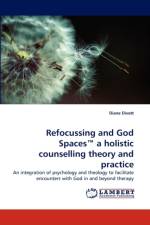
Refocussing and God Spaces is the theory and practice developed by the author Dr Diane Divett. Influenced by her New Zealand Maori and Irish heritage, coupled with pastoral care experience, she saw the need for a holistic therapy. Accordingly, Refocussing with its ¿seven foci system' was designed to identify and attend to unmet needs in all aspects of people's functioning, in their being, having and doing. This included all dimensions: the transpersonal, interpersonal and intrapersonal. Central and unique to Refocussing is ¿God Spaces', providing a predictable, reliable and repeatable way to encounter God in and beyond therapy. These encounters with the Divine provide a way for people's unmet needs to be healed, resourced or resolved. The rationale being that while psychological process is necessary to identify unmet needs ¿ God Spaces allows careful integration of a theological process to attend to those needs. This satisfies people's faith needs, namely, that the inclusion of God is also essential in any therapeutic process.
Abonner på vårt nyhetsbrev og få rabatter og inspirasjon til din neste leseopplevelse.
Ved å abonnere godtar du vår personvernerklæring.