












Gjør som tusenvis av andre bokelskere
Abonner på vårt nyhetsbrev og få rabatter og inspirasjon til din neste leseopplevelse.
Ved å abonnere godtar du vår personvernerklæring.Du kan når som helst melde deg av våre nyhetsbrev.

This thesis shows how the conformal model in geometric algebra is able to describe Euclidean geometry. Since transformations in this model are structure preserving, this algebra is able to treat motions in a unified way. In our search for a general interpolation method of transformations, we focus on determining their logarithms. First we look at how Taylor series can be evaluated for transformations in this algebra. A drawback is that in general infinite series has to be evaluated to achieve exact results. Therefore we also present our generalized Chasles theorem, that classically only takes care of rotations and translations, to decompose motions such that they can be interpolated having a closed form expression. The proposed method successfully describes logarithms of certain compositions of basic transformations, but is not able to yield the general logarithm of a conformal transformation. In our search for such a general logarithm, we have investigated many potentially useful properties and representations, summarized in the appendices.
This monograph provides Bayesian inference for change point problems through Mixture model approach in Time series models viz., changes in mean of the time series with and without auto correlated errors, variance changes in the time series model and order changes in the time series models. MCMC technique is used to obtain the numerical solutions. The main aim of the numerical study is to illustrate the evaluation of the estimates of the parameters on the basis of the methodology developed in this monograph.
This research was designed to examine the methods for improving the teaching of physics to a group of slow learning students in Government Secondary School, Chindit Barracks,Zaria. A total of twenty-eight boys with a mean age of 18.2 years from SSS1 randomly sampled constituted the sample size of the study. The multiple choice assessment tests and pre-treatment tests were used for the study. The study was performed for a period of twelve weeks and after teaching a topic for about four weeks, a posttest was given each time. In addition to the usual classroom lessons and practical, the slow learning group was treated with a number of activities . The pre-test result and some education determinants showed that, the two groups were comparable before the administration of the treatment respectively. The test scores for the post test collected were used for data analysis and testing of the hypothesis. The hypothesis was tested and drawn at 0.05 levels significant. The t-test for two independent groups'' results showed that physics can be taught effectively to the slow learning group by the introduction of an interesting, understandable and useful programme.
The main purpose of this article is to study the optimum design of grounding system of high voltage substations by using artificial neural network. The proposed study will implement the following important contributions: 1-Performance of grounding system under uniform and non-uniform soil resistivity. 2-Grounding by using equal and non-equal spacing grids studying the performance of non equal spacing grid incase of uniform and non-uniform soil. 3-Grounding by grids and rods in non- uniform soil and unequally spaced grids. 4-Safety analysis of grounding grid with different structures. 5-Designing of ANN as a tool to select the optimum grounding system. 6-Performance of grounding system under transient conditions.
Several structural engineering strategies are applied to develop innovative templates based on nanoporous anodic alumina. These templates are subsequently used to develop other nanostructures based on certain materials with multiple applications such as polymers, magnetic metals and semiconductors. These replicated nanostructures could be integrated in various types of nanodevices (e.g. nanoelectrodes for direct deposition of nanoparticles from a gas draught, bulk-heterojunction solar cells, one-dimensional optoelectronic devices, nanofilters and so on). It is expected that the results presented will become a starting point to develop new nanodevices and applications in a wide range of research fields.
The aim of this book was to develop an effective system to improve the sound transmission loss of lightweight partition walls. Effective in this context means that the system would be lightweight, economical,and readily installed with current site practice. The accepted wisdom in the area of sound reduction is to drape the entire area of the partition with a sound absorbing membrane material and the work of this book proceeded on this premise. However during the course of the experiments it was found that the assembly detail at the stud had a much more significant effect than the membrane material on sound reduction. It transpired that the main effect of the membrane material was to provide damping under the screws at the stud and if the material was compressed too much the damping was compromised. The book reports on the introduction of a new ¿sacrificial layer¿ which, when incorporated into the stud assembly allows the full damping effect of the membrane material to manifest itself.The book therefore proposes a strip or wad consisting of layers of membrane material and ¿sacrificial layer¿ to be mounted on the stud prior to the plasterboard.
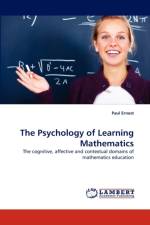
This book overviews concepts, theories and research in the psychology of learning mathematics, including research methodologies. The organising framework is the classification of the central learning outcomes of school mathematics into facts, skills, conceptual structures, general strategies and appreciation. Each component is treated in one or two dedicated chapters. There is a chapter on theoretical and practical aspects of constructivist learning theory, and another on the mathematical processes, strategies, and thinking involved in mathematical problem solving, including meta-cognition. A further chapter treats attitudes to and the appreciation of mathematics. The last two chapters explore a theme that has emerged as important in the psychology of mathematics education in recent years, the impact of context, both task and social context. This concerns the cognitive and psychological significance of both the external representations and situated embodiments of mathematical ideas and tasks, and also their internal, mental representations. It also concerns the links between these two domains including theories of transfer of learning.
Abonner på vårt nyhetsbrev og få rabatter og inspirasjon til din neste leseopplevelse.
Ved å abonnere godtar du vår personvernerklæring.