














Gjør som tusenvis av andre bokelskere
Abonner på vårt nyhetsbrev og få rabatter og inspirasjon til din neste leseopplevelse.
Ved å abonnere godtar du vår personvernerklæring.Du kan når som helst melde deg av våre nyhetsbrev.

Drawing on the extensive public and private writings of the Nicholses and their peers, Silver-Isenstadt vividly portrays Mary Gove Nichols' courageous life and visionary intellect, revealing the rich diversity of opinion within nineteenth-century America's social reform movements and uncovering the inspiring story of a woman who dared to live by the utopian principles she advocated.
"A conscientious and important history of the study of classicism in America during the eighteenth and nineteenth centuries... Ms. Winterer sheds light on the virtual disappearance of the ancients from the modern imagination." -- Wall Street Journal"It is, without question, one of the greatest contributions to (the field) yet published." -- American Historical Review
Enck places great emphasis on enhancing the quality of life while addressing the most common symptoms of terminal illness.
The political dimension of Shelley's thought is grounded through often startling connections between his poems and the debates, events, and personalities of the time, and Peterfreund takes care to connect the theory of language which Shelley's work articulates with present-day literary theory, particularly in the writings of Lacan and Kristeva.
"Microhistory at its best -- illuminating, relevant, and highly readable. Bushman paints a vivid portrait of agrarian life in the Old South... (Her) monograph deserves a wide and attentive audience." -- "History"
Play-by-Play is an eye-opening look at the political infighting invariably produced by the deadly combination of university administrators, athletic czars, and huge revenue.
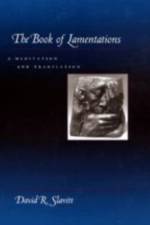
Distinguished poet and translator David R. Slavitt here provides a translation of and meditation upon the Book of Lamentations, the biblical account of the destruction of the Temple in Jerusalem in 587 B.C., on the ninth day of the Jewish month of Av--Tish'a b'Av. (Six centuries later the Romans destroyed the second Temple on the same day.) Most of the Jewish population was deported to Babylon, and the ensuing period came to be known as the Babylonian Captivity. According to tradition, the Book of Lamentations was written in response to this political, social, and religious crisis. The five poems composing the book express Israel's sorrow, brokenness, and bewilderment before God.Tish'a b'Av is the day on which observant Jews fast and pray. And mourn. As Slavitt observes in his meditation: " It is forbidden on Tish'a b'Av even to study the Torah, except for the Book of Job and the Book of Lamentations. This is the day on which we grieve for every terrible thing that happens in this world. It is the worst day of the year."Slavitt's meditation provides a context for reading the scriptural text. Cast in the same style as the Hebrew poetry, his meditation recounts how sorrow and catastrophe have characterized so much of the history of the Jewish people, from their enslavement in Egypt to the Holocaust of Nazi Germany.Few translations of this remarkable book of the Bible attempt to reproduce in English, as Slavitt does here, the Hebrew acrostics. In the original, each verse begins with a different letter of the Hebrew alphabet in sequential order; Slavitt elegantly reproduces this effect using the first 22 letters of the English alphabet. More than a structural or mnemonic device, Slavitt argues, the acrostics are "a serious assertion that the language itself is speaking, that the speech is inspired, and that there is, beyond all the disaster and pain the book recounts, an intricacy and an orderly coherence."
Abonner på vårt nyhetsbrev og få rabatter og inspirasjon til din neste leseopplevelse.
Ved å abonnere godtar du vår personvernerklæring.