
























Gjør som tusenvis av andre bokelskere
Abonner på vårt nyhetsbrev og få rabatter og inspirasjon til din neste leseopplevelse.
Ved å abonnere godtar du vår personvernerklæring.Du kan når som helst melde deg av våre nyhetsbrev.

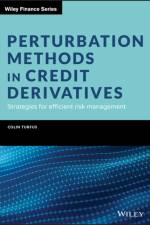
Stress-test financial models and price credit instruments with confidence and efficiency using the perturbation approach taught in this expert volumePerturbation Methods in Credit Derivatives: Strategies for Efficient Risk Management offers an incisive examination of a new approach to pricing credit-contingent financial instruments. Author and experienced financial engineer Dr. Colin Turfus has created an approach that allows model validators to perform rapid benchmarking of risk and pricing models while making the most efficient use possible of computing resources.The book provides innumerable benefits to a wide range of quantitative financial experts attempting to comply with increasingly burdensome regulatory stress-testing requirements, including:* Replacing time-consuming Monte Carlo simulations with faster, simpler pricing algorithms for front-office quants* Allowing CVA quants to quantify the impact of counterparty risk, including wrong-way correlation risk, more efficiently* Developing more efficient algorithms for generating stress scenarios for market risk quants* Obtaining more intuitive analytic pricing formulae which offer a clearer intuition of the important relationships among market parameters, modelling assumptions and trade/portfolio characteristics for tradersThe methods comprehensively taught in Perturbation Methods in Credit Derivatives also apply to CVA/DVA calculations and contingent credit default swap pricing.
The current volume continues the tradition of the Organic Syntheses series, providing carefully checked and edited experimental procedures that describe important synthetic methods, transformations, reagents, and synthetic building blocks or intermediates with demonstrated utility in organic synthesis. These significant and interesting procedures should prove worthwhile to many synthetic chemists working in increasingly diverse areas. A trusted guide for professionals in organic and medicinal chemistry in academia, government, and industries, including pharmaceuticals, fine chemicals, agrochemicals, and biotechnological products.
Evidence-Based Statistics: An Introduction to the Evidential Approach - from Likelihood Principle to Statistical Practice provides readers with a comprehensive and thorough guide to the evidential approach in statistics. The approach uses likelihood ratios, rather than the probabilities used by other statistical inference approaches. The evidential approach is conceptually easier to grasp, and the calculations more straightforward to perform. This book explains how to express data in terms of the strength of statistical evidence for competing hypotheses.The evidential approach is currently underused, despite its mathematical precision and statistical validity. Evidence-Based Statistics is an accessible and practical text filled with examples, illustrations and exercises. Additionally, the companion website complements and expands on the information contained in the book.While the evidential approach is unlikely to replace probability-based methods of statistical inference, it provides a useful addition to any statistician's "bag of tricks." In this book:* It explains how to calculate statistical evidence for commonly used analyses, in a step-by-step fashion* Analyses include: t tests, ANOVA (one-way, factorial, between- and within-participants, mixed), categorical analyses (binomial, Poisson, McNemar, rate ratio, odds ratio, data that's 'too good to be true', multi-way tables), correlation, regression and nonparametric analyses (one sample, related samples, independent samples, multiple independent samples, permutation and bootstraps)* Equations are given for all analyses, and R statistical code provided for many of the analyses* Sample size calculations for evidential probabilities of misleading and weak evidence are explained* Useful techniques, like Matthews's critical prior interval, Goodman's Bayes factor, and Armitage's stopping rule are describedRecommended for undergraduate and graduate students in any field that relies heavily on statistical analysis, as well as active researchers and professionals in those fields, Evidence-Based Statistics: An Introduction to the Evidential Approach - from Likelihood Principle to Statistical Practice belongs on the bookshelf of anyone who wants to amplify and empower their approach to statistical analysis.
Solar PV is now the third most important renewable energy source, after hydro and wind power, in terms of global installed capacity.
Abonner på vårt nyhetsbrev og få rabatter og inspirasjon til din neste leseopplevelse.
Ved å abonnere godtar du vår personvernerklæring.