












Gjør som tusenvis av andre bokelskere
Abonner på vårt nyhetsbrev og få rabatter og inspirasjon til din neste leseopplevelse.
Ved å abonnere godtar du vår personvernerklæring.Du kan når som helst melde deg av våre nyhetsbrev.

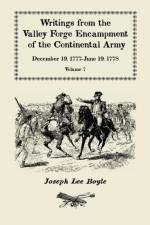
Hundreds of letters and documents written at Valley Forge have been published in collections that represent the best-remembered men of the Revolution. There are also documents of uncounted numbers by lesser officers and staff functionaries that have never been published, or have been printed long ago and are no longer readily available. The intent of this effort is to present a selection of these, in the seventh of such volumes, to allow greater understanding and appreciation of the Valley Forge Encampment. The six month encampment of the Continental Army at Valley Forge has long since entered the realm of American myths. Some of the stories that have become legendary are reinforced in the letters herein. There are a number of references to the lack of shoes, blankets and clothing. Food was in desperately short supply. Efforts to rectify these difficulties are represented in these pages. Documents are arranged chronologically, and the original spelling and punctuation has been retained. A descriptive note at the foot of each entry gives the source location of each document, and identifies the writer and recipient the first time each individual appears. The author scoured the National Archives and more than twenty other state archives, university libraries, and historical societies in his search for these rare papers. An index to full-names, places and subjects adds to the value of this work.
The Montgomery County Sentinel was first published as a weekly newspaper in 1855 by Matthew Fields and has been continuously published, with brief interruptions, until the present. The early focus of the paper was on advertising and politics, with relatively little space devoted to local news. News articles were usually brief and to the point without elaboration. On two occasions, once before and once during the Civil War, the paper suffered brief interruptions while Matthew Fields, a Southern sympathizer, was held by Union military forces. Following the war, publication was continued by Mr. Fields or his family until it was sold in 1932. This volume is a compilation of selected Montgomery County Sentinel extracts, taken as before from available microfilm records, which extends the time covered in the previous work. Some existing copies are torn, partially mutilated, or illegible. Marriages, deaths, civil appointments, voters, jurors, significant events-these records are a goldmine of names and dates, with the added benefit of an index to full-names, places, and subjects. This book is a valuable resource for anyone researching the Montgomery County area. Is your missing relative hiding in these pages?
Alleghany, Craig, and Monroe Counties are located northwest of Roanoke, Virginia, and Monroe County is now part of West Virginia. As the title suggests, this book is a study of life in this region in the decades before the Civil War. It reveals "a fascinating time of carriages, turnpikes, temperance societies and political awakening. To understand the American Civil War, a good study of what caused it is required. Actually, western Virginia started to break away from the eastern portion of the state a lot earlier than the 1850s. The internal rift over the building of turnpikes, canals and railroads ensured bitterness over any slavery issue." The book reveals the development of a business and political elite in society. With business and politics came the reform movements like the idea of organized temperance societies. "Although the religious revivals in this area did much to bring movements about or even to help rationalize their need, business drove the framework." "Business was politics. Business was taverns and springs, ironworks and roads. Potts' Creek Valley in Alleghany and Monroe Counties has all of these industries. The industries and the men who emerged as the community leaders turned what was a wild frontier into an integral part of American society..." "However, this book is not just about business. It's about how people dealt with each other in social situations, such as a simple land dispute, drinking, the vote or spousal abuse...Perhaps it points out why the people of western Virginia are so enlightened. As [the author likes] to say, they are among the 'last of the genteel Virginians.'"Following the seven chapters of the main text, the book presents a section of genealogies or family sketches, after which is an appendix of fines for the 108th Virginia Regiment in 1814, and an appendix which is a partial roster of Company K, U.S. Volunteers for the Mexican War in 1847. Following the appendices is a twenty-five-page list of source notes (testifying to the amount of background research that went into the book) organized by chapter, followed by a section of bibliographical notes on the sources. Illustrations show people, documents and relics pertaining to the region and time period under study. The index is an everyname plus subject index.
Genealogies are always enhanced by thorough documentation, scholarly research, well-organized information, lucid writing and creative speculation, but rarely does one find all of these qualities tied up in one package. Ms. Kwasha's outstanding new book would certainly qualify as one of the valuable exceptions. Providing a wide overview of the Cartwrights who were present in the areas of Maryland, Virginia, North Carolina and Tennessee during the early years of North American colonization, Ms. Kwasha has divided this book into two parts. The first deals with the Cartwrights of Maryland as descended from Matthew Cartwright, born c.1634 in Holland. The second deals with the Cartwrights of Princess Anne County, Virginia, and Pasquotank County, North Carolina, as descended from John Cartwright, born c.1600. Both lines are followed to seven generations. Each part begins with a genealogical outline, which serves the reader as a point of reference for individuals covered in later chapters. Many relevant documents and records, including several wills never before published, have been transcribed. Among these records, as elsewhere throughout the text, Ms. Kwasha adds her own parenthetical observations about the significance or implications of the information being recorded. Drawing from many varied sources, the author's careful analysis has eliminated many errors from works of previous researchers, and the result is a more comprehensive single volume of Cartwright genealogy than is available elsewhere. This broad, easy to read compilation of data should be an enormous help to anyone who is interested in the vast maze of Cartwrights or their allied lines, such as Albertson, Burroughs, Davidson, Jones, Rogers and Tippett. End-of-chapter bibliographies and an every-name index are included.
Under the terms of the charter of Maryland as granted by King Charles I of England, Lord Baltimore and his heirs were given all the land in the colony, with power to dispose of the land in any manner they deemed fit. A land office was set up to administer land grants and collect revenues. Settlers who applied for land grants had to pay fees at every step of the process as they obtained surveys, patents and titles. During those early days, the outer limits of Baltimore County stretched into unexplored territory. The deed records abstracted here-dating from 1659 to 1737-include lands that lie within present-day Baltimore City, Cecil and Harford Counties, and parts of Carroll, Anne Arundel, Howard and Kent Counties. Fourteen deed books were abstracted for this volume, which is divided into fourteen chapters. Each deed book spans a period of time ranging from two years to sixty-six years. The entries are more or less chronological, variations being due to the fact that transactions were often recorded in the books at some later date. A typical entry includes the date of transaction, names of grantors and grantees and their places of residence, acres of land involved and the names signed on the document. Other information is included when available, such as sales price, location of land, neighbors, chain of deed and landmarks. Spellings of names and places have been preserved in their original form, so the reader is encouraged to check all possible spellings of a name of interest. An every-name index assists the researcher.
Abonner på vårt nyhetsbrev og få rabatter og inspirasjon til din neste leseopplevelse.
Ved å abonnere godtar du vår personvernerklæring.