




![Lunenburg County [Virginia] Road Orders, 1746-1764. Published with Permission from the Virginia Transportation Research Council (a Cooperative Organiz af Virginia Genealogical Society](https://cdnbackdoor.tales.as/thumbnail/150x225/00065/55023/cover.1501625329.jpg)
![Brief History of the Staunton and James River Turnpike [Virginia] Published with Permission from the Virginia Transportation Research Council (A C af Virginia Genealogical Society](https://cdnbackdoor.tales.as/thumbnail/150x225/00065/55021/cover.1501625325.jpg)

Gjør som tusenvis av andre bokelskere
Abonner på vårt nyhetsbrev og få rabatter og inspirasjon til din neste leseopplevelse.
Ved å abonnere godtar du vår personvernerklæring.Du kan når som helst melde deg av våre nyhetsbrev.

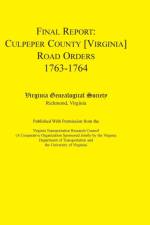
The establishment and maintenance of public roads were among the most important functions of the county court during the colonial period in Virginia. Each road was opened and maintained by an overseer (or surveyor) of the highways, who was appointed each year by the Gentlemen Justices. The overseer was usually assigned all the able-bodied men (the "Labouring Male Tithables") living on or near the road. These laborers then furnished their own tools, wagons, and teams and were required to work on the roads for six days each year.County court records relating to roads and transportation are collectively know as "road orders." The Virginia Transportation Research Council's published volumes of road orders and related materials contain not only information on early roads, but also the names of inhabitants who lived and worked along the roadways, plantations, farms, landmarks, landforms, and bodies of water.Much of this information is found nowhere else in early records, making these publications invaluable not only to historical and cultural resources research, but also to other disciplines, including social history, preservation planning, environmental science, and genealogy.
The establishment and maintenance of public roads were among the most important functions of the county court during the colonial period in Virginia. Each road was opened and maintained by an overseer (or surveyor) of the highways, who was appointed each year by the Gentlemen Justices. The overseer was usually assigned all the able-bodied men (the "Labouring Male Tithables") living on or near the road. These laborers then furnished their own tools, wagons, and teams and were required to work on the roads for six days each year.County court records relating to roads and transportation are collectively know as "road orders." The Virginia Transportation Research Council's published volumes of road orders and related materials contain not only information on early roads, but also the names of inhabitants who lived and worked along the roadways, plantations, farms, landmarks, landforms, and bodies of water.Much of this information is found nowhere else in early records, making these publications invaluable not only to historical and cultural resources research, but also to other disciplines, including social history, preservation planning, environmental science, and genealogy.
The Montgomery County Sentinel was first published as a weekly newspaper in 1855 by Matthew Fields and has been continuously published, with brief interruptions, until the present. The early focus of the paper was on advertising and politics, with relatively litatle space devoted to local news. News articles were usually brief and to the point without elaboration. On two occasions, once before and once during the Civil War, the paper suffered brief interruptions while Matthew Fields, a Southern sympathizer, was held by Union military forces. Following the war, publication was continued by Mr. Fields or his family until it was sold in 1932. This compilation of selected Montgomery County Sentinel extracts is taken from available microfilm records. Marriages, deaths, lists of undelivered letters, civil appointments, voters, jurors, road notices, significant events-these records are a gold mine of names and dates, with the added benefit of an index to names, places, and subjects. This book is a valuable resource for anyone researching the Montgomery County area. Is your missing relative hiding in these pages?
Abonner på vårt nyhetsbrev og få rabatter og inspirasjon til din neste leseopplevelse.
Ved å abonnere godtar du vår personvernerklæring.