




Gjør som tusenvis av andre bokelskere
Abonner på vårt nyhetsbrev og få rabatter og inspirasjon til din neste leseopplevelse.
Ved å abonnere godtar du vår personvernerklæring.Du kan når som helst melde deg av våre nyhetsbrev.

The purpose of the Homestead Act, signed by President Lincoln on May 20, 1862, was to encourage settlement in the western states on unappropriated public land. Any person who was twenty-one years of age, or head of a family, or met certain military requirements was eligible to apply for a homestead. The homesteader had to live on the land continuously and cultivate it for a period of five years in order to obtain the patent. Any person who had borne arms against the U.S., or given aid and comfort to its enemies, was not eligible. This was a significant point since the Homestead Act was passed during the years of the Civil War. The patents read much like any deed. When family information such as marital status or relationship was included, it was abstracted and included along with the name of the applicant. Column headings include: Applicant and Family Information, Filing Date, and Vol.-Pg. In some cases, what was apparently the maiden name of a woman was found in the homestead application.
These agricultural census records name only the head of the household; however, they do yield unique information about how people lived. Often, individuals who were missed on the regular U.S. census will appear on the agricultural census. Six of the agricultural census's original forty-eight columns are transcribed here: name of owner, improved acreage, unimproved acreage, cash value of farm, value of farm implements and machinery, and value of livestock. This volume covers the counties of: Hanover, Henrico, Henry, Highland, Isle of Wight, James City, King George, King and Queen, King William, Lancaster, Lee, Loudoun, Louisa, Lunenburg, Madison, Mathews, Mecklenburg, and Middlesex. A surname index augments the records.
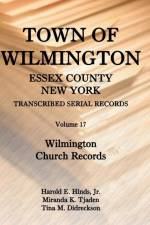
This volume is the seventeenth in a series devoted to presenting a transcription of the surviving serial manuscript records for the town of Wilmington, Essex County, New York, in the High Peaks region of the Adirondack Mountains. Genealogists and family historians should find these Wilmington church records of considerable value for determining if a church-going ancestor was in Wilmington. Additionally, whether a person was a Methodist Episcopal or a Congregational member will better define their particular religious belief. The transcriptions in this volume include: Church Records of the Congregational Church; Methodist Episcopal Church, Book I (1836-1862); Methodist Episcopal Church, Book I.B. (1842-1862); Methodist Episcopal Church, Book II (1862-1882); Methodist Episcopal Church Record of Marriages; Methodist Episcopal Church Alphabetical List of Members; and a Comprehensive Church Record of the Jay and Wilmington Methodist Episcopal Churches. The Wilmington Congregational Church records were transcribed from privately-owned original documents. These records include detailed biographical information, such as whether an individual was married or single. These records span 1834 to 1883; however, the coverage is not continuous and the records are not strictly chronological. The Methodist Episcopal Church records were transcribed from the extraordinary set of records preserved at Wilmington's Whiteface Community United Methodist Church. The ME volumes, other than Book I, are not limited to the Town of Wilmington Methodist Church. The members of the Circuit varied between 1842 and 1862; at various times these records include churches in the towns of Wilmington, Jay, AuSable, Saranac, Keene and the village of AuSable Forks. Entries include church status for members, a record of quarterly Circuit meetings, and detailed information on some members such as: residence, whether single or married, "remarks" (baptized or sprinkled, joined, received in full, came by letter, dropped, removed, withdrew, moved, removed by letter, dead or died). The entries have been transcribed as presented; the original spelling has been maintained. A full name index adds to the value of this work.
These agricultural census records name only the head of the household; however, they do yield unique information about how people lived. Often, individuals who were missed on the regular U.S. census will appear on the agricultural census. Six of the agricultural census's original forty-eight columns are transcribed here: name of owner, improved acreage, unimproved acreage, cash value of farm, value of farm implements and machinery, and value of livestock. This volume covers the counties of: Jackson, Jasper, Jefferson, Johnson, Knox, LaClede, LaFayette, Lawrence, Lewis, Lincoln, Linn, Livingston, McDonald, Macon, Madison, Marion, Mercer, Miller, Mississippi, Moniteau, and Monroe. A surname index augments the records.
These agricultural census records name only the head of the household; however, they do yield unique information about how people lived. Often, individuals who were missed on the regular U.S. census will appear on the agricultural census. Six of the agricultural census's original forty-eight columns are transcribed here: name of owner, improved acreage, unimproved acreage, cash value of farm, value of farm implements and machinery, and value of livestock. This volume covers the counties of: Clinton, Cole, Cooper, Crawford, Dade, Dallas Daviess, DeKalb, Dodge and Putnam, Dunklin, Franklin, Gasconade, Gentry, Greene, Grundy, Harrison, Henry, Hickory, Holt, and Howard. A surname index augments the records.
This book contains many cemeteries, large and small. The listings usually give the soldier's unit, and sometimes the cause of death and exact date.
Abonner på vårt nyhetsbrev og få rabatter og inspirasjon til din neste leseopplevelse.
Ved å abonnere godtar du vår personvernerklæring.