



















Gjør som tusenvis av andre bokelskere
Abonner på vårt nyhetsbrev og få rabatter og inspirasjon til din neste leseopplevelse.
Ved å abonnere godtar du vår personvernerklæring.Du kan når som helst melde deg av våre nyhetsbrev.

The du Ponts, one of the most powerful families in American industry, actively fought policies that gave government more power over the economy. By focusing on one family's contribution to the economic and political debate between the world wars, Burk casts light on the changing fortunes of business and government in twentieth-century America.
Beniger traces the origin of the Information Society to major economic and business crises of the 1800s. Inevitably the Industrial Revolution, with its ballooning use of energy to drive material processes, required a corresponding growth in the exploitation of information.
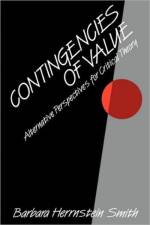
While revisionists are perplexed by questions of value, critical theory-haunted by the heresy of relativism-remains captive to classical formulas. Barbara Herrnstein Smith's book confronts the conceptual problems and sociopolitical conflicts at the heart of these issues and raises their discussion to a new level of sophistication.
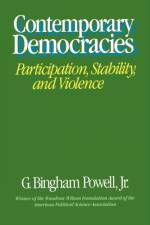
Why do some democracies succeed while others fail? In seeking an answer to this problem, Powell examines the record of voter participation, government stability, and violence in 29 democracies during the 1960s and 1970s. The core of the book is the treatment of the role of political parties in mobilizing citizens and containing violence.
How malleable is human nature? Can an individual really change in meaningful ways? Or, are there immutable limits on the possibilities of human growth set in place by genes and early childhood experiences? These questions touch our deepest political and personal concerns, and have long been a matter of fierce debate in the behavioral sciences.
Yenser ranges over all of Merrill's writing to date, from a precocious book printed when its author was fifteen to his most recent publication, a verse play. He writes about both of the poet's novels and pays particular attention to the epic poem The Changing Light at Sandover.
Here is the fullest available narrative history of the reigns of Diocletian and Constantine, and a new assessment of the part Christianity played in the Roman world of the third and fourth centuries.
Seventeen scholars from varying fields here consider the implications of Confucian concerns--self-cultivation, regulation of the family, social civility, moral education, well-being of the people, governance of the state, and universal peace--in industrial East Asia.
Confronting Poverty proposes thoughtful reforms in employment and training, child support, health care, education, welfare, immigration, and urban policies, all crafted from the successes, as well as the failures, of policies over the past three decades.
Spanning more than two centuries, this book traces the many paths to adulthood that Americans have pursued over time. Conflicting Paths is an innovative history of growing up in America that includes analysis and five hundred first-person testimonials--autobiographies, diaries, and letters.
Gallagher argues that we should not ask why the Confederacy collapsed so soon but rather how it lasted so long. He examines the Confederate experience through the actions and words of the people who lived it to show how the home front responded to the war, endured its hardships, and assembled armies that fought with great spirit and determination.
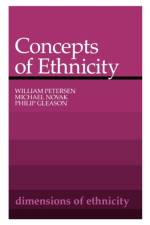
The tightening and loosening of ethnic identity under changing definitions of "Americanism" is emphasized in this volume.
The psychology of thinking often makes comparisons between different groups. On the whole, these comparisons have rendered substantial knowledge; but often, they have employed faulty organizational logic and yielded unfounded or invidious conclusions. Here, Cole and Means survey the problems involved in comparing how people think.
Sociologist Robert Wuthnow notes remarkable similarities in the social conditions surrounding three of the greatest challenges to the status quo in the development of modern society-the Protestant Reformation, the Enlightenment, and the rise of Marxist socialism.
Commonwealth, when first published in 1947, was a pioneer effort to investigate the historical role of government in the American economy. The present edition has been revised by the authors to take into account the research of the past two decades.
In this elegantly written and innovative book, Paul Sniderman and Edward Carmines illuminate aspects of white Americans' thinking about the politics of race previously hidden from sight. In a thoughtful follow-up analysis, they point the way toward public policies that could gain wide support and reduce the gap between black and white Americans.
Kull provides us with the previously unwritten history of the color-blind liberal ideal that the government take no account of the race of its citizens. For 125 years-from the crusades of the Garrisonian abolitionists to the civil rights legislation of the 1960s-this idea was the constitutional focus of the struggle for racial equality in America.
Padberg has written the first full-length study of these colleges, from their revival in 1815 to their suppression in 1880. Drawing almost exclusively on archival material not previously utilized, Father Padberg places his study against the background of anti-clericalism, revolution, the Second Empire, and the first decade of the Third Republic.
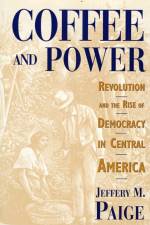
In the revolutionary years between 1979 and 1992, it would have been difficult to find three political systems as different as El Salvador, Costa Rica, and Nicaragua, yet they found a common destination in democracy and free markets. Paige shows that the divergent political histories and the convergent outcome were shaped by one commodity: coffee.
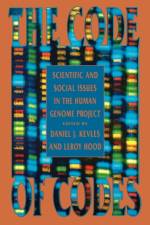
Our genome defines our possibilities and limitations as members of the species. The goal of the pioneering project outlined in this book is to map our genome in detail. This book is a collective exploration of the substance and possible consequences of this project in relation to ethics, law, and society; and to science, technology, and medicine.
In a sequence of short, condensed entries, Ferenczi's diary records self-critical reflections on conventional psychoanalytic theory-as well as criticisms of his own experiments with technique-and his obstinate struggle to divest himself and psychoanalysis of professional hypocrisy.
Abonner på vårt nyhetsbrev og få rabatter og inspirasjon til din neste leseopplevelse.
Ved å abonnere godtar du vår personvernerklæring.