



Gjør som tusenvis av andre bokelskere
Abonner på vårt nyhetsbrev og få rabatter og inspirasjon til din neste leseopplevelse.
Ved å abonnere godtar du vår personvernerklæring.Du kan når som helst melde deg av våre nyhetsbrev.

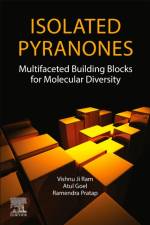
Isolated Pyranones: Multifaceted Building Blocks for Molecular Diversity covers the latest findings on synthesis and chemical reactivity of highly functionalized pyran-2-ones and pyran-4-ones, their reduced analogs and compounds derived from them through chemical reactions, and their applications in drug discovery and material sciences. It covers the mechanisms of the reaction and step by step formation of final products. Numerous pyranones from natural and synthetic origins, as well as their derived products, have shown diverse pharmacological activities and some are in clinical use. The applications of these compounds are not limited to drug development and imaging agents, and they are also used in material science as organic semiconductors, liquid crystals, organic light emitting diodes (OLEDs), organic catalysts, solid state lasers, photovoltaic and photoconductive devices. The book is ideal for organic, bioorganic, physical, material and natural product chemists working to generate diverse molecular entities through ring transformation reactions of pyranones, and those working in material science to generate new chemical entities.
Addition, Elimination and Substitution: Markovnikov, Hofmann, Zaitsev and Walden: Discovery and Development discusses foundational reactions in organic chemistry and their major protagonists, contributions to synthesis, and history. Hofmann, Zaitsev, and Markovnikov are introduced, along with their major discoveries and contributions to organic chemistry. The history of controversies around Markovnikov¿s Rule are addressed. The book introduces Walden¿s original demonstration of configuration inversion, then discusses bimolecular elimination reactions, regioselective addition reactions, regiospecific alkene synthesis, and the development of modern reactions with configuration inversion. With its unique perspective, focus, and comprehensive coverage, this book belongs on the shelf of every organic chemist.
Dairy Foods: Processing, Quality, and Analytical Techniques provides comprehensive knowledge on the different factors involved in the development and safety precautions behind dairy foods, including special references to both theoretical and practical aspects. The book presents relevant information about the quality of dairy foods, including raw milk quality, predictive microbiology and risk analysis, food defense and food fraud. In addition, it looks into environmental aspects and consumer perception and goes on to cover methods and practices to process dairy products and analytical techniques behind dairy product development. Techniques explored include time domain magnetic resonance, thermal analysis and chemometric methods. This will be a valuable resource for researchers and practitioners in the dairy industry, as well as students in dairy science courses.
Inoculating Cities: Case Studies of Urban Pandemic Preparedness begins with a brief historical description of infectious disease outbreaks in cities as well as an overview of infectious disease outbreaks since 2000 that hold profound implications for cities and urban environments ¿ such as severe acute respiratory syndrome (SARS) in 2003, H1N1 influenza in 2009, Ebola virus in 2014, Zika virus in 2015, and more recently, COVID-19 in 2020. Each of these outbreaks affected different geographies of the world and underscored the importance of urban pandemic preparedness or urban health security as a means of mitigating the threats posed by infectious diseases. This book describes several of the characteristics of cities that make them uniquely vulnerable to infectious disease threats which include, but are not limited to, their population density, population diversity, internal and external population movements, and inequalities in cities. Finally, the book discusses frameworks and capacities that are essential for preparing cities to prevent, detect, and respond to infectious disease outbreaks. With contributions from experts and researchers with first-hand experiences with infectious disease outbreaks, their impact on the management of disease, and pandemic preparedness in progressively urban societies, Inoculating Cities addresses the unique threats infectious diseases pose to urban environments and surveys innovative models that cities are using to combat these threats.
The Hypothalamus is an important area of the brain for understanding a variety of neurological disorders. This volume summarizes for readers the anatomy and physiology of the middle and posterior hypothalamus, to better understand pathology and treatment of hypothalamus related disorders. In addition to anatomy and physiology in humans, cytoarchitecture and chemoarchitecture in rodents is provided. The volume explores the role of the hypothalamus in disorders of eating, sleeping, anxiety, and mood, as well as its role in sexual behavior and gender identity. Coverage includes how Parkinson¿s, Alzheimer¿s and other neurological disorders relate to the hypothalamus.
The Hypothalamus is an important area of the brain for understanding a variety of neurological disorders. This volume summarizes for readers the anatomy and physiology of the anterior hypothalamus, to better understand pathology and treatment of hypothalamus related disorders. In addition to anatomy and physiology in humans, cytoarchitecture and chemoarchitecture in rodents is provided. The volume explores the role of the hypothalamus in disorders of eating, sleeping, anxiety, and mood, as well as its role in sexual behavior and gender identity. Coverage includes how Parkinson¿s, Alzheimer¿s and other neurological disorders relate to the hypothalamus.
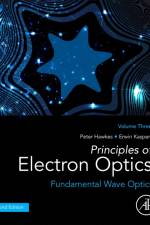
Principles of Electron Optic: Volume Three: Wave Optics, discusses this essential topic in microscopy to help readers understand the propagation of electrons from the source to the specimen, and through the latter (and from it) to the image plane of the instrument. In addition, it also explains interference phenomena, notably holography, and informal coherence theory. This third volume accompanies volumes one and two that cover new content on holography and interference, improved and new modes of image formation, aberration corrected imaging, simulation, and measurement, 3D-reconstruction, and more. The study of such beams forms the subject of electron optics, which divides naturally into geometrical optics where effects due to wavelength are neglected, with wave optics considered.
Human Aging: From Cellular Mechanisms to Therapeutic Strategies offers an exhaustive picture of all the biological aspects of human aging by describing the key mechanisms associated with human aging and covering events that could disrupt the normal course of aging. Each chapter includes a summary of the salient points covered, along with futures prospects. The book provides readers with the information they need to gain or deepen the skills needed to evaluate the mechanisms of aging and age-related diseases and to monitor the effectiveness of therapies aimed at slowing aging. The book encourages PhD and Postdoc students, researchers, health professionals and others interested in the biology of aging to explore the fascinating and challenging questions about why and how we age as well as what can and cannot be done about it.
This book "presents the very real issues associated with climate change and global warming and how it affects the planet and everyone on it. From a physical perspective, the book covers such topics as population pressures, food issues, rising sea-levels and coastline degradation, and health. It then goes on to present social impacts, such as humanitarian issues, ethics, adaptation, urban issues, local action, and socio-economic issues. Finally, it addresses the political impacts, such as justice issues and politics of climate change in different locations. By offering this holistic review of the latest impacts of climate change, the book helps researchers to better understand what needs to be done in order to move toward renewable energy, change societal habits, and move toward sustainable development"--
Clinical chemistry, however, is a topic in which many senior medical students and pathology residents face challenges. This book meets this challenge head on with a clear and easy-to-read presentation of core topics and detailed case studies that illustrate the application of clinical chemistry knowledge to everyday patient care.
Abonner på vårt nyhetsbrev og få rabatter og inspirasjon til din neste leseopplevelse.
Ved å abonnere godtar du vår personvernerklæring.