



















Gjør som tusenvis av andre bokelskere
Abonner på vårt nyhetsbrev og få rabatter og inspirasjon til din neste leseopplevelse.
Ved å abonnere godtar du vår personvernerklæring.Du kan når som helst melde deg av våre nyhetsbrev.

Offering a state-of-the-art, authoritative summary of the most relevant scientific and clinical advances in the field, Principles and Practice of Movement Disorders provides the expert guidance you need to diagnose and manage the full range of these challenging conditions. Superb summary tables, a large video library, and a new, easy-to-navigate format help you find information quickly and apply it in your practice. Based on the authors' popular Aspen Course of Movement Disorders in conjunction with the International Parkinson and Movement Disorder Society, this 3rd Edition is an indispensable resource for movement disorder specialists, general neurologists, and neurology residents
Get ready to pass the Next-Generation NCLEX-PN® Examination (NGN-PN) on your first try with Developing Clinical Judgment for Practical/Vocational Nursing and the Next-Generation NCLEX-PN® Examination. Written by renowned nursing education expert Donna D. Ignatavicius and a team of expert item writers, this practical workbook focuses on developing the clinical reasoning skills you need to succeed on the NGN-PN and in clinical practice. This collection of engaging and practical thinking exercises has been carefully developed to incorporate the National Council of State Boards of Nursing (NCSBN) Clinical Judgment Measurement Model (CJMM) and to emphasize the new item types that will be integral to the NGN-PN. Exercises range from basic to more complex and address all key content areas to fully prepare you for all facets of the exam. This "next-generation" workbook will become an invaluable companion throughout nursing school, helping you grow your clinical reasoning skills to match what's expected on the NGN-PN! Innovative workbook format helps you prepare for the Next-Generation NCLEX-PN® Exam (NGN-PN) through practical thinking exercises that challenge you to apply the National Council of State Boards of Nursing (NCSBN) Clinical Judgment Measurement Model to common clinical scenarios. A comprehensive collection of carefully developed clinical reasoning exercises range from basic to more complex and address all key content areas. Logical three-part organization: Part 1 is an introduction to clinical judgment with examples of how to approach the thinking exercises in the workbook. Part 2 consists of exercises that focus on applying clinical judgment for clients across the lifespan experiencing commonly occurring physical and mental health problems. Part 3 consists of exercises that focus on applying clinical judgment for older-adult clients, a main focus of care for LPN/LVNs. A robust quizzing engine on the companion Evolve website features all of the book's questions in an interactive format to provide a realistic simulated test-taking experience and feedback for remediation An extensive answer key with detailed rationales provides essential review and remediation.
With a focus on how to perform and effectively interpret pelvic ultrasound exams, Pelvic Ultrasound Imaging: A Cased-Based Application offers a unique learning experience that is ideal for ob/gyn and radiology practitioners and residents, urogynecology practitioners and fellows, diagnostic medical sonographers and those who are studying for Board exams. Current cases in gynecology and urogynecology are presented in a step-by-step format based on resident and fellow one-on-one didactic oral case reviews. An expert walk-through for each case's imaging set includes directive questions to help the reader perform proper exam assessment
From the sternoclavicular joint to the distal phalanx, Skeletal Trauma of the Upper Extremity is a practical, one-volume resource covering all aspects of upper limb trauma and surgery. Comprehensive in scope, it features a multidisciplinary, step-by-step approach to evaluation and management, including concise background information and a detailed focus on practical points and surgical techniques. Written by global experts in traumatology, sports medicine, and shoulder, elbow, and hand surgery, this richly illustrated guide brings you into the operating room with leaders in the field. Offers detailed, practical guidance from the originators and/or masters of each procedure, along with multiple, illustrated surgical technique descriptions. Includes pearls and pitfalls, preoperative evaluation and indications, surgical techniques, rehabilitation, and management of complications. Features tables and figures throughout that clearly demonstrate surgical tips and tricks. Identifies controversial topics and covers current challenges such as arthroscopic coracoclavicular/acromioclavicular joint reconstruction, reverse total shoulder arthroplasty for proximal humerus fracture, total elbow arthroplasty for fracture, interosseous membrane reconstruction of the forearm, and many more. Contains more than 500 high-quality illustrations, including anatomical and surgical illustrations, surgical photographs, ultrasounds, and x-rays. Enhanced eBook version included with purchase. Your enhanced eBook allows you to access all of the text, figures, and references from the book on a variety of devices.
Advanced Mathematics for Engineering Students: The Essential Toolbox provides a concise treatment for applied mathematics. Derived from two semester advanced mathematics courses at the author's university, the book delivers the mathematical foundation needed in an engineering program of study. Other treatments typically provide a thorough but somewhat complicated presentation where students do not appreciate the application. This book focuses on the development of tools to solve most types of mathematical problems that arise in engineering - a "toolbox¿ for the engineer. It provides an important foundation but goes one step further and demonstrates the practical use of new technology for applied analysis with commercial software packages (e.g., algebraic, numerical and statistical).
Battery System Modeling provides advances on the modeling of lithium-ion batteries. Offering step-by-step explanations, the book systematically guides the reader through the modeling of state of charge estimation, energy prediction, power evaluation, health estimation, and active control strategies. Using applications alongside practical case studies, each chapter shows the reader how to use the modeling tools provided. Moreover, the chemistry and characteristics are described in detail, with algorithms provided in every chapter. Providing a technical reference on the design and application of Li-ion battery management systems, this book is an ideal reference for researchers involved in batteries and energy storage. Moreover, the step-by-step guidance and comprehensive introduction to the topic makes it accessible to audiences of all levels, from experienced engineers to graduates.
Theories and Technologies of Bionic Drilling Fluids covers the development and use of bionics in drilling fluids. The book considers technical challenges and upgrades to existing drilling fluid technology, presenting a case for the use of bionics in the petroleum industry alongside environmental protection. In response to the increasing need for novel technologies, the title includes insights on how nature-inspired technologies can be successfully developed to help researchers and technicians harness the power of bionics to solve practical challenges. This volume presents over a decade's worth of original research on bionic drilling fluids, offering scientists and engineers a comprehensive handbook. Drilling fluid has contributed to the safe, efficient and smooth implementation of drilling engineering for over a century. However, in recent years, oil and gas reserves have been discovered in difficult-to-access, extreme environments such as the deep ocean. Consequently, geological and ground conditions have become increasingly complex, posing a challenge to resource exploration and development. Bionics, the imitation of characteristics, structures, functions and principles from nature, offers a new approach to drilling fluid technology.
Written specifically for the conventional medical healthcare provider, Medicinal Herbs in Primary Care forms an integral part of the primary care tool belt. Through a series of system-based disease tables, this unique title provides quick, authoritative guidance for the busy practitioner whose patient is requesting guidance on medicinal herbs. The disease tables are supported by herbal monographs that provide expanded details of the available preclinical and clinical evidence laid out in a system-based sequence. Together with the section on herbal basics, this practical reference contains the information today's medical healthcare providers need to develop familiarity with and confidence in the prescription of medicinal herbs. Provides quick answers and evidence-based prescribing guidance for medicinal herbs while also addressing complexities and co-morbidities in patient care. Features 48 system-based disease tables that identify herbs based on strength of evidence and indicate the scope of potential benefits for other conditions the patient may have. Includes 55 monographs for the most common medicinal herbs, with safety and precaution guidelines, summaries of preclinical and clinical trials, chemical constituents and actions, and prescription options for each. Contains an introductory section on the basics of medicinal herbs that dispels common misconceptions regarding herbal medicine. Discusses key topics such as herb-drug interactions, and includes information on SARS-COV-2 where appropriate. Uses typical medical abbreviations throughout for ease of use, and provides a glossary of terms for non-medical and alternative health care providers. Helps conventional medical practitioners partner with patients to determine safe herbal options when appropriate, and ensure safety and efficacy of herbal use. Enhanced eBook version included with purchase. Your enhanced eBook allows you to access all of the text, figures, and references from the book on a variety of devices.
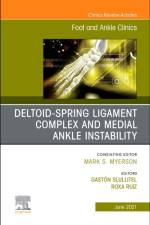
This issue of Foot and Ankle Clinics, guest edited by Dr. Roxa Ruiz and Gaston Slullitel, will discuss Deltoid Spring Ligament Complex and Medial Ankle Instability. This issue is one of four selected each year by long-time series Consulting Editor, Dr. Mark Myerson. Topics in this issue will include: Anatomy of deltoid-spring ligament complex, Biomechanics of medial ankle and peritalar instability, Imaging of peritalar instability, Clinical appearance of medial ankle instability, Arthroscopic assessment and treatment of medial ankle instability, Current concepts in treatment of acute medial ankle instability, State of the art in treatment of chronic medial ankle instability, Current trends in treatment of injuries to spring ligament, Deltoid rupture in ankle fracture, Current concepts in treatment of ligament incompetence in the acquired flatfoot, and The failed deltoid ligament in the valgus misaligned ankle.
Approx.240 pages
Abonner på vårt nyhetsbrev og få rabatter og inspirasjon til din neste leseopplevelse.
Ved å abonnere godtar du vår personvernerklæring.