







Gjør som tusenvis av andre bokelskere
Abonner på vårt nyhetsbrev og få rabatter og inspirasjon til din neste leseopplevelse.
Ved å abonnere godtar du vår personvernerklæring.Du kan når som helst melde deg av våre nyhetsbrev.

Masculinity in American Fiction of the Mid-Twentieth Century
This book brings to light Derrida's rich and thought-provoking discussions of Shakespearean drama.
A comparison of tribal politics and the impact on governance in Kuwait, Oman and Qatar Tribe-state relations are a foundational element of authoritarian bargains in the Middle East - particularly in the Gulf States. However, the structures of governance built upon that foundation exhibit wide differences. What explains this variation in the salience of kinship authority? Through a case comparison of Kuwait, Qatar and Oman, Scott Weiner shows that variation in tribal access to limited resources before state building can account for these differences. Based on empirical data and over 50 interviews with former government officials, tribal leaders, civil society activists and students, the book reveals important new details about state formation on the Arabian Peninsula. Key features Systematically connects the construction of kinship identity to state-level political outcomes Emphasises the importance of pre-state conditions to post-state building politics Assesses kinship politics in the ruling family, state ministries, parliaments, local governing institutions and interpersonal interactions Scott Weiner is a professorial lecturer in political science at George Washington University.
'As time passes, Politics of Friendship, initially a revised version of some of Derrida's many seminars around the questions of nationalism, universalism, antagonism and alterity that continuously cross over ethics and politics, has become a central element in the interpretation of his oeuvre. It radiates in every direction and summons the deepest interrogations. This rich collection of essays, combining accurate philology and audacious contextualisation, does full justice to its importance and will become a necessary companion for its readers.' Etienne Balibar, author of Violence and Civility Twenty-five years after the publication of Derrida's Politics of Friendship (Politiques de l'amitié, 1994), this edited collection gathers twenty-three critical chapters each revisiting this underappreciated text, including Derrida's Geschlecht IV, an essay excluded from the English translation. Engaging closely with Derrida's text are analyses, extensions and critiques of the work. It not only reconsiders the place this book occupies in Derrida's political philosophy but also its potential for contemporary politics, when the promises and perils of political friendship have reappeared, intertwined with both nationalist and anti-nationalist political programmes. Luke Collison is a recent PhD Graduate from the Centre for Research in Modern European Philosophy, Kingston University London. Cillian Ó Fathaigh is a Bill & Melinda Gates Scholar at the University of Cambridge and a Research Fellow at Nottingham Trent University. Georgios Tsagdis is Lecturer in Philosophy at Leiden University, Erasmus University Rotterdam and at the Architectural Association, London. Cover image: Rome, Lazio, Italy (c) saulgranda/Getty Images Cover design: riverdesignbooks.com [EUP logo] edinburghuniversitypress.com ISBN 978-1-4744-8673-6 Barcode
Considers the ideals and realities of generalship across the Greek, Roman and Byzantine worlds This volume is unique in addressing a key aspect of ancient warfare across a broad chronological and cultural span, focusing on generalship from Archaic Greece to the Byzantine Empire in the twelfth century AD. Across this broad span, it explores a range of ideas on how to be a successful general, showing how the art of generalship - a profession that has been occupied variously by the political elite, the mercenary soldier and the eunuch - evolved and adapted to shifting notions of how a good military leader should act. Highlighting developments and continuities in this age-old profession across the Graeco-Roman world, this volume brings together the latest research on generalship from both established and new voices. The chapters examine both ideals of generalship and specific examples of generals, considering the principles underpinning the roles they played and the qualities desired in them. They discuss in particular the intersection between military and political roles, the addresses delivered by generals to their troops, the virtue of courage and the commemoration of victory as well as defeat. In addition, contributors consider cross-cultural comparisons of generalship, with specific chapters devoted to Persian, Arab and Chinese views. Richard Evans taught at the University of South Africa and Cardiff University. In recent years he has been Honorary Research Fellow in the Department of Biblical and Ancient Studies at the University of South Africa. Shaun Tougher is Professor of Late Roman and Byzantine History at Cardiff University, where he has taught since 1997.
Uncovers alternative ways of seeing the environment from the Romantic period Romantic Environmental Sensibility employs a class-based analysis in global studies. The chapters here reveal the extent to which our representations of the land, as well as of the plants, animals and people who live on the land, are imposed upon by habits of thought that are profoundly class-based. It shows how Green Romanticism has simplified Romantic period discourse by bringing to light the multiplicity of perspectives and long-standing inequalities that have been occluded and how current approaches to conservation and animal rights continue to be influenced by a class-bound Romantic environmental sensibility. Ve-Yin Tee is Assistant Professor in the Department of British and American Studies, Nanzan University, Japan.
The Correspondence of James Boswell and Sir William Forbes of Pitsligo Edited by Richard B. Sher This volume, tenth in the Yale Boswell Editions Research Series of correspondence, collects the letters exchanged between James Boswell (1740-1795) and Sir William Forbes of Pitsligo (1739-1806), eminent banker, civic improver, philanthropist, literary and cultural patron, and lay leader of Edinburgh's 'English Episcopal' community. Forbes served Boswell as his most valued Scottish advisor, an affectionate and admired counsellor to whom he would often turn for personal, financial, moral, and religious guidance, and whom he would name executor of his estate and co-guardian of his children. Their friendship probably began in 1759 as new members of the same Masonic lodge in Edinburgh, and it deepened over time, and included their families. Boswell shared with Forbes significant portions of his private journal, and discussed with him his authorial ambitions as he developed the innovative biographical technique that would characterize his major publications on Samuel Johnson. He sought Forbes's opinions about his original 1773 account of what would become his Journal of a Tour to the Hebrides, with Samuel Johnson (1785), and about his journal of his 1777 visit with Johnson at Ashbourne, later used in The Life of Samuel Johnson (1791). Boswell, in turn, broadened and enriched Forbes's social range, providing a gateway into his remarkable circle of friends in London, in particular the members of the 'Literary Club'. As Richard B. Sher explains in his introduction, none of Boswell's other close friends straddled Boswell's various worlds--his family life and professional career in Edinburgh, his lairdship of the Auchinleck estate in Ayrshire, his literary life in London--in this way. The volume, while thoroughly documenting the friendship that lies at its core, also illuminates the lives of Boswell and Forbes individually, especially Boswell's final decade in London. It publishes a total of 111 comprehensively annotated letters, few of which have appeared previously in print: 79 exchanged between Forbes and Boswell between 1772 and 1794, and 32 involving other correspondents. The edition draws extensively on unpublished manuscripts in both the Boswell Collection at Yale and the Fettercairn Papers in the National Library of Scotland, including revealing letters from Forbes to his beloved wife 'Betsy', Lady Forbes, and to his close friend James Beattie, who would become Forbes's own biographical subject in the decade after Boswell's death. Richard B. Sher is Distinguished Professor of History Emeritus in the Federated History Department of New Jersey Institute of Technology and Rutgers University, Newark. He has published widely on topics relating to eighteenth-century Scotland, including The Enlightenment and the Book (2006), Church and University in the Scottish Enlightenment (2nd ed., 2015), and many articles, book chapters, and edited volumes.
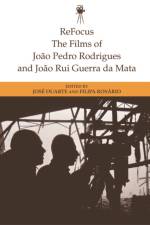
João Pedro Rodrigues and João Rui Guerra da Mata are one of the most cosmopolitan duos in contemporary world cinema. Their films tell us stories of love and human desire, receiving a highly favourable reception among critics and at international festivals. Despite their high profile, Rodrigues and da Mata's work remains relatively understudied. ReFocus: The Films of João Pedro Rodrigues and João Rui Guerra da Mata, paves the way for the study of the directors' work, critically analysing the various cinematic perspectives of their short and full-length feature films. In the first collection solely dedicated to their work, this book addresses the historical, political, stylistic, industry, and cultural dimensions of Rodrigues and da Mata's films, providing critical recognition for their contribution to world cinema. José Duarte teaches Cinema at the School of Arts and Humanities (UL) and he is a researcher at ULICES (University Lisbon Centre for English Studies). He co-edited the book The Global Road Movie: Alternative Journeys around the World (2018). Filipa Rosário is a Research Fellow at the Centre for Comparative Studies, University of Lisbon (CEC-UL). She co-edited the book New Approaches to Cinematic Space (2019), and is the author of O Trabalho do Actor no Cinema de John Cassavetes (2017).
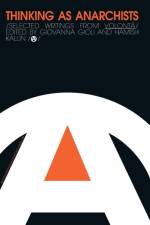
'Gustav Landauer implored anarchists to resist translation and learn how to 'think and feel' unfamiliar languages. Gioli and Kallin do just that. Their beautiful, illuminating and inspiring collection turns an obscured history into a future-gazing meditation on domination and libertarian intervention, teaching us how to think 'about' and 'for' anarchism and collapse that distinction.' Ruth Kinna, Loughborough University 'This book marks a pivotal moment in the history of anarchism - an international gathering held in Venice, Italy in 1984 - that gave birth to a critical (hitherto unpublished) anthology compiled by activists associated with the Italian journal Volontà. Charting new avenues for anarchy's realization, the anthology addresses prescient issues such as liberatory power, patriarchy, ecological transformation, state repression, and "utopian" economics. Giovanna Gioli and Hamish Kallin have combined the original anthology with additional articles from A/Rivista Anarchica and other sources, culminating with a retrospective history of Volontà. Interweaving history, theory, and practice, Thinking as Anarchists is an extraordinary achievement.' Allan Antliff, Director of the University of Victoria's Anarchist Archive In the symbolic year of 1984, thousands of anarchists from all over the world gathered in Venice to explore the future of their shared ideal. This collection brings together a series of influential papers from that moment, centred around the Italian anarchist journal Volontà and the international circle connected to it. Initially published from the early 1980s to the late 1990s, most of these papers have never appeared in English before. Together, they form a treasure trove of anti-authoritarian thinking on issues as diverse as authority, the state, utopia, freedom, patriarchy and how we might envisage an anarchist approach to economics. Remarkably far-ranging in their points of reference, these interventions are truly interdisciplinary seeking to reinvigorate the intellectual heart of the anarchist ideal. This book is essential for historians of anarchism and an engaging intervention for all those who theorise for a radically better world. Key features: The newly translated and fully annotated text allows readers unfamiliar with the context or political background to engage with these arguments for the first time. The introduction situates these papers in their political and historical context and considers the experience of the journal Volontà in relation to emergent forms of autonomous Marxism, the 'new' anarchism and poststructuralism. Features a wealth of vibrant photographs and visual materials, providing a glimpse into the striking richness and creativity of anarchist aesthetics at the time. Turns the debate to the future where in an era of ecological catastrophe and resurgent fascism, it is more vital than ever that activists and academics see the importance of thinking as anarchists. Giovanna Gioli is a Senior Lecturer in Human Geography at Bath Spa University. Hamish Kallin is a Lecturer in Human Geography at the University of Edinburgh.
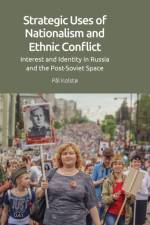
Argues that nationalism and ethnic conflict can be used as strategies to achieve power and influence With a new introductory theoretical chapter, the book collects thoroughly revised nine articles and book chapters based on Pål Kolstø's thirty years of study of nationalism and ethnic conflict in post-Soviet states. Kolstø examines how the drivers behind ethnic conflicts in the non-Russian republics were not only struggle for collective identities but also more mundane interests, such as competition for jobs and positions. He also analyses the transformations of Russian nationalism, both among the ruling elite and in the opposition, with a particular focus on the use of symbolism. Exploring nationalism as a pervasive feature of politics in the modern world, Kolstø argues that both state leaders and 'ethnic entrepreneurs' employ nationalist rhetoric and stratagems to further their political agendas and achieve particular goals. He examines some of the ways this is used as a political strategy and focuses both on nationalism at the societal level and as a state strategy. Pål Kolstø is Professor of Russian and post-Soviet studies at the University of Oslo, Norway.
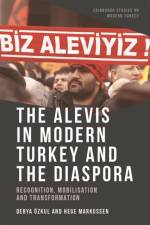
Investigates the Alevis' struggles for recognition in Turkey and the diaspora and transformations in authority and traditional rituals This book explores the struggles of a minority group - Alevis - for recognition and representation in Turkey and the diaspora. It examines how they mobilise against state practices and claim their rights, while at the same time negotiating how they define themselves. The authors offers a conceptual framework to study minorities by looking at both structural and agency-related factors in resisting state pressure and mobilising for their rights. The Alevis in Modern Turkey and the Diaspora is divided into three main sections looking into: the Turkish state and society's pressures over Alevis; how Alevis struggle and obtain representation in various Western countries; and how traditional authority and rituals transform under these conditions. Studying this minority group's experience helps to understand oppression and resistance in the broader Middle East. Key Features 14 detailed case studies provide insights into the struggles for recognition and representation by Alevi communities in Turkey and the diaspora under the AKP administration Demonstrates how the struggles for recognition transform and re-define traditions, authorities and rituals Examines how diverse understandings of Alevi identities interplay with standardised representations of Alevism Opens up the study of the recognition of minorities as local, national and transnational processes Derya Özkul is a Research Officer at the Refugee Studies Centre, University of Oxford. Hege Markussen is a Researcher in History of Religions at the Centre for Theology and Religious Studies, Lund University.
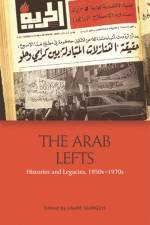
Explores the entangled histories of left-wing movements across the Arab world, Europe and Afro-Asian areas of resistance Relocating the Arab Left in transnational dynamics and revolutionary networks, this book examines the circulation of people, symbols, and ideas between the Arab world, Europe and Afro-Asian areas of resistance. Based on an analysis of textual and audio-visual materials, this book sheds light on the resilience of Arab radical and democratic traditions that took shape despite local and global wars, state coercion, neo-liberal globalisation and repeated failures. Interrogating commonly accepted categories - in particular the category of 'Left' - the collection also invites reflection on how a re-engagement with the 'Long Sixties' relates to today's political landscape and conception of history and temporality. - A transnational history of the Arab Left, this book opens new avenues for research on the Cold War, the Sixties and national emancipation struggles - Features an interdisciplinary team of scholars that bring into conversation a wide range of concerns including radicalisation processes, revolutionary hopes, neoliberal globalisation, Islam and the Left, the legacy of Marxism, communism and left-wing politics in general - Examines the interventions of a wide range of leftist parties and groups in the Middle East, including the Syrian Baath Party, League for Combating Zionism, Israeli Communist Party (MAKI), Syrian-Lebanese Communist Party, Tunisian Communist Party, Egyptian Communist Workers' Party, Socialist Lebanon and the Organisation of the Communist Action in Lebanon - Traces the political involvement of Arab Left figures such as Khaled Bakdash, Mahdi Ben Barka, Clovis Maksoud, Husayn Muruwwah and Khalid Ahmad Zaki Laure Guirguis is Associate Professor and Research Fellow at the Aarhus Institute of Advanced Studies (AIAS) and Associate Researcher at the Institute for Research on the Arab and Muslim World (IREMAM, Aix-en-Provence).
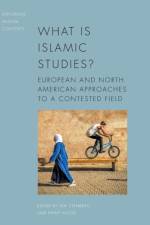
Explores the vibrant, divided and evolving field of Islamic studies in Europe and North America The study of Islam and Muslims has expanded greatly in Europe and North America in recent decades and has become a passionately debated and divided field. This collection critically assesses the development of the field of Islamic Studies and its place in society. Featuring contributions from anthropologists, historians and scholars of religion, each chapter contains new empirical material and discusses approaches to the study of Islam, past and present. The book situates Islamic Studies within broader discussions of the construction of identity and its political implications in Europe and North America. Authors also address tensions between normative and non-normative approaches to the study of Islam and Muslims and consider how these might be reconciled. Key features Covers topics ranging from gender and secularism to pop music and modern science Discusses contemporary and historical approaches in Islamic Studies Features contributions from leading scholars studying Islam and Muslims, including Shahzad Bashir, Hadi Enayat, Juliane Hammer, Aaron Hughes, Carool Kersten, Susanne Olsson and Jonas Otterbeck Addresses the role of both Muslims and non-Muslims in the ongoing construction of Islam Philip Wood is Professor of History at The Aga Khan University, Institute for the Study of Muslim Civilisations. Leif Stenberg is Dean and Professor of Islamic Studies at The Aga Khan University, Institute for the Study of Muslim Civilisations.
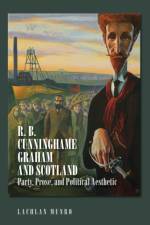
Explores the complex life of the most controversial and enigmatic Scot of his generation, and his contribution to Scottish life and letters R. B. Cunninghame Graham was a well-known and hugely influential figure in late 19th- and early 20th-century Scottish politics and literature. This book explores Graham's early political views, his time as a Member of Parliament, his disillusionment with the Liberal Party and his reputation as the first declared 'socialist' MP. Using documentary evidence and tangible philosophical links, the book traces Graham's early political influences derived directly or indirectly from key 19th-century figures, particularly William Morris. It also examines Graham's anti-imperialist, anti-colonial and anti-racist speeches and writings, and his active support for women's rights and universal suffrage. Lachlan Munro strips away the mythology surrounding Graham to reveal an altogether more complex picture, exploring his political and literary achievements, during a time of enormous political, economic and cultural upheaval - the reverberations of which are still ongoing. Lachlan Munro is the editor of An Eagle in a Hen-House: Selected Political Speeches and Writings of R. B. Cunninghame Graham (2017).
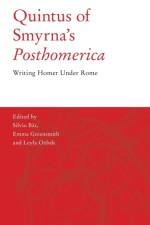
Offers a literary and cultural-historical analysis of the Posthomerica This collection offers a new collaborative reading of Quintus Smyrnaeus' Posthomerica: a major, fascinating Greek epic written at the height of the Roman Empire. Building on the surge of interest in imperial Greek poetry seen in the past decades, this volume applies multiple approaches - literary, theoretical and historical - to ask new questions about this mysterious, challenging poet and to re-evaluate his role in the cultural history of his time. Bringing together experienced imperial epic scholars and new voices in this growing field, the chapters reveal Quintus' crucial place within the inherited epic tradition and his role in shaping the literary politics of Late Antique society. Silvio Bär is Professor of Classics at the University of Oslo. Emma Greensmith is Associate Professor of Classical Languages and Literature at the University of Oxford and a Fellow of St John's College. Leyla Ozbek is Research Fellow of Greek Language and Literature at the Scuola Normale Superiore of Pisa.
Abonner på vårt nyhetsbrev og få rabatter og inspirasjon til din neste leseopplevelse.
Ved å abonnere godtar du vår personvernerklæring.