




Gjør som tusenvis av andre bokelskere
Abonner på vårt nyhetsbrev og få rabatter og inspirasjon til din neste leseopplevelse.
Ved å abonnere godtar du vår personvernerklæring.Du kan når som helst melde deg av våre nyhetsbrev.

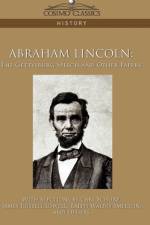
Old as history is, and manifold as are its tragedies, I doubt if any death has caused so much pain to mankind as this has caused, or will cause, on its announcement; and this, not so much because nations are by modern arts brought so closely together, as because of the mysterious hopes and fears which, in the present day, are connected with the name and institutions of America.-from Ralph Waldo Emerson's remarks at Lincoln's funeral, April 19, 1865Here, in one compact volume, is an extraordinary tribute to the life and legacy of one of the greatest presidents in United States history. Abraham Lincoln's (1809-1865) own words stand as powerful testimony to his wisdom and leadership: here you'll find his famous Gettysburg Address, both inaugural addresses, the Emancipation Proclamation, a selection of correspondence, his last public speech, and other notable papers. Also included are:. an 1891 essay by Carl Schurz (1829-1906), a prominent and trusted member of the Lincoln administration, a loving but un-idealized acclamation of the man and his work that delves into the deep sense of morality and prodigious intellect that informed his presidency. a stirring and emotional 1864 defense of Lincoln's prosecution of the Civil War by his friend, poet James Russell Lowell (1819-1891). Ralph Waldo Emerson's (1803-1882) eulogy of Lincoln. poetry in honor of the fallen president by Lowell, John Greenleaf Whittier, Oliver Wendall Holmes, and Walt Whitman.Written by those who knew him, loved him, and witnessed his dramatic impact on United States during its most perilous crisis, this collection offers us the invaluable perspective of his contemporaries and the beginnings of the towering image we have of Abraham Lincoln today.
[I]f the Gods have neither the power nor the inclination to help us; if they take no care of us, and pay no regard to our actions; and if there is no single advantage which can possibly accrue to the life of man; then what reason can we have to pay any adoration, or any honors, or to prefer any prayers to them? Piety, like the other virtues, cannot have any connection with vain show or dissimulation; and without piety, neither sanctity nor religion can be supported; the total subversion of which must be attended with great confusion and disturbance in life.-from The Nature of the GodsRoman orator and politician Cicero provides a vital firsthand viewpoint on the fall of the Roman Empire, and a grounding in his work is necessary for appreciating philosophers who came after him, including Saint Augustine, upon whom he exerted a profound influence. This edition, a replica of the 1877 translation by C. D. Yonge, offers highly readable versions of some of Cicero's most significant writings:. Tusculan Disputations is a classic of Stoic metaphysics, Cicero's argument that virtue is the root of the only true human happiness.. On the Nature of the Gods, which examines multiple viewpoints on the gods and religion, is an excellent example of the philosophical dialogue, and of Cicero's skeptical method.. On the Commonwealth, one of Cicero's most important works of political philosophy, sets out his thoughts on the ideal society.Roman lawyer and philosopher MARCUS TULLIUS CICERO (106-43 B.C) also wrote On Invention, On the Orator, On the Republic, and On the Laws.British scholar CHARLES DUKE YONGE (1812-1891) is also the author of The Life of Marie Antoinette, Queen of France and History of England From 1760 to 1860.
The old saying, "Marry in haste and repent at leisure," will never lose its force. Worse than the man whose selfishness keeps him a bachelor till death, is the young man, who, under an impulse he imagines to be an undying love, marries a girl as poor, weak, and selfish as himself.-from "Chapter VII: As to Marriage"Subtitled A Ladder to Practical Success, this little book is chock full of handy advice for a young man looking to make his way in the world... or at least in the world of 1895, when it was first published. Calhoun's guidance encompasses:. the importance of correct habits. the value of experience. selecting a calling. some of labor's compensations. patience and perseverance. and more.While some of its core counsel is timeless, this quaint work is a charming look back at a society that no longer exists.Also available from Cosimo Classics: Calhoun's Business Hints for Men and Women.American artist and writer ALFRED ROCHEFORT CALHOUN contributed photography, sketches, and articles to publications including Harper's Weekly and the Philadelphia Press.
The principal apartments in all Japanese houses are at the back, looking out on these miniature landscapes... A lake, a rockwork, a bridge, a stone lantern, and a deformed pine, are indispensable; but whenever means and circumstances admit of it, quaintnesses of all kinds are introduced. Small pavilions, retreats for tea-making, reading, sleeping in quiet and coolness, fishing under cover, and drinking saké... ¬ -from "Letter XVI" Taking the form of letters to a beloved sister, this chronicle of an 1878 trip to Japan is a classic Victorian travel journal. Isabella Bird was a woman who, she readily admits herself, was ill-suited to the middle-class British life she was brought up in and much more at home in the "savage wilds." Intrigued by the "real" Japan, the outlying areas that were then yet untouched by galloping Westernization, she spent time in the remote villages of the Ainu, the ancient peoples of Japan, and touring much of the backcountry of that exotic land. Charming and insightful, this lovely book will please readers of travel adventure. British writer ISABELLA LUCY BIRD (1831-1904) traveled extensively around the globe. She is also the author of A Lady's Life in the Rocky Mountains (1879), Journeys in Persia and Kurdistan (1891), and Among the Tibetans (1894). ~ ~ ~
It is true that not a few men kill themselves by overwork; but the proportion of such is small to the number who die from violating the laws of health; and death from excessive activity is far preferable to death from rust. The spirits may be exhausted by employment, but they are utterly destroyed by idleness.-from "Choice of a Profession"William Mathews may have been the perfect 19th-century source for advice on personal achievement: in his long, busy life; he was a successful lawyer, newspaper publisher, university professor, and journalist. This collection of essays on making one's way in the world began as an 1871 series of articles for the Chicago Tribune that were reconsidered and expanded for this 1872 book. Mathews shares his still pertinent wisdom on such success-minded topics as:. the concept of luck, and how it is abused. why concentration and focus are key. the importance of maintaining physical health. how to cultivate self-reliance. why originality is vital to success. the necessity of practical talent and knowledge. being economical with your time. being smart about money. and much more.American writer WILLIAM MATHEWS (1818-1909) also wrote Words, Their Use and Abuse (1876), Hours with Men and Books (1877), and Monday-Chats (1877).
Abonner på vårt nyhetsbrev og få rabatter og inspirasjon til din neste leseopplevelse.
Ved å abonnere godtar du vår personvernerklæring.