

Gjør som tusenvis av andre bokelskere
Abonner på vårt nyhetsbrev og få rabatter og inspirasjon til din neste leseopplevelse.
Ved å abonnere godtar du vår personvernerklæring.Du kan når som helst melde deg av våre nyhetsbrev.

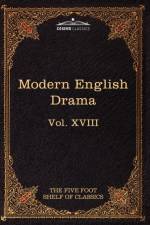
Author names not noted above: Oliver Goldsmith, Percy Bysshe Shelley, Robert Browning, and Lord Byron.Originally published between 1909 and 1917 under the name "Harvard Classics," this stupendous 51-volume set-a collection of the greatest writings from literature, philosophy, history, and mythology-was assembled by American academic CHARLES WILLIAM ELIOT (1834-1926), Harvard University's longest-serving president. Also known as "Dr. Eliot's Five Foot Shelf," it represented Eliot's belief that a basic liberal education could be gleaned by reading from an anthology of works that could fit on five feet of bookshelf.Volume XVIII features six of the greatest plays of 17th-, 18th-, and 19th-century England writers:¿ All for Love, the Shakespearean tragedy by JOHN DRYDEN (1631-1700)¿ The School for Scandal, the comedy of manners by RICHARD BRINSLEY SHERIDAN (1751-1816)¿ She Stoops to Conquer, the satire by OLIVER GOLDSMITH (1730-1774)¿ The Cenci, the controversial verse drama by PERCY BYSSHE SHELLEY (1792-1822)¿ A Blot in the 'Scutcheon, the tragedy by ROBERT BROWNING (1812-1889)¿ Manfred, the supernatural drama by LORD BYRON (1788-1824)
Good Newes from New England, first published in 1624, was written by one of the first Pilgrim leaders to enter the United States. Edward Winslow, an English immigrant and plantation leader from the Mayflower, wrote in a journal his account of the new world, which was subsequently published in order to convince more pilgrims to make the long voyage to America. The entries, which are separated into months, discuss a wide range of topics, from food and weather to the Native Americans and their reception and treatment of the pilgrims. Winslow's account is a remarkable primary source for those interested in America's early foundations.Edward Winslow (1595-1655) was an English immigrant on the Mayflower, a leader and founder of the Plymouth colony, and governor of Plymouth in 1633, 1636, and 1644. Winslow also founded Marshfield in Plymouth where he owned an estate called Careswell and lived until his death. Winslow's account of the "first Thanksgiving" in Mourt's Relation is one of only two first-hand written testimonies in existence.
A Dweller on Two Planets was "channeled" to FREDERICK SPENSER OLIVER (1866-1899) at his Northern California home near Mount Shasta over a period of three years, beginning when he was seventeen. The true author, according to Oliver, was Phylos the Thibetan, a spirit and one-time inhabitant of the lost continent of Atlantis. Oliver claimed not to have written any of the text, asserting here that he was merely transmitting that which Phylos revealed to him. In fact, professed Oliver, the manuscript was dictated to him out of sequence (much of it backward) so that he could not interfere with the outcome.In this classic of new age and spiritual literature, Phylos describes in rich detail the culture, politics, architecture, and science of Atlantis, as well as its demise. He addresses karma and reincarnation, and predicts technological innovations in the 20th century that match and even exceed those of Atlantis.Supporters maintain that many of those predictions came true. Read for yourself and decide.
Abonner på vårt nyhetsbrev og få rabatter og inspirasjon til din neste leseopplevelse.
Ved å abonnere godtar du vår personvernerklæring.