



Gjør som tusenvis av andre bokelskere
Abonner på vårt nyhetsbrev og få rabatter og inspirasjon til din neste leseopplevelse.
Ved å abonnere godtar du vår personvernerklæring.Du kan når som helst melde deg av våre nyhetsbrev.

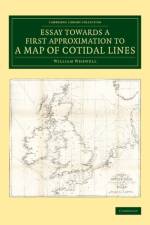
Cotidal lines are lines on a map which connect points at which the same tidal level occurs simultaneously. Isaac Newton had explained the movement of the tides by the action of the moon and sun, and Daniel Bernoulli had used Newton's findings to create tide tables for specific locations, but William Whewell wanted to take research further by gathering and analysing information which would link cotidal points or lines across the world. Fellow and eventually Master of Trinity College, Cambridge, Whewell (1794-1866) published this work in 1833. In it he proposes various observations that would need to be undertaken to produce a cotidal map, with detailed descriptions of the factors to be taken into account in computing the results. In 1837, Whewell, several of whose other works are also reissued in this series, was awarded a royal prize medal by the Royal Society for his work on 'tidology'.
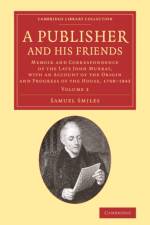
This two-volume account of the life and friendships of the publisher John Murray (1778-1843), told largely through his voluminous correspondence, was published in 1891 by Samuel Smiles (1812-1904), whose Lives of the Engineers, Self-Help, and other works are also reissued in the Cambridge Library Collection. Murray was only fifteen when his father, the founder of the famous firm, died, but after a period of apprenticeship he took sole control of the business, becoming the friend as well as the publisher of a range of the most important writers of the first half of the nineteenth century, in both literature and science. Perhaps his most famous author was Lord Byron, whose memoir of his own life, considered unpublishable, was burned in the fireplace at Murray's office in Albemarle Street, London. Volume 1 commences with the beginnings of the firm in Scotland, and takes the story up to 1818.
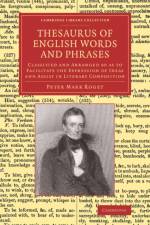
Peter Mark Roget (1779-1869), of Huguenot stock, trained as a physician in Edinburgh and London, yet he was increasingly drawn to the sciences, corresponding with Erasmus Darwin, Thomas Beddoes and Humphry Davy. He practised medicine (free of charge) in London at the Northern Dispensary, which he co-founded, and lectured on physiology and medical topics. His Bridgewater Treatise, on animal and vegetable physiology, is also reissued in the Cambridge Library Collection. Roget is remembered today for the present work, first published in 1852 following his retirement from professional duties. As the preface makes clear, he had contemplated such a work for nearly fifty years. It supplies a vocabulary of English words and idiomatic phrases 'arranged ... according to the ideas which they express'. The thesaurus, continually expanded and updated, has always remained in print, but this reissued first edition shows the impressive breadth of Roget's own knowledge and interests.
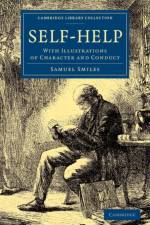
One of the most popular and prolific writers during the Victorian age, Samuel Smiles (1812-1904) emphasised individual responsibility in the pursuit of personal and social improvement. Among other titles, his acclaimed Lives of the Engineers (1861-2) and insightful Autobiography (1905) are also reissued in the Cambridge Library Collection. He is best known, however, for the present work. First published in 1859, it sold 20,000 copies in its first year, more than a quarter of a million by 1905, and was widely translated. Using hundreds of biographical examples, ranging from George Stephenson to Josiah Wedgwood, Smiles champions the virtues of hard work, perseverance and character in achieving success. While these values appealed to a large readership in the book's heyday, later critics saw the work as promoting a form of selfish materialism. However interpreted, this remains a crucial text for those fascinated by the Victorian drive for self-improvement.
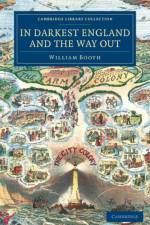
This classic work in the literature of poverty was published in 1890 by William Booth (1829-1912), the founder of the Salvation Army. It was in fact mostly written by the crusading journalist W. T. Stead (referred to as an anonymous 'friend of the poor' in Booth's preface), but the practical ideas for relieving the poverty and squalor of late Victorian British cities are all Booth's own. Reworking the cliche of 'Darkest Africa', in the first part he describes the 'submerged tenth' of Darkest England - destitute and/or criminal - and goes on to suggest the way to 'Deliverance', which includes better housing, education and training for work, and the sending of the urban poor to 'colonies', both overseas and in the British countryside. These proposals had their critics, but drew wide attention to an appalling aspect of urban life of which the prosperous classes were barely aware.
History of the Afghans was compiled by Nimat Allah (fl.1613-30) at the court of the Mughal emperor Jahangir (1569-1627). Drawing on various manuscript sources, it contains both mythical and historical accounts of the Afghan people. The wide coverage includes discussion of the Pashtun and their origins, the prophet Yakub (Jacob), King Talut (Saul) and the Afghan migration to Ghor, the late medieval sultans Bahlul, Sikandar and Ibrahim of the Lodi dynasty, and the lives of saints. The work also features the genealogy of Afghan tribes as well as reports of miracles. The German orientalist Bernhard Dorn (1805-81) published this English translation from the original Persian between 1829 and 1836. This reissue incorporates the separately published parts in one volume. Dorn's respected translation of this important text remains of interest to scholars of Asiatic history and tradition.
An English civil servant who worked in British India and Nepal, Brian Houghton Hodgson (c.1801-94) was also a specialist in Tibetan Buddhism. First published in 1874, this is a collection of his essays on nineteenth-century Nepal and Tibet, earlier versions of which had appeared in the Journal of the Bengal Asiatic Society and two books of Hodgson's own, later updated for the Phoenix, a monthly magazine for China, Japan and eastern Asia. Diverse in coverage, the essays represent over thirty years' research. Those in Part 1 focus on Buddhism, covering religious practices, writing, literature, attitudes to Buddhism and the differences between Buddhism and Shaivism. The pieces in Part 2 explore other aspects of Nepal and the Himalayas, such as tribal culture, colonisation and commerce. Discussing a range of linguistic, cultural, sociological and economic topics, this collection remains relevant to scholars working in these fields.
An important mathematician and astronomer in medieval India, Bhascara Acharya (1114-85) wrote treatises on arithmetic, algebra, geometry and astronomy. He is also believed to have been head of the astronomical observatory at Ujjain, which was the leading centre of mathematical sciences in India. Forming part of his Sanskrit magnum opus Siddhanta Shiromani, the present work is his treatise on algebra. It was first published in English in 1813 after being translated from a Persian text by the East India Company civil servant Edward Strachey (1774-1832). The topics covered include operations involving positive and negative numbers, surds and zero, as well as algebraic, simultaneous and indeterminate equations. Strachey also appends useful notes made by the orientalist Samuel Davis (1760-1819). Of enduring interest in the history of mathematics, this was notably the first work to acknowledge that a positive number has two square roots.
Chinese, in its various forms, is spoken today by over a billion people, making it the most spoken language in the world. A member of the Sino-Tibetan family, it is a tone language with an analytic structure. First published in 1814, this grammar of colloquial Chinese was compiled by the Christian missionary Joshua Marshman (1768-1837), who was inspired to do so after preparing a Chinese translation of the Bible. It begins with a preliminary essay outlining the characters of Chinese, its tones, its system of monosyllables and its relationship to neighbouring languages. The grammar itself is extensive, covering all aspects of the language's structure, including case, agreement, pronouns, verbs, mood, tense, prosody, parts of speech and dialect variation. Illustrated with numerous examples and explaining each grammatical concept in detail, this work remains useful and relevant in historical linguistics.
The orientalist Edward William Lane (1801-1876) is best remembered for his mighty Arabic-English Lexicon and his classic translation of One Thousand and One Nights. Fascinated by Egypt, he made his first visit in 1825, undertaking a study of Egyptian life and customs which became his Description of Egypt, unpublished until more than a century after his death. His two-volume Modern Egyptians (also reissued in this series) remains an important text today. Material for the lexicon was collected in Cairo between 1842 and 1849 and, upon returning to England, Lane became a virtual recluse while compiling it. Following his death, the publication of the last three volumes was supervised by his great-nephew Stanley Lane-Poole (1854-1931). The sixth was prefaced with this biographical account, first published separately in 1877. It is based upon family recollections, the manuscript of Description of Egypt, and Lane's diary of his second stay there.
Son of an Arctic whaler, William Scoresby (1789-1857) made the first of many voyages to northern latitudes when he was just ten years old. Later a scientist and clergyman, he wrote on a wide range of topics, and his observations on the Arctic prompted further exploration of the region. The two works reissued here together draw on his experience of seafaring in difficult conditions. First published in 1835, Memorials of the Sea is coloured by Scoresby's belief in divine providence. He discusses the observance of the Sabbath at sea, and considers the Mary Russell murders of 1828, where a ship's captain killed his crew. Scoresby interviewed the perpetrator himself and draws his own conclusions as to the meaning of the incident. The second work included in this reissue is The Franklin Expedition (1850), drawing together considerations relating to the fate and whereabouts of the missing explorers.
A philhellene who took part in the Greek war of independence alongside Lord Byron, George Finlay (1799-1875) later published this work on the country's ancient history in 1844. The text covers political, religious and social life in Greece from the Roman conquest of 146 BCE until 717 CE, the beginning of the Isaurian dynasty of the Byzantine Empire. By focusing on the many ways in which Greece differed from Rome, Finlay demonstrates that the Roman Empire was by no means homogenous in terms of culture or political organisation, and that these differences contributed to the more obvious divides between the eastern and western empires, not only in terms of social life and government but also in terms of their ultimate demise. Also reissued in this series are Finlay's History of the Greek Revolution (1861) and his seven-volume History of Greece (1877), covering the period from the Romans to 1864.
This innovative aid to the study of Italian was published in 1867 by Maria Francesca Rossetti (1827-76), the older sister of Dante Gabriel, William Michael and Christina. A scholar and teacher of Italian, she was later to publish A Shadow of Dante, a guide to the Divine Comedy, also reissued in the Cambridge Library Collection. Her purpose here, as she explains in her preface, is to demonstrate idiomatic Italian usage by providing short passages translated very literally into English, so that the 'unnatural' English phraseology demonstrates the correct Italian construction. The passages are to be translated back into Italian, with the help of some supplied vocabulary and an opening chapter which elucidates some of the more difficult aspects of Italian grammar, often by comparing Italian with French usage. The technique had long been used for Latin and Greek prose composition, but was innovatory for modern languages.
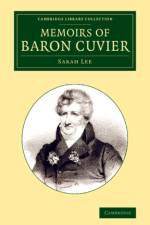
The author and artist Sarah Lee (1791-1856) was a remarkable traveller and scientist in her own right. With her first husband, Thomas Bowdich, she explored the flora, fauna and local culture of the Asante region and Gabon in west Africa. The pair then went in 1819 to Paris, to study zoology under the famous Cuvier, in preparation for another trip to Africa. They financed their stay by translating French scientific books into English, and became close friends of Cuvier himself. Their second expedition proved a disaster, as Thomas Bowdich died in 1824, leaving Sarah alone in Africa with three small children. She made her way back to England, and made her living from scientific translation and her own writings. This biography of her mentor was published in 1833, shortly after his death, and remained the authoritative work in English on the most distinguished scientist of the age.
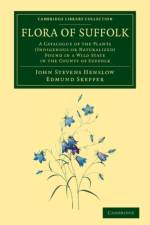
An influential professor of botany at Cambridge, John Stevens Henslow (1796-1861) revived his department and helped develop the current University Botanical Garden for study, teaching and conservation. A mentor to the young Darwin, he proved an educational innovator, initiating the study of individual sciences at Cambridge and practical examinations at the University of London. While rector of Hitcham in Suffolk, he took an interest in local politics, welfare and popular education. This led to the publication in 1860 of this catalogue, which collated the observations and work of amateur botanists. Henslow was the overarching academic and technical consultant while Edmund Skepper is credited with organising and collating the information from the contributors. Catalogued taxonomically, each plant's Latin and common name is given along with its physical description, common locations, rarity or commonality, and periods of flowering or germination. It remains a valuable guide for amateur botanists and naturalists.
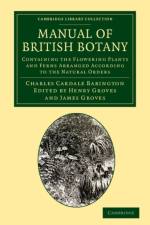
First published in 1843, this book ran to eleven editions, with two published posthumously. Compiled by Cambridge botanist Charles Cardale Babington (1808-95) over the course of nine years, this was the first comprehensive catalogue of British plants for nearly a century and was conveniently pocket-sized for fieldwork. Babington was by this time the leader in the taxonomical research of higher plants. Providing both the Latin nomenclature assigned at the time and the common English or anglicised name, he divides plants according to the Linnaean natural orders and describes them in great technical detail. A useful glossary is also included to help the reader navigate the descriptions. As demonstrated in Memorials, Journal and Botanical Correspondence (also reissued in this series), Babington was a highly esteemed and influential scientist. This is the expanded 1904 ninth edition of his invaluable and enduring compendium.
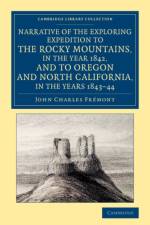
Published together in 1846 for a British readership, these reports of two westward expeditions shed light on the challenges of exploration in nineteenth-century North America. Led by the army officer and future presidential candidate John Charles Fremont (1813-90), who became known as 'the Pathfinder', the first expedition ranged west of the Missouri River, while the second pushed beyond the Rocky Mountains, north to Fort Vancouver and then south into Mexican-held California. Fremont's detailed accounts are accessible to the non-specialist: this edition omits 'only the portions which are altogether astronomical, scientific, and philosophical, and, therefore, not adapted for general utility'. When originally published separately in 1843 and 1845, the narratives enthused a great many Americans, encouraging them to migrate west by providing stirring inspiration, valuable maps and practical information. Fremont's words and deeds remain of interest in the debate surrounding the 'manifest destiny' of the United States.
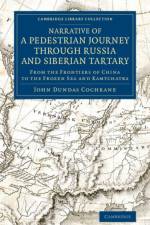
John Dundas Cochrane (1780-1825) was destined for the sea from an early age, but is best remembered as 'the Pedestrian Traveller'. At the end of the Napoleonic Wars, he set out on a six-year tour of France, Spain and Portugal on foot. When in 1820 the Admiralty turned down his offer to explore the river Niger, he decided instead to walk round the world via Russia, Siberia and North America. On his arrival in St Petersburg, the Russian government gave him money to continue his journey using sledges and canoes where necessary, but he abandoned it in Kamchatka, marrying a local woman and returning with her to England. This account of his travels was published in 1824 and was immediately popular, going into several editions. By no means a scientific survey, it is full of interesting anecdotes and observations about a then unknown and mysterious area of the world.
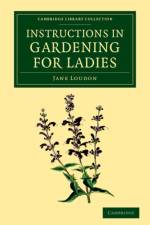
Jane Loudon (1807-58), the Mrs Beeton of the Victorian gardening world, wrote several popular books on horticulture and botany, specifically for women. She is also remembered as the author of The Mummy! - an early work of science fiction - and as editor of The Ladies' Companion. Her knowledge of plants and gardening was gained from her husband, the landscape designer John Claudius Loudon, whom she married in 1830, and from attending the lectures of the botanist John Lindley. Her notes from these were published as articles in John Loudon's Gardener's Magazine. This book, first published in 1840, was an immediate success, selling 1,350 copies on the day of publication and more than 200,000 in total. Written in the approachable style typical of her works, it covers all the elements of horticulture, and helped to encourage many Victorian women to take up gardening as a hobby.
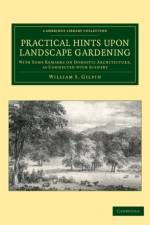
William Sawrey Gilpin (1761/2-1843), landscape painter and illustrator, later became a landscape gardener and writer. He set himself up as a drawing master in Paddington Green and also illustrated picturesque travel-writing. Between 1804 and 1806 he was the first president of the Society of Painters in Water Colours, and then the third drawing master at the Royal Military College in Marlow. After being discharged from this post, Gilpin became a successful landscape gardener and advisor to the nobility. His approach to landscape gardening was influenced by painting and Sir Uvedale Price's Essay on the Picturesque (1794). Gilpin's Hints, published in 1832, advocates that landscapes should be improved by the 'taste' of a painter's eye, and artificial buildings united with their surroundings. Like his landscape practice, this book was highly regarded by Gilpin's contemporaries for its emphasis on the picturesque, especially when landscape gardening centred upon the introduction of exotic plants.
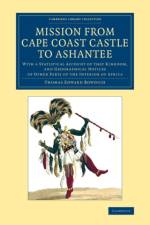
This work by Thomas Edward Bowdich (1791?-1824) describes the journey he made on behalf of the Royal African Company from Cape Coast Castle in West Africa into the territory of the Ashanti, a warlike tribe which had legendary resources of gold and which had been attacking European settlements along the Gold Coast. The intention was to make a peace and trade treaty with the Ashanti, and also to learn more about their culture and customs. Bowdich, not the original leader of the expedition, took control, and negotiated a treaty of mutual co-operation and trade. He returned to Europe in 1818, publishing this fascinating account in 1819, but he felt that his own efforts, and his book, did not receive the rewards they merited. He died on a second, scientific expedition to West Africa, leaving his widow, naturalist and artist Sarah (later Lee), to edit and publish his last work.
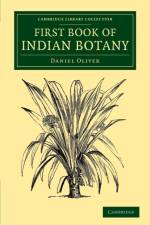
Well known among his contemporaries for his unrivalled knowledge of aberrant plants, Daniel Oliver (1830-1916) ran the herbarium at Kew Gardens and held the chair of botany at University College London, for which he was recommended by Charles Darwin. Although Oliver never visited India, his expertise in Indian botany grew considerably after he worked with an enormous number of dried specimens rescued from the cellars of the East India Company. In this book, first published in 1869, he sets out the basics of botanical study in India for the absolute beginner. It includes instruction on the anatomy of simple plants, lessons in collection and dissection, and explanations of botany's often dense terminology. Annotated diagrams appear throughout, in both microscopic and macroscopic views. Rigorous and carefully structured, Oliver's book remains an excellent resource for novice botanists and students in the history of science.
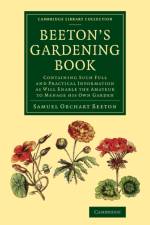
Samuel Orchart Beeton (1831-77), the publishing entrepreneur who made his wife's Book of Household Management one of the bestselling titles of the century, gave his name to many other books of domestic, medical and general information for the middle classes. (The 1871 Book of Garden Management, published and probably compiled by him, is also reissued in this series.) This work was published in 1874 by Ward Lock, to whom Beeton was forced to sell his own business after a financial collapse in 1866. The book contains 'such full and practical information as will enable the amateur to manage his own garden'. It covers flower, fruit and vegetable gardening, with a section on garden pests and a monthly calendar of tasks. It also contains advertisements for gardening and medicinal products, as well as for other books from the publishers, offering a fascinating insight into social as well as garden history.
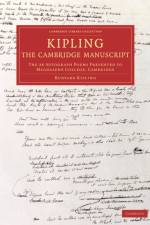
Since 1913 Magdalene College, Cambridge, has elected a succession of outstanding figures in literature and the arts to honorary fellowships of the college. On the occasion of his election in 1932, Rudyard Kipling (1865-1936) presented the college with a manuscript poem entitled 'To the Companion' which celebrated Magdalene's best-known graduate, Samuel Pepys. After his death, his widow, Caroline Kipling, bequeathed the present collection of manuscript poems - many of them redrafted and corrected, and thus giving insights into Kipling's creative process - to the college. The bound volume comprises some twenty-eight poems in all (including multiple versions of key stanzas of 'The White Man's Burden'), together with a fragment of an unpublished poem entitled 'The Song of the Engine'. Its publication in the Cambridge Library Collection makes the poems available to the scholar, the Kipling enthusiast, and the general reader.
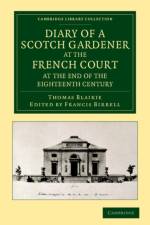
Scottish gardener and botanist Thomas Blaikie (1751-1838) spent the majority of his life in France, where he designed and planted some of the most famous Parisian gardens: he drew up the original plans for the gardens of the Chateau de Bagatelle and renovated the Parc Monceau. He became a favourite of Marie Antoinette, and served patrons among the highest ranks of the aristocracy in pre-revolutionary France, including the Comte d'Artois and the Duc d'Orleans. After surviving the French Revolution, he received a commission to create gardens for Empress Josephine at her Malmaison country retreat. Blaikie kept this fascinating diary from 1775 until August 1792. More than just an account of his vast gardening knowledge and achievements, the book gives a unique insight into the social history of the revolutionary period in France. It was edited by the critic and journalist Francis Birrell (1889-1935) and first published in 1931.
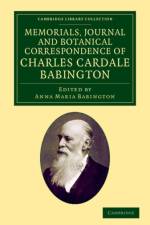
Collated by his widow and published in 1897, this collection of memorials, journal extracts and letters of Charles Cardale Babington (1808-95) demonstrates the esteem in which he was held by so many. An influential professor of botany at Cambridge, Babington left to the university a legacy that included the huge herbarium that he had partly funded himself, as well as some 1,600 volumes from his own library. His benevolence and generosity of knowledge, time and money endeared him to many departments and societies, while his works on local flora inspired others to produce many of the county floras that are still used today. His Manual of British Botany (also reissued in this series) first appeared in 1843 and made a huge impact on the study of the subject. These collected writings and tributes will offer students and scholars valuable insight into the breadth of his scientific interests and achievements.
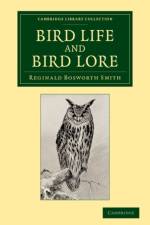
'Birds have been to me the solace, the recreation, the passion of a lifetime.' So wrote Reginald Bosworth Smith (1839-1908), former Classics master at Harrow School. As a young man, he published his first book on birds while teaching at Oxford, and he continued to combine his lifelong love of birds with classical and literary teaching and research. He retired to a country house in Dorset and in 1905 published this book, based on a series of articles written in his retirement. Recording his own observations, some of many years before, and peppered with scholarly references to birds in literature, the essays cover individual birds such as the owl, the raven and the magpie, as well as bird-watching in Dorset and beyond. Imparting a love and respect for wildlife that remains inspiring, this book will be of great interest to the bird-lover and scholar of today.
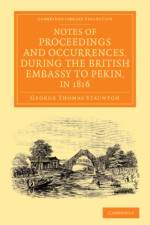
Sir George Thomas Staunton (1781-1859), Sinologist and politician, was a key figure in Anglo-Chinese relations, as had been his father. In 1798 he began working for the British East India Company in Canton (Guangzhou), where he was the only Englishman who could understand Chinese, having begun learning it as a child. By 1815, British trade with China was worth over GBP4 million in tea duties alone, and there was immense pressure for the Chinese to relax their restrictions. In 1816, following earlier failed missions, an embassy, including Staunton as second commissioner, was organised to seek better trading conditions and to press the emperor for the opening up of a second harbour. Chinese mistrust and British arrogance led to the failure of the embassy, with no imperial audience given. This account, privately published in 1824, is a valuable document in the understanding of the historical background to Britain's relationship with China into the twentieth century.
An important mathematician and astronomer in medieval India, Bhascara Acharya (1114-85) wrote treatises on arithmetic, algebra, geometry and astronomy. He is also believed to have been head of the astronomical observatory at Ujjain, which was the leading centre of mathematical sciences in India. Forming part of his Sanskrit magnum opus Siddhanta Shiromani, the present work is his treatise on arithmetic, including coverage of geometry. It was first published in English in 1816 after being translated by the East India Company surgeon John Taylor (d.1821). Used as a textbook in India for centuries, it provides the basic mathematics needed for astronomy. Topics covered include arithmetical terms, plane geometry, solid geometry and indeterminate equations. Of enduring interest in the history of mathematics, this work also contains Bhascara's pictorial proof of Pythagoras' theorem.
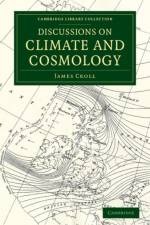
The cause of the ice ages was a puzzle to nineteenth-century climatologists. One of the most popular theories was that the affected continents must somehow have been hugely elevated and, like mountains, iced over. However, in this 1885 study of the problem, James Croll (1821-90) argues that such staggering movement would have been impossible. Instead, he puts forward a new theory: that the eccentricity of the earth's orbit changes at regular intervals over long periods, creating 'great secular summers and winters'. Adopting a meticulous approach to the facts, he disproves a host of well-established notions across several disciplines and makes some remarkable deductions, including the effect of ocean currents on climate, the temperature of space, and even the age of the sun. With a focus on logical argument and explanation rather than mathematics, his book remains fascinating and accessible to students in the history of science.
Abonner på vårt nyhetsbrev og få rabatter og inspirasjon til din neste leseopplevelse.
Ved å abonnere godtar du vår personvernerklæring.