



Gjør som tusenvis av andre bokelskere
Abonner på vårt nyhetsbrev og få rabatter og inspirasjon til din neste leseopplevelse.
Ved å abonnere godtar du vår personvernerklæring.Du kan når som helst melde deg av våre nyhetsbrev.

John Dunn (1834-95) became an infamous figure ('a perfect gorilla') in Britain after his involvement in the Anglo-Zulu war of 1879. A British subject who had lived all his life in South Africa, he spent his early years learning to be an expert hunter of large game before becoming a confidant of the Zulu king Cetshwayo, quickly accumulating wealth and power; although already married, he took forty-nine wives and fathered one hundred and seventeen children. However, when war broke out he sided with the British against his former friend and patron, and was rewarded with a huge tract of territory in the former Zulu kingdom. This book, published in 1886 and edited by his friend D. C. F. Moodie (1838-91), presents his side of the story, and contains fascinating insights into an extraordinary life lived among the Zulus in the nineteenth century.
Charles Henry Robinson (1861-1925) was a Cambridge scholar who, during the 1890s, published several books on the language, literature and culture of the Hausa people. Hausa is an African language originating in Niger and northern Nigeria and spoken widely in West and Central Africa as a lingua franca. Published in 1897, Robinson's Grammar was written to serve the needs of missionaries, colonial staff and army officers who wished to communicate with the local people, but made no claim to be definitive or comprehensive. Until the twentieth century Hausa was written in an Arabic script, examples of which are given, while the exercise sections of the grammar are transliterated for students unfamiliar with Arabic. The vocabulary, mainly relating to agriculture, trade and domestic life, was chosen to suit the practical needs of Robinson's intended audience, and reveals much about colonial life in West Africa as well as providing linguistic information.
In this volume, Mordechai Z. Cohen explores the interpretive methods of Rashi of Troyes (1040-1105), the most influential Jewish Bible commentator of all time. By elucidating the 'plain sense' (peshat) of Scripture, together with critically selected midrashic interpretations, Rashi created an approach that was revolutionary in the talmudically-oriented Ashkenazic milieu. Cohen contextualizes Rashi's commentaries by examining influences from other centers of Jewish learning in Muslim Spain and Byzantine lands. He also opens new scholarly paths by comparing Rashi's methods with trends in Latin learning reflected in the Psalms commentary of his older contemporary, Saint Bruno the Carthusian (1030-1101). Drawing upon the Latin tradition of enarratio poetarum ('interpreting the poets'), Bruno applied a grammatical interpretive method and incorporated patristic commentary selectively, a parallel that Cohen uses to illuminate Rashi's exegetical values. Cohen thereby brings to light the novel literary conceptions manifested by Rashi and his key students, Josef Qara and Rashbam.
Charles Henry Robinson (1861-1925) was a Cambridge scholar who, during the 1890s, published several books on the language, literature and culture of the Hausa people of West Africa. This study, published in 1896, documents his pioneering fieldwork during which, in three months, he travelled 1500 miles across rivers, mountains, villages and towns. Public interest in the Hausa was high at the time, due to their recruitment as troops by Britain in the Ashanti conflict, and by France to consolidate French power in Madagascar. However, Robinson argues against the perception of the Hausa as primarily a warlike people, despite their formidable strength in battle. In this vivid account of his time among them, he portrays the Hausa as successful traders who excelled above all in commercial endeavours. Exploring enterprises from textiles and tobacco to hunting and river transportation, Robinson gives fascinating first-hand insights into this important African community.
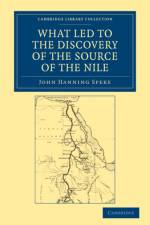
John Hanning Speke (1827-1864) was a British army officer and explorer, remembered for his expeditions in search of the source of the Nile and his disputes with Richard Burton on that subject. On an expedition begun in 1856 Burton and Speke reached Lake Tanganyika together, but Speke travelled on alone to Lake Victoria. He controversially gave lectures about the lakes in London in 1859, without awaiting Burton's return. Speke returned to Africa later that year, leading an expedition organised by the Royal Geographical Society, to explore Lake Victoria and investigate whether it really was the source of the Nile. This book, published in 1863, describes the 1859 expedition's challenging and eventful journey through present-day Zanzibar, Tanzania and Uganda, and the indigenous peoples the explorers encountered. Speke made invaluable surveys of the area, but it was only after his death that his views about the Nile were finally proved correct.
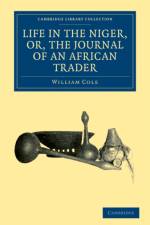
First published in 1862, William Cole's journal records his experiences in the highly challenging circumstances of a trading expedition to Africa. Cole outlines in graphic detail the dangers he had to endure, and describes how he 'surmounted the most glaring difficulties'. Often displaying a wry humour, Cole's memoir speaks directly to the reader, with a tone of immediacy. In an anecdotal style, he describes the customs and costumes of the natives, and their often hostile reactions to him, and recounts how he was regularly without food, arms or assistance. The journal tells of the barbarity and cruelty he witnessed, alongside occasional acts of kindness or amusing situations. Cole's thoughts frequently revert to England, displaying his homesickness and his longing to return. Describing his life in Africa as 'a mixture of smiles and tears', Cole paints a vivid picture of a European in Africa during the mid-nineteenth century.
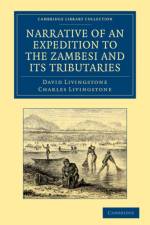
The success of the Victorian explorer and missionary David Livingstone's first book, Missionary Travels (1857), led to his receiving government funding in 1858 for an expedition up the Zambezi River. The trip was expected to last two years, and was intended to further commercial and scientific as well as missionary aims. However, owing to internal disagreements, illness (including the death of Livingstone's wife), drought and tribal warfare, the explorers' mission took six and a half years and achieved little apart from collecting plant and geological specimens. The upper reaches of the Zambesi proved unnavigable owing to rapids and waterfalls, and the expedition was recalled. This account, published in 1865 by Livingstone (1813-1873) and his younger brother Charles, who had accompanied him, was in part an attempt to excuse the problems which had beset the expedition, and restore Livingstone's reputation in order to gain backing for further ventures.
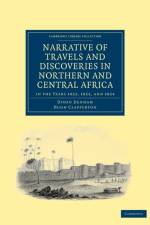
Major Dixon Denham (1786-1828) and Lieutenant Hugh Clapperton (1788-1827) were British explorers famous for their explorations in Africa. Between 1822 and 1825, they set out to investigate the lower course of the River Niger and the swamps and forests of the Guinea Coast, accompanied by the physician Dr Walter Oudney (1790-1824), who sadly died of a fever during the expedition. This important book, first published in 1826, brings together the memoirs of all three explorers to document their mission, which represented the first complete crossing of the Sahara by Europeans in recorded history. Diverse and insightful, it recounts phenomena such as the transportation of slaves from the Sudan, the salt industry in the heart of the desert, and encounters with native tribes. Providing unique insights into pre-colonial Africa, these vivid recollections remain of great interest to historians of Africa, cultural anthropologists and geographers alike.
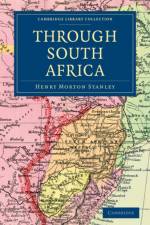
Henry Morton Stanley (1841-1904), the Welsh-born explorer famous for his 1871 meeting with the missionary David Livingstone, travelled widely in Africa. First published in 1898, this is a compendium of letters written by Stanley during his travels to Bulawayo, Johannesburg and Pretoria, which lend a unique insight into colonial South Africa in the late nineteenth century. Focusing on the country's culture and commercial development, he recalls his impressions of industries such as railways, farms and gold mines, social issues such as immigration and poverty, and the contentious relations between the Boer peoples and the British colonists which led to the Second Boer War. Through his passionate exposition, we learn of his adversity towards President Kruger's policies, and his compassion for the people who he claims were left to starve because the government's priorities were military. His memoirs provide a revealing snapshot of an important period in South Africa's history.
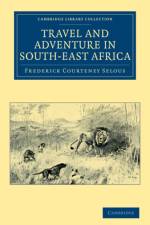
Frederick Courteney Selous (1851-1917) was a British explorer, officer, hunter, and conservationist, famous for his work in south-east Africa. In early 1882 he embarked on an eleven-year expedition to record species that, to his great sadness, were becoming endangered. First published in 1893, these revealing memoirs document the wildlife, landscapes and people that characterised his journey. Through vivid descriptions and extensive illustrations, he recalls exhilarating adventures with lions, leopards, hyenas and crocodiles, recounts challenging treks across lakes and mountains, and describes hostile - and at times barbaric - encounters with native peoples. Detailed accounts of hunting endeavours, colonial institutions, and commercial enterprises such as gold mining, also feature in this study, which provides a unique and diverse perspective on Africa in the late nineteenth century. Insightful and revealing, Selous' experiences remain of enduring interest to geographers, anthropologists, zoologists, and all those interested in African history and culture.
John Hanning Speke (1827-64) was an officer in the British Indian Army, best known for his explorations of Africa. In the 1850s he embarked on two major expeditions there, the first, to Somalia, inspiring the second, to East Africa, during which he endeavoured to locate the source of the White Nile. This book of 1864 brings together his memoirs of both ventures, in which he draws connections between the two, and provides dramatic recollections of his endurance of captivity, attack, and tropical disease. Despite the obstacles he faced, on his second mission he identified Lake Victoria as the Nile's source; however his claims were heavily contested, as the loss of vital equipment had left questions about its altitude and extent unanswered. The lake was eventually proved to be the source after Speke's tragic death from a gunshot wound, making these memoirs a cornerstone in the historical geography of Africa.
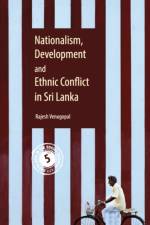
This book examines the relationship between ethnic conflict and economic development in modern Sri Lanka. Drawing on a historically informed political sociology, it explores how the economic and the ethnic have encountered one another, focusing in particular on the phenomenon of Sinhala nationalism. In doing so, the book engages with some of the central issues in contemporary Sri Lanka: why has the ethnic conflict been so protracted, and so resistant to solution? What explains the enduring political significance of Sinhala nationalism? What is the relationship between market reform and conflict? Why did the Norwegian-sponsored peace process collapse? How is the Rajapaksa phenomenon to be understood? The topical spread of the book is broad, covering the evolution of peasant agriculture, land scarcity, state welfarism, nationalist ideology, party systems, political morality, military employment, business elites, market reforms, and development aid.
The field of policy studies has always been interested in analyzing and improving the sets of policy tools adopted by governments to correct policy problems, and better understanding and improving processes of policy analysis and policy formulation in order to do so. Past studies have helped clarify the role of historical processes, policy capacities and design intentions in affecting policy formulation processes, and more recently in understanding how the bundling of multiple policy elements together to meet policy goals can be better understood and done. While this work has progressed, however, the discussion of what goals policy designs should serve remains disjointed. Here it is argued that a central goal, in fact, 'the' central goal, of policy design is effectiveness. Effectiveness serves as the basic goal of any design, upon which is built other goals such as efficiency or equity.
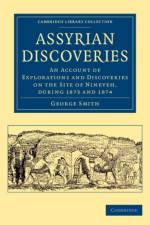
The Assyriologist George Smith (1840-76) was trained originally as an engraver, but was enthralled by the discoveries of Layard and Rawlinson. He taught himself cuneiform script, and joined the British Museum as a 'repairer' or matcher of broken cuneiform tablets. Promotion followed, and after one of Smith's most significant discoveries among the material sent to the Museum - a Babylonian story of a great flood - he was sent to the Middle East, where he found more inscriptions which contained other parts of the epic tale of Gilgamesh. In this 1875 work, a bestseller in its day, Smith describes his expedition, the difficulties encountered, and the discoveries, including hundreds of inscriptions which increased knowledge of the Babylonian and Assyrian civilisations but also had a profound effect on traditional biblical studies. Smith died in Aleppo in 1876, having revolutionised understanding of the ancient Near East.
The concept of the developmental state emerged to explain the rapid growth of a number of countries in East Asia in the postwar period. Yet the developmental state literature also offered a theoretical approach to growth that was heterodox with respect to prevailing approaches in both economics and political science. Arguing for the distinctive features of developmental states, its proponents emphasized the role of government intervention and industrial policy as well as the significance of strong states and particular social coalitions. This literature blossomed into a wider approach, firmly planted in a much longer heterodox tradition, that explored comparisons with states that were decidedly not developmentalist, thus contributing to our historical understanding of long-run growth. This Element provides a critical but sympathetic overview of this literature and ends with its revival and a look forward at the possibility for developmentalist approaches, both in the advanced and developing world.
This text organizes a range of results in chromatic homotopy theory, running a single thread through theorems in bordism and a detailed understanding of the moduli of formal groups. It emphasizes the naturally occurring algebro-geometric models that presage the topological results, taking the reader through a pedagogical development of the field. In addition to forming the backbone of the stable homotopy category, these ideas have found application in other fields: the daughter subject 'elliptic cohomology' abuts mathematical physics, manifold geometry, topological analysis, and the representation theory of loop groups. The common language employed when discussing these subjects showcases their unity and guides the reader breezily from one domain to the next, ultimately culminating in the construction of Witten's genus for String manifolds. This text is an expansion of a set of lecture notes for a topics course delivered at Harvard University during the spring term of 2016.
Clements R. Markham (1830-1916) began his career in the Royal Navy, sailing to South America, learning Spanish, and participating in the Arctic search for Sir John Franklin. In 1852, determined to succeed as an explorer and geographer, he travelled to Peru and visited the site of the ancient city of Cuzco, previously little known in Europe. Published in 1856, this is Markham's lively account of his travels. In his description of arriving in Panama we see a picture of the mid-nineteenth-century eagerness to explore (or exploit) Latin America. Markham's stay in Cuzco allowed him ample time to study the ruins and research the lost Inca civilisation, and also gave him his introduction to the properties of the cinchona plant, a source of quinine, which he later returned to collect and introduce to India, as described in his 1862 Travels in Peru and India (also reissued in the Cambridge Library Collection).
This anonymous and light-hearted work was first published in 1803: reissued here is the edition of 1824, of which the authors describe themselves as 'a Brace of Cantabs'. It claims both to be a guide to 'the academical customs' of the University of Cambridge and to its 'colloquial or cant terms' with notes on those that differ from the usage of Oxford. The balance of information is given to the less serious aspects of university life: for example, considerably more space is given, in the definition of 'bishop', to a recipe for mulled port wine than to the clerical role. The work abounds in puns (in English and Latin), anecdotes, and extracts (mostly amusing) from more serious histories of the university, and ends with a tailpiece on how to graduate 'the reading way' and 'the varmint way'. This fascinating work demonstrates that the publication of spoof 'guides to freshmen' is nothing new.
Known for developing the concept of Mullerian mimicry, whereby poisonous species with a common predator display similar warning signals, the naturalist Johann Friedrich Theodor (Fritz) Muller (1821-97) spent most of his working life in Brazil. Having emigrated from Germany, owing partly to his radical atheism, he became a strong early supporter of Darwinism. Drawing on his studies of crustaceans, he originally published this work in German as Fur Darwin (1864), and sent the great naturalist a copy. Muller became a regular correspondent, and Darwin supported the translation of Muller's work, firstly for his personal use and also in the published 1869 version that is reissued here, rendered into English by the naturalist William Sweetland Dallas (1824-90), with several updates by Muller. Using case studies of crustaceans to provide evidence for certain aspects of Darwinian theory, Muller draws up evolutionary classifications of the various species examined.
Although best known as an archaeologist, William Greenwell (1820-1918) was also ordained as a priest and served as librarian of Durham Cathedral. A keen angler into his later years, he is known too for his creation of 'Greenwell's glory', a famous British trout fly. As an archaeologist, Greenwell excavated nearly 300 burial mounds, carrying out intensive fieldwork from 1862. First published in 1877, this work is a detailed account of some 230 Bronze Age barrows across England, largely in the East Riding of Yorkshire. Organised by parish, this work records these excavations, giving dimensions and descriptions of their form and finds. Accompanying the survey are contributions by the respected Oxford physician and physiologist George Rolleston (1829-81) describing the skulls found in the barrows. Featuring many illustrations of the finds, including the skulls, the book also contains an appendix discussing prehistoric flora and fauna.
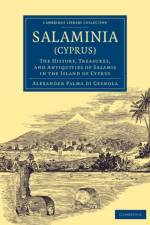
Alessandro Palma Di Cesnola (1839-1914) travelled to Cyprus in 1873 to take up an honorary post secured by his brother Luigi, who was the American consul there and also an amateur archaeologist. Obtaining funding from the British financier Edwin Lawrence, Alessandro carried out his own excavations, chiefly around Salamis. Replete with more than 700 illustrations, this 1882 publication records the most notable artefacts from the Lawrence-Cesnola collection, including gold jewellery, ivory objects, engraved gems, coins, and terracotta statuettes. The book sheds considerable light on the ancient Egyptian, Phoenician, Greek and Roman influences that shaped Cypriot art over the centuries. Di Cesnola's activities generated controversy, however, as he had flouted regulations in removing these artefacts. After the British Museum declined to acquire the whole collection, the bulk of it was sold at auction. His brother's finds were recorded in Cyprus: Its Ancient Cities, Tombs, and Temples (1877), which is also reissued in this series.
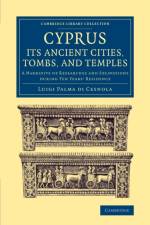
Born in Italy, Luigi Palma di Cesnola (1832-1904) settled in the United States and fought for the North in the American Civil War, becoming a cavalry colonel. Appointed by Abraham Lincoln, he then served as consul to Cyprus from 1865 to 1877. As an amateur archaeologist, he directed excavations throughout the island. In this 1877 publication, including maps and illustrations, Cesnola gives a useful sketch of Cypriot history and contemporary customs in addition to providing an important record of his archaeological practices and discoveries. He covers a number of ancient settlements where significant finds were made, notably Paphos, Amathus and Kourion. Many of the uncovered artefacts were controversially removed from Cyprus and sold to New York's Metropolitan Museum of Art; Cesnola served as its first director. His brother Alessandro's Salaminia (1882), recording his own excavations and discoveries in Cyprus, is also reissued in this series.
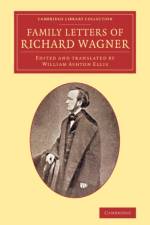
William Ashton Ellis (1852-1919) abandoned his medical career in order to devote himself to his Wagner studies. Best known for his translations of Wagner's prose works and of Carl Friedrich Glasenapp's multi-volume biography of the composer, Ellis published in 1911 this English translation of Wagner's Familienbriefe, spanning the years 1832-74. An inveterate letter writer, Wagner was the youngest-but-one of ten children and Ellis describes the character of these letters to his sisters, his mother, his brother-in-law and his nieces as a reflection of the composer in the 'driest and most neutral of lights', claiming that within the family it is impossible to be pretentious. An appendix by Glasenapp, giving brief biographical details of family members, is also included. Despite the stylistic idiosyncrasies of the translations, these letters remain of importance, capturing something of the tone of Wagner's prose style and shedding light on his extraordinary life.
While working for the East India Company in Bengal, Charles Wilkins (1749-1836) became one of first Europeans to master the Sanskrit language. He proceeded to set up a printing press in Calcutta to publish works in Sanskrit and other Indian languages. Wilkins also undertook further related projects, including this work, published in London in 1808, which was part of his larger scheme to write a dictionary of the language and to translate a great epic poem, the Mahabharata. The grammar was the only part of the project that was completed. He never finished the dictionary, and only translated about one-third of the poem, though the part he worked on, the Bhagavad-Gita, became famous. The grammar attempts a comprehensive explanation of the language, ranging from the Devanagari alphabet to indeclinable words, and it was a vital resource in making Indian languages accessible to an English-speaking public.
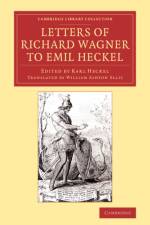
A great admirer of Richard Wagner, the music publisher Emil Heckel (1831-1908) founded the first Wagner Society in Mannheim in 1871. His purpose was to inspire others to help raise the necessary funds for the inaugural Bayreuth Festival. William Ashton Ellis (1852-1919) abandoned his medical career in order to devote himself to his Wagner studies. Best known for his translations of Wagner's prose works, he published in 1899 this English translation of Heckel's memoirs (originally edited by his son Karl), interwoven with letters from Wagner to Heckel, who is described by the composer as his 'energetic friend'. Notwithstanding the stylistic idiosyncrasies of the translation, the work provides a valuable first-hand account of the progress made towards establishing what would become one of the world's most prestigious music festivals. The letters span the years 1871 to 1883.
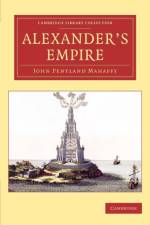
The classical scholar J. P. Mahaffy (1839-1919) is known equally for his work on Greek texts and Egyptian papyri (his edition of The Flinders Petrie Papyri is reissued in the Cambridge Library Collection). He graduated from Trinity College, Dublin, and spent the rest of his working life there, ultimately as provost from 1914 until his death. In this illustrated 1887 work, Mahaffy describes Alexander's extraordinary conquest of territories in Europe, Africa and Asia, the collapse of his empire after his death, and the later subjugation of the successor kingdoms to the power of Rome. With his American collaborator Arthur Gilman (1837-1909), Mahaffy discusses Alexander's place in history before giving a close account of his career and death. The successor dynasties, and dominant rulers such as Demetrius II and Pyrrhus, their feuds and their attempted resistance to the rise of Rome, are depicted in an engaging and dramatic narrative.
This book demonstrates the rich diversity and depth of political philosophy in the twentieth century. Catherine H. Zuckert has compiled a collection of essays recounting the lives of political theorists, connecting each biography with the theorist's life work and explaining the significance of the contribution to modern political thought. The essays are organized to highlight the major political alternatives and approaches. Beginning with essays on John Dewey, Carl Schmitt and Antonio Gramsci, representing the three main political alternatives - liberal, fascist and communist - at mid-century, the book proceeds to consider the lives and works of emigres such as Hannah Arendt, Eric Voegelin, and Leo Strauss, who brought a continental perspective to the United States after World War II. The second half of the collection contains essays on recent defenders of liberalism, such as Friedrich Hayek, Isaiah Berlin and John Rawls and liberalism's many critics, including Michel Foucault, Jurgen Habermas and Alasdair MacIntyre.
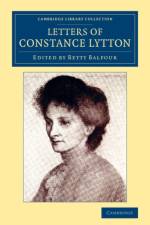
First published in 1925, this selection of letters throws light upon the life and character of Constance Lytton (1869-1923), a brave and influential figure in the movement for women's suffrage. From an aristocratic background, she became a member of the Women's Social and Political Union in 1909, calling on the support of her many contacts. Among her achievements was the first-hand exposure of the poor treatment and force-feeding of working-class women on hunger strike in prison: she deliberately had herself arrested and imprisoned in disguise and under an alias. Compiled by her sister, Betty Balfour (1867-1942), these letters cover her adult life, mainly comprising correspondence from Lytton to close family members, interspersed with illustrations of her and her family. Despite omissions - particularly details relating to her personal relationships - this collection remains an important tribute to her life and to the history of suffrage and prison reform.
The German poet Mathilde Wesendonck (1828-1902), author of the texts of the Wesendonck Lieder, was the wife of Wagner's patron, the wealthy silk merchant Otto Wesendonck. From 1852 until 1858, the Wagners lived next to the Wesendoncks in Zurich and an intense relationship developed between Wagner and Mathilde, subsequently reflected in the impossible love at the heart of his opera Tristan und Isolde. Prepared by the American musicologist Gustav Kobbe (18578), who provides a helpful connecting narrative, this 1905 translation of a selection of 'the most intimate and striking' of Wagner's impassioned letters to Mathilde charts the course of the opera's creation. Written between 1853 and 1863, the letters show Wagner thinking aloud not only about Tristan but also the planning of Parsifal. As Mathilde's letters to Wagner were destroyed, the exact nature of their relationship and of her inspiration musically will never be fully established.
Richard Wagner (1813-83) grew up in Dresden and served as Kapellmeister to King Frederick Augustus II of Saxony there from 1843 until he was forced to flee the country after the 1849 uprising. His operas Rienzi and Der fliegende Hollander received their first performances at the Dresden Court Theatre. During his time in the city, Wagner became firm friends with the composer and violinist Theodor Uhlig, the stage manager and chorus master Wilhelm Fischer, and the comedian and costume designer Ferdinand Heine. This collection of letters from the composer to his three great friends covers the period 1841-68. First published in 1888, the letters are reissued here in the 1890 English translation by the pianist and Beethoven scholar John South Shedlock (1843-1919). They offer an intimate and compelling insight into Wagner's personal and professional life and his forthright views on many contemporary musicians and public figures.
Abonner på vårt nyhetsbrev og få rabatter og inspirasjon til din neste leseopplevelse.
Ved å abonnere godtar du vår personvernerklæring.