









Gjør som tusenvis av andre bokelskere
Abonner på vårt nyhetsbrev og få rabatter og inspirasjon til din neste leseopplevelse.
Ved å abonnere godtar du vår personvernerklæring.Du kan når som helst melde deg av våre nyhetsbrev.

Henry Adams (1838-1918), journalist, novelist, and historian, was the great-grandson of John Adams and grandson of John Quincy Adams, both presidents of the United States. A professor of medieval history at Harvard whose areas of research were wide-ranging, he was deeply interested in the evolution of democracy in the United States. While Adams is best remembered for his autobiography The Education of Henry Adams (1907), for which he was posthumously awarded a Pulitzer prize, his nine-volume history of the United States during the presidencies of Jefferson and Madison (1801-17), which was published 1889-91, has been hailed as one of the greatest historical works in English. Adams was an advocate of scientific history, and this monumental work adheres to its principles, considering social trends and circumstances rather than focusing on particular events. Volume 2 continues the account of the first administration of Thomas Jefferson (1801-5).
Henry Adams (1838-1918), journalist, novelist, and historian, was the great-grandson of John Adams and grandson of John Quincy Adams, both presidents of the United States. A professor of medieval history at Harvard whose areas of research were wide-ranging, he was deeply interested in the evolution of democracy in the United States. While Adams is best remembered for his autobiography The Education of Henry Adams (1907), for which he was posthumously awarded a Pulitzer prize, his nine-volume history of the United States during the presidencies of Jefferson and Madison (1801-17), which was published 1889-91, has been hailed as one of the greatest historical works in English. Adams was an advocate of scientific history, and this monumental work adheres to its principles, considering social trends and circumstances rather than focusing on particular events. Volume 1 describes the first administration of Thomas Jefferson (1801-5).
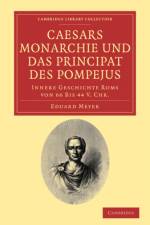
Eduard Meyer (1855-1930) was a distinguished German historian of antiquity whose interests spanned ancient Greece, Rome and Egypt. After his doctoral studies he worked as private tutor for the British consul general in Constantinople. He lectured on ancient history at various German universities and became a professor at Berlin University (1902-23), where he was appointed rector in 1919. This book on the origins of the Roman Empire was first published in 1918; this reissue reproduces the 1922 third printing. It describes the rise of Pompey and his relations with Caesar and Crassus, the rift between Pompey and Caesar, and the civil war. Meyer analyses Caesar's ambitions, the interventions of Sallust and Cicero, and the socio-economic and military situation of the Roman empire under Caesar, before describing the conspiracy that led to his murder. He supports his arguments by close reference to contemporary Latin sources.
The founding of the African Association in 1788 was arguably the starting point of the European race to explore Africa. The organisation lay behind many of the most famous expeditions to Africa at the end of the eighteenth century, including those of Mungo Park, Friedrich Hornemann and John Lewis Burckhardt. This volume, published in 1802, includes fascinating details of their expeditions. We read of the failure of earlier projects, and Sir Joseph Banks' recommendation of Hornemann to the Association, stating that 'his youth, his prudence ... and lively zeal' would make him a fine 'acquisition'. Of Mungo Park, the Association heard that he was 'a young man of no mean talents'. Alongside the insights into the preparations for the expeditions, the volume includes letters and detailed accounts from both Park and Hornemann, and meticulous contemporary maps, providing a unique picture of the earliest days of exploration in Africa.
The son of a naturalist, William Bartram (1739-1823) was commissioned to undertake a tour of south-eastern North America in 1773. Collecting seeds, taking specimens and making meticulous drawings and observations of previously unknown flora and fauna, his four-year expedition took him from the foothills of the Appalachians, through Florida and on to the Mississippi. First published in 1791, within ten years this account had been translated into German, French and Dutch. A unique historical record now, and of particular interest at the time, his accounts of the Seminole, Creek and Cherokee Indians were seen by contemporaries as being sympathetic towards peoples commonly regarded as little better than savages, but his writings persuaded others of the need for a more humane approach to the indigenous people. This work influenced not only scientists, but writers such as Wordsworth and Coleridge, and it remains a classic of American science, history and literature.
American philanthropist Elihu Burritt (1810-79) was involved in and lectured widely on many causes, including the abolition of slavery, temperance, and world peace. Known as the 'learned blacksmith' because of his early training in the trade, he was eventually appointed US consul in Birmingham, England, from 1865 to 1870. In addition to his campaigning, Burritt was a prolific writer, producing books and articles on a range of subjects. In this work, published in 1868, he assembles a collection of his writings published between 1850 and 1855 in a variety of periodicals. This compilation covers a wide range of topics - from the Great Exhibition of 1851 to the 'Anarchy of Governments' - drawing from his experiences in Europe and in the USA. Much of Burritt's writing is devoted to the issue of international relations, and to his desire for a 'Congress of Nations' devoted to ending conflict in Europe.
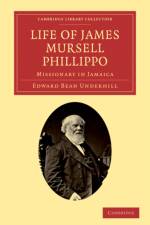
Edward Bean Underhill (1813-1901), the energetic and much-travelled secretary of the Baptist Missionary Society, was active throughout his life in publishing and researching Baptist history. This 1881 biography of his recently-deceased friend James Phillippo (1798-1879) is based on diaries, a manuscript autobiography and papers made available to Underhill by Phillippo's family. Phillippo devoted over fifty years to Baptist missionary work in Jamaica and was a fierce advocate for the abolition of slavery. He landed in Jamaica in 1823, and developed a strong following, despite being banned from preaching to slaves on several occasions. In the 1830s he helped to establish free villages where newly emancipated (and now homeless) slaves could settle. Underhill's thorough account of Phillippo's eventful life focuses specially on the missionary's hard-won victories over his wealthy and powerful opponents. The book includes a list of the many schools and churches established by Phillippo in Jamaica.
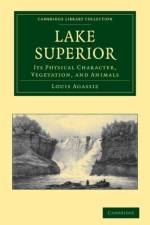
Written by Swiss-born geologist and explorer Louis Agassiz (1807-73), this 1850 publication was the first detailed scientific account of the natural phenomena of Lake Superior. Agassiz, who became a professor at Harvard and later founded the Harvard Museum of Comparative Zoology, was the first scientist to suggest that the earth had experienced an ice age. In the summer of 1848 he led an expedition of his students to Lake Superior, to examine the northern shores, which had previously received very little attention from scientists. The artist James Elliot Cabot (1821-1903), who was included in the party, wrote the 'narrative' of the tour to accompany the scientific report, and this makes up the first part of the work. The rest of the book describes the geological phenomena and zoological distribution in and around the lake, comparing it with similar regions of the world.
Written by Rosanna ('Rose') Blennerhassett (c.1844-1907), the daughter of baronet Sir Arthur Blennerhassett, this work of 1893 recounts the adventures of two Anglican nurses who worked in Umtali (now Mutare in northern Zimbabwe). In 1890 Blennerhassett sailed to Johannesburg to nurse victims of a typhoid outbreak, meeting Lucy Sleeman on board. At the end of their period of service, the pair opted to go north into Mashonaland rather than returning to England. They undertook a two-week journey of 190 miles on foot in the bush from the Pungwe river to Umtali, where they established the first hospital, in a series of beehive-shaped mud huts. The pair remained there for two years, often working without a doctor. The book recounts every aspect of their daily adventures, from baking cakes and constructing coffins out of whisky cases to bizarre encounters with witch hunters, a man-eating lion, and Cecil Rhodes.
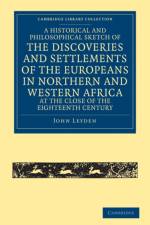
Although he had never set foot in Africa, Scottish poet and linguist John Leyden (1775-1811) decided to publish in 1799 this compilation on 'discoveries and settlements' there, drawing from the published works of explorers. His aim was 'to exhibit the progress of discoveries at this period in North and West Africa', giving descriptions of places such as Guinea, the Gold Coast, and Sierra Leone, as well as accounts of their people. He begins the work by discussing a meeting of the African Association on 9 June 1788, where a map depicted the interior of the continent as 'an extended blank'. Leyden attempts to provide information on those unknown areas by using the travel accounts of writers - including the Scots explorer Mungo Park - who had ventured into the African interior, to put together a narrative which makes this work a valuable collection of eighteenth-century accounts by European explorers in Africa.
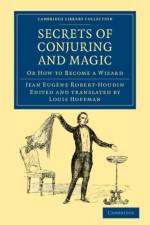
Jean Eugene Robert-Houdin (1805-71) is often called the father of modern conjuring. His name was later adopted by magician and escape artist Harry Houdini, whose highly sceptical expose of Victorian spiritualism is also published in this series. The best-known magician of his time, Robert-Houdin toured France, England and Germany, performed for Queen Victoria, and was sent to French Algeria by Napoleon III to demonstrate the perceived superiority of French magic to the local shamans. This book, originally published in 1868, is devoted primarily to coin and card tricks, but Robert-Houdin also describes many other magical tricks and includes a history of conjuring. In 1877 the book appeared in this English translation by Louis Hoffmann (1839-1919). Hoffmann (real name Angelo John Lewis, a barrister) had published his own guide to magic in 1876, and both books caused controversy for revealing the secrets of stage magicians in such unprecedented detail.
First published in 1853, this book chronicles the personal experience of the 'Kaffir' war of 1851-2 (now known as the eighth Xhosa or frontier war), between the European settlers and the native inhabitants of the Eastern Cape in South Africa. Serving as a lieutenant, William Ross King (1822-90) sailed to South Africa from Cork with the 74th Highlanders in March 1851 and remained there until late 1852. His memoir was not intended as a detailed history of military operations in the Kaffir war and in fact encompasses all of King's experiences in South Africa rather than focusing solely on the conflict. The book is especially notable for its extremely one-sided account of events: King exhibits a particularly scathing attitude towards the Xhosa people, who were 'committing the most deliberate outrages and murders' and displaying 'cowardly treachery' towards the European settlers.
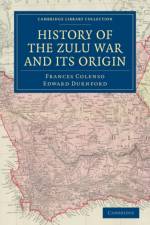
First published in 1880, just a year after the titular conflict took place, this account by Frances Colenso (1849-87) of the 1879 war between British settlers and the Zulu population in South Africa is remarkable in its defence of the Zulu people, a very unusual view for a British writer at this time. Colenso was the daughter of controversial bible scholar John William Colenso, the first Anglican bishop of Natal. This book was intended to support her father's criticism of British policy, but while she credits her father's influence and opinions in shaping her book, Colenso is careful to state that the work is her own. Beginning with the causes of the conflict, which she identifies as an unjust and barbaric British invasion, Colenso describes the Zulu war chronologically to its conclusion. The military details of the war were provided by Lieutenant-Colonel Edward Durnford, a close friend of Colenso's.
Best known for his theory of electromagnetism, James Clerk Maxwell (1831-79) was Cambridge University's first Cavendish Professor of Experimental Physics. Albert Einstein described his work as 'the most profound and the most fruitful that physics has experienced since the time of Newton'. He carried out brilliant work in thermodynamics and statistical mechanics, laying the foundation for the kinetic theory of gases. This book, published originally in 1871, summarises his work in this field. It includes the 'Maxwell relations' that still feature in every standard text on thermodynamics. It also outlines his famous thought experiment, later named Maxwell's 'demon'. This idea, which appeared to contradict the second law of thermodynamics, would inspire scientific debate well into the twentieth century. More recently, it has sparked developments in the new sciences of nanotechnology and quantum computing.
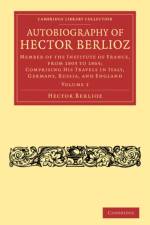
Hector Berlioz (1803-69) was one of the most original and colourful composers of his generation whose music was in many ways ahead of its time. He was also a respected journalist and critic. Begun in 1848, his celebrated Memoires were completed by 1865 but published posthumously in 1870. They are the best-known of his writings and reflect the man - passionate, imaginative, idealistic, opinionated and witty - and give a fascinating, first-hand, insight into his life. He shares his uncompromising thoughts on his contemporaries and the musical establishment in France, writes candidly about his love affairs and engagingly on his music and travels. This first English translation from the original French, published in 1884, will appeal to the music lover and the general reader. Volume 1 (1803-41) includes his childhood in the Isere, studies in Paris, struggles to establish himself and travels in Italy during 1831-2.
First published in 1782, this response to Raynal's The Revolution of America (also reissued in this series) by Thomas Paine (1737-1809) has been eclipsed by Paine's other work and largely overlooked. Written a year after Raynal's account of the American Revolution appeared in English, Paine's 'corrections' run to nearly eighty pages. His main critique of Raynal is that his argument stresses political theory rather than actions in the real world, an approach that lacks practicality. Paine argues against Raynal's assertion that the American War of Independence erupted over a tax dispute, and downplays France's involvement in the movement for independence. However, while attacking Raynal's influential work, he does so diplomatically, believing that the Abbe was writing from too great a distance to assess accurately the causes and principles of the conflict. This book has been hailed by scholars as the first of Paine's publications to demonstrate his internationalist views.
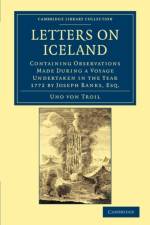
Swedish archbishop Uno von Troil (1746-1803) had a lifelong enthusiasm for travel and scientific study which led him to accompany the famous naturalist Sir Joseph Banks (1743-1820) on an expedition to Iceland in 1772. Banks was already well known for his role as botanist on Captain Cook's first voyage on the Endeavour, which mapped the Pacific and uncharted parts of Australia and New Zealand. This book, first published in 1780, is a compilation of letters written by von Troil, documenting the tour of Iceland. The letters describe volcanos and other geological features as well as providing meteorological information and an account of the northern lights. Through his amiable and enthusiastic correspondence, von Troil paints a picture of the Icelandic people, their national character and culture, including their diet and occupations. Also featured is an account of the religious history of Iceland and the organisation of the Icelandic church.
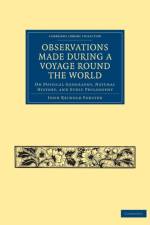
John Reinhold Forster (1729-98), a scientific writer and translator of German origin, took part in Cook's second Pacific voyage, from 1772 to 1775, and published this study, which records his examinations of 'nature in its greatest extent; the earth, the sea, the air, the organic and animated creation', in 1778. He drew upon the ideas of 'the most ingenious men of the age' in constructing his observations on natural history and navigation. The first half of the book addresses the physical aspects of the world: earth and land, oceans, global changes and flora and fauna. The second half focuses on the anthropological origins of the people of the southern seas. The book was originally written as a popular travel narrative, and it remains an important publication which will appeal to readers interested in historical geography, zoology, ethnology, astronomy and travel writing.
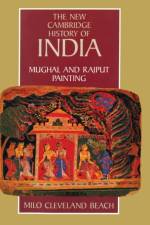
The Mughals - descendants of Timur and Genghiz Khan with strong cultural ties to the Persian world - seized political power in north India in 1526 and became the most important artistically active Muslim dynasty on the subcontinent. In this richly illustrated book, Dr Milo Beach shows how, between 1555 and 1630 in particular, Mughal patronage of the arts was incessant and radically innovative for the Indian context. The author reveals how Mughal painting was defined by the styles popular at the imperial court, whereas Pajput painting consisted of many local court styles, corresponding to the various Hindu kingdoms, each with different tastes and artistic inspirations. By reproducing nearly 200 examples in this study, Milo Beach traces the interplay of the traditions of Mughal and Rajput painting from the sixteenth to nineteenth centuries. He demonstrates the tolerance each showed towards outside influence and change and thus helps to define a uniquely Indian attitude towards the arts.
Kant's anthropological works represent a very different side of his philosophy, one that stands in sharp contrast to the critical philosophy of the three Critiques. For the most part, Kantian anthropology is an empirical, popular, and, above all, pragmatic enterprise. After tracing its origins both within his own writings and within Enlightenment culture, the Element turns next to an analysis of the structure and several key themes of Kantian anthropology, followed by a discussion of two longstanding contested features - viz., moral anthropology and transcendental anthropology. The Element concludes with a defense of the value and importance of Kantian anthropology, along with replies to a variety of criticisms that have been levelled at it over the years. Kantian anthropology, the author argues, is 'the eye of true philosophy'.
This Element examines the many facets of ethical realism and the issues at stake in metaethical debates about it-both between realism and non-realist alternatives, and between different versions of realism itself. Starting with a minimal core characterization of ethical realism focused on claims about meaning and truth, we go on to develop a narrower and more theoretically useful conception by adding further claims about objectivity and ontological commitment. Yet even this common understanding of ethical realism captures a surprisingly heterogeneous range of views. In fact, a strong case can be made for adding several more conditions in order to arrive at a proper paradigm of realism about ethics when understood in a non-deflationary way. We then develop this more robust realism, bringing out its distinctive take on ethical objectivity and normative authority, its unique ontological commitments, and both the support for it and some challenges it faces.
This Element provides an opinionated introduction to the debate in moral philosophy over identifying the basic elements of well-being and to the related debate over the nature of happiness. The question of the nature of happiness is simply the question of what happiness is (as opposed to what causes it or how to get it), and the central philosophical question about well-being is the question of what things are in themselves of ultimate benefit or harm to a person, or directly make them better or worse off.
As Socrates famously noted, there is no more important question than how we ought to live. The answer to this question depends on how the reasons that we have for living in various different ways combine and compete. To illustrate, suppose that I've just received a substantial raise. What should I do with the extra money? I have most moral reason to donate it to effective charities but most self-interested reason to spend it on luxuries for myself. So, whether I should live my life as I have most moral reason to live it or as I have most self-interested reason to live it depends on how these and other sorts of reasons combine and compete to determine what I have most reason to do, all things considered. This Element seeks to figure out how different sorts of reasons combine and compete to determine how we ought to live.
'Phase-only Fresnel holograms,' which can be displayed on a single SLM without the need for lenses or complicated optical accessories, substantially simplifies 3-D holographic display systems. Exploring essential concepts, theories, and formulations of these phase-only Fresnel holograms, this book provides comprehensive coverage of modern methods for generating such holograms, which pave the way for commercial products such as compact holographic projectors, heads-up displays, and data security enhancement. Relevant MATLAB codes are provided for readers to implement and evaluate the theories and formulations of different methods, and can be used as a quick start framework for further research and development. This is a crucial and up-to-date treatment of phase-only Fresnel holograms for students and researchers in electrical and electronic engineering, computer science/engineering, applied physics, information technology, and multimedia technology, as well as engineers and scientists in industry developing new products on 3-D displays and holographic projection.
The field of ultracold atomic physics has developed rapidly during the last two decades, and currently encompasses a broad range of topics in physics, with a variety of important applications in topics ranging from quantum computing and simulation to quantum metrology, and can be used to probe fundamental many-body effects such as superconductivity and superfluidity. Beginning with the underlying and including the most cutting-edge experimental developments, this textbook covers essential topics such as Bose-Einstein condensation of alkali atoms, studies of BEC-BCS crossover in degenerate Fermi gas, synthetic gauge fields and Hubbard models, and many-body localization and dynamical gauge fields. Key physical concepts, such as symmetry and universality highlight the connections between different systems, and theory is developed with plain derivations supported by experimental results. This self-contained and modern text will be invaluable for researchers, graduate students and advanced undergraduates studying cold atom physics, from both a theoretical and experimental perspective.
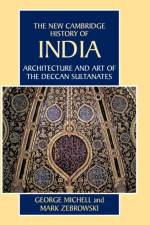
The Muslim kingdoms of the Deccan plateau flourished from the fourteenth to eighteenth centuries. During this period, the Deccan sultans built palaces, mosques and tombs, and patronised artists who produced paintings and decorative objects. Many of these buildings and works of art still survive as testimony to the sophisticated techniques of their craftsmen. This volume is the first to offer an overall survey of these architectural and artistic traditions and to place them within their historical context. The links which existed between the Deccan and the Middle East, for example, are discernible in Deccani architecture and paintings, and a remarkable collection of photographs, many of which have never been published before, testify to these influences. The book will be a source of inspiration to all those interested in the rich and diverse culture of India, as well as to those concerned with the artistic heritage of the Middle East.
This Element introduces several prominent themes in contemporary work on the epistemology and methodology of ethics. Topics addressed include skeptical challenges in ethics, epistemic arguments in metaethics, what (if anything) is epistemically distinctive of the ethical. Also considered are methodological questions in ethics, including questions about which ethical concepts we should investigate, and what our goals should be in ethical inquiry.
Natural selection causes adaptation, the fit between an organism and its environment. For example, the white and grey coloration of snowy owls living and breeding around the Arctic Circle provides camouflage from both predators and prey. In this Element, we explore a variety of such outcomes of the evolutionary process, including both adaptations and alternatives to adaptations, such as nonadaptive traits inherited from ancestors. We also explore how the concept of adaptation is used in evolutionary psychology and in animal behavior, and the adequacy of methods used to confirm evolutionary accounts of human traits and behaviors.
In 1868, eight years after his death at the hands of Abyssinian tribesmen, the memoirs of Walter Chichele Plowden (1820-60) were published in Britain, having been prepared for publication by his brother Trevor. As the first British consul appointed to Abyssinia in 1848, Plowden was in a unique position to record contemporary local history (although as consul he was not an unequivocal success), and this book contains his detailed account of all levels of Abyssinian society. A close associate of the Emperor Tewodros (Theodore), who slaughtered 2,000 people in retaliation for Plowden's death, he includes a vivid characterisation of this important figure, and provides an exceptionally useful contemporary source for the turbulent history of Abyssinia in the mid-nineteenth century. The book also includes two maps, one of the northern frontier of Abyssinia drawn by Plowden himself, and the other modelled on the British War Office map of Abyssinia.
First published in 1831, this account of a notorious event in the history of the navy makes extensive use of letters, papers and the testimony of those involved. Sir John Barrow (1764-1848) was Second Secretary to the Admiralty, and so had unrivalled access to official documents. He begins with a chapter detailing the first visit to Tahiti by Captain Cook. The mutiny, Bligh's 4,000-mile voyage in an open boat, the capture and court martial of some of the mutineers and the fate of the remainder who settled on Pitcairn Island are described with clarity and even-handedness. Whilst acknowledging that Bligh was 'a man of coarse habits' with 'mistaken notions with regard to discipline', Barrow is unequivocal that the episode 'ought to operate as a warning ... to our brave seamen, not to be led astray ... either by order or persuasion of some hot-brained, thoughtless, or designing person'.
Abonner på vårt nyhetsbrev og få rabatter og inspirasjon til din neste leseopplevelse.
Ved å abonnere godtar du vår personvernerklæring.