






Gjør som tusenvis av andre bokelskere
Abonner på vårt nyhetsbrev og få rabatter og inspirasjon til din neste leseopplevelse.
Ved å abonnere godtar du vår personvernerklæring.Du kan når som helst melde deg av våre nyhetsbrev.

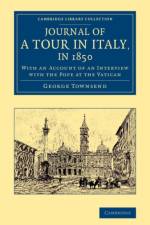
A Church of England clergyman and biblical scholar, George Townsend (1788-1857) gained recognition for preparing chronological arrangements of both the Old and New Testament. First published in 1850, the present work is an intriguing account of his journey to Italy for an audience with Pope Pius IX, whom he intended to convert to Protestantism. Townsend's journal features details of his stay in Paris, where he was received by the city's archbishop, as well as remarks on the churches and clergy he encountered along the way. In Rome and the Vatican, he visited the main sites of interest while commenting on points of doctrinal divergence and the hospitality shown towards him. Warmly received by Pius IX, who chose to interpret the visit as ecumenical, Townsend inevitably failed in his ultimate objective. Tendentious and forthright, his work sheds light on a strain of English anti-Catholicism.
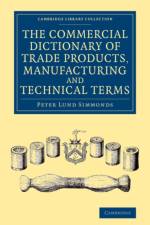
An industrious journalist and editor of periodicals, Peter Lund Simmonds (1814-97) wrote across a range of subjects, including natural history and applied science. An active member of the Royal Society of Arts, he first published this dictionary in 1858. Reissued here in its revised and enlarged edition of 1867, it contains more than 22,000 entries. The curious can discover within that a calcar is a furnace in a glassworks, or that the best kind of Cuban tobacco is known as calidad. Readers will also learn that the hautboy can be either eaten or played, being the name for both a wild strawberry and a form of oboe. Testifying to the proliferation of manufactured goods in the nineteenth century, and the contemporary desire to diffuse 'sound and useful knowledge among the masses', this work will appeal to readers interested in the history and lexicon of trade and technology.
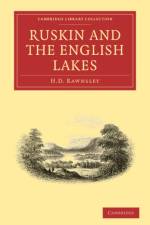
John Ruskin (1819-1900), the influential Victorian art critic and social theorist, lived in the Lake District for nearly 30 years. This biographical study, first published in 1901, focuses on the significance of the region in Ruskin's life and art. It begins with his first visit as a five-year-old, when he became ''a dedicated spirit' to the beauty and the wonders of Nature', and ends with accounts of his funeral and memorial at Coniston. It describes his commitment to the local people and their traditional crafts, and his relationship with the poet Wordsworth. The author, H. D. Rawnsley (1851-1920), was a clergyman, conservationist and keen art lover based in the Lake District who had been personally tutored by Ruskin and who was one of the founders, in 1884, of the heritage organisation that became the National Trust.
Over the course of three decades, the English businessman and inventor Thomas Hancock (1786-1865) took out sixteen patents relating to the potential applications of natural rubber. Hancock's fascination with this material, the properties of which had not been fully appreciated in England, drove him to experiment extensively with manufacturing methods. This led to the development of the mechanical process of 'mastication' and the chemical process of vulcanization, the end product of which was used by Macintosh to create waterproof garments. This illustrated account of Hancock's discoveries and methods was first published in 1857. It covers the origin of his interest in natural rubber and his subsequent experiments and patents. Also included are details about the plants from which natural rubber is extracted. The result is an informed chronicle of the commercial exploitation of a versatile and lucrative resource.
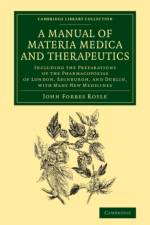
Having served as a military surgeon in India, where he also pursued botanical research and investigated the efficacy of Hindu medicines, John Forbes Royle (1798-1858) went on to become a professor of materia medica at King's College, London. Acknowledging the need for a thorough yet manageable textbook on the subject, he published in 1847 this manual containing entries on the medicinal substances derived from minerals, plants and animals that were used in Britain at that time. The terminology, operations and aims of pharmaceutical practice are also addressed, and the differing preparations of the London, Edinburgh and Dublin pharmacopoeias are taken into account for the benefit of students. Furthermore, the work provides information on recently discovered medicines, 'as may be seen among the Preparations of Iron and of Gold, as well as in Matico, Indian Hemp, Bebeerine &c'.
First published in 1874 and reissued here in its second edition of 1879, this substantial work provides information on the vegetable material medica used by Victorian pharmacists, principally in Britain but also in India. Arranging the entries according to the type of plant from which each drug is derived, Daniel Hanbury (1825-75) and Friedrich August Fluckiger (1828-94) give a description of each drug as well as covering its botanical origin and history, including its first medicinal application. They also discuss chemical composition, referring to the investigations of other scientists as well as their own, and comment on microscopic structure. Intending to create a broad reference work rather than an encyclopaedia, the authors chose not to focus on the therapeutic applications of the drugs. In many instances, however, they give some information on how the plant products are used. The appendix provides short biographical and bibliographical notes.
The nineteenth century witnessed great advances in technology which made transporting natural resources overseas significantly easier. At the centre of a global empire, Britain felt the full economic benefits of introducing and cultivating a range of commercial plants both domestically and in her colonies abroad. First published in 1890, this succinct work by the English botanist John Reader Jackson (1837-1920) surveys these plants. The concise descriptions are enhanced by instructive drawings of significant species. The introduction also contains a chronological table of the century's most important developments in commercial botany. This is followed by chapters organised according to the applications of plants, notably in food, drink, medicine, and the building trade. Jackson points out the species which revolutionised these industries, identifying those at the heart of rapidly growing markets. The coverage includes many commodities which remain commercially significant, such as palm oil, sugar cane, and cotton.
Walter Bagehot (1826-77), the influential political and economic essayist, wrote a number of books that became standards in their respective fields. He attended University College, London, where he studied mathematics and gained a master's degree in intellectual and moral philosophy. He was called to the bar, but instead chose a career in his father's banking business. He wrote widely on literature, economics and politics, co-founding the National Review in 1855. He became editor-in-chief of The Economist in 1860 and remained in that post until his death. This work, published originally in 1873 and described by J. M. Keynes as 'an undying classic', is a masterpiece of economics. It explains the world of finance and banking, concentrating on crisis management, and its ideas are as relevant today as ever, especially in the face of the global financial crisis that emerged in 2007.
As well as being the most distinguished painter of his generation, Sir Joshua Reynolds (1723-92) was also the author of several works of art criticism and guides for artists, some of which originated as lectures delivered to the students of the Royal Academy by him as their founding president. This work, first published in 1778, collects six of the addresses given to the Academy on 'Prize Day', between 1769 and 1776, prefaced with the first address by Reynolds to his fellow artists of the newly founded institution in 1769. Each discourse was later printed and distributed to those present at Reynolds' expense. They present his views of the purpose of art, and in particular the necessity of intellectual dignity in what he calls the 'great style' of the Florentine Renaissance masters. The discourses also demonstrate his wide reading among the aesthetic theorists of his own and earlier ages.
French astronomer Camille Flammarion (1842-1925) firmly believed that science should not be the preserve of elites. His passion for the discoveries of his time is palpable throughout this classic introduction to astronomy, which stands as a landmark in the history of popular science writing. It features 360 illustrations, including highly detailed maps of the Moon and Mars, the latter being of special interest for Flammarion as he compared and contrasted it with the Earth. Originally published in 1880, the work won the approval of the Academie Francaise and the Minister of Public Instruction. This reissue is of the version that appeared in 1881 after 50,000 copies had already reached an enthusiastic readership. Its translation into English as Popular Astronomy (1894) and another accessible work by Flammarion, Le Monde avant la creation de l'homme (1886), are also reissued in this series.
An accomplished telegraph engineer in his own right, Sir Charles Bright (1863-1937) was the son of Sir Charles Tilston Bright (1832-88), who had achieved greatness in laying the first transatlantic cable in 1858. The younger Bright worked alongside his father for a time, continued his research, and became an authority on the subject. Examining the history, construction and working of submarine telegraphs, this 1898 treatise traces both technical and commercial developments, looking also at the labour involved. Bright addresses the laying of cables across the globe, giving accounts of projects in India, South America and beyond. Illuminating the many commercial uses for submarine cables, Bright provides an informed survey of the early standardisation of telegraphy systems. Replete with detailed illustrations and technical drawings, this work remains an indispensable resource on the history of telecommunications and electrical engineering.
The novelist and essayist Elizabeth Hamilton (1756?-1816) received her education at a day school from the age of eight, and later recalled her childhood and schooldays fondly. However, intellectual girls in the period were regarded with some suspicion, and she remembered hiding from visitors those books that might be deemed inappropriate for a young woman. Later embarking on a literary career, she published in 1801 her Letters on Education, republished in this second edition of 1801-2. Owing much to the theories of John Locke as well as the period's standard conduct-book advice on the education of girls, Hamilton's work offers detailed theoretical explorations of how children learn. 'Be not afraid my good friend,' she writes, 'that I intend making speculative philosophers of your daughters.' Volume 2 begins with a comment on the necessity of obtaining knowledge of our intellectual faculties, and how this knowledge is to be acquired.
The novelist and essayist Elizabeth Hamilton (1756?-1816) received her education at a day school from the age of eight, and later recalled her childhood and schooldays fondly. However, intellectual girls in the period were regarded with some suspicion, and she remembered hiding from visitors those books that might be deemed inappropriate for a young woman. Later embarking on a literary career, she published in 1801 her Letters on Education, republished in this second edition of 1801-2. Owing much to the theories of John Locke as well as the period's standard conduct-book advice on the education of girls, Hamilton's work offers detailed theoretical explorations of how children learn. 'Be not afraid my good friend,' she writes, 'that I intend making speculative philosophers of your daughters.' Volume 1 includes comments on the 'pernicious effects of parental partiality', considering also 'contempt for the female character' and 'pride of station'.
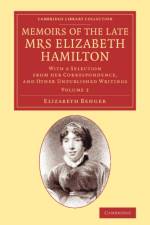
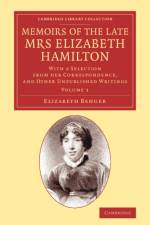
The novelist and essayist Elizabeth Hamilton (1756?-1816) wrote with especial distinction on the subject of education. Inspired by her older brother, the orientalist Charles Hamilton, she pursued her literary ambitions, informing her work with a knowledge of history, philosophy and politics. Her ability to present complex ideas in an accessible manner did much to secure her an appreciative readership. Establishing her reputation with a satirical attack on radical thought, Memoirs of Modern Philosophers (1800), she enjoyed her greatest literary success with The Cottagers of Glenburnie (1808), a tale of moral reformation. Her Letters on the Elementary Principles of Education (1801) is also reissued in this series. The present work was first published in two volumes in 1818 by her friend and fellow novelist Elizabeth Benger (1775-1827). Volume 2 contains selected letters and Hamilton's previously unpublished critique of the Book of Revelation.
The novelist and essayist Elizabeth Hamilton (1756?-1816) wrote with especial distinction on the subject of education. Inspired by her older brother, the orientalist Charles Hamilton, she pursued her literary ambitions, informing her work with a knowledge of history, philosophy and politics. Her ability to present complex ideas in an accessible manner did much to secure her an appreciative readership. Establishing her reputation with a satirical attack on radical thought, Memoirs of Modern Philosophers (1800), she enjoyed her greatest literary success with The Cottagers of Glenburnie (1808), a tale of moral reformation. Her Letters on the Elementary Principles of Education (1801) is also reissued in this series. The present work was first published in two volumes in 1818 by her friend and fellow novelist Elizabeth Benger (1775-1827). Volume 1 includes a biographical fragment by Hamilton, along with a selection of journal extracts and satirical essays.
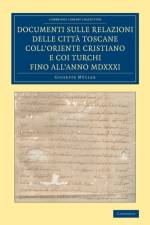
Born in Moravia, the philologist and historian Joseph (Giuseppe) Muller (1825-95) translated into Italian several major works of German classical scholarship. He held positions at the universities of Pavia and Padua, in the state archives of Florence, and finally in Turin. This work, published in Florence in 1879, prints original documents from the archives of the Tuscan city states in Latin, occasionally Greek, and later in Italian, ranging from the twelfth to the sixteenth century. The first half comprises correspondence with the crusader kings, the Christian communities of the Near East, and subsequently the Ottoman sultanate, introducing ambassadors and negotiating privileges for the city states' communities and representatives in the region. The second half contains the deliberations of the maritime republics on sailing routes and trade schedules. Together they illuminate political and practical relations between the Orthodox, Catholic and Muslim worlds surrounding the Mediterranean in this formative period.
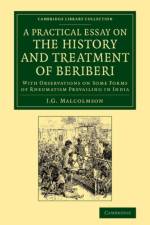
Reissued here together are two medical works, both published in 1835, by John Grant Malcolmson (1803-44), a British surgeon based in India. His extended essays explore the symptoms, diagnosis and treatment of beriberi and rheumatism, conditions which were widespread in Asia at the time. Also describing the contrasting effects that the illnesses had on India's native population and on European colonials, Malcolmson draws on his first-hand experience to speculate on the underlying causes. His analysis of beriberi, forming the larger of the two components here, discusses a disease which had perplexed doctors in the early nineteenth century. Beginning with numbness and spasms in the legs, and eventually rendering the patient completely bedridden, beriberi was frequently fatal, and physicians frequently confused it with other rheumatic disorders. It is now known to be caused by a deficiency of thiamine (vitamin B1).
A Scottish doctor and botanist, George Watt (1851-1930) had studied the flora of India for more than a decade before he took on the task of compiling this monumental work. Assisted by numerous contributors, he set about organising vast amounts of information on India's commercial plants and produce, including scientific and vernacular names, properties, domestic and medical uses, trade statistics, and published sources. Watt hoped that the dictionary, 'though not a strictly scientific publication', would be found 'sufficiently accurate in its scientific details for all practical and commercial purposes'. First published in six volumes between 1889 and 1893, with an index volume completed in 1896, the whole work is now reissued in nine separate parts. Volume 6, Part 1 (1892) contains entries from Pachyrhizus angulatus (a large climbing herb) to rye (not indigenous to India).
A Scottish doctor and botanist, George Watt (1851-1930) had studied the flora of India for more than a decade before he took on the task of compiling this monumental work. Assisted by numerous contributors, he set about organising vast amounts of information on India's commercial plants and produce, including scientific and vernacular names, properties, domestic and medical uses, trade statistics, and published sources. Watt hoped that the dictionary, 'though not a strictly scientific publication', would be found 'sufficiently accurate in its scientific details for all practical and commercial purposes'. First published in six volumes between 1889 and 1893, with an index volume completed in 1896, the whole work is now reissued in nine separate parts. Volume 6, Part 2 (1893) contains entries from Sabadilla (an imported plant, the seeds of which produce a neurotoxin) to silica (used in the production of glass).
Born in Franconia, the son of a rabbi, Joseph Wolff (1795-1862) was baptised in 1812. Educated in Hebrew, Greek and Latin, he later studied Arabic, Syriac and Aramaic in Vienna, and Christian theology in Rome before being expelled from the city for his heretical views. He came to England, became a member of the Church of England, and then embarked on his missionary work. Though he met with limited evangelical success, the books he went on to publish made him well known at home. Reissued here is his 1835 account of travels in the early 1830s through the Middle East and Asia, during which he experienced robbery and disease, journeyed through the Himalayas, and was hosted by numerous royal courts. This tale, exotic and extraordinary, is a remarkable source for those interested in nineteenth-century orientalism and Christian missionary zeal.
Actor and baritone Eduard Devrient (1801-77) first met Felix Mendelssohn (1809-47) in 1822, and they remained close friends thereafter. During his lifetime, Mendelssohn achieved celebrity status as a composer, virtuoso pianist and conductor, and it was Devrient who secured in 1829 the famous performance in Berlin, under Mendelssohn's direction, of the St Matthew Passion, which began the Bach revival. First published in German in 1869, this work is reissued here in the English translation of the same year by Natalia Macfarren (1827-1913), singer and wife of the composer Sir George Macfarren. Her work as a translator included the first English versions of Wagner's Lohengrin and Verdi's Rigoletto. Although Devrient does not always exactly reproduce the correspondence, particularly where Mendelssohn is critical of others, the letters and commentary here serve to illuminate the development of a great composer.
An eminent botanist and natural historian, George Simonds Boulger (1853-1922) wrote a number of books on plant life in the British Isles. First published in 1902, this manual explores the characteristics and uses of one of the most abundant and versatile natural materials. In the first part, Boulger outlines the general biological function and uses of wood. He also describes the classification of wood, and the durability of different timbers. The second part catalogues the types of wood that are used commercially. Boulger explains the distinguishing characteristics and uses of hundreds of different kinds of timber, which are listed alphabetically. Featuring 82 illustrations, the book also includes appendices explaining some of the terminology and science of wood, and a select bibliography. Boulger's work on economic botany, The Uses of Plants (1889), is also reissued in the Cambridge Library Collection.
First published in 1870, this 'museum of literary odds and ends' was condensed from material in a manuscript that was thrice the size of the finished book. At the end of his life, Ebenezer Cobham Brewer (1810-97) substantially revised and updated the Dictionary in 1895 and it has appeared in new versions ever since. Reissued here in its first edition, the work reflects Brewer's distinct style and draws on a lifetime's reading. Elucidating the etymology of some 20,000 unusual and everyday words and phrases, the collection touches on diverse subjects ranging from history and literature to mythology and magic. Brewer's charming preface describes the book as an 'alms-basket of words' and promises to examine terms such as 'killed with kindness' and 'kettle of fish'. Readers will be enlightened as to the original meaning of familiar and unfamiliar phrases, many of which have fallen out of use yet testify to the richness of an evolving language.
Of German birth, Sir August Friedrich Manns (1825-1907) secured for himself a central place in nineteenth-century British musical life. Appointed by George Grove in 1855 to conduct the orchestra at the relocated Crystal Palace in Sydenham, ande held the post for more than four decades, establishing a high reputation for the Saturday Concerts and attracting internationally recognised soloists. Manns was involved in every aspect, from developing the repertoire to taking rehearsals. Under his baton, many of the great works of Brahms, Schubert and Berlioz received their first British performances, alongside world premieres of pieces by British composers such as Sullivan and Macfarren. Secretary of the Guildhall School of Music, Henry Saxe Wyndham (1867-1940) published in 1909 this engaging portrait of a musician greatly esteemed by players and audiences alike.
After Napoleon Bonaparte's defeat at Waterloo (1815), the British government exiled him to the island of St Helena, where he forged a friendship with Betsy Balcombe (later Abell, 1802-71), the thirteen-year-old daughter of the government official in whose premises he stayed while Longwood House was being prepared as his residence. In these vivid memoirs, first published in 1844, Abell recalls her time spent with Napoleon, painting a portrait of a humorous and boyish character, of whom she was initially afraid, but then came to view as a friend and companion. Recounting his arrival, his opinions on music, wine and religion, his thoughts on his surrender and his battle tactics, his way of life, and his departure for his permanent incarceration at Longwood, Abell's recollections, which offer an unusual view of one of the most significant figures of modern history, have since inspired many documentaries, dramas and children's stories.
Professor of natural philosophy at the Royal Institution between 1853 and 1887, the physicist and mountaineer John Tyndall (1820-93) passionately sought to share scientific understanding with the Victorian public. A lucid and highly regarded communicator, he lectured on such topics as heat, light, magnetism and electricity. In this collection of twelve lectures, first published in 1863, Tyndall discusses the general properties of heat and its associated physical processes, such as convection, conduction and radiation. He presents concepts so that they are intelligible to non-specialists, and helpful illustrations of laboratory equipment accompany his descriptions of experiments and phenomena. Throughout, he explains the research and discoveries of renowned scientists, including Sir Humphry Davy, Julius von Mayer, James Prescott Joule, and Hermann von Helmholtz. Several of Tyndall's other publications, from his lectures on sound to his exploration of alpine glaciers, are also reissued in this series.
Watkin Tench (1758-1833) was a British Marine officer who was held prisoner from 1794 to 1795 in Brittany, at the height of the French Revolution. During his imprisonment he wrote a series of letters to a friend in London (it is not clear whether this was genuine correspondence or a genre narrative), which was published in 1796. In them we learn of the adverse conditions he experienced on two convict hulks in Brest harbour, and his later period of parole in private lodgings in Quimper, which he recalls more favourably, as he was allowed to roam the countryside within a three-mile radius of the town. Tench's letters reveal his thoughts on the turbulence and uncertainty brought about by the revolution, and the resistance (largely inspired by religion) of the Bretons to it. This is a fascinating first-hand account of France at a time of rapid political change.
This biography of the Champollion brothers was published in Grenoble in 1887. Jean-Francois (1790-1832) was a child prodigy who had taught himself numerous ancient languages in his teenage years, despite not having received any formal education. Having become an assistant professor of history at Grenoble in his nineteenth year, Jean-Francois published a decipherment of the trilingual Rosetta Stone in 1824, thus offering the key to an understanding of Egyptian hieroglyphics and consequently of the civilisation of ancient Egypt. His older brother, Jacques-Joseph (1778-1867), although a less gifted scholar, supported Jean-Francois and kept his name and achievement before the public after his early death. Jacques-Joseph's son Aime-Louis (1813-94), the author of this biographical account, followed in his father's footsteps, becoming the librarian of the Bibliotheque Royale and publishing works on palaeography. Based on original letters, this is the only near-contemporary biography of the pioneering Egyptologist.
Philippe Renouard (1862-1934) published this biographical directory of members of the Parisian book trade from the introduction of printing in 1470 until the sixteenth century in 1898. It replaced the only other existing catalogue, by Augustin-Martin Lottin, published more than a century earlier. Renouard corrected many of the errors in Lottin's catalogue and filled in gaps in information, extending his directory to include names and addresses of booksellers and printers, and the dates during which they were active, and family genealogies. The book also includes a map of the university quarter and city of Paris marked with the locations of former publishing houses. It remained the authoritative source on the topic until the 1960s, when the Bibliotheque Nationale published a newly revised and enlarged version.
This collection of 48 Latin documents dating from the sixth to the ninth centuries was published anonymously in Paris in 1848, when its focus on St Denis, the burial place of the French kings, would have been highly politically sensitive. Many of the charters relate to land, revenues or rights given by Merovingian and Carolingian kings to religious institutions near Paris closely connected to their dynasty. Subjects include Childebert I's foundation of the abbey of St Vincent in 558, donating fields, meadows, forests, fisheries and mills on the River Seine, and grants to St Denis from benefactors including Chlotharus II in 527, Dagobert I in 637, Childebert III in 710 (the taxes on a market) and Chilperichus II in 716-7 (100 cows and a forest). Writings by Pope Nicholas I and a Byzantine emperor also appear. The book provides valuable information about land and power in early medieval France.
Abonner på vårt nyhetsbrev og få rabatter og inspirasjon til din neste leseopplevelse.
Ved å abonnere godtar du vår personvernerklæring.