

Gjør som tusenvis av andre bokelskere
Abonner på vårt nyhetsbrev og få rabatter og inspirasjon til din neste leseopplevelse.
Ved å abonnere godtar du vår personvernerklæring.Du kan når som helst melde deg av våre nyhetsbrev.

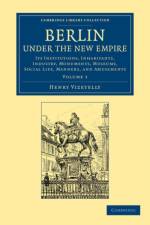
In the wake of German unification in 1871, Berlin became a place of increased interest to the other nations of Europe. The journalist Henry Vizetelly (1820-94) made his first journey to the capital of the new empire in 1872. Based on observations from a series of visits, this two-volume work presents a witty and detailed portrait of the city and its inhabitants. In Volume 1, Vizetelly describes travelling to Berlin and his mixed first impressions. He sketches a brief history of the city and its development from the thirteenth century onwards, and in a series of essay-style chapters he discusses aspects of Berlin culture and society - including dinner-party etiquette - as well as political and military personalities. Illustrated with hundreds of engravings from designs by German artists, the work first appeared in 1879. Vizetelly's Paris in Peril (1882) and Glances Back Through Seventy Years (1893) are also reissued in this series.
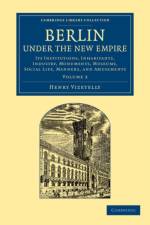
In the wake of German unification in 1871, Berlin became a place of increased interest to the other nations of Europe. The journalist Henry Vizetelly (1820-94) made his first journey to the capital of the new empire in 1872. Based on observations from a series of visits, this two-volume work presents a witty and detailed portrait of the city and its inhabitants. The topics covered in Volume 2 include the Prussian Landtag, the Reichstag, Berlin's places of education, its palaces, churches and museums, and its restaurants, cafes and beer gardens. Chapters on theatre, music, satire and socialism give a vivid sense of the cultural and political zeitgeist. Illustrated with hundreds of engravings from designs by German artists, the work first appeared in 1879. Vizetelly's Paris in Peril (1882) and Glances Back through Seventy Years (1893) are also reissued in this series.
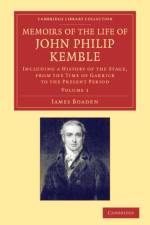
Born into the theatre, though originally intended for Catholic holy orders, John Philip Kemble (1757-1823) made as great a name for himself on the English stage as his gifted older sister, Sarah Siddons. Known for his mastery of tragic Shakespearian roles, among which Coriolanus was deemed his finest, Kemble also distinguished himself as acting manager at Drury Lane under Sheridan. Described by Sir Walter Scott as 'grave, critical, full and laudably accurate', this extensive two-volume biography was the work of James Boaden (1762-1839), an author well acquainted with the foremost theatrical personalities of his day. Boaden's biographies of Sarah Siddons, Elizabeth Inchbald and Dorothy Jordan have also been reissued in this series, along with his edition of David Garrick's correspondence. Volume 1 of the present work covers Kemble's career through to his first season in charge at Drury Lane in 1788-9.
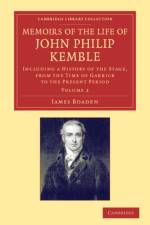
Born into the theatre, though originally intended for Catholic holy orders, John Philip Kemble (1757-1823) made as great a name for himself on the English stage as his gifted older sister, Sarah Siddons. Known for his mastery of tragic Shakespearian roles, among which Coriolanus was deemed his finest, Kemble also distinguished himself as acting manager at Drury Lane under Sheridan. Described by Sir Walter Scott as 'grave, critical, full and laudably accurate', this extensive two-volume biography was the work of James Boaden (1762-1839), an author well acquainted with the foremost theatrical personalities of his day. Boaden's biographies of Sarah Siddons, Elizabeth Inchbald and Dorothy Jordan have also been reissued in this series, along with his edition of David Garrick's correspondence. Volume 2 of the present work opens with the season of 1789-90 at Drury Lane and closes with the text of Kemble's will.
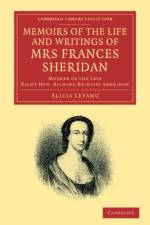
Frances Sheridan (1724-66) won acclaim in her day as both a playwright and novelist. Her most famous work, the sentimental novel Memoirs of Miss Sidney Bidulph (1761), found favour with Samuel Johnson, while her comedy The Discovery (1763) was staged by David Garrick at Drury Lane. Her fame was later eclipsed by that of her son, the playwright and politician Richard Brinsley Sheridan (1751-1816). Written by Alicia Lefanu (1791-c.1844), her granddaughter, this 1824 publication reaffirms the significance of Frances Sheridan's own work as a writer. Recounting her successes and incorporating her own recollections, the book reveals a woman admired both for her literary output and for her character. This work also includes reflections on the life of her son, whose early writing was influenced by that of his mother. Thomas Moore's two-volume biography of Richard Brinsley Sheridan has also been reissued in this series.
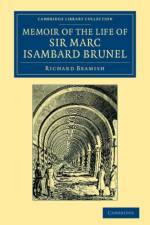
Abandoning a military career, Richard Beamish (1798-1873) decided to become a civil engineer. His suitability as a biographer of Sir Marc Isambard Brunel (1769-1849) stems from the period he spent working closely with the Brunels on the Thames Tunnel. Published in 1862, this memoir recounts the elder Brunel's eventful life and work, including his youth in France, his flight to America in the aftermath of the French Revolution, his lesser-known ventures in the early nineteenth century, and the tunnelling project which would consume much of the second half of his life. An informed portrait of a figure who has since been outshone by his more famous son, this book includes first-hand accounts of the ill-fated early attempt to build the Thames Tunnel, which was abandoned in 1828 due to flooding and lack of funds, and of Brunel's vindication upon its eventual completion in 1843.
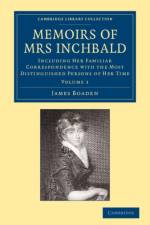
Although she overcame a stammer to fulfil her acting ambitions, Elizabeth Simpson (1753-1821), known as Mrs Inchbald after her marriage in 1772, was more acclaimed for her good looks than her performances. Her husband was an actor, and she formed strong friendships with Sarah Siddons and John Philip Kemble, but her greatest impact was as a playwright, novelist, editor and critic. Despite her decision to destroy a four-volume autobiography, her extensive surviving journals and letters allowed James Boaden (1762-1839) to publish this two-volume work in 1833. Having produced biographies of Siddons, Kemble and Dorothy Jordan (which are also reissued in this series), Boaden presents here an informed account of this remarkable woman's personal, theatrical and literary life. Volume 1 covers the period from her birth to 1796 and includes as an appendix The Massacre (1792), a suppressed historical drama about the persecution of Huguenots in 1572.
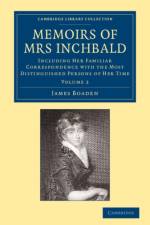
Although she overcame a stammer to fulfil her acting ambitions, Elizabeth Simpson (1753-1821), known as Mrs Inchbald after her marriage in 1772, was more acclaimed for her good looks than her performances. Her husband was an actor, and she formed strong friendships with Sarah Siddons and John Philip Kemble, but her greatest impact was as a playwright, novelist, editor and critic. Despite her decision to destroy a four-volume autobiography, her extensive surviving journals and letters allowed James Boaden (1762-1839) to publish this two-volume work in 1833. Having produced biographies of Siddons, Kemble and Dorothy Jordan (which are also reissued in this series), Boaden presents here an informed account of this remarkable woman's personal, theatrical and literary life. Volume 2 covers the period from 1796 until her death. It includes as an appendix A Case of Conscience (1800), a play that had not been previously performed or published.
Best known for The Rivals and The School for Scandal, Richard Brinsley Sheridan (1751-1816) was already a celebrated comic playwright when he entered Parliament in 1780. Turning his wit and talent as a writer to political oratory, he won acclaim for his speeches in the House of Commons. As an independent-minded Whig, he had to reconcile his distrust of monarchical power with his role as friend and confidant to the future George IV. Sheridan's was ultimately a turbulent life, rocked by affairs, heavy drinking and constant debt. This successful and influential two-volume biography, first published in 1825, was written by the poet Thomas Moore (1779-1852), who went on to chart the life of Lord Byron. Volume 1 covers Sheridan's early life and career as a writer, including extensive extracts from unfinished plays.
Best known for The Rivals and The School for Scandal, Richard Brinsley Sheridan (1751-1816) was already a celebrated comic playwright when he entered Parliament in 1780. Turning his wit and talent as a writer to political oratory, he won acclaim for his speeches in the House of Commons. As an independent-minded Whig, he had to reconcile his distrust of monarchical power with his role as friend and confidant to the future George IV. Sheridan's was ultimately a turbulent life, rocked by affairs, heavy drinking and constant debt. This successful and influential two-volume biography, first published in 1825, was written by the poet Thomas Moore (1779-1852), who went on to chart the life of Lord Byron. Volume 2 covers Sheridan's political career, his speeches in Parliament and his final years, closing with reflections on his life.
Thomas Bewick (1753-1828) is synonymous with finely crafted wood engravings of the natural world, and his instantly recognisable style influenced book illustration well into the nineteenth century. During his childhood in the Tyne valley, his two obsessions were art and nature. At fourteen, he was apprenticed to the engraver and businessman Ralph Beilby (1743-1817) with whom he later published A General History of Quadrupeds (also reissued in this series). The present work, with its text compiled from various sources, was the first practical field guide for the amateur ornithologist, inspiring also artists and writers. Each of the two volumes contains hundreds of illustrations of breathtaking beauty and precision: one for each species, neatly capturing its character in exquisite detail, interspersed with charming vignettes of country life. Volume 2, first published in 1804, covers water birds, including sandpipers, terns, grebes and guillemots.
Robert McNab (1864-1917), lawyer, politician, and historian, was one of the most prominent and influential of New Zealand's early intellectuals, renowned for his meticulous gathering of historical resources. The result of nine years of painstaking research, this book was developed from a series of articles on Southland history published in the newspaper Southern Standard in the late 1890s. Murihiku spans the history of European exploration and settlement in the South Island, from the voyages of Abel Tasman and Captain Cook to the arrival of the sealers, whalers, missionaries, and the early settlers in the years leading up the Treaty of Waitangi in 1840. The book was first published in 1905. After extensive research in archives in Australia, the USA, and Britain, McNab produced a more substantial edition in 1907. This third edition appeared in 1909. McNab was elected fellow of the Royal Geographical society in 1908.
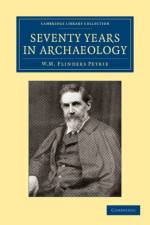
Among the leading Egyptologists of his day, Sir William Matthew Flinders Petrie (1853-1942) excavated over fifty sites and trained a generation of archaeologists. He is credited with bringing his subject to a much wider audience, and his talent for exposition is reflected in this accessible autobiography, first published in 1931 and illustrated throughout. It describes life on digs in the late nineteenth and early twentieth centuries, providing rich insights into developing archaeological methods. Petrie's most important discoveries are recounted, including his unearthing of the Merneptah Stele, some of the earliest evidence of mummification, and elements of Greek and Roman cultural influence in Egypt. Furthermore, he reflects here on his innovative practice of recording and preserving every artefact, not just obvious museum pieces. Petrie wrote prolifically throughout his long career, and a great many of his other publications are also reissued in this series.
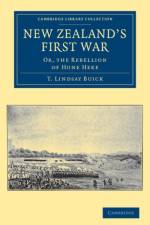
Thomas Lindsay Buick (1865-1938) became interested in New Zealand history while working as a political journalist in Wellington, and became an influential figure in the field. He wrote twelve books and numerous pamphlets on the early history of the country and was elected Fellow of the Royal Historical Society in 1914. This book, first published in Wellington in 1926, describes one of the most significant conflicts in nineteenth-century New Zealand, the Flagstaff War (1845-6), in which European settlers and their Maori supporters fought those Maori who were resisting colonial encroachment. A key figure during the war was the Nga Puhi chief Hone Heke, from the Bay of Islands, who famously refused to acknowledge British sovereignty and repeatedly felled the British flagpole in Kororareka. Buick's account probes the complex relationships among the warring factions, describes the individual phases of the war, and explains how peace was eventually restored.
An exceptional child prodigy at the keyboard, the organist and composer William Crotch (1775-1847) attracted the attention of both George III and Charles Burney, going on to become one of the most eminent musical figures of his day. Following a period of study in Cambridge, at the age of fifteen he was appointed organist at Christ Church, Oxford. At twenty-one he assumed the university's chair of music, a post he retained until his death. The first principal of the Royal Academy of Music between 1822 and 1832, Crotch is remembered today for his oratorio Palestine. The present work, which first appeared in 1831, made his expertise available to a wider audience. Based on popular lectures given in Oxford and London, the book includes a penetrating assessment of contemporary musical taste and a list of Crotch's sheet music. His Elements of Musical Composition (1812) is also reissued in this series.
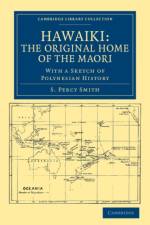
Stephenson Percy Smith (1840-1922) was a New Zealand ethnologist and surveyor. As a young man, he travelled six hundred miles exploring the volcanic interior of North Island, and had many interactions with the Maori population, whose language, history and traditions fascinated him throughout his career as a government surveyor. In 1892 he co-founded the Polynesian Society, in whose journal this study originally appeared. The first book edition was published in 1898, and this third, updated edition in 1910. Using indigenous sources gathered in Polynesia and New Zealand, Smith constructed an elaborate history of the Polynesians, and argued that they were ultimately descended from Aryan ancestors in India. His theory of Maori origins was accepted by several generations of scholars, but was eventually superseded by modern historical and archaeological research. However, his pioneering work, acclaimed in its day, still provides fascinating insights into both nineteenth-century Polynesian culture and colonial ethnography.
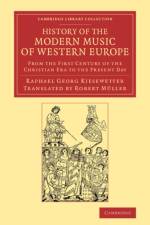
A high-ranking official in the Imperial War Office in Vienna, Raphael Georg Kiesewetter (1773-1850) is better known for his musicological activities. An accomplished amateur musician, he studied with Albrechtsberger, hosted private concerts of early music, and was closely involved in the affairs of Vienna's Society of the Friends of Music. His important collection of scores is now in the Austrian National Library. He also wrote a number of books and articles, including a pioneering study of Arabic music which was the first to use original sources, owing to the assistance of orientalist Joseph von Hammer-Purgstall. Originally published in German in 1834 and reissued here in its 1848 English translation, the present work is considered Kiesewetter's most significant and remains accessible to the general reader. Based on an evolutionary approach influenced by the Enlightenment, the book presents seventeen epochs which are named after their most characteristic composers.
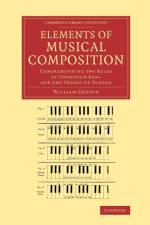
An exceptional child prodigy at the keyboard, the organist and composer William Crotch (1775-1847) attracted the attention of both George III and Charles Burney, going on to become one of the most eminent musical figures of his day. Following a period of study in Cambridge, at the age of fifteen he was appointed organist at Christ Church, Oxford. At twenty-one he assumed the university's chair of music, a post he retained until his death. The first principal of the Royal Academy of Music between 1822 and 1832, Crotch is remembered today for his oratorio Palestine. The present work, first published in 1812, made his expertise available to a wider audience. A clearly written primer on music theory, composition and figured bass, it includes an abundance of musical examples. Crotch's Substance of Several Courses of Lectures on Music (1831) is also reissued in this series.
Edward Gibbon Wakefield (1796-1862) was a colonial advocate and political theorist, who was influential in the early colonisation of New Zealand and South Australia. Wakefield read widely on contemporary economics and social questions, and his theory of colonisation helped shape the British Empire. He formed the New Zealand Association in 1837 to create a new colony in that country, finally emigrating himself in 1852. His son, the editor of this volume of letters, was appointed secretary of the first settler expedition to New Zealand in 1839, and was elected political representative for Canterbury in 1854. The letters in the volume, published in 1868, which span the period 1847-50, trace the history of the town of Canterbury from Wakefield senior's suggestion of church-led settlement in the 1840s to its foundation in 1850-1. A planned second volume was never published.
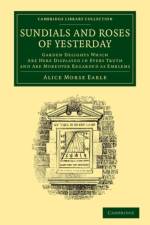
The American social historian and antiquarian Alice Morse Earle (1851-1911) published this lavishly illustrated book, among the last of her works, in 1902. By this time she had developed a distinctive style of historical writing which made innovative use of material evidence in its focus on the details of everyday life. She was particularly interested in family and society in colonial America, and her views about the importance of ancestry were reflected in her membership of the National Society of the Daughters of the American Revolution. Her fascination for beautiful things found lively expression in this learned and charming exploration of two 'garden delights'. Drawing readily on folklore, literature and anecdote, Earle brings to life her history of sundials and roses in Europe and America, touching on practical, aesthetic and symbolic aspects.
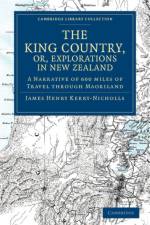
Originally published in 1884, this work by the relatively unknown 'gentleman explorer' James Henry Kerry-Nicholls (d. 1888) focuses on nineteenth-century New Zealand. It recounts the journey into what he describes as terra incognita, the area known as the King Country, almost exclusively Maori and little explored by Europeans due to political difficulties and Maori hostility. Travelling with only three horses and what he could carry on them, and accompanied by an interpreter, he endeavoured to cover and accurately record details of an area totalling 10,000 square miles; owing to good contacts, he was even able to meet Maori King Tawhiao. Writing in what now seems an imperialist style, he recounts a history of Maori-European relations, notes potential sites for European settlement, includes geographical surveys and descriptions of the landscapes, and supplies a map which gives the 'most complete chart of the interior of the North Island as yet published'.
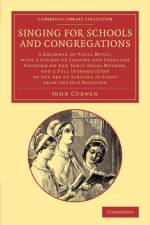
John Curwen (1816-80), minister and music educationist, is remembered for his promotion in Britain of the tonic sol-fa system of teaching singing. He had an innate understanding of the social value of music in education, and it was in response to being asked in 1841 to recommend the best way of teaching music in Sunday schools that he developed Norwich schoolteacher Sarah Glover's system from her Scheme for Rendering Psalmody Congregational (1835). He would spend the rest of his life refining it. Not to be confused with John Hullah's 'fixed doh' system, Curwen's method spread rapidly and by the 1860s over 180,000 people in Britain were learning tonic sol-fa. First published in 1843 and reissued here in its revised and expanded edition of 1848, this thorough textbook sets out Curwen's method, complete with a wide range of exercises for class practice.
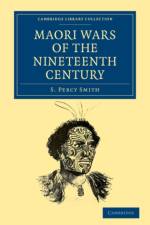
Stephenson Percy Smith (1840-1922) arrived in New Zealand as a boy, and in early 1858 travelled six hundred miles exploring the volcanic interior of North Island, including Taupo, Lake Tarawera and the Tongariro-Ruapehu area, returning via Rangitikei and Wanganui. He also witnessed the unrest caused by the rapid European encroachment on Maori lands. After retiring in 1900 from his career as a government surveyor, Smith devoted himself to the study of the Maori and co-founded the Polynesian Society, in whose journal this study originally appeared between 1899 and 1901. Reissued here in its enlarged second edition of 1910, it deals with the inter-tribal 'Musket Wars' of the early nineteenth century, when different Maori communities competed for territory shortly before European settlement began in earnest. Although Smith's interpretations do not meet modern scholarly standards, his pioneering work still provides fascinating insights into nineteenth-century Maori traditions and their colonial reception.
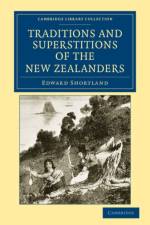
This historical and anthropological account of the Maori of New Zealand was published in 1854 by the English physician and colonial administrator Edward Shortland (1812-93). Shortland was deeply interested in Maori culture, learned the language, and wrote ethnographic studies including The Southern Districts of New Zealand (1851) and Maori Religion and Mythology (1882), also included in this series. In various roles including 'Protector of Aborigines', he often served as interpreter, and played an active role in mediating not only between Europeans and Maori, but between different Maori factions. Unlike many of his contemporaries, Shortland's approach was to interact with the Maori rather than merely observe them. In this book, Shortland often cites named Maori individuals as his sources, which makes his treatment of topics such as tapu, land tenure and rites of passage distinctive. He also covers Maori cosmology and origin narratives, genealogies, education, proverbs, songs and spells.
The politician, landowner and journalist W. C. Wentworth (1790-1872), was an energetic and controversial character in the early history of modern Australia. Together with Gregory Blaxland and William Lawson, he was the first to cross Australia's Blue Mountains. A well-known public figure in the colony of New South Wales, he founded a newspaper called The Australian (in 1824) and campaigned, among other things, for a free press, trial by jury, rights for emancipated convicts, public education, and a representative government. He also became extremely wealthy. In this book, first published in 1819, Wentworth argues that the Australian colonies are a better choice than the United States of America for European emigrants. The book contains a vast amount of information about the colonies of New South Wales and Tasmania, together with Wentworth's suggestions for the improvement of their government, and remains an important source for historians.
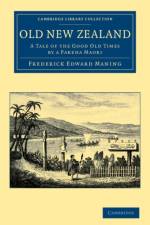
First published anonymously in 1863, this classic book recounts the experiences of Frederick Edward Maning (c.1811-83), an Anglo-Irish trader who emigrated to Tasmania with his family as a boy and later relocated to New Zealand. A self-styled 'Pakeha-Maori' ('Pakeha' is the Maori word for a white New Zealander), Maning acquired land and settled down with a Maori woman, occupying a tenuous position between the two cultures. Observing that the old Maori way of life was rapidly disappearing due to the increased European presence in New Zealand, Maning endeavoured to record Maori customs and material culture before all knowledge of them disappeared. Old New Zealand is a mixture of history, autobiography and anecdote, and the author insists all the incidents and people described are real. The language is informal, and the narrative vigorous and rapid, with lively dialogues and occasional Maori phrases. A glossary explains Maori words and concepts.
George Dolby (?-1900) was the manager of Charles Dickens' highly successful reading tours in England and America between 1866 and 1870. He published this memoir of Dickens in 1885. Dickens was a keen amateur actor and had many friends involved with the theatre. He had begun public readings from his works in 1853 for charity, but in 1858 his first for-profit tour, lasting three months, covered much of England, Scotland and Ireland, and netted over GBP10,000. Without props or costumes, he brought his most popular characters to life, and continued to undertake lengthy and exhausting tours until shortly before his death (which some believed had been hastened by his exertions on stage). Dolby's account covers only the period of his own connection with Dickens, but he describes in detail the constant travel which the tours entailed, the people they encountered, and the enthusiastic response with which Dickens was everywhere received.
A masterpiece of rhetoric and an impassioned defence of faith in the face of persecution, this work represents a key work in the Latin patristic canon. Addressing the magistrates of the Roman court, Tertullian submits 'the real facts in the case of the Christians', defending the legitimacy of the new faith while charging its detractors with hypocrisy and worse. Scathing, eloquent and defiant, the Apology demonstrates the importance of classical rhetoric to the identity of the controversial religion and its recent converts. This edition (1917), accompanied by a complete commentary by J. E. B. Mayor and translation by Alexander Souter, has been called 'by the far the best commentary ever published' on the work. Published posthumously from Mayor's extensive Cambridge lecture notes, the commentary is a starting point for anyone seeking a full understanding of the text's critical history. Souter's English translation makes it accessible to experts and non-experts alike.
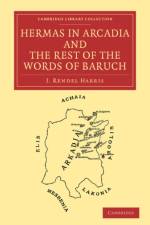
Much of the work of James Rendel Harris (1852-1941), palaeographer and biblical scholar, focused on the translation and understanding of early Christian writing, and this collection of two volumes of essays examines two key texts. The first work in this reissue, published in 1896, discusses the book known as 'The Shepherd of Hermas'. This early work, thought to be written in Rome around the first or second century CE, is composed of three parts: visions, commandments and similitudes. Harris examines aspects of the work, such as how to interpret the ninth similitude - as allegory or literally - and discusses in detail questions about translation. Themes of other essays include the legendary library of Prester John in Abyssinia, the third-century writer Gaius the Presbyter and problems surrounding the fourth-century Codex Euthalianus. The second work, published in 1889, is concerned with the apocalyptic language in the book of Baruch.
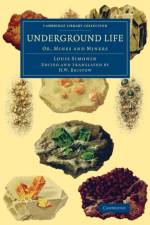
Born in Marseilles, Louis Simonin (1830-86) became a leading mining engineer of his age. He travelled widely on government and private commissions, particularly around the United States, where he was held in very high esteem. His posthumous renown rests primarily on this substantial work on mining, first published in 1867. The book is divided into three parts, dealing with coal mining, metal mining, and the mining of precious stones. It covers metallurgy and mineralogy, the history of mining, and techniques, methods and equipment. Bringing the struggles of miners to life, and enhanced by numerous illustrations by some of the leading engravers of the day, the book is regarded as having inspired and informed Emile Zola, whose great novel Germinal (1885) depicts coal miners' lives during a strike. Simonin's work reached a wide readership in his native France, and this English translation appeared in 1869.
Abonner på vårt nyhetsbrev og få rabatter og inspirasjon til din neste leseopplevelse.
Ved å abonnere godtar du vår personvernerklæring.