






Gjør som tusenvis av andre bokelskere
Abonner på vårt nyhetsbrev og få rabatter og inspirasjon til din neste leseopplevelse.
Ved å abonnere godtar du vår personvernerklæring.Du kan når som helst melde deg av våre nyhetsbrev.

F. H. Bradley (1846-1924) was the foremost philosopher of the British Idealist school, which came to prominence in the second half of the nineteenth century. Bradley, who was a life fellow of Merton College, Oxford, was influenced by Hegel, and also reacted against utilitarianism. He was recognised during his lifetime as one of the greatest intellectuals of his generation and was the first philosopher to receive the Order of Merit, in 1924. His work is considered to have been important to the formation of analytic philosophy. In metaphysics, he rejected pluralism and realism, and believed that English philosophy needed to deal systematically with first principles. This work, first published in 1893, is divided into two parts: 'Appearance' deals with exposing the contradictions that Bradley believed are hidden in our everyday conceptions of the world; and in 'Reality', he builds his positive account of reality and considers possible objections to it.
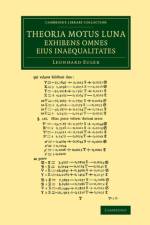
The problem of the moon's orbit was one that Leonhard Euler (1707-83) returned to repeatedly throughout his life. It provided a testing ground for Newton's theory of gravitation. Could the motion of the moon be entirely accounted for by Newton's theory? Or, as Euler initially suspected, did other forces need to be invoked? For practical purposes, if the moon's orbit could be accurately predicted, its motion would provide the universal timekeeper required to solve the longitude problem. In addition to the mathematical 'three-body problem', a topic still under investigation today, Euler was faced with the statistical problem of reconciling observations rendered inconsistent by experimental error. The present work, published in Latin in 1753, is Euler's triumphant solution. It may not be the last word on a subject which has occupied mathematicians and astronomers for over three centuries, but it showed that Newton's laws were sufficient to explain lunar motion.
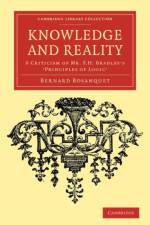
After more than a decade teaching ancient Greek history and philosophy at University College, Oxford, British philosopher and political theorist Bernard Bosanquet (1848-1923) resigned from his post to spend more time writing. He was particularly interested in contemporary social theory, and was involved with the Charity Organisation Society and the London Ethical Society. He wrote numerous articles before beginning this book, which was his first and was published in 1885 as a response to the Principles of Logic, published in 1883, by his contemporary F. H. Bradley (1846-1924). Bosanquet, who was deeply influenced by the German philosopher Hegel (1770-1831), argues that there are 'signs of a philosophical movement in this country which may assimilate what is really great in European philosophy, without forfeiting the distinctive merits of English thought'. With this as the framework, the book examines the relationship of judgment and logic to knowledge.
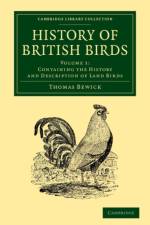
Thomas Bewick (1753-1828) is synonymous with finely crafted wood engravings of the natural world, and his instantly recognisable style influenced book illustration well into the nineteenth century. During his childhood in the Tyne valley, his two obsessions were art and nature. At fourteen, he was apprenticed to the engraver and businessman Ralph Beilby (1743-1817) with whom he later published A General History of Quadrupeds (also reissued in this series). The present work, with its text compiled from various sources, was the first practical field guide for the amateur ornithologist, inspiring also artists and writers. Each of the two volumes contains hundreds of illustrations of breathtaking beauty and precision: one for each species, neatly capturing its character in exquisite detail, interspersed with charming vignettes of country life. Volume 1, first published in 1797, covers land birds, including eagles, owls, sparrows and finches.
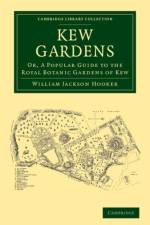
The eminent British botanist Sir William Jackson Hooker (1785-1865) expanded and developed the Royal Botanic Gardens at Kew into a world-leading centre of research and conservation. Appointed its first full-time director in 1841, Hooker came to Kew following a highly successful period in the chair of botany at Glasgow University. He quickly began to extend the gardens, arranging for the building of the now famous Palm House and establishing the Museum of Economic Botany. This volume reissues Hooker's popular guides to the gardens (sixteenth edition) and to the museum (third edition), both published in 1858. Illustrated throughout, these documents reveal the areas and specimens accessible to a receptive Victorian public. Hooker's ten volumes of Icones Plantarum (1837-54) have also been reissued in this series, along with many works by his son and equally accomplished successor, Sir Joseph Dalton Hooker (1817-1911).
In this short work of 1860, William Craft (c.1825-1900), assisted by his wife Ellen (c.1825-91), recounts the remarkable story of how they escaped from slavery in America. Having married as slaves in Georgia, yet unwilling to raise a family in servitude, the couple came up with a plan to disguise the light-skinned Ellen as a man, with William acting as her slave, and to travel to the north in late 1848. This compelling narrative traces their successful journey to Philadelphia and their subsequent move to Boston, where they became involved in abolitionist activities. Later, the couple sought greater safety in England, where they lived for a number of years and had five children. A success upon its first appearance, the book touches on the themes of race, gender and class in mid-nineteenth-century America, offering modern readers a first-hand account of how barriers to freedom could be overcome.
A miller's son, George Green (1793-1841) received little formal schooling yet managed to acquire significant knowledge of modern mathematics, especially French work. In 1828 he published his Essay on the Application of Mathematical Analysis to the Theories of Electricity and Magnetism, the work for which he is now celebrated. Admitted to Cambridge in 1833 as a mature student, Green went on to become a fellow of Gonville and Caius College. His early death, however, cut short a promising career as a mathematical physicist. While English contemporaries saw what he might have achieved, they did not understand what he had actually achieved. Only when William Thomson (later Lord Kelvin) rediscovered Green's first publication and shared it with the French mathematical elite was his greatness truly appreciated. Edited by the Cambridge mathematician Norman Macleod Ferrers (1829-1903) and published in 1871, this collection comprises Green's influential essay and nine further papers.
In 1844, the Prussian schoolmaster Hermann Grassmann (1809-77) published Die Lineale Ausdehnungslehre (also reissued in the Cambridge Library Collection). This revolutionary work anticipated the modern theory of vector spaces and exterior algebras. It was little understood at the time and the few sympathetic mathematicians, rather than trying harder to comprehend it, urged Grassmann to write an extended version of his theories. The present work is that version, first published in 1862. However, this also proved too far ahead of its time and Grassmann turned to historical linguistics, in which field his contributions are still remembered. His mathematical work eventually found champions such as Hankel, Peano, Whitehead and Elie Cartan, and it is now recognised for the brilliant achievement that it was in the history of mathematics.
A three-level (B1+ to C1) integrated skills course for higher education students at university or on foundation courses. Designed specifically for students preparing for university, this integrated skills course develops language and real academic skills essential for successful university studies across disciplines. With authentic lectures and seminars, language informed by the Cambridge Academic Corpus and Academic Word Lists, the course guarantees that students learn real, up-to-date English that is relevant to their university studies. The Teacher's Book provides extensive teacher support including teaching notes and additional worksheets for the classroom.
A pioneering Egyptologist, Sir William Matthew Flinders Petrie (1853-1942) excavated over fifty sites and trained a generation of archaeologists. In the early 1890s, he carried out significant work at Tell el-Amarna, the site of the ancient capital of Akhetaten. The illustrated 1894 excavation report that he co-authored has also been reissued in this series, along with many of his other publications. Petrie played a notable part in the preservation of a number of cuneiform tablets that became known collectively as the Tell el-Amarna letters. In this 1898 work, he presents summaries of the most important documents. They offer insights into war, peace and diplomacy in the Near East during the reigns of Amenhotep III and Akhenaten in the fourteenth century BCE. Informative notes on individuals and places mentioned in the letters help set them in context, while the methods used to interpret them are also elucidated.
Luke Howard (1772-1864) was a pharmacist and businessman, but is most famous for his contributions to meteorology. He classified clouds by their appearance and gave them their modern names of cumulus, cirrus, nimbus and stratus. He was educated at a Quaker school in Oxfordshire, then trained as a pharmacist, but was fascinated by weather throughout his life, and developed into a keen amateur meteorologist. He wrote several important texts on the subject including The Climate of London, an early study in urban climatology, and On the Modification of Clouds (both also reissued in this series). Published in 1837, Seven Lectures on Meteorology covers the components of the atmosphere, seasonal variation in winds and temperature, the use of barometers, cloud structure, and visual phenomena such as rainbows and the Aurora Borealis. This reissue also includes Howard's short 1842 book which details selected British weather data from 1824 to 1841.
Among the leading Egyptologists of his day, Sir William Matthew Flinders Petrie (1853-1942) excavated over fifty sites and trained a generation of archaeologists. As a young man, he demonstrated an aptitude for mathematics and used this skill to measure monuments across the south of England, including Stonehenge. Published in 1877, this work was based in part on these early surveys and provides great insight into the linear measurements used by ancient civilisations. Notably, Petrie establishes that accurate measurement was possible in societies without writing systems. His innovative approach to metrology draws comparisons between units of measurement used by peoples separated by great spans of time and distance, ranging from medieval Ireland to ancient Egypt. Petrie went on to write prolifically throughout his long career, and a great many of his other publications are also reissued in this series.
A pioneering Egyptologist, dedicated to careful, methodical and economical research, Sir William Matthew Flinders Petrie (1853-1942) made Near Eastern archaeology a much more rigorous and scientific discipline. This 1906 publication covers Petrie's work in the Sinai Peninsula, investigating the historical and biblical significance of the region, especially as it related to the Exodus. Copiously illustrated with photographs, the book depicts the region's climate, geography and antiquities, recording the logistical and archaeological processes that characterised Petrie's approach. Notable is the material on ancient turquoise mines and a Middle Kingdom temple at Serabit el-Khadim, where inscriptions in the previously unknown Proto-Sinaitic script were discovered. Several chapters by Charles T. Currelly (1876-1957) record additional travels and observations. Petrie wrote prolifically throughout his long career, and a great many of his other publications are also reissued in this series.
Among the leading Egyptologists of his day, Sir William Matthew Flinders Petrie (1853-1942) excavated over fifty sites and trained a generation of archaeologists. Pioneering in his rigorous recording of evidence, Petrie wrote prolifically throughout his long career and is credited with bringing his subject to a wider audience. A great many of his other publications are also reissued in this series. First published in 1892 and intended for non-specialists, this highly readable book summarises Petrie's recent work in Egypt, including his surveying of the pyramids of Giza and his discovery of the city of Naukratis in the Nile Delta. Illustrated throughout with detailed line drawings, this work sheds much light on Petrie's influential approach as well as the technological and artistic achievements of ancient Egyptian civilisation. It will appeal to those who wish to learn about the birth of modern Egyptology and the methods of its founding father.
A pioneering Egyptologist, Sir William Matthew Flinders Petrie (1853-1942) excavated over fifty sites and trained a generation of archaeologists. The two excavation reports now reissued here together were first published in 1891 and 1892 respectively, written in collaboration with other experts. They outline significant finds at the pyramids of Lahun and Meidum, and at Gurob and Kahun, notably the latter's cache of Middle Kingdom papyri. Petrie and his collaborators describe in detail how they came to make these discoveries, shedding light on developing archaeological practices used towards the end of the nineteenth century. Petrie's professional method of painstakingly recording every find is well demonstrated here, and each report includes a section of valuable illustrative material. Petrie wrote prolifically throughout his long career, and a great many of his other publications - for both specialists and non-specialists - are also reissued in this series.
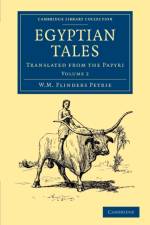
Although some of Egypt's most important archaeological finds were made in the late nineteenth century, at a time when historical fiction was popular, the literature of Egypt had reached very few English readers. Aiming to bring ancient Egypt to life in the public imagination, eminent archaeologist W. M. Flinders Petrie (1853-1942) published in 1895 this two-volume collection of original stories, accompanied by illustrations and helpful contextualising comments. The four tales of Volume 2 are set in the period from the reign of Thutmose III during the eighteenth dynasty to the time of Setna, a son of Ramesses II of the nineteenth dynasty. Shedding light on contemporary life and literature, the stories represent a valuable resource for Egyptologists and folklorists. Petrie's rendering of the stories into English, based on translations of various papyri, remains accessible to all. Many more of his works, for both specialists and non-specialists, are also reissued in this series.
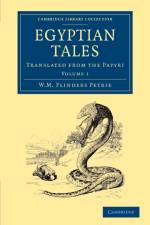
Although some of Egypt's most important archaeological finds were made in the late nineteenth century, at a time when historical fiction was popular, the literature of Egypt had reached very few English readers. Aiming to bring ancient Egypt to life in the public imagination, eminent archaeologist W. M. Flinders Petrie (1853-1942) published in 1895 this two-volume collection of original stories, accompanied by illustrations and helpful contextualising comments. The six stories of Volume 1 include elements of both fantasy and historical fact, spanning the period from the court of Khufu during the fourth dynasty to the death of Amenemhat I, founder of the twelfth. Shedding light on contemporary life and literature, the stories represent a valuable resource for Egyptologists and folklorists. Petrie's rendering of the stories into English, based on translations of various papyri, remains accessible to all. Many more of his works, for both specialists and non-specialists, are also reissued in this series.
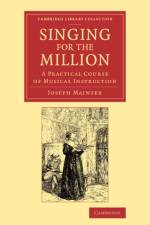
Joseph Mainzer (1801-51), priest, music teacher and composer, had an important influence on the development of the choral movement in the first half of the nineteenth century. Forced to flee his native Germany in 1833 because of his political views, he arrived in London in 1839 via Brussels and Paris, where his singing classes for labourers were immensely successful. Although his musical compositions are largely forgotten, his mission to bring singing to the masses is not: he published a number of works on the subject and established Mainzer's Musical Times, which later became The Musical Times. First published in 1841, this short singing textbook for an English audience is a classic resource in music education, presenting the basics of the fixed sol-fa system together with a generous quantity of musical examples. Mainzer's 1848 work, Music and Education, has also been reissued in this series.
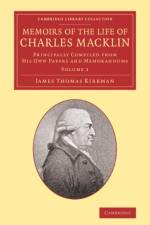
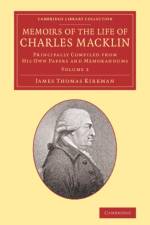
Drawing on his own papers and first published in 1799, this two-volume account traces the colourful life of the actor and playwright Charles Macklin (c.1699-1797). His long career serves as the focal point in a history of the eighteenth-century theatre and its most celebrated performers. Hailed for his enduring interpretation of Shakespeare's Shylock, a role he played for some fifty years, Macklin has been credited with the theatre's move towards realism. His life was just as dramatic offstage, marked as it was by a series of controversies and fierce rivalries. In 1735 he was convicted of the manslaughter of a fellow actor in a quarrel over a wig, and in 1775 he successfully pressed charges of conspiracy against theatregoers who had rioted during his performances. Volume 1 covers Macklin's childhood and early career, including his trial for the killing of Thomas Hallam.
Drawing on his own papers and first published in 1799, this two-volume account traces the colourful life of the actor and playwright Charles Macklin (c.1699-1797). His long career serves as the focal point in a history of the eighteenth-century theatre and its most celebrated performers. Hailed for his enduring interpretation of Shakespeare's Shylock, a role he played for some fifty years, Macklin has been credited with the theatre's move towards realism. His life was just as dramatic offstage, marked as it was by a series of controversies and fierce rivalries. In 1735 he was convicted of the manslaughter of a fellow actor in a quarrel over a wig, and in 1775 he successfully pressed charges of conspiracy against theatregoers who had rioted during his performances. Volume 2 covers the latter part of Macklin's career up to his death. Also included is a selection of letters written to his son.
One of the great algebraists of the nineteenth century, Marie Ennemond Camille Jordan (1838-1922) became known for his work on matrices, Galois theory and group theory. However, his most profound effect on how we see mathematics came through his Cours d'analyse, which appeared in three editions. Reissued here is the first edition, which was published in three volumes between 1882 and 1887. While highly influential in its time, it now appears to us a transitional work between the partially rigorous 'epsilon delta' calculus of Cauchy and his successors, and the new 'real number' analysis of Weierstrass and Cantor. The first two volumes follow the old tradition while the third volume incorporates a substantial amount of the new analysis. Ten years later, the even more influential second edition followed the new point of view from its start. Volume 1 (1882) covers differential calculus.
One of the great algebraists of the nineteenth century, Marie Ennemond Camille Jordan (1838-1922) became known for his work on matrices, Galois theory and group theory. However, his most profound effect on how we see mathematics came through his Cours d'analyse, which appeared in three editions. Reissued here is the first edition, which was published in three volumes between 1882 and 1887. While highly influential in its time, it now appears to us a transitional work between the partially rigorous 'epsilon delta' calculus of Cauchy and his successors, and the new 'real number' analysis of Weierstrass and Cantor. The first two volumes follow the old tradition while the third volume incorporates a substantial amount of the new analysis. Ten years later, the even more influential second edition followed the new point of view from its start. Volume 2 (1883) covers the theory of integrals.
One of the great algebraists of the nineteenth century, Marie Ennemond Camille Jordan (1838-1922) became known for his work on matrices, Galois theory and group theory. However, his most profound effect on how we see mathematics came through his Cours d'analyse, which appeared in three editions. Reissued here is the first edition, which was published in three volumes between 1882 and 1887. While highly influential in its time, it now appears to us a transitional work between the partially rigorous 'epsilon delta' calculus of Cauchy and his successors, and the new 'real number' analysis of Weierstrass and Cantor. The first two volumes follow the old tradition while the third volume incorporates a substantial amount of the new analysis. Ten years later, the even more influential second edition followed the new point of view from its start. Volume 3 (1887) covers the integration of differential equations and the calculus of variations.
Published in 1848, this short work by Joseph Mainzer (1801-51) argues for the considerable value of music as part of general education. A German priest, teacher and composer, Mainzer had an important influence on the development of amateur music and the choral movement in the first half of the nineteenth century. Attracting large numbers of adult labourers, he gave free singing classes, using his own highly influential teaching system. Music, Mainzer argues here, not only brings direct moral and social benefits, but also takes the place of potentially harmful habits and leisure activities, such as the drinking of alcohol. The work defines music in relation to its educational value and potential, exploring the origins, development and moral influence of music since the ancient Greeks. Mainzer also discusses the ways in which music is taught at all levels.
Admired and studied by both Mozart and Beethoven, Franz Joseph Haydn (1732-1809) imbued his life-enhancing compositions with wit, elegance and deep emotion. His output was prolific and included symphonies (most notably those written during his two visits to London, where he received a rapturous welcome), string quartets, chamber music, piano sonatas and choral works. This concise biography, first published in 1884, forms part of music critic Francis Hueffer's Great Musicians series, which was intended to provide succinct accounts of popular composers for the general reader. The author, Pauline D. Townsend, drew much of her material for the book from the painstaking research on Haydn published by the German musicologist Carl Ferdinand Pohl, archivist and librarian of the Vienna Society of the Friends of Music. A list of Haydn's works forms an appendix, based on the information in Grove's Dictionary of Music and Musicians.
In terms of musical composition, all but the first five of his thirty-five years were astoundingly productive for Wolfgang Amadeus Mozart (1756-91). A stream of glorious symphonies, piano concertos, chamber music, operas and the sublime but unfinished Requiem poured from his pen. German philologist and archaeologist Otto Jahn (1813-69) was inspired to write a scholarly biography of Mozart following a conversation at Mendelssohn's funeral in 1847. He immersed himself in intensive research on the composer and his music, publishing the first edition of this landmark work in four volumes between 1856 and 1859. A second edition followed in 1867, incorporating new material and making use of Kochel's 1862 catalogue of Mozart's works. It is from this edition that Pauline D. Townsend made her three-volume English translation, first published in 1882. Volume 1 covers Mozart's life to 1778, including tours with his father and employment under Archbishop Colloredo.
In terms of musical composition, all but the first five of his thirty-five years were astoundingly productive for Wolfgang Amadeus Mozart (1756-91). A stream of glorious symphonies, piano concertos, chamber music, operas and the sublime but unfinished Requiem poured from his pen. German philologist and archaeologist Otto Jahn (1813-69) was inspired to write a scholarly biography of Mozart following a conversation at Mendelssohn's funeral in 1847. He immersed himself in intensive research on the composer and his music, publishing the first edition of this landmark work in four volumes between 1856 and 1859. A second edition followed in 1867, incorporating new material and making use of Kochel's 1862 catalogue of Mozart's works. It is from this edition that Pauline D. Townsend made her three-volume English translation, first published in 1882. Volume 2 covers Mozart the man, the break with Colloredo, his move to Vienna, marriage, and Freemasonry.
In terms of musical composition, all but the first five of his thirty-five years were astoundingly productive for Wolfgang Amadeus Mozart (1756-91). A stream of glorious symphonies, piano concertos, chamber music, operas and the sublime but unfinished Requiem poured from his pen. German philologist and archaeologist Otto Jahn (1813-69) was inspired to write a scholarly biography of Mozart following a conversation at Mendelssohn's funeral in 1847. He immersed himself in intensive research on the composer and his music, publishing the first edition of this landmark work in four volumes between 1856 and 1859. A second edition followed in 1867, incorporating new material and making use of Kochel's 1862 catalogue of Mozart's works. It is from this edition that Pauline D. Townsend made her three-volume English translation, first published in 1882. Volume 3 discusses the Mozart-Da Ponte operas and the Requiem, and also includes a list of his works.
One of the most prolific composers of the nineteenth century, Sir George Alexander Macfarren (1813-87) produced operas, symphonies, and instrumental and choral works, and is remembered today for the overture Chevy Chace. Son of the London impresario George Macfarren, he studied composition with Cipriani Potter at the Royal Academy of Music, becoming a professor there in 1837. Despite encroaching blindness, which became total in 1860, he remained at the centre of British musical life, continuing to compose, lecture, write and teach. Following the death of William Sterndale Bennett in 1875, he became professor of music at Cambridge and principal of the Royal Academy of Music. Reissued here is the 1882 third edition of a series of lectures on harmony delivered at the Royal Institution in 1867, intended to enhance the amateur listener's musical appreciation. They are based on Alfred Day's controversial Treatise on Harmony (also reissued in this series).
From his funerary monument in Stratford-upon-Avon to the engraving by Droeshout in the First Folio, the depictions of William Shakespeare (1564-1616) have long been the subject of scrutiny. Equally, the mystery surrounding the identity of 'W. H.', the dedicatee of Shakespeare's sonnets, continues to capture the imagination. This volume brings together three works that were originally published separately: two pieces on the portraits and one on the sonnets. A playwright turned theatrical biographer, James Boaden (1762-1839) cultivated a lifelong interest in Shakespeare. His illustrated 1824 analysis of the portraits examines the evidence concerning their authenticity. This is followed by an 1827 investigation by the portrait painter Abraham Wivell (1786-1849), who engages critically with Boaden's findings and those of others. Finally, Boaden's 1837 essay on the sonnets presents the case for naming William Herbert, Earl of Pembroke, as their dedicatee - a claim taken up by many later scholars.
Abonner på vårt nyhetsbrev og få rabatter og inspirasjon til din neste leseopplevelse.
Ved å abonnere godtar du vår personvernerklæring.