




Gjør som tusenvis av andre bokelskere
Abonner på vårt nyhetsbrev og få rabatter og inspirasjon til din neste leseopplevelse.
Ved å abonnere godtar du vår personvernerklæring.Du kan når som helst melde deg av våre nyhetsbrev.

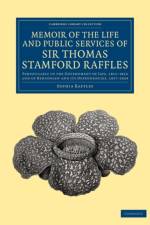
During his last voyage back to England, the ship of Sir Thomas Stamford Raffles (1781-1826) caught fire, consuming many of the papers from which future biographers might have worked. When he died two years later, the task of sifting through the surviving materials and recording his life and career fell to his widow Sophia (1786-1858). Her substantial biography, first published in 1830, remains an essential source of information about one of the key figures of British colonialism in the East Indies. At the centre of the book, interspersed with many of her husband's letters, is Raffles' struggle against his Dutch opponents, with whom he clashed on ideological grounds - he noted with distaste their mistreatment of the local population and their advocacy of slavery. It was this rivalry which convinced Raffles to found Singapore as a trading post. His two-volume History of Java (1817) is also reissued in this series.
The German classical philologist Friedrich August Wolf (1759-1824) developed a holistic approach which deeply influenced modern classical studies. In this 1795 treatise, he argues that the poems attributed to Homer were composed orally and that, prior to their transcription, they were altered by editors and performers in order to appeal to contemporary audiences, only coming together in their apparent artistic unity once they had been written down. Like many scholars of his day, seeking to reach an international audience, Wolf wrote in Latin here. And although he may have intended to address further questions relating to the Homeric epics, only this volume was ever published. Radical at the time, the arguments presented here now form the foundation of modern Homeric scholarship, shedding light on the composition, performance, transmission and evolution of ancient poetry.
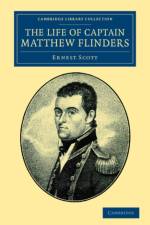
Matthew Flinders (1774-1814) joined the Royal Navy at fifteen, later claiming to have been inspired by Robinson Crusoe. He served under William Bligh, and charted the Bass Strait in 1798. In 1801 he was commissioned to chart 'New Holland', and so became the first to circumnavigate the island he referred to as Australia. After being shipwrecked on the Barrier Reef and imprisoned for six years on Mauritius on suspicion of spying, he returned to England in 1810 and began work on A Voyage to Terra Australis. He died the day after his book and maps were published. This biography, published in 1914 to mark the centenary of his death, was the first comprehensive study of this central figure of Australian maritime exploration. The leading Australian historian Ernest Scott (1868-1939) based his account on material held in private collections in France as well as on documents deposited in Australian libraries.
The library of the literary scholar Richard Farmer (1735-97) was first and foremost a working reference collection, the books acquired not as treasures, but to be read and appreciated. Farmer's library included all four Shakespeare folios and was remarkable for its Elizabethan literature and black letter, which provided the source material for his scholarly work. Notable acquaintances such as Samuel Johnson, George Steevens, Edmond Malone and Isaac Reed all benefitted from Farmer's knowledge, and Thomas Percy's Reliques of Ancient English Poetry drew directly on the library itself. In 1798, Farmer's books were sold at an auction attended by many of the next generation's greatest book collectors. Reissued here is a copy of the catalogue featuring handwritten annotations by an anonymous attendee who recorded the prices paid and the names of many buyers, uniquely capturing the dispersal of one of the eighteenth century's great libraries.
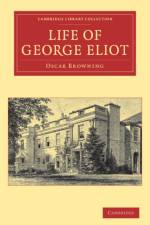
'George Eliot' was the pseudonym of Marian Evans (1819-80), possibly the greatest of the Victorian novelists, whose works include The Mill on the Floss (1860), Middlemarch (1871-2) and Daniel Deronda (1876). Her personal life was complex - she was an independent woman who challenged social conventions. Her friend, Eton master and historian Oscar Browning (1837-1923), was moved to write this affectionate assessment of her life, and it was published in 1890, offering 'no claims ... but a friendship of fifteen years, and a deep and unswerving devotion to her mind and character'. Browning takes a chronological approach, focusing mainly on the beginnings of Eliot's writing career and on her novels, while adding recollections of their encounters. He also writes with candour about Eliot's relationship and cohabitation with the married writer G. H. Lewes (1817-78), which transgressed the social norms of the period.
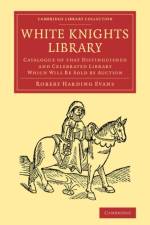
The dispersal of the library amassed by George Spencer-Churchill (1766-1840), Marquess of Blandford and later fifth Duke of Marlborough, is most commonly cited today as a preservative against folly. The collection contained some of the most sought-after incunabula of a period defined by the high prices paid for early printed books. It included a fine selection of Caxtons, spectacular botanical and emblem books, and the iconic Valdarfer Boccaccio - the first edition of the Decameron, purchased by Blandford in 1812 for the unprecedented sum of GBP2,260. The Boccaccio was symptomatic of the profligate expenditure of its buyer. By 1819 his spendthrift ways had ruined him, leading to the sale of his opulent estate at Whiteknights, near Reading, and the dispersal of one of the key libraries in the era of bibliomania. Reissued here together are the two parts of the auction catalogue, both annotated by an auction attendee who recorded details of the purchasers and the prices paid. Ed Potten, Head of Rare Books at Cambridge University Library, has provided a new introduction that places the catalogue in its wider context.
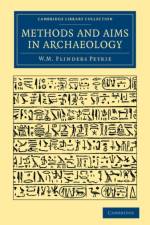
A pioneering Egyptologist, Sir William Matthew Flinders Petrie (1853-1942) excavated over fifty sites and trained a generation of archaeologists. In this short but classic work of 1904, he explains his vision for the young science of archaeology. Petrie outlines his processes and goals for an excavation, offering advice on how to manage workers drawn from the local population as well as guidance on creating a thorough record of a dig, the importance of which had not been fully appreciated by many contemporary archaeologists. His methods were highly influential in their more systematic and scientific approach to archaeology at a time when many of its practitioners were more focused on acquiring attractive artefacts than advancing knowledge. The text is accompanied by 66 illustrations. Petrie wrote prolifically throughout his long career, and a great many of his other publications - for both specialists and non-specialists - are also reissued in this series.
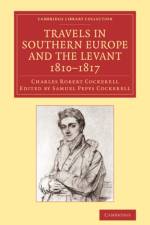
The architect Charles Robert Cockerell (1788-1863) was encouraged to travel at a young age, so that he might draw inspiration from the great works of European architecture. However, when the Napoleonic Wars made parts of the continent inaccessible to Englishmen, his eye was turned towards southern Europe and the Ottoman Empire. This version of the Grand Tour took up seven years, during which he recorded the events in his journals. There his observations would have remained had it not been for the editorial labours of his son, Samuel Pepys Cockerell (1844-1921), who published the present work in 1903. The narrative takes in such cities as Constantinople, Athens, Florence and Rome. Touching also on friendships made with such figures as Byron, the text gives a sense of what continental travel was like at that time and how the architecture of the past continued to captivate designers in the modern age.
Written by his son John Romney (1757-1832) and published in 1830, nearly three decades after the artist's death, this collection of anecdotes and biographical episodes traces the extraordinary career of George Romney (1734-1802), highlighting his early training as a joiner in the family firm, his artistic education at the hands of the disreputable Christopher Steele, and his eventual fame as a portraitist of fashionable London. Recollections of personal and professional encounters with such influential figures as Laurence Sterne and Richard Payne Knight provide insights into the circumstances that inspired Romney's most famous works. Including an engraving of his self-portrait of c.1784, a section on his brother and fellow painter Peter Romney (1743-77), and a list of the designs and studies which were donated in 1817 to the Fitzwilliam Museum in Cambridge, this work reveals much about the eighteenth-century art world, its patrons and its pitfalls.
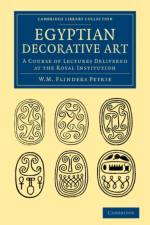
Among the leading Egyptologists of his day, Sir William Matthew Flinders Petrie (1853-1942) excavated over fifty sites and trained a generation of archaeologists. He published these carefully illustrated lectures in 1895. Exploring the ancient Egyptians' passion for decoration, he demonstrates his view that the elaborate use of hieroglyphs and design 'made the Egyptian the father of the world's ornament'. Petrie describes and illustrates the four main areas of decoration: the geometrical use of lines, spirals and curves; the representation of natural images such as feathers and flowers; the existence of structural patterns resulting from ancient techniques of building or manufacture; and the use of symbolic emblems such as the vulture, scarab and lion. Much modern-day design, Petrie argues, is influenced by ancient Egyptian aesthetics. Many of his other publications - for both Egyptologists and non-specialists - are also reissued in this series.
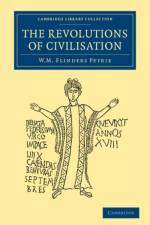
Among the leading Egyptologists of his day, Sir William Matthew Flinders Petrie (1853-1942) excavated over fifty sites and trained a generation of archaeologists. This short yet well-illustrated work, first published in 1911, sketches humankind's achievements over 10,000 years, establishing patterns in the rise and fall of civilisations. Drawing on his extensive knowledge of ancient Egypt, and looking also at Greece, Rome and beyond, Petrie defines each civilisation as having a summer of growth and a winter of decline, revealing his controversial eugenic view that while migration can initially reinvigorate a society, the mixing of peoples over time leads ultimately to that society's deterioration. Correlating developments in the production of art and material culture in different places, Petrie argues that civilisation is not a continuous state, but intermittent and recurrent. Many of his other publications - for both Egyptologists and non-specialists - are also reissued in this series.
The library of the chandler John Ratcliffe (1707-76) was amassed before the onset of 'bibliomania', and perfectly illustrates the last days of a period of book collecting when scholars and commoners could hope to compete with wealthy noblemen. The collection contained over a hundred incunabula, including forty-eight Caxtons, and a fine selection of sixteenth-century English books, alongside contemporary literature and Presbyterian tracts. Many of Ratcliffe's incunabula had been purchased from James West, others from Anthony Askew. In turn, his books were acquired by a circle of his contemporaries, including William Herbert, Charles Chauncy and William Hunter. However, the purchase of some of the finest books by the aristocratic Justin MacCarthy Reagh provided a hint of what was to come. Reissued here is James Christie's 1776 sale catalogue, featuring handwritten annotations by an attendee at the auction who recorded the prices paid and the names of buyers.
The library of the physician Anthony Askew (1722-72) was outstanding in both printed books and manuscripts. He may have failed in his ambition to secure a complete collection of every printed edition of the Greek classics, but he did amass a classical library which remained unsurpassed until Spencer. Although he was later accused of plagiarism, virtually every edition of Aeschylus down to the 1850s cited 'Askew's collations'. He also secured Richard Mead's fine collection of Latin and Greek manuscripts, alongside other early classical codices from the Maffei library. The dispersal of Askew's collection in two sales, ten years apart, attracted international interest. Bidders at the 1775 book sale included George III, while the manuscript sale in 1785 led to acquisitions by the British Museum, the Bodleian and Cambridge University Library. Now reissued together, the sale catalogues have been annotated here by auction attendees who recorded prices and some purchaser details.
Once the political centre of Lower Egypt, the city of Tanis was in ruins by the time pioneering archaeologist W. M. Flinders Petrie (1853-1942) arrived in the late nineteenth century. He recruited more than a hundred workers from nearby settlements to help with his excavations there. Now reissued together, these two reports of Petrie's discoveries were originally published separately in 1885 and 1888. His colleague Francis Llewellyn Griffith (1862-1934) contributes epigraphic analysis and translations. Each report contains much illustrative content, such as maps and photographs of the sites as well as drawings of the finds and hieroglyphic inscriptions. The 1888 publication also covers work carried out at Nebesheh and Defenneh, neither of which had been previously studied by archaeologists. Alexander Stuart Murray (1841-1904) discusses the important discoveries of painted vases at the latter site. Many of Petrie's other Egyptological publications are also reissued in this series.
A pioneer of British Egyptology, Sir John Gardner Wilkinson (1797-1875) first travelled to Egypt in 1821, the year before Champollion published his breakthrough work on the Rosetta Stone. As public interest in Egypt grew, Wilkinson studied and sketched the country's major archaeological sites, most notably the tombs of Thebes. When published in 1835, the present work was the first major book in English on the subject and the most substantial since the French Description de l'Egypte. The text and plates present a detailed picture of contemporary Egypt in relation to its ancient heritage. Wilkinson remodelled and expanded the work as Modern Egypt and Thebes (1843), and his chapter here on daily life in the days of the pharaohs formed the basis of his celebrated Manners and Customs of the Ancient Egyptians (1837). Both titles are also reissued in this series.
Paving the way for modern feminist thinking, Mary Wollstonecraft (1759-97) dared to challenge traditional eighteenth-century attitudes towards women. First published in 1787, this book discusses how girls can best be educated to become valuable wives and mothers. It argues that women can offer the most effective contribution to society if they are brought up to display sound morals, character and intellect, rather than superficial social graces. Wollstonecraft later developed her ideas in A Vindication of the Rights of Woman (also reissued in this series), in which she attacked the educational restrictions imposed upon women. Her writings formed a cornerstone of the battle for women's rights in the nineteenth and twentieth centuries. Prompting deeper reflection upon the role and status of women in modern society, the present work remains an instructive and provocative read for those seeking to learn about the roots of feminism in its social and historical context.
The foremost neoclassical sculptor of his age, Antonio Canova (1757-1822) is best known for his masterpiece The Three Graces, embodying in marble an ideal of feminine beauty. Descended from stonecutters, Canova was apprenticed to the sculptor Giuseppe Bernardi, quickly establishing his reputation for originality through works such as Psyche Revived by Cupid's Kiss. The idealism of his art, moving away from ornate baroque style, did much to increase the popularity of contemporary sculpture, and his skills were greatly acclaimed and in demand during his lifetime. The present work, first published in 1825 by the Scottish minister John Smythe Memes (1795-1858), is one of the many eulogistic works that appeared soon after Canova's death. Opening with a contextualising history of the development of modern sculpture, the book closely studies Canova's body of work and also contains a chronological catalogue of his creations with details of their owners and locations.
Professor of Political Economy at Cambridge, MP and Postmaster General, Henry Fawcett (1833-84) was a radical supporter of both feminism and class equality. He campaigned for the widening of access to universities and the preservation of public open spaces, and oversaw the development of the telephone network. This biography, first published in 1885, was written by Leslie Stephen (1832-1904), Fawcett's contemporary at Cambridge, who later helped found the Dictionary of National Biography. Although their ideologies diverged later in their careers, Stephen and Fawcett's friendship lasted for over thirty years. Stephen, who was uncertain at their first encounter whether Fawcett was a Cambridge undergraduate or a farmer, gives a lively account of his friend's years at Cambridge and his successful academic and parliamentary career, achieved despite his blindness (the result of an accident in 1858). The book provides fascinating insights into the life of this often overlooked but remarkable politician.
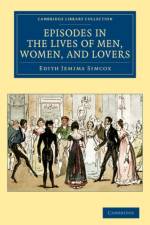
Edith Simcox (1844-1901) was a prominent British feminist, social critic and prolific writer. She published many articles and essays advocating support for women's right to education, improved working conditions and suffrage. Her scholarly works in philosophy and economic history sought to demonstrate that contemporary capitalism was not the only route to a prosperous society. Her articles appeared in many periodicals and among her books are Natural Law (1877) and the two-volume Primitive Civilizations (1894), both also reissued in this series. Simcox was an admirer and friend of the novelist George Eliot (1819-80), and her second book, published in 1882, is a collection of essays on a range of subjects, some of which were inspired by events in Eliot's life. Simcox uses her writings to explore melancholy, love, loss and longing through stories and sketches. For more information on this author, see http://orlando.cambridge.org/public/svPeople?person_id=simced
One of the most influential of the Victorian philosophers, Henry Sidgwick (1838-1900) also made important contributions to fields such as economics, political theory, and classics. An active champion of higher education for women, he founded Cambridge's Newnham College in 1871. He attended Rugby School and then Trinity College, Cambridge, where he remained his whole career. In 1859 he took up a lectureship in classics, and held this post for ten years. In 1869, he moved to a lectureship in moral philosophy, the subject where he left his greatest mark. Published posthumously in 1902, this work is Sidgwick's expository critique of the leading schools of thought that had emerged to rival his philosophy of utilitarianism, which he had presented previously in his masterpiece The Methods of Ethics (also reissued in this series).
One of the most influential of the Victorian philosophers, Henry Sidgwick (1838-1900) was the author of the masterpiece of utilitarianism, The Methods of Ethics. He also made important contributions to fields such as economics, political theory, and classics. An active champion of higher education for women, he founded Cambridge's Newnham College in 1871. He attended Rugby School and then Trinity College, Cambridge, where he remained his whole career. In 1859 he accepted a lectureship in classics, and held this post for ten years. He then changed direction and in 1869 took up a lectureship in moral philosophy. In this book, published in 1886, Sidgwick gives an objective summary of ethical philosophies throughout history. He considers general issues in ethics and then gives a detailed critique of the work of major philosophers from early Greek thinkers through to his nineteenth-century contemporaries.
Caroline Norton (1808-77), author and law reform campaigner, was the granddaughter of the playwright Sheridan and soprano Elizabeth Linley. Her disastrous, violent marriage in 1827 to the financially irresponsible Tory MP and barrister George Norton led her to seek escape in writing poetry. Anonymous autobiographical novels followed, exploring women's powerlessness in marriage, together with regular contributions to periodicals such as Macmillan's Magazine. Flamboyant, intelligent and temperamental, she secured her place in literary society, numbering Disraeli and Dickens among her friends. Ever jealous, her husband accused her of adultery with Lord Melbourne, but the case was unproven. In revenge, he refused his wife access to their sons, and it was this act which led to her determined campaign to improve the rights of women in marriage and divorce. This work, first published anonymously in 1837, was instrumental in the subsequent passing of the Custody of Infants Act (1839).
What is the nature of dialectic according to Hegel? And what is achieved by its means? These are the main questions that John McTaggart (1866-1925) seeks to answer in this work, first published in 1896. At the beginning of the twentieth century, the Cambridge-educated philosopher and fellow of Trinity College enjoyed a prominent position within the circle of idealist philosophers, and was regarded as one of England's leading Hegel scholars. Although a proponent of the German philosopher's dialectical thinking in general, McTaggart was not uncritical of Hegel's philosophy and objected to his application of abstract thought. In this work, McTaggart not only gives the reader a thorough introduction to Hegel's understanding of the dialectic method but also exposes a number of points on which he considers Hegel's teaching to be inaccurate: one of these is Hegel's insistence that evil is merely a delusion.
T. H. Green (1836-82) was a leading member of the British Idealist movement, which adopted the continental philosophy of Hegel and Kant while rejecting utilitarianism. As well as being a prominent philosopher, Green was an influential educational reformer and an active member of the Liberal party. Green's writings can be placed into three categories: religion, philosophy and politics. This work was the most complete statement of Green's philosophy, although it remained unfinished at his death (though parts had been published in the philosophical review Mind in 1882). Edited by A. C. Bradley, a former student and brother of Green's fellow Idealist F. H. Bradley, the book, which contains four parts (on metaphysics, the will, the moral ideal and progress, and the application of moral philosophy to the guidance of conduct), was published posthumously in 1883. Like other Idealists, Green criticised empiricism for creating an unnecessary dualism between thought and the real.
Having acquired a Shakespeare folio for a few shillings, anthropologist Daniel Wilson (1816-92) found in The Tempest a source of scientific intrigue. Writing more than two hundred years before Darwin propounded his theory of evolution, in his final play Shakespeare had created a missing link caught between the animal and the human. In this monograph, first published in 1873, Wilson uses the strange and unfortunate character of Caliban as a means through which to explore the principles of evolution. He traces many of the play's plot devices back to real events that perhaps inspired them - from storms in Bermuda to records of semi-human creatures around the world - and brings literary commentary into science as he links the relationships set out in the play to anthropological principles. This interdisciplinary approach makes the book both an entertaining exegesis of the play and a uniquely accessible explanation of contemporary scientific theories.
At a time when German philosophy was dominated by idealism, German philosopher and physician Ludwig Buchner (1824-99) wrote Kraft und Stoff, an influential work advocating materialism, in 1855. It went through many editions and was widely read across the world. The controversy surrounding the book led to Buchner leaving his post at the University of Tubingen, but he went on to establish the German Freethinkers' League, the first German organisation for atheists. This book, first published in 1864, is a translation of the eighth edition, and is edited by J. Frederick Collingwood, who wanted to bring Buchner's work to an English audience. It contains translations of the prefaces from the first, third and fourth editions of Kraft und Stoff, and an introductory letter from Buchner which expresses his belief that Darwin's theory of evolution has given support to his materialist theory.
A gifted yet controversial anatomical teacher, Robert Knox (1791-1862) published this remarkable study in 1852. It explores the influence of anatomy on evolutionary theories and fine art respectively. The first part of the work discusses the lives and scientific insights of the eminent French naturalists Georges Cuvier (1769-1832) and Etienne Geoffroy Saint-Hilaire (1772-1844). Rejecting the explanations offered by natural theology, Knox maintains that descriptive anatomy can give answers to questions surrounding the origin and development of life in the natural world. The latter part of the book is concerned with the relation that anatomy bears to fine art, specifically the painting and sculpture of the Italian Renaissance. Entering the debate about the importance of anatomical knowledge in art, Knox focuses on 'the immortal trio' of Leonardo da Vinci, Michelangelo and Raphael. Henry Lonsdale's sympathetic biography of Knox has also been reissued in this series.
Among the ablest anatomical teachers of his day, Robert Knox (1791-1862) also busied himself with the study of zoology and ethnology. Prepared by his pupil and colleague Henry Lonsdale (1816-76), this 1870 biography explores the scope of Knox's scientific research and the nature of his character. It describes how Knox developed at Edinburgh one of the most significant anatomical schools in Britain, playing a dominant role in expanding the comparative anatomy collection held by the city's Royal College of Surgeons. Despite his eminence and popularity as a lecturer, his reputation was deeply tarnished by his association with the notorious murderers Hare and Burke, who had provided Knox with bodies for dissection. Drawing on surviving correspondence and information gathered from friends and colleagues, Lonsdale's work stands as a robust defence and sympathetic portrait of a prominent yet controversial figure in the history of nineteenth-century medicine.
F. H. Bradley (1846-1924) was the foremost philosopher of the British Idealist school, which came to prominence in the second half of the nineteenth century and remained influential into the first half of the twentieth. Bradley, who was educated at Oxford, and spent his life as a fellow of Merton College, was influenced by Hegel, and also reacted against utilitarianism. He was recognised during his lifetime as one of the greatest intellectuals of his generation and was the first philosopher to receive the Order of Merit, in 1924. This collection of some of Bradley's most important journal articles was first published in 1914. He examines coherence and identity theories of truth, and discusses pragmatism and radical empiricism. The book contains extensive discussion of the work of Bertrand Russell and William James, while other essays cover a range of different subjects such as faith, memory, error and God.
British Idealist F. H. Bradley (1846-1924) was one of the most distinguished and influential philosophers of his time. He made contributions to metaphysics, moral philosophy and the philosophy of logic. The author of Appearance and Reality (1893), a classic in metaphysics (also reissued in this series), he rejected pluralism and realism. In this polemic, first published in 1876, Bradley argues against the dominant ethical theories of his time. Essays in this book entitled 'Pleasure for Pleasure's Sake' and 'Duty for Duty's Sake' examine and criticise hedonistic utilitarianism and Kantian ethics respectively. Bradley disagreed with individualism, and in 'My Station and its Duties' he discusses the idea that self-realisation can only be found as part of the social organism. This is a classic ethical work that will be valuable both to those studying the ethical theories discussed, and to those interested in the history of philosophy.
Abonner på vårt nyhetsbrev og få rabatter og inspirasjon til din neste leseopplevelse.
Ved å abonnere godtar du vår personvernerklæring.