


Gjør som tusenvis av andre bokelskere
Abonner på vårt nyhetsbrev og få rabatter og inspirasjon til din neste leseopplevelse.
Ved å abonnere godtar du vår personvernerklæring.Du kan når som helst melde deg av våre nyhetsbrev.

John Venn (1834-1923), a leading British logician, moral scientist and historian of Cambridge, came from a noted family of clerics, although he resigned from the clergy as his philosophical studies led him away from Anglican orthodoxy. This family memoir, published in 1904, covers the careers of three centuries of Venn clergy, together with an outline of the family origins and pedigrees. The family came from Devon, where William Venn was ordained in 1595, and two of his sons followed him. Richard Venn was displaced and jailed during the Commonwealth. The author's father, John, was the founder of an evangelical sect at Clapham (where his father Henry had also been curate), and of the Church Missionary Society, an organisation in which the author's brother, Henry, played a leading role. The study provides a microcosmic history of the Anglican Church from the Reformation to the end of the nineteenth century.
Originally written for private circulation among the Royal Family, this book, written by Lieutenant-General Charles Grey (1804-70), was first published in 1867. It details Prince Albert's life from his birth in 1819 through to his wedding to Queen Victoria and the first year of their married life. The Queen commissioned Grey, who had been secretary to both Albert and herself, as her husband's biographer, and the book was granted a wider publication, so that all who read it would 'tend to a better and higher appreciation of Prince Albert's great character'. Sourced from letters and memoranda, the book traces the development of Albert from an intelligent and gentle boy to the intellectual and moral compass of a nation. It records Albert's first visits to England, the wedding, his love for his adopted country and life in London, and includes details such as an attempted assassination of the Queen.
This volume of letters was published in 1884, when General Gordon (1833-85) was engaged in the controversial defence of Khartoum that claimed his life the following year. The reputation of 'Chinese' Gordon, a complex figure, unpopular with the British government and military but adored by the people and press, was fed by works such as this. Covering his time in the Crimea as a young lieutenant, and later in the drawing up of the new frontiers between the Russian and Ottoman empires, these letters were published by his later biographer, Demetrius C. Boulger (1853-1928) as evidence of Gordon's strength of character and value as a military leader. One reviewer noted in them an 'indomitable cheerfulness of disposition, patient endurance, trustful fatalism, simple courage and faith, ... [and] single-hearted devotion to duty', words which reflected the popular view of Gordon as a symbol of British national pride and imperial honour.
Originally published in 1792, this work was revised (incorporating new material) and corrected for the 1805 edition, reissued here. As a ship's purser and occasional Judge Advocate, Delafons had considerable experience of advising in naval courts martial, including first-hand involvement for the defence in the trial of Peter Heywood, a midshipman on board HMS Bounty during the mutiny of 1789. He intended this work to be a textbook for conducting judicial proceedings in the Royal Navy, and it is also now a fundamental text for historians and researchers in both the legal and naval history of a period of British maritime supremacy. Delafons covers the subjects of jurisdiction, evidence, sentencing, and the roles of individuals within the trial. He also makes a comparison between the law of the Navy and its practical applications and that of the civil courts, and examines the development of the Naval Code itself.
The diarist Mrs Henry Duberly (1829-1902), born Frances Locke, came to public attention through her Journal Kept during the Russian War, an 1855 account (also reissued in this series) of her experiences accompanying her husband's regiment in the Crimea, often as the only woman present. Her descriptions of military action - including the cavalry charges at Balaklava - and the hardships and gossip of army life, made it a popular success, although a dedication to Queen Victoria was declined. This 1859 volume narrates the Hussars' subsequent posting to India during the Mutiny. Describing the practicalities and privations of a 2,028 mile march through Rajputana from Bombay, and culminating in an account of the battle of Gwalior, including the news of Rani Lakshmi Bai's suicide, it illuminates the nature of military life in this tense period of Indian history, as well as the role of women on both sides of the conflict.
Published in 1867, this book discusses the Crimean War from a pro-Turkish perspective. Sir Adolphus Slade (1804-77) covers the history of Ottoman military development as well as the origins of the Eastern Question, and the events leading to the outbreak of war. As a naval officer, whose Records of Travels in Turkey, Greece, &c., and of a Cruize in the Black Sea, with the Capitan Pasha is also reissued in this series, he was lent to the Turkish fleet in 1849 and took the name Mushaver Pasha. For seventeen years he worked to overhaul the navy, especially the defences of the Bosphorus, and his successes made him impatient with the allied French and British fleets. In 1854, an argument with their Admirals led to his removal from active service, and to a bitterness reflected in this book, which nevertheless provides a fascinating perspective on the war's diplomatic and military complexities.
The liberal Radical MP Sir Charles Wentworth Dilke (1843-1911) campaigned for (among many other causes) votes for women and labourers, legalisation of trade unions and universal education. His republican sentiments damaged his political reputation, and earned him the hostility of Queen Victoria. However, despite his views on the monarchy he was an imperialist, and his early work, Greater Britain (1868; also available in this series), was widely read. In the 1890s he became known as a parliamentary expert on military, colonial and foreign affairs. This 1892 work, co-written with Spenser Wilkinson (1853-1937), a journalist and military historian, together with Dilke's earlier work, Problems of Greater Britain, led to the founding of a parliamentary committee on imperial defence. The book argues that, while hoping to avert war by diplomacy, the Government has a duty to maintain a naval and military force to protect the interests of its citizens.
In 1823, after relatively undistinguished diplomatic missions to Sicily and China, Lord Amherst (1773-1857) was appointed Governor-general of Bengal, a compromise candidate following Canning's sudden withdrawal to become foreign secretary. Arriving in India, he found the country on the brink of war with Burma, which he was unable to prevent or quickly to resolve, resulting in an expensive and demoralising two-year campaign, and the death of his eldest son. This 1894 biography, written by Anne Thackeray Ritchie (1837-1919), elder daughter of the novelist, and journalist Richardson Evans (1846-1923), was part of a series established by Sir William Wilson Hunter (1840-1900), a former Administrator in the subcontinent. Decidedly flattering in tone and glossing the War as 'a glorious enterprise of arms', this book, which quotes extensively from Lady Amherst's diary and other contemporary sources, is a fascinating example of the late-Victorian presentation of earlier colonial administration.
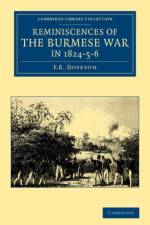
This first-hand account of the First Anglo-Burmese War (1824-6) was written by Captain Frederick Doveton of the Royal Madras Fusiliers and published in 1852. Intending to feed the contemporary British fascination with tales of Burma and its people, Doveton gives a brief history of the conflict, placing it into the context of the events leading up to the outbreak of the Second War (1852-3). He then offers a 'personal narrative' of his experiences, aimed at a popular rather than professional readership. His descriptions of Burmese life, landscape, and customs are full of anecdotes. These include his surprise at the natives playing chess, and his experience of having a tattoo; but he also shows respect for a people with an ancient history and culture, and conveys vividly the complexities and hardships of warfare and army life in an inhospitable terrain.
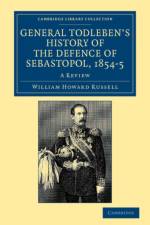
The journalist William Howard Russell (1820-1907) is sometimes regarded as being the first war correspondent, and his reports from the conflict in the Crimea are also credited with being a cause of reforms made to the British military system. This 1865 book began as a review in The Times of the five-volume work of General Eduard Todleben (or Totleben), the military engineer and Russian Army General, whose work in creating and continually adapting the land defences of Sevastopol in 1854-5 made him a hero and enabled the fortress to hold out against British bombardment for a whole year. Russell added extracts from the original book to his review, and enlarged his commentary on the Russian text, producing a thorough and accurate synthesis, but always highlighting the central importance of the Russian work to any student of the history of the Sevastopol siege.
The journalist William Howard Russell (1820-1907) is sometimes regarded as being the first war correspondent, and his reports from the conflict in the Crimea are also credited with being a cause of reforms in the British military system. This account of his time there, first published in 1858 and expanded in this 1895 edition, explains how Russell was sent by The Times of London in 1854 to join British troops stationed in Malta. He spent the next two years witnessing some of the key moments of the war, including the battle of Balaclava and the ill-fated Charge of the Light Brigade. His newspaper reports of the fighting and of the living conditions for the troops were widely read and very influential. In this retrospective work, Russell gives a more personal narrative of his experiences, making this an important account of one the most brutal wars of the nineteenth century.
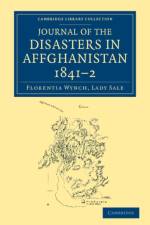
Lady Sale (nee Florentia Wynch, 1790-1853) became an instant heroine when her journal of the disastrous events in Afghanistan in 1841-2 was published in 1843. The wife of Sir Robert Sale, second-in-command of the British forces, she was taken hostage, along with her daughter and baby grand-daughter, after the massacre of over 4,500 British troops at Kabul, while her husband commanded a besieged garrison at Jalalabad. The small group of hostages was moved from place to place, with only the clothes they stood up in, to evade attempts at rescue over a period of nine months. Eventually, they were able to bribe a tribal leader to release them, and they met up with a British rescue party just before Afghani pursuers overtook them. Lady Sale's diary, carried in a cloth bag at her waist, was published almost unedited, and is an extraordinary account of her ordeal.
H. Rider Haggard (1856-1925) is best known as the successful writer of adventure stories with exotic backgrounds such as King Solomon's Mines. However, he also served on a number of royal commissions, and in managing his wife's Norfolk estate became a recognised expert on agricultural matters. His A Farmer's Year (1898, also reissued in this series), recounts the work of the farm, together with observations on rural life and the state of agriculture in general. In 1905 he published this work, a diary of his garden in 1903. After an introductory chapter (with a plan) describing the the garden, orchard and glasshouses, and the staff he employed, the diary begins, relating the tasks and experiences of the year, from spraying against red spider mite in January to decorating the house with greenery on Christmas Eve. This beautifully written book reveals the horticultural taste and practice of the Edwardian era.
The journalist and author W. H. Davenport Adams (1828-91) established a reputation for himself as a popular science writer, translator and lexicographer. He also wrote several children's books. In this 1889 work, Adams gives a general introduction to alchemy in Europe and traces the development of magic and alchemy in England from the fourteenth century onwards. Initially the disciplines were persecuted by the Church and met with 'the prejudice of the vulgar', languishing throughout the sixteenth and seventeenth centuries. In Book 1 Adams portrays the English 'magicians' Roger Bacon, whom he considers to have been ahead of his contemporaries; John Dee and William Lilly, astrologists of the sixteenth and seventeenth centuries, respectively; and the English Rosicrucians. Book 2 is a historical account of witchcraft in England and Scotland, from the middle ages to the witch trials of the seventeenth century, and includes a chapter on witchcraft in literature.
'A pioneer of modern anthropology', A. C. Haddon (1855-1940) contributed to the fields of embryology and evolutionary science before turning his interests to human civilisation and its history. In this work, first published in 1910, Haddon makes use of his wide-ranging knowledge of folk rituals and religious beliefs to introduce readers to basic principles of sympathetic magic, divination, talismanic powers and fetishism. A strong believer in the importance of preserving local religious practices and beliefs, Haddon uses the work to document customs from Britain to West Africa, America to Australia. Topics include forms of contagious magic, premised on a mutual influence between objects; amulets and talismans; magical names and words; and divination. In the second portion of the book, devoted to fetishism, Haddon offers an authoritative description of the fetish as a 'habitation, temporary or permanent, of a spiritual being', establishing basic definitions for an important field of cultural research.
Charles Piazzi Smyth (1819-1900) was appointed to the post of Astronomer Royal for Scotland and Regius Professor of Astronomy at Edinburgh University in 1846. He was respected for his practical work, and his Teneriffe, an Astronomer's Experiment (1858) is also reissued in this series. However, this book, first published in 1864, is testimony to the author's interest in 'pyramidology', and although it was so popular in his own lifetime that it was reprinted five times, his eccentric interpretation of the data he had collected by measuring all aspects of the Great Pyramid of Giza damaged his scientific reputation. Smyth was convinced that the British measurement standard of an inch as a basic unit of length was associated with the sacred cubit of the Bible. This measure was supposedly incorporated in the Pyramid, which he claimed was built under divine guidance by the Ancient Israelites, and enshrined scientific information.
Although famous throughout Europe for his mind-reading skills, Stuart C. Cumberland (1857-1922) was a staunch critic of the 'rascality' of some spiritualist practices and their practitioners. He claimed that many of the seances and other events which he had experienced were merely fraudulent money-making impostures. He wrote several books on his life as a thought-reader, in which he also revealed the techniques of fake mediums and psychics. (His That Other World, of 1918, is also reissued in this series.) In this 1888 work, Cumberland narrates his own history and career and describes some of his most memorable seances. One of these took place in the House of Commons, where Cumberland subjected none other than the prime minister at the time, W. E. Gladstone, to having his thoughts read. Their encounter made a great impression on the author, who found Gladstone one of his most remarkable subjects.
Chemist and illusionist John Henry Pepper (1821-1900) lectured at the Royal Polytechnic Institution in London, and incorporated experiments, illusions and magic lanterns into his popular science lectures. In 1862 he developed a stage-show illusion called 'the ghost'. This involved using strategically placed pieces of glass and specific lighting in order to create the illusion of ghostly figures on stage. The illusion was immensely popular in the second half of the nineteenth century - it was visited by royalty, and Pepper's show toured to America, Canada and Australia. In this book, first published in 1890, Pepper details the history of 'the ghost' and the process of carrying out the illusion. 'Pepper's Ghost' is considered to be a precursor to cinema, and this book will be of interest to those studying the development of popular nineteenth-century culture, the 'entertainment industry', and the origins of cinema.
Joseph Ennemoser (1787-1854) was born in Tyrol and, after fighting in the Tyrolean rebellion and the Napoleonic wars, qualified as a physician in Berlin. He later became professor at the recently founded University of Bonn, and eventually opened a successful medical practice in Munich. Ennemoser was a leading figure in the then highly fashionable field of 'animal magnetism' (popularised by Mesmer in the later eighteenth century) and hypnosis, and his emphasis on the connection between the mind and physical health foreshadowed Freud's development of psychoanalysis. The holistic views of the mesmerists incorporated ideas both from natural philosophy and from German Romanticism, and Ennemoser and his contemporaries wrestled with the problem of integrating materialist and mystical viewpoints. In this 1842 publication, Ennemoser analyses the relationship between 'animal magnetism', nature and religion, focusing on phenomena including visions, their physiological and psychological explanations, and the application and effects of 'magnetic' treatments.
William Newnham (1790-1865) was a general medical practitioner, also qualified as an apothecary, who played a prominent role in his profession and was widely recognised for his skill. His particular medical interest lay within the fields of gynaecology and obstetrics, although he also published several papers on topics including phrenology and human magnetism. This 1830 publication contains a series of essays he had recently written for The Christian Observer. In them, Newnham argues that dreams, visions, apparitions and other apparently spiritual manifestations, whether good or bad, arise from physiological rather than supernatural causes. He provides evidence that the effects on the brain from disease, medications (including nitrous oxide and opium) and trauma, causing 'disturbance of brainular function', can produce such experiences. Anticipating criticism, he insists that the light of science benefits true religion rather than undermining it, contrasting 'real Christianity' with 'superstitious' creeds including Catholicism, Islam and Hinduism.
This is the final book written by the seventeenth-century occultist and alchemist, Thomas Vaughan (1621-66). Originally published under Vaughan's penname, Eugenius Philalethes, in 1655, the work found a new audience in the Rosicrucian circles of the nineteenth century, when William Wynn Westcott, Supreme Magus of the Society, republished the volume in 1896 with a commentary by an associate, S. S. D. D. 'I have read many Alchemical Treatises', its annotator comments, 'but never one of less use to the practical Alchemist than this.' For its later readers, however, the value of the text lay in its insights into the history of hermetic thought rather than its alchemical advice. An important work of occultist philosophy in both its seventeenth- and nineteenth-century contexts, it purports to reveal nothing less than the origin of all life. The paragraph-by-paragraph commentary in turn demonstrates the history of its reception and interpretation.
The political philosopher and writer William Godwin (1756-1836), who was also the husband of writer Mary Wollstonecraft and father of Mary Shelley, was known for his philosophical works and novels. In this work, originally published in 1834, Godwin turns to the issue of the supernatural, and to some of the famous - and sometimes unexpected - people associated with it. He begins by defining some magic practices, such as divination, astrology, and necromancy, giving examples of the latter from the Bible. The remainder of the work consists of brief sketches of people and places involved in the occult world, beginning in the Ancient Middle East and Greece, surveying the Christian era in Europe, and ending with the New England witch trials. In a remarkable work of synthesis, he discusses apparently supernatural episodes in the lives of many historical figures, from Socrates and Virgil to Joan of Arc and James I.
Published in 1874, this collection of reports by the chemist and scientific journalist Sir William Crookes (1832-1919) describes his controversial research into psychic forces. In 1870, Crookes decided that science had a duty to study preternatural phenomena associated with spiritualism, and he spent the next four years carrying out experiments which tested famous mediums including D. D. Home, Kate Fox and Florence Cook. This fascinating work describes Crookes' witnessing of the movement of bodies at a distance, rappings, changes in the weights of bodies, levitation of individuals and automatic writing. Although he was strongly criticised by his contemporaries, Crookes would not be deterred from his psychical research, demonstrating that he thought all natural phenomena worthy of scientific investigation. A great experimentalist, Crookes refused to be bound by tradition and convention, and his story reveals one of the important episodes in the history of the spiritualist movement.
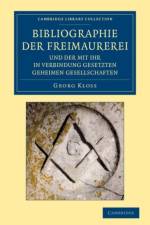
The Frankfurt physician Georg Kloss (1787-1854) was an avid bibliophile and a Freemason. In 1835 his large collection of early printed books was sold by Sotheby's in London, as his extra-curricular interests had shifted from incunabula to the history of freemasonry. He went on to publish several scholarly books on the subject, of which this bibliography (Frankfurt, 1844) was the first. Mentioned by Frederick Leigh Gardner in 1911 as 'excellent though exceedingly scarce', it records over 5,000 books, documents and references relating to freemasonry. These date from 1723 to 1835, and many are very rare, having been printed in tiny quantities. Kloss's bibliography is organised thematically, with sections devoted to topics including Masonic history, ritual, rules and regional jurisdictions (notably France), and related movements including theosophy, kabbalah, the Templars and the Rosicrucians. It also contains indexes of lodges and of authors, translators and composers.
Best known now for his Sherlock Holmes stories, Arthur Conan Doyle (1859-1930) was also an astute and entertaining critic. In this collection of essays first published in 1907, he takes the reader on a tour of his own bookshelf and explores an eccentric range of topics, from the unreasonable opinions of Samuel Johnson to the deficiencies of Ivanhoe and the fascination of Treasure Island. While the importance of deep, intellectual reading is emphasised throughout, across an impressive scope of scientific and literary subjects, Conan Doyle is also firm in his belief that popular fiction is vital and that creativity should not be restricted by strict fact. Including sixteen illustrations, twelve essays and a full index, this book presents reading as a form of unlimited escape, a stance still at the heart of literary debate today, and will interest students of literary theory and the general reader alike.
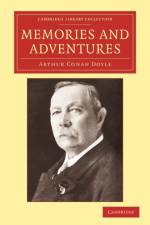
Known as 'the great northern diver' to his crewmates, Sir Arthur Conan Doyle (1859-1930) fell into the Arctic Ocean on three occasions during his voyage as doctor on a whaler, before becoming part of the harpooning crew. This adventure sets the scene for the remarkable variety of his later life. In his autobiography, first published in 1923, he details everything from that first voyage to his literary success, his collaboration with playwright J. M. Barrie (whose Sherlock Holmes parody is included), and his involvement in the setting up of volunteer groups during the First World War. He describes how the methods of Sherlock Holmes helped him solve several real-life mysteries and, in a touching counterpoint to this scientific approach, closes with a chapter on his belief in spiritualism. Characteristically astute and entertaining, this book will appeal to students of early twentieth-century history, Holmes fans and the curious general reader alike.
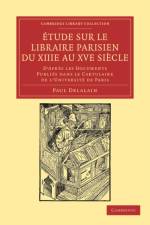
The French bookseller, publisher and printer Paul Delalain (1840-1924) was the author of several studies on the history of the book and of the printing press, including L'imprimerie et la librairie a Paris de 1789 a 1813 (1899) and Les libraires et imprimeurs de l'Academie francaise de 1634 a 1793 (1907). First published in 1891, this book contains the French translation of Volumes 1 and 2 of the Latin Chartularium Universitatis Parisiensis. These records of statutes and regulations, originating from the University of Paris between 1200-86 and 1286-1350 respectively, detail the conditions under which booksellers and stationers were allowed to practise their trade, and give intriguing glimpses of the people involved, including Englishmen and Scots. Delalain's introduction to these documents studies the status of Parisian booksellers in the thirteenth and fourteenth centuries, shedding light on such points as the difference between a libraire and a stationnaire.
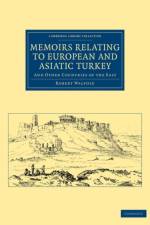
Robert Walpole (1781-1856), great-nephew and namesake of Britain's first prime minister, was a classical scholar and clergyman. After graduating from Trinity College, Cambridge, he visited Greece and the Middle East. This work, first published in 1817 and reissued in its second edition in 1818, consists of extracts from the unpublished papers of J. B. S. Morritt, John Sibthorp, Philip Hunt, J. D. Carlyle and other travellers, with descriptions of antiquities, and notes by the editor. The topics vary considerably and reflect the wide interests of contemporary educated and travelled men at a time when many were extending their Grand Tour to the Eastern Mediterranean. They include discussions of the weakness of the Turkish government, observations on natural history, accounts of Greek Orthodox monastic libraries including those of Mount Athos, and descriptions of Greek pottery and archaeological excavations. The book remains a rich source for scholars from a wide range of disciplines.
Patrick Colquhoun (1745-1820) was one of the founders, in 1798, of the Thames River Police. Initially a merchant based in Glasgow, he later moved to London and was appointed as a magistrate in the East End. In 1796, he published (anonymously) a report on the types of crime in the capital, and the need for regulation of the behaviour of the inhabitants to suppress it. The work examines the different categories of crime in London, such as illegal trading in the docks, fraud, burglary, and robbery. Later chapters discuss the issue of punishment as well as the changes Colquhoun believed were required in the existing police force. In this 1797 fourth edition - one of six later editions that were published by 1799 - Colquhoun added a lengthy exposition on gambling. Although many of his measures were considered unworkable, Colquhoun's ideas played an important part in the development of modern policing.
The name of Jean-Francois Champollion (1790-1832) will always be associated with the decipherment of Egyptian hieroglyphs. Champollion himself was a child prodigy who had taught himself numerous ancient languages in his teenage years, despite not having received any formal education. In this 1824 work, he expands on the discoveries he had previously outlined in 1822, giving a long and systematic account of his research, which was based on the insight of Thomas Young that clusters of hieroglyphs on the tri-lingual Rosetta Stone could be matched to known Greek and Latin names. He gave phonetic values to the signs, and then linked them to the Coptic language (familiar from its use in the liturgy of the Coptic Christian Church in Egypt), which he recognised as being descended from ancient Egyptian. The work was originally published in two volumes (the second being of illustrations), which are here bound as one.
Abonner på vårt nyhetsbrev og få rabatter og inspirasjon til din neste leseopplevelse.
Ved å abonnere godtar du vår personvernerklæring.