





Gjør som tusenvis av andre bokelskere
Abonner på vårt nyhetsbrev og få rabatter og inspirasjon til din neste leseopplevelse.
Ved å abonnere godtar du vår personvernerklæring.Du kan når som helst melde deg av våre nyhetsbrev.

When the Army officer and politician Francis Rawdon-Hastings (1754-1826) arrived in Calcutta to serve as Governor-General in October 1813, British India comprised three presidencies and was beset by problems relating to warring states, weakened armed forces, insufficient funds, and rebellious Gurkhas and Maratha chieftains. This brief first-person account discusses these problems, touching especially on the war against Nepal (1814-16) - after which the Governor-General was created First Marquess of Hastings - and the offensive operations against Pindari raiders and restive chieftains in the Third Anglo-Maratha War (1817-18). First published in 1824 to justify Hastings' political, military and financial conduct in office, this work offers direct insight into a colonial leader's mentality and the strategic thinking behind the expenditure of blood and money for the furtherance of British imperialism.
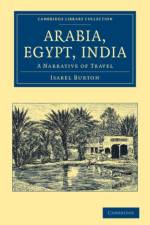
Lady Isabel Burton (1831-96) was a distinguished nineteenth-century traveller, writer and critic. She and her husband Richard explored the Middle East, India, Africa and South America extensively during his diplomatic placements and for their own pleasure. Individually and collaboratively they produced several exquisitely detailed travelogues, recording custom, culture, politics and geography. This account of their travels, first published in 1879, details the Burtons' leisurely route to India through Europe before crossing the Mediterranean and continuing south through Egypt and the Arabian Peninsula. This skilful and humorous narrative brings the places and people to life through personal anecdotes, observations and colourful description. Burton's political and historical comments on the lands she travels through are reasoned, well-researched and afford valuable insight into public opinion and world affairs at this time.
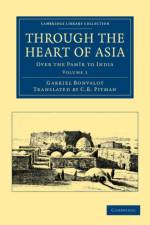
The French explorer, author and legislator Gabriel Bonvalot (1853-1933) received funding from the French government to lead two expeditions to Central Asia in the 1880s. This two-volume English translation by C. B. Pitman of the French original was published in 1889 and is a richly illustrated account of the second of the two Asian expeditions, in which Bonvalot and the scientist Guillaume Capus attempted to enter Afghanistan. Although the party was detained and sent back to Samarkand upon entering Afghanistan, they refused to concede defeat, as Bonvalot was determined to reach India via a trail believed to run across the Pamir and Hindu Kush mountains. In Volume 1, Bonvalot describes the journey from Marseille via Tehran to Samarkand, interspersing his narrative with observations of the climate and culture they encounter. At the Afghan border, guards warn that 'they will hack us to pieces and throw our bodies into the stream'.
Written by General Sir George St Patrick Lawrence (1804-84) of the British Indian Army, this 1874 book is a memoir of his long and active service in India. The son of a distinguished officer in the army of the East India Company, he arrived in India in 1821, and was a participant in all the major military encounters of the period, including the Anglo-Afghan Wars, where he was involved in the 'Cabul disaster' and later narrowly avoided execution as a hostage, the Anglo-Sikh wars, and the Indian Mutiny, during which he and his family survived great danger. Lawrence, whose health had been undermined during the Mutiny, resigned from the army and returned to England in 1864. He entrusted his letters and diaries to William Edwards of the Bengal Civil Service, who compiled the work from these sources, and supplies a brief overview of Lawrence's career in his preface.
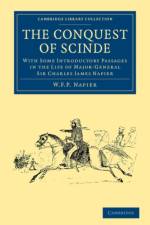
Written by military historian Major-General William Napier (1785-1860), and published in 1845, this book describes the conquest of the Indian territory of Scinde (Sindh), and includes a biographical sketch of Major-General Sir Charles Napier (1782-1853), the British Army's Commander-in-Chief in India, and the author's brother. Napier, whose History of War in the Peninsula and the South of France is also reissued in this series, describes in detail how Scinde became inextricably drawn into the sphere of influence of the government of British India, and the events (including the First Anglo-Afghan War and its consequences) leading to its conquest. Napier's interpretation of events was almost immediately challenged by Sir James Outram in Conquest of Scinde: A Commentary (1846; also reissued in this series). The Appendices include extracts from the private correspondence of Sir Charles Napier, revealing his personal concerns during the course of the campaign alongside the historical narrative.
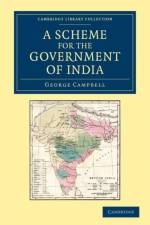
Sir George Campbell (1824-92) spent a number of years in the administration of India at a time when rule over the country was being transferred from the East India Company to the British Crown. In this 1853 work, he offers an outline of policy for a future government. He believes that India is capable of being the most civilised country in the world, and favours introduction of the western model of development to India. Campbell laments the lack of co-ordination among various agencies of the government, and finds executive efficiency in an inverse proportion to staff numbers, thus supporting the idea of a small government. He argues for the establishment of an authoritative central power to guide, direct and propel the local administrations. Some of the problems he identified and the remedies he suggested are as relevant to the governance of India today as they were then.
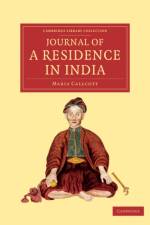
The daughter of a naval officer, Maria Graham (1785-1842), later Lady Callcott, combined her passion for travel with a diligent attention to scholarship and self-improvement. In 1808, the talented linguist and artist sailed for India with her family. She travelled widely in south and east India and Ceylon, and became fascinated by the culture, religion and antiquities of the sub-continent. This, the first of her celebrated travel journals, was published on her return to England in 1812. She regarded it as a supplement to scholarly works of history or economics, aiming to give a real, and unusually open-minded, impression of the country. Covering flora and fauna, social life, and tourist attractions, and written in a vivid style with her own illustrations, the book was an immediate success, the second edition (reissued here) appearing in 1813. It was followed by volumes on Brazil and Chile, also available in this series.
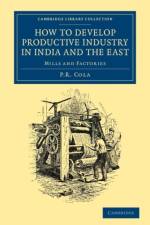
The craft of manufacturing cotton was learnt by the British in India, but the East India Company's drive for profits caused the development of a cotton-spinning industry in Britain, which grew enormously when mechanical processes were introduced during the industrial revolution. Subsequent protectionist legislation which forbade the export of anything except raw cotton meant that India's supremacy in the industry was lost to Britain in the nineteenth century. This 1867 work, edited by P. R. Cola, who owned the Arkwright Cotton Mills in Bombay (Mumbai), argues for investment in up-to-date machinery, and provides a blueprint for developing a host of industries such as cotton and other textiles, jute, sugar, oil and iron, which would bring prosperity to India. Containing illustrations and statistical data, the book gives useful insights into the early development of many industries in India and in some of the other economies of the East.
Published in 1879, this work is a first-hand account by a female traveller in nineteenth-century India. Broad in its scope and empirical in its presentation, the book is formed from descriptions of the travels of Harriet Murray Aynsley (1827?-98) and her husband in northern and central India over three years. Originally intended for the private interest of family and friends, the text remains clear, accessible and engaging to the general reader. Travelling from Bombay to Hyderabad through myriad cities and villages, including Delhi, Varanasi, Jaipur and Lucknow, Aynsley records her observations on native life, including descriptions of festivals, industry, clothing, domestic practices, food and famine, politics and religion. She vividly describes the architecture and landscapes of the places she visits, incorporating atmospheric anecdotes of her experiences. The book also contains much historical background, based on careful research, which puts the author's personal impressions into a broader context.
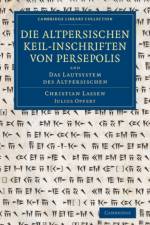
The decipherment of the ancient cuneiform scripts was one of the major breakthroughs in nineteenth-century archaeology and linguistics. Among the scholars working on Old Persian was Christian Lassen (1800-76), professor of Sanskrit at Bonn. Lassen's book on cuneiform inscriptions from Persepolis appeared in 1836, a month before his friend Eugene Burnouf independently published very similar conclusions. Lassen's account gives vivid insights into the detective work involved, as he painstakingly compares individual words and grammatical forms with their Avestan and Sanskrit equivalents, and proposes sounds for the symbols. The book uses a specially designed cuneiform font, and credits the printer, Georgi of Bonn. This Cambridge Library Collection volume also includes a short monograph on Old Persian phonology published in Berlin in 1847 by the Assyriologist Julius Oppert (1825-1905). Oppert revisits Lassen's conclusions in the light of Henry Creswicke Rawlinson's important 1846 memoir on the trilingual Behistun inscription.
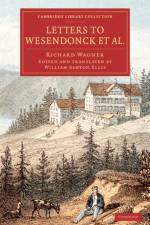
William Ashton Ellis (1852-1919) abandoned his medical career in order to devote himself to his Wagner studies. Best known for his translations of Wagner's prose works, Ellis also translated Wagner's letters to family and friends. In this 1899 publication, most of the letters are those which Wagner wrote to the wealthy retired silk merchant Otto Wesendonck, who provided Wagner with generous financial support and whose wife, Mathilde, provided the words for the Wesendonck Lieder. Also included here are letters to the German writer Malwida von Meysenbug, who was also a friend of Nietzsche, and to the novelist Eliza Wille, at whose house in Zurich, a meeting place for the cognoscenti, Wagner was a regular guest. She later published her memories of the composer. Despite the stylistic idiosyncrasies of the translations, these letters remain of value because they capture something of the colour of Wagner's prose and personality.
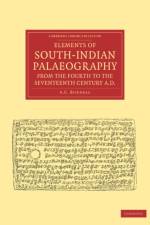
Published in 1874, this groundbreaking monograph on the palaeography of southern India gained great scholarly acclaim. Arthur Coke Burnell (1840-82) served in the Indian Civil Service and as a judge, also building up a large collection of original or copied Sanskrit manuscripts. Originally intended as an introduction to his vast and pioneering Classified Index to the Sanskrit Manuscripts in the Palace at Tanjore (1880), this work won Burnell an honorary doctorate at the University of Strasbourg. Replete with documentary evidence, it contains copies and explanations of numerous texts, the decipherment of which threw new light upon an obscure chapter in the history of writing, offering new theories for dating the introduction of writing into India and the origin of southern Indian alphabets and numerals. Although Burnell's work has since been built on and sometimes superseded, this is still a much-cited resource in South Asian palaeography and epigraphy.
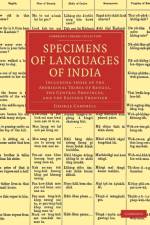
This 1874 work by Sir George Campbell, a British government official whose Scheme for the Government of India is also reissued in this series, presents a survey of the diverse languages of India, using material obtained usually by British army officers trained by Campbell to collect 'specimens' in the course of their normal work. The tabular material is presented with the English words or phrases in one column and their equivalent in the Indian language under discussion in another: most of the languages are represented by more than one dialect, such as the 'Punjabee of Lahore' and the 'Punjabee of Mooltan'. In his introduction to the work, Campbell emphasises that the survey is not scientific, and his main conclusion is that in addition to the broad division of Aryan and Dravidian language types, India contains a huge number of 'aboriginal' languages which will require further study.
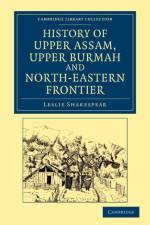
Soldier and military historian L. W. Shakespear (1860-1933), published this book on the north-eastern frontier of India and its tribes in 1914. He had served in the Assam Military Police Force, and this book, which is illustrated with photographs taken by the author, is 'an attempt to produce something useful and readable at least for those who care about that little known but very interesting corner of India'. The work begins with a review of the archaeology and history of the area, and is particularly concerned with the ethnography of the various border tribes, such as the Kachari, Ahom and Naga. The small beginnings, in 1823, of the tea industry, which still forms an important part of the region's economy, are described, and the work ends with a consideration of the strategic importance of the area, in the context of a widely expected 'awakening' and modernisation of China.
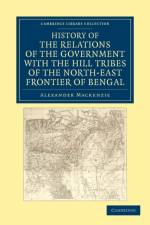
Sir Alexander Mackenzie (1842-1902) joined the Indian Civil Service in 1862. His career began in Bengal, first as an assistant magistrate and then as a secretary to the local government. His report Memorandum on the North-East Frontier of Bengal (1869) was welcomed as a valuable guide to political relations in the area for government officials. This book, first published in 1884, is the updated and developed version of that report. It was extensively researched by Mackenzie, using government records, and was considered to be authoritative on the political relations between the Government and the hill tribes of Assam, Cachar and Chittagong. Mackenzie dedicates a chapter to each tribe and details their response to British colonisation and any negotiations that took place. Relevant notes and reports by officials who had come into contact with the tribes are also included as appendices. Mackenzie's thorough work remains an authoritative historical source today.
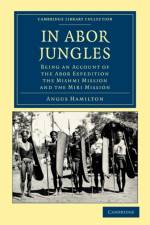
This 1912 book by Angus Hamilton (1874-1913), a Fellow of the Royal Geographical Society, is an account of the British military expeditions to quell uprisings among remote tribes in north-eastern India in 1911-12. Famous for his earlier books on Afghanistan, the problems of the Middle East, and Somaliland, Hamilton gives a full account of the various phases of the 'Abor expedition' which resulted in a crushing defeat of the local tribes. The book begins with a survey of the geography of the area, and a description of the Abor people, explaining the turbulent background to the murder in March 1911 of two British officials. A highly detailed and illustrated account then follows of the murders, and of the punitive response of the government in Delhi, which sent an expedition both to bring the area back under control and also to carry out geographical surveys of a relatively unknown area.
Edward Vizetelly (1847-1903) was the son of the publisher Henry Vizetelly and a perceptive war correspondent. He began his career for the Daily News and New York Times, covering the Franco-Prussian War, where he narrowly escaped being shot as a spy. This work, published in 1901, recounts the next period of his career, with vivid descriptions of people and places. In 1878, Cyprus was ceded to Britain by Turkey, and Vizetelly, then in Athens, was sent to report on the Island, where he remained for four years. In 1882, he moved to Egypt, where Arab unrest led to the massacre of Europeans in Cairo and the bombardment of Alexandria by British warships. On his return to Europe in 1889, he was commissioned by the owner of the New York Herald to find H. M. Stanley, using Zanzibar as his base. He concludes with a brief summary of subsequent events in Africa.
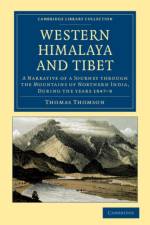
Explorer and naturalist Thomas Thomson (1817-78) led an intrepid life. He started his career as an assistant surgeon with the East India Company and soon became a curator of the Asiatic Society's museum in Bengal. He was sent to Afghanistan in 1840 during the First Anglo-Afghan War, and was captured but managed to escape as he was about to be sold as a slave. Undaunted by this misfortune, he accepted a perilous mission to define the boundary between Kashmir and Chinese Tibet in 1847. During his eighteen-month journey, Thomson explored the Kashmir territories and went as far north as the barren Karakoram Pass. He collected valuable geographical and geological information as well as a wealth of botanical specimens. He describes his findings in minute detail in this account, first published in 1852. Thomson later became a Fellow of the Linnean Society, the Royal Geographical Society and the Royal Society.
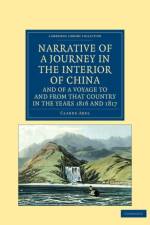
Clarke Abel (c.1780-1825) was Chief Medical Officer accompanying Lord Amherst's unsuccessful diplomatic embassy to China in 1816. Encouraged by Sir Joseph Banks, he acted as official naturalist to the expedition, which penetrated further into China than had been possible for previous western visitors. Although most of his large collection of botanical and mineralogical specimens was lost during the return voyage, survivals included several new species, some of which were named after him. This work, published in 1818, made Abel's reputation, and he was elected to the Royal Society the following year. His geological survey of the Cape of Good Hope, studied on the outward journey, is particularly impressive. Abel's account of Chinese society and culture is an important record of a country which was then largely inaccessible to Europeans. An appendix by Robert Brown (Banks' botanist) lists the specimens that survived the shipwreck, which is itself dramatically described.
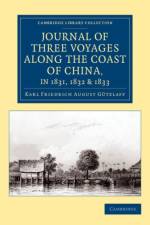
The Prussian-born Protestant missionary Karl Friedrich August Gutzlaff (1803-51) sought to spread Christianity in the Far East. A gifted linguist, he sailed to Siam and worked on a translation of the Bible into Thai. The British missionary Robert Morrison had fired his interest in China, and Gutzlaff later focused his evangelising efforts there, learning several dialects and distributing translated literature. The present work, featuring an introductory chapter by fellow missionary William Ellis on Chinese attitudes to foreign influence, was first published in 1834. Gutzlaff had left Siam in 1831 in a Chinese junk trading along the coast of China. The next year, as an interpreter aboard an East India Company vessel, he also visited Korea and Okinawa. The third voyage recounted here describes the places and peoples encountered from Canton to Manchuria. Also reissued in this series are Gutzlaff's Sketch of Chinese History (1834) and China Opened (1838).
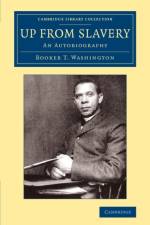
Born into slavery on a Virginia plantation, Booker T. Washington (1856-1915) educated himself tirelessly in the years after the American Civil War. In 1881, he was appointed head of the Tuskegee Institute, a teacher-training college for African Americans. As a writer, orator and fundraiser, he became one of the leading figures of the black community. Washington argued that the best way of bettering the social position of African Americans was through vocational education, which would make them indispensable and productive members of society. In this 1901 autobiography, he uses his life as an example to illustrate these principles, covering particularly the work of the Tuskegee Institute and his fundraising on behalf of black education. The book also contains the full text of his 1895 Atlanta Exposition speech, which created the model for Southern race relations until Washington's death and the emergence of more overtly assertive African-American civil rights leaders.
When Scottish botanist Robert Fortune (1812-80) travelled to Japan in 1860, shortly after it had reopened to foreign visitors for the first time in centuries, he found the islands to be both mysterious and dangerous. This work, first published in 1863, is Fortune's spirited account of his travels, from Nagasaki to Yedo (modern-day Tokyo) and then on to Peking (Beijing). Fortune had previously spent several years in China researching tea plants and tea-growing technology, which he later introduced to the plantations of India. (His books on his experiences in China are also reissued in the Cambridge Library Collection.) An engaging raconteur, Fortune includes here not only detailed horticultural information, but also his observations and opinions on Japan's 'strange people and their very beautiful land'. This remains for scholars and general readers an illuminating piece of travel writing, enhanced by the illustrations throughout.
First published in 1847, this is an important description of what were then little-known parts of China by the botanist Robert Fortune (1812-80). Son of a hedger, Fortune rose to be one of the most famous gardeners, botanists and plant hunters of his day, making several visits to China to bring out commercially important plants, especially tea for introduction to British India, and ornamental plants (many now bearing the name fortunei) which were enthusiastically taken up by Victorian gardeners. His three years in China took him to areas newly open to Europeans after Chinese defeat in the First Opium War (1839-42). His sometimes trenchant criticisms of the Chinese - like his contemporaries, he was fully persuaded of the superiority of the West - are balanced by his knowledgeable comments on local flora and plant cultivation, and the book remains an insightful early description of inland regions of China.
Clergyman and ornithologist H. B. Tristram (1822-1906), was an early supporter of Darwin's evolutionary theories - in his 1859 paper 'On the Ornithology of North Africa' - who became both a Fellow of the Royal Society and canon residentiary of Durham; he was also the Church Missionary Society's representative in the county for forty years. This 1895 volume, the last of many travel narratives he published, is an account of a sojourn in Japan, visiting his daughter Katherine, then headmistress of the Society's school for girls in Osaka. As well as describing the country's minority Christian communities, Tristram's highly readable narrative covers Japanese customs, industries, shrines and ornithology, with excursus on both native wild birds and local practices for taming them. It illustrates the author's ongoing interest in both religion and the natural sciences, as well as illuminating cultural contact between Britain and Japan in this formative period.
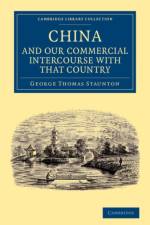
The sinologist George Thomas Staunton (1781-1859) learned Chinese as a child and accompanied his father on a trip to China in 1792 where, though the Ambassador's page, he was the only member of the delegation who could speak to the Emperor in Chinese. A career in the East India Company's Canton factory followed, and he translated many texts between Chinese and English. Upon his return to Britain in 1817, he spent many years as a Tory MP and often spoke about China and its trade with Britain. He also continued to write about these issues, and this collection of translations and essays, published in 1822, reflects Staunton's varied interests - ranging from a translation of the Chinese history, Tung-wha-loo to his own writings on the Company's trade disputes with the Emperor - making this work a unique and valuable source of information on British cultural, economic, and diplomatic relations with China in the early nineteenth-century.
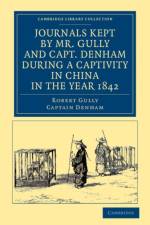
Published in 1844, this extraordinary book consists of the diaries of Robert Gully and Captain Denham, the Commander of the merchant vessel Ann, who were imprisoned in China in 1842, and notes exchanged between the two men (who were held captive in separate places). After some months of imprisonment, Gully was murdered, but Denham survived and was eventually released. The book, edited by 'a barrister', was designed to inform the British public of 'matters of which hitherto they have had slender but doubtful accounts', and to apply political and diplomatic pressure on the Chinese government, whose official account of the incident denied any wrong-doing by its representatives. Gully had distinguished himself in the taking of Ningpo during the Opium War of 1841-2, and later boarded the Ann to return to Macao. The vessel was subsequently wrecked off Formosa (Taiwan), where events related in the book occurred.
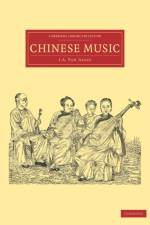
First published in 1884 by the Statistical Department of the Inspectorate General of Customs in Shanghai, this work is probably best known as a source of musical material for Puccini's opera Turandot. It was reprinted several times and remained the primary source in a Western language of detailed information on Chinese music until the mid-twentieth century. Van Aalst, born in Belgium in 1858, spent his working life with the Imperial Maritime Customs Service where his ability as a musician was noticed by the Inspector General, Robert Hart. It is thought likely that the work was published to coincide with the London Health Exhibition of 1884 in South Kensington to which Van Aalst had been sent to lecture. Different types of music (ritual and popular), the range of instruments, and musical notation are all explained, the intention being to enable a better understanding of Chinese music by those in the West.
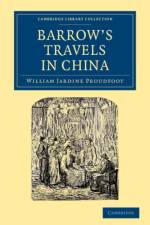
William Jardine Proudfoot (c.1804-1887) published his critique of Sir John Barrow's Travels in China (1804; also reissued in this series) with the agenda of exposing the latter as unreliable and unjust. Barrow had accompanied Lord Macartney on the first British mission to the Chinese Imperial Court (1792-4), in a party that also included the official astronomer, Dr James Dinwiddie, Proudfoot's grandfather. Comparing Barrow's account to that found in other records, Proudfoot concludes that the earlier work was 'a great humbug', ascribing to Barrow the 'powerful motive' of self-promotion. In a work full of vitriol against its subject, Proudfoot's concern is to honour the memory of the mission's members, whom he felt Barrow belittled and vilified, and also to point out factual inaccuracies, accusing him of seeking amusement rather than truth in his anecdotes. Read alongside Barrow's work, it makes for an interesting, scornful, and often entertaining counter.
A three-volume essay writing course for students in American English. Academic Writing Skills 1 takes students through a step-by-step process from writing a paragraph to essays. It is appropriate for students new to academic writing who need general training in essay writing skills.
A three-volume essay writing course for students in American English. Academic Writing Skills 1 takes students through a step-by-step process from writing a paragraph to essays. It is appropriate for students new to academic writing who need general training in essay writing skills.
Abonner på vårt nyhetsbrev og få rabatter og inspirasjon til din neste leseopplevelse.
Ved å abonnere godtar du vår personvernerklæring.