










Gjør som tusenvis av andre bokelskere
Abonner på vårt nyhetsbrev og få rabatter og inspirasjon til din neste leseopplevelse.
Ved å abonnere godtar du vår personvernerklæring.Du kan når som helst melde deg av våre nyhetsbrev.

This volume proposes a new, analytically more powerful conceptualization of political party. It provides in-depth analyses of seventeen contemporary political parties in Latin America and shows how and why they vary in the degree to which they fulfill the functions of democratic representation.
The unique conspiracy group called QAnon is growing in both membership and political power, and understanding this phenomenon is key to combating QAnon's negative effects on society. This book uses social science theory to explain the attraction and spread of the defining conspiracy movement of our times.
A detailed study of 60 contentious episodes in European politics where governments' austerity policies and institutional reforms were opposed during and after the Great Recession (2008-2015). The book provides methods and tools for the systematic analysis of the interactions between governments, their challengers, and third-party actors.
This Element refines and extends analyses France's colonial history up to contemporary antiracist and environmental struggles. It narrates the perspective of the urban field recordist, reinventing the bourgeois figure of the flaneur as a feminist-decolonial activist and configuring listening as an expressly spatial practice of mapping the city.
A rigorous, yet accessible, textbook for computer science students learning probability. It covers topics of interest to computer scientists, including randomized algorithms, simulation, statistical inference, and stochastic systems modeling. Replete with engaging real-world examples, exercises, and full-color illustrations.
This accessible guide to data modeling introduces basic probabilistic concepts, gradually building toward state-of-the art data modeling and analysis techniques. Aimed at students and researchers in the sciences, the text is self-contained and pedagogical, including practical examples and end of chapter problems.
For scholarly and lay readers who are looking for a theoretically powerful, historically grounded, richly textured analysis of U.S. racial dynamics, with a special focus on how people of Asian descent have been positioned relative to whites and Black people for nearly two centuries.
The second edition of this popular text explores advanced topics in probability while keeping mathematical prerequisites to a minimum. With copious exercises and examples, it is an ideal guide for graduate students and professionals in application domains that depend on probability, including operations research, finance and machine learning.
The first commentary on Caesar's Bellum Gallicum to approach it as a literary text. Students will appreciate the drama of the narrative, the sustained intertextual borrowings and allusions, the rhetoric of the speeches, and the artistry of the language. Both author and text emerge in a completely new light.
This self-contained textbook introduces students and researchers of AI to the key mathematical concepts and techniques necessary to learn and analyze machine learning algorithms. Readers will gain the technical knowledge needed to understand research papers in theoretical machine learning, without much difficulty.
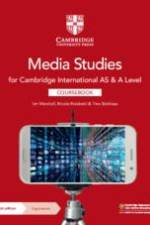
Media shapes our understanding of the world. Enable your learners to develop a critical understanding of international media as they explore this vast and varied field, from production processes and technologies to media power and regulation. With a skills-based approach, the coursebook with digital access guides learners through activities of progressive complexity as they develop essential critical and analytical skills. Suitable for the Cambridge International AS & A Level Media Studies syllabus (9607), for examination from 2024. Written by expert authors and practising teachers, the coursebook provides full syllabus coverage so you can teach with confidence.
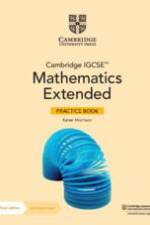
This third edition of the extended practice book helps your students develop their skills further, whether they are studying in class or at home. A wide variety of exercises, reflection, self-assessment, examples and questions support them in consolidating their learning and help prepare for assessment, alongside additional features such as key learning statements, tips and more. Answers are available on Cambridge GO.
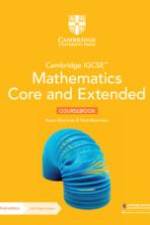
The third edition fully covers both Core and Extended content through the 'spiral' approach, where students build on their previous learning as they progress through the course. In addition to a wealth of practice questions and support for English as a second language learners, we have included a number of projects to encourage students to put their theory into practice provided by NRICH - a collaboration between the Faculties of Mathematics and Education at the University of Cambridge. Answers are available on Cambridge GO.
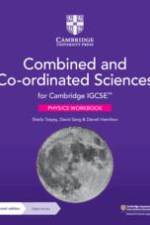
New editions support Cambridge IGCSE Combined Science and IGCSE Co-ordinated Sciences for examination from 2025. This accessible write-in workbook is the perfect companion to the coursebook. Students have the opportunity to practice their essential science skills, including data presentation and analysis, consolidate their understanding, and apply their learning to new situations. Exercises are structured into three levels of increasing complexity, which they first support, then provide practice opportunities, and finally challenge learners. As an exercise progresses, the amount of support is reduced, enabling students to become confident, responsible learners. Answers are available to teachers via Cambridge GO.
New editions support Cambridge IGCSE Combined Science and IGCSE Co-ordinated Sciences for examination from 2025. This accessible write-in workbook is the perfect companion to the coursebook. Students have the opportunity to practice their essential science skills, including data presentation and analysis, consolidate their understanding, and apply their learning to new situations. Exercises are structured into three levels of increasing complexity, which they first support, then provide practice opportunities, and finally challenge learners. As an exercise progresses, the amount of support is reduced, enabling students to become confident, responsible learners. Answers are available to teachers via Cambridge GO.
New editions support Cambridge IGCSE Combined Science and IGCSE Co-ordinated Sciences for examination from 2025. This accessible write-in workbook is the perfect companion to the coursebook. Students have the opportunity to practice their essential science skills, including data presentation and analysis, consolidate their understanding, and apply their learning to new situations. Exercises are structured into three levels of increasing complexity, which they first support, then provide practice opportunities, and finally challenge learners. As an exercise progresses, the amount of support is reduced, enabling students to become confident, responsible learners. Answers are available to teachers via Cambridge GO.
This first edition worked solutions manual will save you a lot of preparation time through readily-made solutions for a variety of questions in the coursebook. The resource is also particularly helpful for the non-calculator requirements of the updated syllabus. You can use the manual to quickly check your students' solutions or share solutions with them so they can identify where they went wrong and self-assess. Students will find the additional commentary helpful for the more challenging topics. You have the flexibility to use the manual how you prefer.
Learners will feel fully supported with the updated Cambridge IGCSE(TM) and O Level Additional Mathematics Coursebook, which builds on their mathematical understanding through a number of features such as NRICH projects, discussions, challenge questions and reflection tasks. With a wealth of exercises and past-paper questions, students will get the opportunity to practise what they have learnt to help prepare for assessment and their further mathematical studies ahead. Answers are available on Cambridge GO.
"An accessible and rigorous introduction to classical fluid mechanics, with a robust emphasis on theoretical foundations and mathematical exposition. Suitable for a one- or two-semester sequence, it provides a flexible teaching pathway for graduate students in aerospace, mechanical, chemical, and civil engineering, and applied mathematics"--
"Presenting European Romanticism as a phenomenon that superseded national borders, and in which Britain played a vital role, this Cambridge History illuminates myriad forms of cultural mediation and transfer, and reveals the period's productive tensions, synchronicities, and interactions within and across borders"--
"Michelle Tusan profoundly reshapes the story of how the First World War ended in the Middle East. Tracing Europe's War with the Ottoman Empire through to the signing of Lausanne which finally ended the war in 1923, she places the decisive Allied victory over Germany in 1918 in sharp relief against the unrelenting war in the East"--
This book surveys the role of animals across literary history. It explores how engaging with animals alters our understanding of what it means to write and read, and why this is important for thinking about a series of cultural, ethical, political, and scientific developments and controversies.
Public banks are banks located within the public sphere of a state. They are pervasive, with more than 900 institutions worldwide, and powerful, with tens of trillions in assets. Public banks are neither essentially good nor bad. Rather, they are dynamic institutions, made and remade by contentious social forces. As the first single-authored book on public banks, this timely intervention examines how these institutions can confront the crisis of climate finance and catalyse a green and just transition. The author explores six case studies across the globe, demonstrating that public banks have acquired the representative structures, financial capacity, institutional knowledge, collaborative networks, and geographical reach to tackle decarbonisation, definancialisation, and democratisation. These institutions are not without contradictions, torn as they are between contending public and private interests in class-divided society. Ultimately, social forces and struggles shape how and if public banks serve the public good.
Abonner på vårt nyhetsbrev og få rabatter og inspirasjon til din neste leseopplevelse.
Ved å abonnere godtar du vår personvernerklæring.