









Gjør som tusenvis av andre bokelskere
Abonner på vårt nyhetsbrev og få rabatter og inspirasjon til din neste leseopplevelse.
Ved å abonnere godtar du vår personvernerklæring.Du kan når som helst melde deg av våre nyhetsbrev.

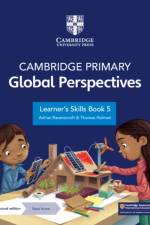
This series supports teachers and learners of the Cambridge Primary and Lower Secondary Global Perspectives curriculum frameworks (0838.1129). Join Arun, Sofia, Marcus and Zara as they explore global issues and support learners to develop key 21st century skills. This learner's skills book with digital access contains units dedicated to the six skills of analysis, collaboration, communication, evaluation, reflection and research and is filled with adaptable activities that promote active learning. Learners are also encouraged to reflect on topics at a personal, national and global level. This resource can be adapted to any Cambridge Global Perspectives(TM) topic, such as 'Looking after planet Earth' and 'The world of work'. Suggested answers are available for teachers via Cambridge GO.
The authorized, paginated WTO Dispute Settlement Reports in English: cases for 2019.
The authorized, paginated WTO Dispute Settlement Reports in English: cases for 2019.
The authorized, paginated WTO Dispute Settlement Reports in English: cases for 2019.
The authorized, paginated WTO Dispute Settlement Reports in English: cases for 2019.
The authorized, paginated WTO Dispute Settlement Reports in English: cases for 2019.
The authorized, paginated WTO Dispute Settlement Reports in English: cases for 2019.
The authorized, paginated WTO Dispute Settlement Reports in English: cases for 2019.
The authorized, paginated WTO Dispute Settlement Reports in English: cases for 2019.
The authorized, paginated WTO Dispute Settlement Reports in English: cases for 2019.
The authorized, paginated WTO Dispute Settlement Reports in English: cases for 2019.
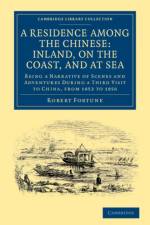
China was still largely alien territory for westerners in the mid-nineteenth century. In this book, first published in 1857, Robert Fortune (1813-1880) describes his third visit there, but despite his relative familiarity with the country, his account is full of strange and bizarre sights and happenings. Beginning in Shanghai, where he was sent to collect tea samples for the East India Company, he describes an earthquake and the myths of its aftermath, along with his fears of becoming embroiled in the Taiping Rebellion. A keen botanist and entomologist in his own right, he also collected insects (a pastime that led him to become a figure of great hilarity among the locals) and explored the flora of the north. His account of his three-year expedition offers a glimpse of the Chinese language and culture through the lens of Victorian expectations, and is a fascinating resource for students and the general reader.
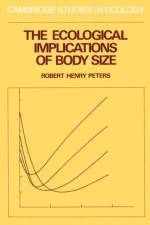
It is generally recognized that larger animals eat more, live longer, have larger offspring, and so on; but it is unusual to see these commonplace observations as a basis for scientific biology. A large number of empirically based relationships describe biological rates as simple functions of body size; and other such relations predict the intrinsic rate of population growth, animal speed, animal density, territory size, prey size, physiology, and morphology. Such equations almost always exist for mammals and birds, often for other vertebrates and invertebrates, sometimes for protozoa, algae, and bacteria, and occasionally even for plants. There are too many organisms to measure all aspects of the biology of every species of population, so scientists must depend on generalizations. Body size relations represent our most extensive and powerful assemblage of generalizations, but they have never been organized for use in ecology. This book represents the largest single compilation of interspecific size relations, and instructs the reader on the use of these relationships; their comparison, combination, and criticism. Both strengths and weaknesses of our current knowledge are discussed in order to indicate the many possible directions for further research. This important volume will therefore provide a point of departure toward a new applied ecology, giving quantitative solutions to real questions. It will interest advanced students of ecology and comparative physiology as well as professional biologists.
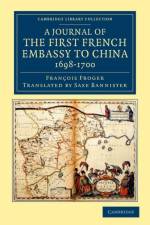
It was not until the early twentieth century that the previously unpublished source of this 1859 work was identified as being itself a reworking of François Froger's Relation du premier voyage, fait en 1698, 1699 et 1700, a journal of his experiences as a young engineer while sailing with the first French ambassadorial party to China. This translation by Saxe Bannister (1790-1877) supplements the original official account with anecdotes and notes: the work is therefore based on composite primary evidence. This does not detract, however, from the worth of this book, in which Bannister uses a lengthy introduction and appendices of further primary evidence to apply what can be learned from earlier works to the contemporary context of the Opium Wars, aiming to promote a more peaceful and balanced attitude towards China. It is a useful example of scholarly propaganda in the history of nineteenth-century Anglo-Chinese relations.
John Leigh Smeathman Hatton (1865-1933) was a British mathematician and educator. He worked for 40 years at a pioneering educational project in East London that began as the People's Palace and eventually became Queen Mary College in the University of London. Hatton served as its Principal from 1908 to 1933. This book, published in 1920, explores the relationship between imaginary and real non-Euclidean geometry through graphical representations of imaginaries under a variety of conventions. This relationship is of importance as points with complex determining elements are present in both imaginary and real geometry. Hatton uses concepts including the use of co-ordinate methods to develop and illustrate this relationship, and concentrates on the idea that the only differences between real and imaginary points exist solely in relation to other points. This clearly written volume exemplifies the type of non-Euclidean geometry research current at the time of publication.
Designed for students, aficionados of classical music, and historians, this volume offers a wide-ranging, multi-disciplinary and comprehensive view of one of the most important musicians of the twentieth century at his 100th anniversary. Scholars from diverse backgrounds and fields have contributed rich insights into Bernstein's life and work in an approachable style, shedding light on Bernstein's social, professional and ideological contexts including his contemporaries and rivals on Broadway, his artistic collaborations, his celebrity status as a conductor on the international concert circuit, and his involvement in music education via broadcasting. From his early education, through his conducting and composing careers, to his fame as musical and cultural ambassador to the world, this book views Bernstein the man and the artist and provides a fascinating overview of American classical music culture during Bernstein's long career in the public spotlight.
The novels of Charles Dickens (1812-70), with their inimitable energy and their comic, tragic and grotesque characters, are still widely read, and reworked for film and television. Great Expectations was (like most of Dickens' works) first published in serial form, in his periodical All the Year Round, shortly before the first book edition of 1861. The serial version is now reissued in the Cambridge Library Collection simultaneously with the three-volume book edition and a volume of newly photographed actual-size colour images of the entire original manuscript. Dickens himself had the manuscript bound and presented to his friend Chauncy Hare Townshend, with whom he shared an interest in mesmerism and the occult, and in 1868 Townshend bequeathed his library (including the manuscript) to the Wisbech and Fenland Museum. Dickens scholars and enthusiasts will now be able easily to study the two-column serialisation alongside the work-in-progress and the first book edition.
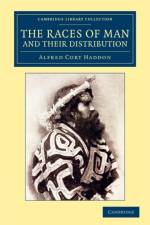
The Cambridge anthropological expedition of 1898-9 to the Torres Strait and New Guinea, led by the zoologist and anthropologist Alfred Cort Haddon (1855-1940), marked an epoch in field methodology. This edition, published in 1924, examines some of the major physical differences between human beings that Haddon used to distinguish race, looking at skin colour, hair, stature, nose, face, and head form, and is thorough and wide-ranging in offering examples from throughout the world. He also suggests some reasons for the geographical distribution of the races. This was a new approach, though Haddon's findings are necessarily condensed here, providing a valuable work of reference rather than a full study. Forming the basis for a larger work, this book is is an important example of early scientific anthropology, while Haddon's curatorial work in the Museum of Archaeology and Ethnology in Cambridge made this a primary centre for anthropological study and research.
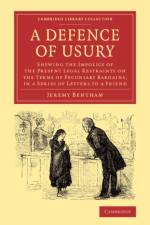
The utilitarian philosopher and jurist Jeremy Bentham (1748-1832) argues in this collection of letters for the cessation of government control of the rate of interest. The work first appeared in 1787 and is reissued here in the version published in Dublin in 1788. The final letter, addressed to Adam Smith, is a response to Smith's Wealth of Nations (1776), arguing against the limits to inventive industry forced by the restriction on rates. Throughout the work is Bentham's emphasis on the value, both ethical and practical, of allowing private citizens to regulate their own financial dealings. Bentham offers a sophisticated philosophical, economic and political analysis of 'usury' and in so doing provides a template for a wider liberal view. Influential at the time of publication, the work still retains its significance in making a case for the proper relationship between the individual and the state.
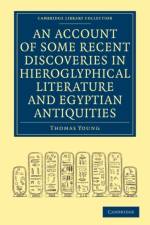
Thomas Young (1773-1829) was an English physician who was one of the first modern scholars to attempt to decipher ancient Egyptian hieroglyphs, and made significant contributions to a variety of other academic disciplines. He was elected a Fellow of the Royal Society in 1794 and in 1803 published an article establishing the wave theory of light. Young became interested in hieroglyphs in 1814, when he was sent a fragment of papyrus from Egypt. After acquiring a copy of the Rosetta Stone inscriptions Young made rapid progress, publishing his results in 1816 and 1819. When Champollion published his groundbreaking work on hieroglyphs in 1822 Young believed that Champollion had based that work on his earlier translations without acknowledgement, which Champollion denied. This book was published in 1823 in an attempt by Young to lay 'public claim to whatever credit be my due', and provides a summary of his hieroglyphic research.
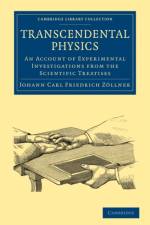
A pioneer in the field of astrophysics, Johann Zöllner (1834-1882) was a professor of physics and astronomy at the University of Leipzig and an associate of the Royal Astronomical Society. Zöllner was best known for his work on astronomical photometry and spectrum analysis, on which he published widely. He invented the astronomical photometer used for measuring stellar magnitudes. He was also interested in optical illusions: the 'Zöllner illusion' consists of straight parallel lines which appear to be unparallel. This book, published in German in 1878-1879 and translated into English by Charles C. Massey in London in 1880, exemplifies the shift in Zöllner's interests in later life: he became involved in the public debate surrounding the scientific veracity of spiritualism. Here Zöllner describes his observations of experiments conducted by the medium Henry Slade in his own home.
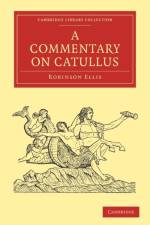
This 1876 work is the magisterial commentary by the Oxford scholar Robinson Ellis (1834-1913) on the life and oeuvre of the Roman poet Catullus, whose work illuminates the closing years of the Roman Republic. Our knowledge of Catullus' life derives almost entirely from his own writings. Three manuscripts survive which contain a collection of poems that are ascribed to him, and all three date from the fourteenth century. Ellis considers the research that has already been undertaken on the poet and his environment but mostly draws on his own work in assessing the value of the Renaissance Italian commentators who established the generally accepted poetic canon. He traces the Greek influences that Catullus was exposed to and discusses his use of different metres, while also speculating on the identity of his beloved Lesbia, a controversial question still unresolved in the twenty-first century.
Hargrave Jennings' 1870 work joins the debates of the nineteenth century that sought to determine the relationships between modern science, religion, and the supernatural. A prolific writer and an occultist, Jennings (1817-1890) had previously published on the religions of India. He spent two decades researching and writing this work, which is the first history in English of the Rosicrucians. As he states, his 1858 Curious Things of the Outside World first asserted the ideas he elaborates in this text, and he is not a member of the Rosicrucian sect, simply a historian of it. This was his best-known book, in which the discussion extends to the Kabbalah, Gnosticism, the Druids, and ancient and medieval cultures; five editions were subsequently printed, and it was translated into German in 1912. It will interest scholars of the history of ideas, of the relationship of science and magic, and of the occult.
Talbot Baines Reed wrote in a period of transition when hot metal typesetting and offset printing were transforming the scale and scope of printing. In the previous 350 years, England had experienced civil war and started the Industrial Revolution. The dissemination of printed information and learning is inextricable to this history, and the art with which this was done is a quintessential part of English culture. Reed is distinctly aware of the great debt that his contemporaries had to the early typographers (notable among them William Caslon - considered the first great English typographer - and John Baskerville), and everywhere in his work is this shown in his meticulous and unstinting presentation of the fascinating details of their artistic exploration and expression. Modern readers will enjoy the technical and historical insight this work affords, and also find the style and presentation fresh and engaging.
Professor Sassen has updated her conclusions for this paperback edition.
The work of the poet and novelist Sir Walter Scott (1771-1832) frequently reflected his interest in Scottish history, and he is regarded as having written some of the most influential historical fiction of the nineteenth century. His literary works include the poem The Lady of the Lake and the novels Waverley and Ivanhoe. Originally published in two volumes in 1814-17, this one-volume reissue is a work of non-fiction that illuminates Border history as revealed through architecture and artefacts. Scott was not the sole author, but his substantial introduction sets the historical scene for the entries on various castles, churches and other historic structures on both sides of the border. Illustrative extracts of his poetry are also included, along with many detailed engravings of the evocative scenes and buildings described.
Robert Hogg (1818-97) was a British nurseryman and an early secretary of the Royal Horticultural Society: a prize medal is named in his honour. Born in Berwickshire, Hogg trained in medicine at Edinburgh before following his father into fruit tree cultivation, and became joint editor of the Cottage Gardener, later the Journal of Horticulture. In 1851, he published The British Pomology (also reissued in this series): this work, on apples, was apparently intended as a study of British fruit trees, but no further volumes followed. Instead, in 1860, Hogg published this comprehensive catalogue of British fruit, which ran to five, increasingly extended, editions over the next twenty-five years. It became the standard reference work, and was even plagiarised in Scott's Orchardist: however Hogg sued and obtained an injunction preventing further sales. Hogg promoted systematic work in the Royal Horticultural Society and was instrumental in setting up its fruit committee.
Robert Dale Owen (1801-1877) left Scotland at the age of twenty-four to help run an experimental colony in New Harmony, Indiana, established by this father Robert Owen, the social reformer. While in the United States, he became a prominent proponent of slave emancipation and public education, eventually joining the Indiana legislature before moving on to become a member of the United States Congress, which led to his posting as a diplomat in Naples. In addition to his political interests, Owen was fascinated with the world of spiritualism. In this work, published in 1871, he assesses Protestantism and Catholicism and considers how spiritualism can 'confirm the truths and assure the progress of Christianity'. He goes on to explain at length the characteristics of spiritualism, including the physical manifestations and identity of spirits, as well as his own experience of apparitions.
The origins of tea-brewing in India and China are still lost to history. In this 1882 guide to the Indian tea industry, Samuel Baildon (a tea-planter about whom little is known) describes some of the earliest theories and legends surrounding it, including both botanical speculations and the Chinese stories of Bodhidharma, the Indian monk said to have introduced tea to China and Japan. Well-versed in the investment opportunities of the Indian plantations, Baildon also provides a frank tour of the nineteenth-century industry. He includes advice for investors, who he insists must not try to assist the managers of their plantations, and for potential tea-planters, who he strongly discourages from the profession if they enjoy free time, reading, or friends. With specific and anecdotal accounts of the plantations written for newcomers to the trade, this candid guide now represents an invaluable resource for students of colonial history and agriculture.
Robert Hogg (1817-97), son of a Scots nurseryman, was destined for a career in medicine, but abandoned his studies to pursue horticulture. Employed by a famous London tree nursery, he travelled widely in Britain and Europe to study gardening practice. This work, first published in 1851, was intended to encourage a taste for the 'most important, most instructive, and intellectual branch of horticultural science' - the cultivation of fruit. (The book is subtitled 'The Apple', as though further volumes on other fruit were intended, but none appeared, though Hogg did publish The Fruit Manual (also reissued in this series) in 1860.) It lists and gives detailed descriptions, including drawings, of 401 apples in cultivation in Great Britain, and a further 541 of which Hogg had no direct knowledge. He provides classification lists by fruit colour, shape, seasonality and region - a fascinating resource for the history of horticulture and of food.
Abonner på vårt nyhetsbrev og få rabatter og inspirasjon til din neste leseopplevelse.
Ved å abonnere godtar du vår personvernerklæring.