











Gjør som tusenvis av andre bokelskere
Abonner på vårt nyhetsbrev og få rabatter og inspirasjon til din neste leseopplevelse.
Ved å abonnere godtar du vår personvernerklæring.Du kan når som helst melde deg av våre nyhetsbrev.

This collection of essays covers relations between town and country, regional economic systems, and historical regional studies in late medieval and early modern Germany, in particular how these bear upon social and religious change in the age of the Reformation. Starting from case-studies of South-West Germany, Switzerland and Alsace, the essays broaden out to consider the formation of economic landscapes, the development of urban territories, and the survival of forms of serfdom throughout Germany as a whole. While issues of economic and social structure take pride of place, they are accompanied by analysis of regional mentalities and cultural identities as well.With an Introduction by Tom Brady.
The study uses recently declassified Russian and Japanese documents to re-examine the military, diplomatic, social, political, economic, and cultural history of the Russo-Japanese War. This research provides fascinating new information about the decline of Imperial Russian and the rise of Imperial Japan in the early 20th century.
"The EU and Territorial Politics Within Member States" draws on case studies from Germany, Belgium, Spain, the United Kingdom, Cyprus, Ireland and Italy to address the question: Does the European Union create new conflicts among territorial entities within member states or provide new avenues for the resolution of conflicts between them?
Globalization, modernization and colonialism have played a pivotal role in the social transformation of Southeast Asian societies. The essays in this volume examine three aspects of this transformation: social change and development, the role of intellectuals, religion and cultural values. The volume honours the distinguished Malaysian sociologist Syed Hussein Alatas and his seminal contributions to the sociology of Southeast Asian societies. They have been written by his present and former colleagues, friends andstudents. Their contributions, reflect, complement and extend the influence of his ideas on contemporary research and social science scholarship.
Nils Blomkvist discusses how the Baltic Rim was initially Europeanized between 1075 and 1225 AD. He compares the indigenous civilisations to the prevailing western European one. After the expansive Viking period, European penetration became a process of discovery. The importance of the Catholic Reform movement and its unintentional ties to the formation of an endurable commodity market are outlined. Clashes and compromises are investigated in case studies of the Kalmarsund region, Gotland and the Daugava valley. Dissimilar cases of state formation are compared: those of Sweden and Livonia. Many classical scholarly problems are revisited. A new approach to the period's narrative sources brings to life Scandinavian, German, Russian, Finno-Ugrian and Baltic attitudes and day-to-day concern in the midst of a change of epic dimensions.
This book describes how style of dress influences the body's demeanour and habit. In describing dress practices in three West African communities - Muslim, Animist and Christian - it considers the role played by dress in the enculturation of the body.
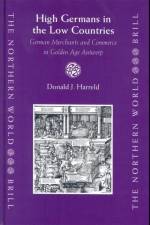
This volume looks at the South German merchant community during Antwerp's Golden Age by examining German involvement in the social life of the city as well as by tracing merchants' commercial activities. The first section of the book considers the institutions of trade and the role Germans played in their development and how Germans interacted with other foreign merchant communities. The second section takes a wider view by tracing the commercial networks that South German merchants operated in and by quantifying South German participation in Antwerp's foreign trade.
This volume approaches the history of the great city of Alexandria from a variety of directions: its demography, the interaction between Greek and Egyptian and between Jews and Greeks, the nature of its civil institutions and social relations, and its religious, and intellectual history.
"The Pen-Pictures is a well-known source for the history of the Gold Coast," modern Ghana, cited and quoted by both professional historians and interested lay-people. This annotated edition is the first reprint of the book and offers a lively and both historically and literarily interesting text about an important phase in Ghanaian history. The added introduction and annotation offer a context hitherto unavailable to the scholar and general reader.
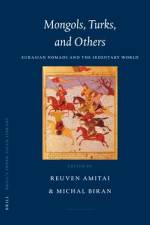
The interaction between Eurasian pastoral nomads and the surrounding sedentary societies is a major theme in world history. This volume explores the mulitfarious nature of nomadic society and its relations with China, Russia and the Middle East from antiquity into the contemporary world with emphasis on the Mongol and Turkish peoples.
This book addresses the often vexed question of national maritime claims and the delimita.tion of international maritime boundaries.
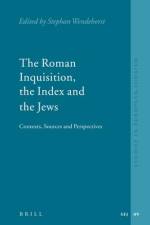
In comparison to the Iberian Inquisitionslittle research has been done on the attitude of the Roman and Universal Inquisition to the Jews. The present volume deals with the relations between the Catholic Church, Jews and Judaism and the potential of the now accessible sources in the archive of the Congregation for the Doctrine of the Faith in Rome for throwing new light on this intricate relationship. It starts with contributions by Kenneth Stow, Piet van Boxel, Hanna W?grzynek, Amnon Raz-Krakotzkin, Eleazar Gutwirth, Michael Studemund-Halivy and Sandra Neves Silva on key areas of the encounter between the Roman Church and the Jews such as papal policy, censorship and the Converso milieu. It moves on to presentations ofarchival material from the Congregations of the Roman Inquisition and of the Index by Claus Arnold, Antje Brdcker and John Tedeschi and concludes with sketches of ongoing and prospective research projects by Stephan Wendehorst, Ariella Lang and Hubert Wolf.
This book uses insights from religious studies, literary theory, and the history of science for understanding the Sumerian composition "Nanse and the Birds" in the context of the Old Babylonian scribal school. It contains editions of all the relevant Sumerian texts.
The focus of this volume is on the various forms of local, informal and/or customary law and their interaction with human rights.
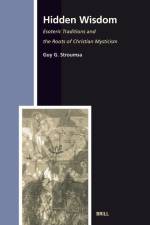
This book investigates the problem of esoteric traditions in early Christianity, their origin and their transformation in Patristic hermeneutics, in the West as well as in the East. It argues that these traditions eventually formed the basis of nascent Christian mysticism in Late Antiquity. This publication is a revised edition of the original hardback publication, please click here for details.
"A History of the Greek Language" is a kaleidoscopic collection of ideas on the development of the Greek language through the centuries of its existence.
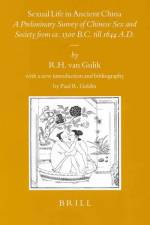
In 1961 Robert van Gulik published his pioneering overview of "Sexual Life in Ancient China," This edition of the work is preceded by an elaborate "introduction" by Paul Rakita Goldin assessing the value of Van Gulik's volume, the subject itself, and its author. The introduction is followed by an extensive and up-to-date "bibliography" on the subject, which guides the modern reader in the literature on the field which appeared after the publication of Van Gulik's volume. One of the criticisms in 1961 regarded the Latin translations of passages deemed too explicit by Van Gulik. In this 2002 edition all Latin has for the first time been translated into unambiguous English, thus making the full text widely available to an academic audience.
This text is about the indigenous Nyoongar people of the south-west of Western Australia and their perspectives on racism, which has had a devastating effect on their lives and culture since colonisation; and the multicultural policies that are effective in Australia.The author, and those Nyoongars interviewed, give valuable insight into Aboriginal lives. Their comments reveal how Nyoongar people survived the colonialism, cultural genocide, the horrendous state government policies under which they were forced to exist, the Stolen Generations of children and the loss of their land, identity, culture, and purpose in their lives. Presently, they are fighting for equality and for recognition as being part of the oldest living culture in the world, that of the Australian Aborigines.
According to Durkheim comparative sociology is sociology itself. Comparative criminology goes back to the days of Durkheim, but today it is possible to conduct group comparisons in many settings and with an incredible array of data. This book represents a variety of approaches making comparisons. The emphasis is on creative methods, challenging theory and unusual subject matter. Topics range from Micro-Macro Criminology to Police Strength and from Women Police to Crime Prevention Policies in the UK and the US.
Governance is not a topic that easily lends itself to neat and precise definitions. Although concepts and practices of governance are profoundly under-specified, they are frequently associated with three dimensions: how and why governments are structured, what processes they employ in governing, and what results they are able to accomplish in serving their societies. The articles in this book represent a wide range of scholarly interests that extend from the abstract and conceptual to the specific and applied.
Forest Spiders of South East Asia offers the first comprehensive systematic account of all sac and ground spiders of South East Asia, which together constitute an estimated 12% of all spiders in the region. All ten subfamilies, 57 genera and numerous species of the region are defined, described, and illustrated. One new subfamily and a large number of new genera and species are described and named. Several hundreds additional, described and new, species are referred to. Distribution of all species covered in this volume is shown in 50 maps. More than a thousand line drawings and 16 colour photographs are used to illustrate the descriptions of the species, of which the great majority has never been illustrated before.The book provides a modern revision of all sac and ground spiders with clear illustrated diagnosis and descriptions of all known members of this group and many new species and genera. Identification of all 47 families occurring in the region is illustrated in beautiful and detailed drawings.
In this book the author re-examines the relevance of the seminal texts of western civilization for the present environmental debate. He is arguing that what we today know as 'Christian cosmology' is in fact a grafting of classical Greek philosophy onto ancient Israelite thought, with certain valuable traditions being all but lost in the process. The dietary laws of Leviticus and Deuteronomy, in particular, still prove surprisingly relevant today.
This publication presents the results of several years of archaeometallurgical surveys and excavations in the Taurus Mountains of southern Turkey. In addition instrumental analyses of metal artifacts spanning from the aceramic Neolithic to the end of the second millennium B.C. (8000-2000 B.C.) placed within their archaeological contexts are presented as precursors to the rise of technologically sophisticated metal industries in Anatolia.
This book gives a critique of the contemporary global capitalist system and the adverse consequences suffered by the developing countries as a result of their 'integration' into this system. The current neoliberal paradigm of capitalist development as the only or the best alternative for the economic, social and political development of the developing countries is rejected. The authors search for more human and ecologically sustainable alternatives, focusing on Latin America, Asia and women.
Ever since the end of China's civil war in 1949, Taiwan has embarked on its own distinct, divergent path of development. In light of its remarkable achievements and inherent difficulties, therefore, Taiwan should not be considered a renegade province of China, but a society with a democratically-elected government that has taken a route different from the rest of China in developing its own cultural norms and values. This book examines the issues of democratic transition, political imprisonment and the political economy in Taiwan.
Most people, and indeed governments, hold the conviction that reforms, rather than revolutions, are likely to produce more appropriate and acceptable results. This is especially true for developing countries. That is because reforms are gradual in their implementation and respectful to past policy fabrics of a society. On the other hand, the simultaneous spread of communication technology, global liberalization of the market, and peripheral homogenization of cultures, have caused extreme tensions in just these developing countries. In this book, scholars from different countries around the world highlight the reforms and the tensions, in the light of the questions: what has been achieved, what has failed, and what is still needed? Experiences from such diverse locations as Nigeria, Ghana, Guatemala, South Korea, Taiwan, Zimbabwe, and Tanzania are combined with more general observations from other countries.
The eighth century has not been analysed as a period of economic history since the 1930s, and is ripe for a comprehensive reassessment. The twelve papers in this book range over the whole of Europe and the Mediterranean from Denmark to Palestine, covering Francia, Italy and Byzantium on the way. They examine regional economies and associated political structures, that is to say the whole network of production, exchange, and social relations in each area. They offer both authoritative overviews of current work and new and original work. As a whole, they show how the eighth century was the first century when the post-Roman world can clearly be seen to have emerged, in the regional economies of each part of Europe.
In today's European arts and sciences most of the time we see not only other, but also our own cultural traditions and the different forms of modernity like a dim image in a mirror. And the future of our own and other cultures seems to be shrouded in mystery, because our gift of knowledge and inspired messages are only partial. The question this book addresses is whether it is possible to get an almost face-to-face intimacy with various forms of cultural tradition and modernity by using our experiences and our powers of imagination, i.e. our expectations, in a more fruitful way.The contributors to this book try to give answers to this weighty question by taking as a guideline Erasmus's famous motto "ad fontes, i.e. always go to the sources. Without, however, nursing the illusion that our partial knowledge will ever be complete. Is there, they ask, a real chasm between the 'modern' West and the 'traditional' East, as so many authors have argued? And if so, how deep is the chasm and how is it to be bridged? How much do people in the West know about their own cultural tradition and the modern times they live in? How much do they know of the traditions and the modernities of the East and how much do they need to know in order to cope with what the future will probably bring? Are our images of cultural tradition and modernity in East and West, in Past and Present so blurred that we look at them as through a glass, darkly? What the contributors to this book argue for is the necessity of looking at developments both in East and West, both in Past and Present from a wider perspective, of taking a global point of departure. They argue for greater understanding and communication betweencultures, for cultural pluralism (as distinct from cultural relativism). They argue for the open, tolerant, non-dogmatic and critical thought that was the most important characteristic of Erasmus's philosophy.The chapters in this book can be useful to a broad audience and a
"Virtual History and the Bible" asks where we are at the beginning of the new millennium and how we got that way. What if important events in ancient history had turned out differently? How different might the present century be? This is a volume about history, not fantasy or fiction. Sixteen eminent historians of the Bible discuss not only what might have happened differently but demonstrate how, in practice, biblical historians go about reconstructing the past.
Abonner på vårt nyhetsbrev og få rabatter og inspirasjon til din neste leseopplevelse.
Ved å abonnere godtar du vår personvernerklæring.