












Gjør som tusenvis av andre bokelskere
Abonner på vårt nyhetsbrev og få rabatter og inspirasjon til din neste leseopplevelse.
Ved å abonnere godtar du vår personvernerklæring.Du kan når som helst melde deg av våre nyhetsbrev.

Lying is a familiar and morally important phenomenon. No matter if it is in election battles, in personal relationships or in the form of fake news - lying affects us almost every day. Showcasing cutting-edge research on the concept of lying, including work on blatant falsehoods, children's concept of lying and deception in the courtroom, this interdisciplinary collection examines what it means to lie and how lying should be defined.Bringing together leading and rising scholars from philosophy, psychology, linguistics and anthropology, chapters present novel empirical findings using a variety of methods including experiments, armchair methods, corpus studies and fMRI. Advancing our understanding of the concept of lying, it also focuses on related concepts such as "fake news" and "bullshit", as well as fundamental questions such as whether lying is morally worse than misleading. It is an essential resource for any student or scholar looking to stay ahead of the latest developments in the philosophy of lying and related fields in philosophy of language, ethics and moral philosophy, philosophy of law, moral psychology, linguistics and cognitive science.
Calling all Ghosts fans! This is the ultimate celebratory gift book for all of you in desperate need of another Ghosts fix, complete with in-depth interviews with the actors, the directors and the crew, a behind-the-curtain peek at what happened on the film set, scenes that were left on the cutting-room floor, bloopers, episode guides and character profiles, and much, much more. Collated and written by the show's beloved creators-actors-writers - Mat Baynton, Simon Farnaby, Martha Howe-Douglas, Jim Howick, Laurence Rickard and Ben Willbond - this is a hilarious and amazing profusion of stories, memories and secrets that will help fill that Ghosts-shaped hole. From understanding how the ghosts walked through walls to discovering how long it took to do Robin's make-up, and from learning who stole what from the set to reliving favourite moments, Ghosts: Brought to Life is a treasure-trove of fascinating insight into the makings of this comedy legend, a series that brought families together and touched people's lives.
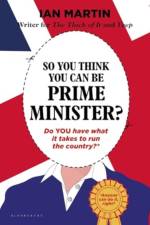
The perfect gift for fans of The Thick of It, Have I Got News for You and general moaning about the UK government: Do YOU have what it takes to be the next Prime Minister?Most of us know our limitations, especially when it comes to a career choice. We watch documentaries about A&E departments and the heroes who work there, and we think no. Oh no, thanks very much. We wouldn't have the nerve, or the stamina, or the resilience to do THAT. But who amongst us hasn't looked at the woeful performance of a prime minister and thought: 'Really, is that all there is to it? Even I could do that'. Now is your opportunity to familiarise yourself with what the job of prime minister actually is. This satirical and illuminating guide takes you through the craft and mystery of it all - packed full of quizzes, personality tests, word searches and much more - to see if you've got what it takes. In this book you will find:- Media training: top professional advice for the novice aspirational politician, including live rehearsals with interviewers, trick questions, sustained ignoring and how to choose the perfect walk on track. - PM Cards: which one of the past PMs is your political guiding light?- Money: how to charm people out of money on an industrial scale, complete with a guide on how to create a cash for honours system with your family- A Brief History of the Office of PMs: it won't surprise you to learn that they simply made it up as they went along. Written by Ian Martin, Emmy award winning writer, who was a core member for The Thick of It (and their swearing consultant too), Veep and The Death of Stalin, this is the ultimate guide to keep you and the family (or should we say your performance coaches) busy to see whether you're going to be our next Prime Minister this year. GOOD LUCK!
This collection explores the relationship between the state and private law. It does this by addressing four overlapping questions; opening by asking why states recognise and enforce private law obligations and liabilities. It goes on to ask how the state as a legal actor is subject to private law. The third question explored relates to the relationship between private law and public law. Finally, it examines what the role of the public interest is in private law. With the perspective of world-leading commentators, from both academia and the judiciary, this book provides a fascinating assessment of a crucial but complex relationship.
This edited collection is the first book-length academic publication on the Palestinian Bedouins at risk of forced displacement in the Central West Bank and Greater Jerusalem area. At its core are two questions: firstly; what are the humanitarian vulnerabilities they face and how are they produced/constructed? And secondly, how does protracted impunity for international law violations drive humanitarian protection risks for them? It interweaves international law, community-based empirical research and interdisciplinary perspectives, to offer the broadest possible framework for understanding these complex and complicated questions.
This book establishes, analyses and systemises the challenges that AI evidence poses to fundamental rights and principles of criminal procedure, as well as the rule of law. Taking a four-part approach, distinguished experts contribute chapters on the six examined countries (Germany, Luxembourg, the Netherlands, France, England and Wales and the US) that provide the basis for the comparative analysis and the development of concrete policy proposals. Part one provides a comparative overview of the challenges of using AI evidence in court, highlighting the gaps in the current regulatory frameworks that cannot be easily closed by traditional doctrine of criminal proceedings. Part two offers insights from data protection law, ICT law and human rights law that will shape the future regulation of AI evidence in criminal courts. Part three addresses complex issues related to the use of AI evidence and ensuring its admissibility by the courts. Lastly, part four proposes policies to rectify or mitigate the above established deficiencies in the current legal framework.
This open access book establishes an interpretative framework by means of a functionalist-originalist reading of EU law and comparative federalism, in particular US constitutional law. The EU is undergoing one of the most profound structural crises of its history, relating to the rule of law and fundamental rights. The author conceptualises the existential question in terms of ontology, constitutional legitimacy, doctrine and institutional process. By providing the first conceptual methodology (based on comparative federalism and focusing on law and rights) the book develops proposals which can be used to address the EU's current constitutional challenges.The ebook editions of this book are available open access under a CC BY-NC-ND 4.0 licence on bloomsburycollections.com.
This book unveils gaps, inconsistencies, and barriers to accountability emerging from the intersections between IHL and ICL in the definition and treatment of indiscriminate and disproportionate attacks as jus in bello violations. The book identifies and explains the unresolved legal problems surrounding the prevention and control of indiscriminate and disproportionate attacks as international war crimes, and critically unpacks the macroscopic implications of these problems for international adjudications. It goes on to address the challenges posed by these attacks as key causes of civilian victimization in war. The author demonstrates that the Rome Statute of the ICC, legibus sic stantibus, does not allow to prosecute and punish the most recurring forms of indiscriminate and disproportionate attacks, crucially impairing the ability of this institution to pursue the objectives declared by its founding treaty. It concludes by offering two amendment proposals for the Rome Statute to bridge the gaps and overcome the antinomies identified.
By developing a new ontological argument for the existence of God, Joshua R. Sijuwade presents an innovative approach that enriches the existing discourse with fresh insights and a contemporary perspective.The ontological argument seeks to demonstrate the existence of God from an a priori standpoint and Sijuwade begins by addressing the substantial critique the modal argument has received. He embarks on a rigorous exploration, providing needed analysis and a positive iteration termed the 'Rational Ontological Argument', rooted in a novel modal methodology known as Rational Modal Realism.Using this new method, Sijuwade focuses on demonstrating how the central concepts and theories within modal metaphysics and epistemology-such as modal realism, modal rationalism, trope theory and ontological pluralism-offer a means to develop a victorious ontological argument.Employing contemporary analytic methods and suggesting productive directions for further research, Sijuwade makes a key contribution to philosophy of religion and re-invigorates the age-old philosophical argument for the existence of God.
'Richard Wilson's meticulously researched, powerfully argued and brilliantly written account of Shakespeare's 20th-century fascist followers is not just an important but a genuinely essential book.' Robert Shaughnessy, Guildford School of Acting, UKIn this illuminating book, Richard Wilson demonstrates how in the 20th century Shakespeare and his plays were subjected to a sustained institutionalized misreading, which served the purposes of proto-, present and future fascism. It exposes how Shakespeare was misappropriated by the far right to represent Britain's supposedly glorious history, and the ways in which they utilized him and the cultural capital of his work. Wilson argues that in Britain the plays were invoked as a way to anglicize fascism, as its leaders campaigned 'to recover theatre for the national cause' by 'looking back fondly to Elizabethan England'. His extensive and rigorous research also gestures beyond Britain, taking in case studies from North America, Germany and France.Some of the names this book unearths will surprise: many of the right-wing political views or leanings of the prominent figures discussed have been brushed under the carpet, left unexplored or ignored. Across its ten chapters, this book provides in-depth case studies of a wide variety of figures, from A. K. Chesterton, who was both editor of the British Union of Fascists' newspaper Blackshirt and former manager of press and publicity at the Shakespeare Memorial Theatre, to celebrated Shakespeareans such as G. Wilson Knight, through to writers, artists and theatre practitioners including W. B. Yeats, T. S. Eliot, Edward Gordon Craig and Philip Larkin, among many others. At a time when democracy is under threat, populism is on the rise and far right views are increasingly prominent in our political landscape, Richard Wilson's book makes an especially vital and timely contribution to Shakespeare scholarship.
In this book, Mark Player explores how the do-it-yourself ethos of punk empowered a new generation of Japanese filmmakers during a time of crisis and change for Japan's film industry. Drawing on first-hand interviews with filmmakers of the jishu eiga (self-made film) tradition, such as such as Ishii Gakuryu, Yamamoto Masashi, Tsukamoto Shin'ya, and Fukui Shozin, Player explores how the bricolage style of punk was harnessed to create exciting intermedial film aesthetics informed by punk rock, graffiti painting, street performance, animation, and music technologies.Taking into account the practical, phenomenological and political ramifications of combining different media elements, Player offers in-depth readings of films such as Burst City (1982), Robinson's Garden (1987) and Tetsuo: The Iron Man (1989). He goes on to trace the changing sociocultural position of Japan's punk movement throughout the 1980s, from its euphoric early-80s highpoint to a growing dysphoria brought about by its co-opting and convergence by the mainstream.
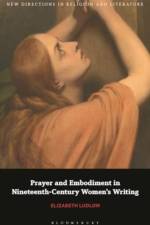
In the 19th century, an era that saw a reconfiguration of the relationship between the self, the world and the divine, women writers probed the theological depths of embodied faith in new ways through poetry, fictional, devotional prose and life writing.Elizabeth Ludlow explores how, through this process, they articulated what it means to pray, and thereby understand one's place in a world of individual and communal bodies. The eight women writers discussed - Elizabeth Barrett Browning, Josephine Butler, George Eliot, Elizabeth Gaskell, Dora Greenwell, Felicia Hemans, Adelaide Procter and Christina Rossetti - provide accounts of prayer that stress the only way to experience and respond to something of the transcendent is through embracing lived experience and through a recognition of the connectedness of all bodies. In detailing how these writers engage with new ways of thinking about faith, desire and the material world, Ludlow argues that they offer models for ethical modes of being in the world and pave the way for later theologies of embodiment.
This book offers a new, more critical perspective on the regulation and protection of individuals under international humanitarian law. Providing a historical account of the changing concept of individuals since 1864, the study draws on social constructivism. This approach casts light on the struggle of making sense of, and agreeing on, the position of individuals in armed conflicts, often hidden by international humanitarian law's conventional narratives. This intriguing study grapples with a difficult and disputed area of the law of armed conflict, making a singular and significant contribution which will be welcomed by all scholars in the field.
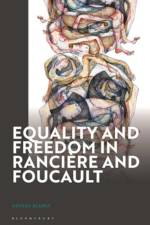
Responding to the increasing need for new and peaceful forms of emancipation, Stuart Blaney offers a unique solution in the synergy between two pioneering strands of continental philosophy: Michael Foucault's ideas on freedom and Jacques Ranciere's ideas on equality. Building a dialogue between these two thinkers, Blaney presents new perspectives on their work and a clear picture that emancipation comes from everyday practices rather than any particular movement or revolution.In exploring these combined views of equality and freedom, Blaney draws on some of the central facets of both concepts, including revolution, disagreement, care for the self, free speech and stoicism. To put these ideas into a practical framework of real, lived experience, we are introduced to the figure of Louis-Gabrielle Gauny the nineteenth century worker-poet and self confessed plebeian philosopher. Gauny is a nexus for Ranciere's and Foucault's ideas; his life exemplifying a dual mode of existence in-between conformity and political revolution. This lived philosophy of equality and freedom shows the strong synergy between the two concepts, with one reinforcing the other and strengthening their efficacy as forms of emancipatory practice.
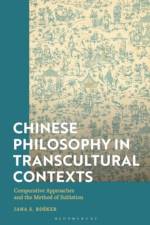
In this open access book Jana S. Rosker presents a novel dialectical method to our comprehension of diverse philosophical ideas. Analyzing philosophical discourses that have emerged in China and the Sinophone region, Rosker applies the method to examples from across the history of thought. From Ancient Chinese logicians to 20th-century intellectuals, she connects thinkers and offers fresh insights into key aspects of philosophy. The result is a series of vibrant dialogues among different intellectual traditions, providing new understandings of transcultural philosophical interactions. The ebook editions of this book are available open access under a CC BY-NC-ND 4.0 licence on bloomsburycollections.com.
"Offering the first full-scale edition of Thomas Gray's Latin poetry along with a facing English translation, this book balances accessibility and readability. Estelle Haan provides the reader with a detailed introduction and a comprehensive commentary that situate Gray's Latin verse in relation to his works on translation theory, queer theory, feminist theory and, especially, his appropriation of classical and Neo-Latin literature. This book also traces hitherto unlocated manuscripts of several of his Latin poems, and includes an editio princeps of his recently discovered Latin verses pertaining to his Neapolitan sojourn"--
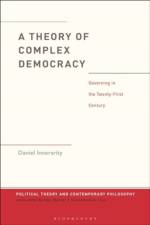
Do our political systems and democracies really reflect the complex reality of the 21st century? Or does politics seem to be legislating about yesterday's world? In his latest book, Daniel Innerarity warns of the gap between the political concepts that serve as our guide and our overly complex reality that has long ceased to respond to them. Arguing that this theoretical deficit leads to a political practice that simplifies and impoverishes our democracies, nourishing the demagogues and sustaining reassuring old narratives, Innerarity proposes a modern update of key political concepts, from power and sovereignty to territory and representation. The theory of democracy originates from a time of relative social and political simplicity. There was less pluralism, less interdependence, political entities were autarkic, and the technological tools they had to handle had nothing to do with the sophistication of our artificial intelligence, our financial system, or the technological advances in medicine. And yet, Innerarity argues, there is no need to despair. If democracy has made the transition from the polis to the nation-state, from direct democracy to representative democracy, there is no reason to suppose that it cannot face new challenges, as long as it is provided with an adequate political architecture. Drawing on a broad range of sources, including classical and contemporary theorists, A Theory of Complex Democracy presents a new theory of democracy and government for the 21st century, a theory that starts from the premise that the most promising rejuvenation of our democracies is to make them more complex.
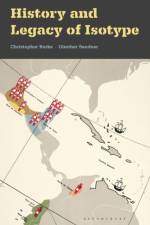
Based on extensive archival research, this open access book provides a fresh perspective on the early history of Isotype and pictographic communication, with new information about largely unknown episodes throughout its development. The picture-script Isotype (International System of Typographic Picture Education), previously conceived as the Vienna Method of Pictorial Statistics, evolved through numerous publications and exhibitions in the early 20th century. Christopher Burke and Günther Sandner trace how its development responded to differing cultural and political climates, through a period when the idea of a universal language - an artificial or planned language - was linked to ideas of internationality and democratic planning. This book explores in depth, for the first time, the early picture-statistical work carried out at Austrian institutions during a new era of visual education and communication during and after World War II. Examining the work of Isotype's initiators - Otto Neurath, the founding director of The Social and Economic Museum of Vienna, the artist Gerd Arntz, and Marie Reidemeister, who performed the role of 'transformer', a prototype of the modern information designer - this book challenges existing conceptions of an enormously influential pictographic language. Richly illustrated throughout with over 60 examples of work by key figures, this book provides a comprehensive history of Isotype and offers critical reflections on its legacy within, and relevance to, contemporary design practice.The eBook editions of this book are available open access under a CC BY-NC 4.0 licence on bloomsburycollections.com.
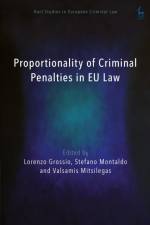
This book develops a systematic analysis of the principle of proportionality of penalties in EU law.Taking a four-part approach, the book firstly looks at the protection of victims' rights in EU law and the lessons to be learned from regional and international instruments. It looks specifically at the case law of the CJEU, such as the Victims' Rights Directive and the Compensation Directive. It then goes on to look at the state of play of victims' rights in the national laws of the Member States, such as France, Germany, Hungary, the Netherlands, Romania, Lithuania and Ireland. Part three addresses the need for coherence and balance between the different interests at stake. Finally, the book looks at the prospects, putting forward a fresh perspective on the topic.Until now, the principle has been mainly assessed from a criminological point of view. By departing from existing literature, the book advances an original EU law perspective on proportionality of penalties, which underlies the analysis of its theorisation, place and influence on domestic criminal systems. Building upon this approach, scholarly contributions in the book systematically delve into the various implications of the principle in EU law, while paying particular attention to its profound interaction with criminal law concepts.
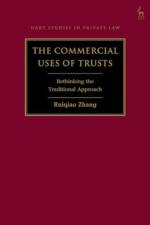
This book provides a systematic and critical analysis of the role trusts play in modern commercial markets. Commercial trusts are complex and ever-evolving, and a reassessment of the traditional legal norms relating to them is much needed in order to provide new doctrinal insights. The book does just that: focusing on trusts in the UK, while drawing on developments in European jurisdictions and in China. It presents a thought-provoking assessment and a unified understanding of commercial trusts.
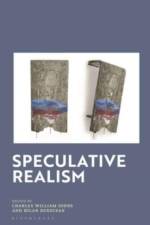
Throughout the history of Heideggerian thought - a thought which surely shapes our understanding of 'Being' in the 20th and 21st century (as well as the history of western metaphysics in general) - there seems to be no place for what Plato, Hegel and Marx before him called 'dialectics'. For Heidegger, the dialectical method was "a philosophical embarrassment". Equally, for one of our more contemporary philosophers, Graham Harman, there is no appearance of the word 'dialectic' in his complete oeuvre. In this relatively short book, Johns and Bensusan, in the style of Derrida, looks over the absence or spectre of the signifier 'dialectic' in both Heidegger and Harman's work, arguing that such a negation of the term turns out to be more of an intentional repression than any passive neglection. Rather, the editors insist that such a repression finds its way into their writing as an alternative interpretation of their core concepts. Bringing together for the first time Hegelian thought in relation to both Speculative Realism and Harman's work, this volume markedly serves less as a Hegelian critique of such thinkers and more as a Heideggerian and Harmanian resuscitation of the dialectic in Hegel; as a realist method capable of integration into contemporary philosophy. Offering a new way of conceiving 'dialectics' based on recent developments in science and the most cutting edge of contemporary philosophy, this book is indispensable to anyone interested in the crossroads of contemporary strands of idealism, materialism and realism. Perhaps, in this sense, the 'speculative' term antecedent in both Hegel's Speculative Philosophy and Speculative Realism can finally be reconciled in true dialectical form.
This collection looks at the protection of victims' rights in EU law. Taking a four-part approach, it firstly focuses on the Victims' Right Directive and the proposal for a Directive on combating violence against women. It then explores victims' rights in the national laws of the Member States, including France, Germany, Hungary, the Netherlands, Romania, Lithuania and Ireland.Finally it analyses the main challenges in the field and the need for coherence between the different competing interests.
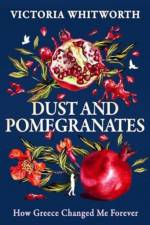
From a magical childhood in Kenya, through misery at an American high school, to rescue by an inspirational teacher in England, Victoria Whitworth weaves a sublimely rich narrative, which is both an ode to her beloved Greece and Corfu, and a highly original exploration of myth and legend. Her adventures in the often weird and unsettling world of a Corinth English language school, and the shattering experience of her rape by a Greek taxi driver, lead Victoria to question some deeply familiar stories. Did Agamemnon really kill his daughter Iphigenia, so the wind would fill their sails for Troy? Was beautiful Helen of Troy a powerful enchantress? Or a tragic victim? Was Theseus, the Minotaur slayer, a superhero, or a predatory rapist? Or were they all of these things? This beautiful memoir asks repeatedly where truth lies, and how, as women, we can survive violence and conquer fear.
A gripping and inspiring account of one of the world's toughest races through the eyes of an extraordinary woman, and how she (and all of us) can use the lessons she learned to live a life of authenticity and success
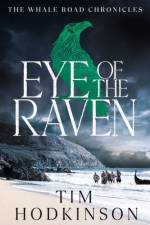
PREORDER EYE OF THE RAVEN, THE EXCITING NEW WHALE ROAD CHRONICLES VIKING ADVENTURE FROM TIM HODKINSON, NOW!Alone in a foreign land, Viking warrior Einar must choose his loyalties in the face of warfare. The gripping new instalment in the Whale Road Chronicles. For the first time, Einar and the Wolf Coats find themselves divided as circumstances mean they end up on opposing sides: the Wolf Coats in Ireland, and Einar in the lands of the English. With war brewing and a great battle on the horizon, can Einar and his comrades reunite in time - or will the horrors of war make their split a permanent one?
This innovative and thought-provoking book studies how subrogation and marshalling should be understood in the context of private law.Subrogation and marshalling are legal rules which give a person new rights with prima facie the same content as someone else's extinguished rights. There is little examination of why the law does this. This book argues that the key to understanding subrogation is the distinctive form of the rights that it creates. The form of rights created reflects a particular role in ensuring interpersonal justice: subrogation's role is to properly distribute the burden of debts. Taking this model, the book goes on to resolve persistent controversies in the case law, including when subrogation should occur, what rights it should create, the relationship between subrogation and marshalling, and whether subrogation is a remedy for unjust enrichment.
This book provides a timely and much-needed critical legal review of children's participation in healthcare that goes beyond merely documenting the extent and scope of participation, and explores the importance, definition of, and barriers to their meaningful participation. Addressing a gap in the literature, the book uses a combination of empirical data, childhood and participatory theory, and legal analysis to study the participation of children and young people in the medical context from a child's rights perspective. Centring the unheard and underrepresented lived experiences of recent and past child patients, and doctors, the book uses Interpretative Phenomenological Analysis, a methodology traditionally used in psychology, to provide a refreshing and unique exploration of children's participation in their healthcare. The book explores to what extent national law and international non-binding conventions have created a 'right' to participation, studies the application of national law in clinical practice asking whether the law facilitates meaningful participation, and analyses the interaction between law and quasi-legal regulations.The book will be useful for academics, children's activists, and legal and clinical practitioners.
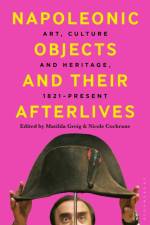
Two centuries after Napoleon Bonaparte's death, this edited volume brings together a diverse group of historians, art historians, and museum professionals to critically examine the enduring power of visual and material culture in the making of Napoleonic memory. While most discussions surrounding the legendary figure explore his impact on legislative, political, or military reform, this innovative volume explores the global dimensions of the trade in Napoleonic collectibles, art, and relics over time.Representing new avenues of research and scholarship, Napoleonic Objects and their Afterlives investigates the material objects and cultural forms that Napoleon inspired through a range of themes. These include art collecting, the circulation and display of objects, political and imperial symbolism, and the flexibility and ambiguity of Napoleon's enduring legacy. The essays examine how and why, despite his contentious role in contemporary memory, Napoleon continues to escape much historical and popular censure. They explore the ways people have connected with the idea of him: on stage and screen; in museums and galleries; and most intimately of all, by gathering items said to have belonged to him, right down to his toothbrush and locks of his hair.Napoleonic items can be official or personal, serious or comical, luxury or disposable, yet little work has been done to bring together these diverse cultural histories into conversation with one another. With its broad, multi-disciplinary approach, including perspectives from art history, film studies, cultural history, and museum curation, the book provides a deep critical insight into the cult of personality surrounding Napoleon and its effect on our understanding of celebrity culture today and in the future. Includes an additional foreword by Napoleon's biographer, Ruth Scurr, author of In Gardens and Shadows (2021).
Metaphysics of Nature in Kant's Opus postumum argues that Kant's last, unfinished manuscript contains an attempt to work out the long-awaited "system of pure speculative reason" or "metaphysics of nature" Kant had been promising for many years. Challenging current readings of Opus postumum that claim to show how Kant was filling a "gap" in the Critical system, this book explores how the gap might be the system itself. Suggestive of an entirely different approach, Metaphysics of Nature in Kant's Opus postumum argues that we must develop a more radical, open-ended reading of Kant's last drafts, now known as Opus postumum (1796-1803), so as to situate them in a broader light. Thomson offers a new interpretation of the place and role of the hundreds of pages bundled into "fascicles" which Kant left on his desk when he died by taking his demand for a "metaphysics of nature" to be the seed from which they grow and the centre around which they orbit. By starting out with the often overlooked Architectonic of Pure Reason in Critique of Pure Reason, this book explores how Opus postumum is this future born into the present; it is Kant's attempt to deliver on the Critical promise of a fully worked out metaphysics of nature.
This book explains the new requirements of the EU Artificial Intelligence Act in an understandable and application-oriented manner. In addition to a complete commentary on the AI Act, the book contains chapters on technical and ethical principles, and responsibility for AI and data protection aspects. It describes in detail which obligations are imposed on providers and commercial users of AI systems, how such systems can be introduced and used in compliance with the law, and what requirements the providers and users of such systems are subject to.
Abonner på vårt nyhetsbrev og få rabatter og inspirasjon til din neste leseopplevelse.
Ved å abonnere godtar du vår personvernerklæring.