

Gjør som tusenvis av andre bokelskere
Abonner på vårt nyhetsbrev og få rabatter og inspirasjon til din neste leseopplevelse.
Ved å abonnere godtar du vår personvernerklæring.Du kan når som helst melde deg av våre nyhetsbrev.

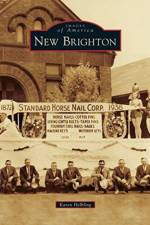
New Brighton's unique and rich history dates back to 1788. Its location on the Beaver River attracted industries, such as the Townsend Company, Wilson's Mill, Sherwood Pottery, Standard Horse Nail, Dawes and Myler, and the Pittsburgh Wallpaper Company, and brought immigrants in search of employment to the thriving community. Some businesses that supported the growing town were Kenah's Apothecary, Milo Wilson's Butterine store, Bestwick Hardware, A.D. Gilliland Dry Goods, Ewing Brothers, and Stuart Magee's grocery. Notable citizens included Edward Dempster Merrick, a 19th-century entrepreneur who founded the Merrick Art Gallery; author and journalist Grace Greenwood; and the famous Noss family. New Brighton opens a window to an era of bustling businesses and industries, Junction Park, school days, and yesteryear modes of transportation. It also gives a rare look inside the house known locally as the "Castle," built in 1894 by 19th-century industrialist Frederick Merrick.
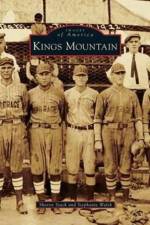
A gold rush in the 1790s brought people to an area in North Carolina known as White Plains. With the promise of prosperity from the gold rush and an abundance of land suitable for farming, the area was soon settled by Scotch-Irish and German pioneers. As the railroad was being built, officials asked the local postmistress to name the new railroad station. She chose Kings Mountain, after the Revolutionary War battle fought eight miles south. Over time, Kings Mountain has flourished with industries, churches, education, and cultural institutions while the friendly, hardworking residents have found success in the mines and textile mills. Kings Mountain looks back over 100 years of the city's residents as they work, study, worship, play, and celebrate their heritage.
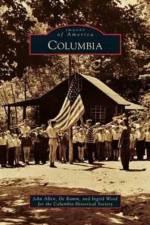
Nestled in the crossroads of Connecticut's eastern highlands, Columbia was home to Eleazar Wheelock's Moor's Indian Charity School, founded in 1754. This Puritan parish was transformed by the early-19th-century Industrial Revolution and was later changed into an exurb of Hartford by the 20th-century automobile. Beginning in 1720, Columbia residents harnessed waterpower for all manner of mills, including grist, cider, sorghum, carding, fulling, saw, shingle, and wood turning. Hop River Village was the site of the first large-scale industrial cotton mill in Connecticut in 1837. Today, the mills are long gone. The Ten Mile River, Hop River, dramatic Columbia Lake Ravine, Utley Hill Preserve, and pristine Columbia Lake hold clues to a once bustling commercial center. Post-World War II Columbia grew into a vital residential, recreational community with small industries and an agricultural heritage.
Although the City of Marion's motto, "Where Main Street Meets the Mountains," was chosen to describe the present-day city, it is also an apt description of Marion's past. Founded in 1844 at a rugged crossroads at the foot of the Blue Ridge Mountains, Marion was hewn out of the land by the hard work and determination of its citizens. Mountaineer mingled with businessman, and a unique community took shape, colored across time by triumph, tragedy, and progress. In Marion, the community's rich history is brought to life in over 200 vintage images. Drawn from small private collections as well as from public archives, many of these photographs are published for the first time. Historical images show Marion's early days when horse and wagon struggled to navigate the muddy ruts of Main Street, the aftermath of the disastrous fire of 1894, gatherings and public events at the dawn of the 20th century, the beginnings of industry, and glimpses of everyday life. The city's three mill villages are also featured: Clinchfield, Cross Mill, and East Marion.
Washington & Old Dominion Railroad covered therailroad s corporate history, construction, and operation. Thissecond volume expands the coverage with a geographic focus on fourlocations: Rosslyn, Great Falls, Leesburg, and Purcellville. The imageswithin offer a look at the railroad s feed and grain business, railfan-typeviews of equipment, and a visual record of methods used to maintainthe right-of-way and place equipment back on the tracks. Additionally, this work offers a history of the conversion of the right-of-way into thevery popular Washington & Old Dominion Railroad Regional Park.Learn about the history of mills and their place in the local economy.See how the Burro crane was a jack of all trades. Look under the hoodand inside the cab to imagine what it was like to be an engineer onone of the railroad s Baldwin-Westinghouse electric freight locomotives."
Forest Hills grew out of an experiment--the transformation of 142 undeveloped acres into America's first garden city. From the early renderings of 1909 came a "fairy-book suburb," as Sinclair Lewis wrote, with architecture that was inspired by medieval villages. The success of the community bred development of homes, churches, and businesses on nearby plots. Forest Hills landed the most prestigious tennis tournament in the country. Theodore Roosevelt visited. Helen Keller moved in. Only generations later would the peace shatter when residents viciously protested a historic proposal for public housing.
Abonner på vårt nyhetsbrev og få rabatter og inspirasjon til din neste leseopplevelse.
Ved å abonnere godtar du vår personvernerklæring.