![The Works of ... Daniel Waterland. to Which Is Prefixed, a Review of the Author's Life and Writings, by W. Van Mildert. [With] a General Index af Daniel Waterland](https://cdnbackdoor.tales.as/thumbnail/150x225/products/00296/96752/the-works-of-daniel-waterland-to-which-is-prefixed-a-review-of-the-authors-life-and-writings-by-w-van-mildert-with-a-general-index.jpg)
![The Works of ... Daniel Waterland. to Which Is Prefixed, a Review of the Author's Life and Writings, by W. Van Mildert. [With] a General Index af Daniel Waterland](https://cdnbackdoor.tales.as/thumbnail/150x225/products/00308/77928/the-works-of-daniel-waterland-to-which-is-prefixed-a-review-of-the-authors-life-and-writings-by-w-van-mildert-with-a-general-index.jpg)


Gjør som tusenvis av andre bokelskere
Abonner på vårt nyhetsbrev og få rabatter og inspirasjon til din neste leseopplevelse.
Ved å abonnere godtar du vår personvernerklæring.Du kan når som helst melde deg av våre nyhetsbrev.

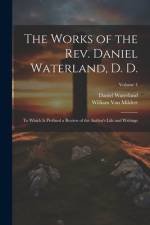
Daniel Waterland was an 18th-century theologian and controversialist whose writings on the Trinity and other theological topics generated heated debate. This collection brings together Waterland's major works, including his influential defense of the doctrine of the Trinity. William Van Mildert's preface provides valuable context for Waterland's life and work.This work has been selected by scholars as being culturally important, and is part of the knowledge base of civilization as we know it.This work is in the "public domain in the United States of America, and possibly other nations. Within the United States, you may freely copy and distribute this work, as no entity (individual or corporate) has a copyright on the body of the work.Scholars believe, and we concur, that this work is important enough to be preserved, reproduced, and made generally available to the public. We appreciate your support of the preservation process, and thank you for being an important part of keeping this knowledge alive and relevant.
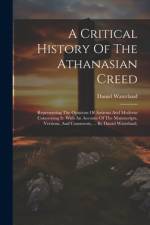
A Critical History of the Athanasian Creed is a scholarly analysis of one of the most important documents in Christian theology. Waterland's book explores the origins, development, and controversies surrounding the Athanasian Creed, and offers a wealth of insight into its meaning and significance for believers and scholars alike. It is an essential resource for anyone interested in the history of Christianity and the role of creeds in shaping religious doctrine.This work has been selected by scholars as being culturally important, and is part of the knowledge base of civilization as we know it.This work is in the "public domain in the United States of America, and possibly other nations. Within the United States, you may freely copy and distribute this work, as no entity (individual or corporate) has a copyright on the body of the work.Scholars believe, and we concur, that this work is important enough to be preserved, reproduced, and made generally available to the public. We appreciate your support of the preservation process, and thank you for being an important part of keeping this knowledge alive and relevant.
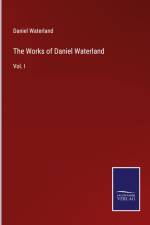
This book is a collection of works by the British theologian Daniel Waterland, including a review of his life and writings by W. Van Mildert. The author covers a range of topics in theology and philosophy, offering valuable insights into the intellectual trends of the 18th century.This work has been selected by scholars as being culturally important, and is part of the knowledge base of civilization as we know it.This work is in the "public domain in the United States of America, and possibly other nations. Within the United States, you may freely copy and distribute this work, as no entity (individual or corporate) has a copyright on the body of the work.Scholars believe, and we concur, that this work is important enough to be preserved, reproduced, and made generally available to the public. We appreciate your support of the preservation process, and thank you for being an important part of keeping this knowledge alive and relevant.
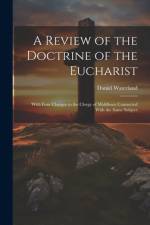
Waterland's review of the doctrine of the Eucharist is an important contribution to the theological debates of his time. In this work, he offers a careful and thoughtful analysis of the doctrine and considers its implications for liturgical practice and church governance. This book is an essential read for scholars and students of religious studies, theology, and church history.This work has been selected by scholars as being culturally important, and is part of the knowledge base of civilization as we know it.This work is in the "public domain in the United States of America, and possibly other nations. Within the United States, you may freely copy and distribute this work, as no entity (individual or corporate) has a copyright on the body of the work.Scholars believe, and we concur, that this work is important enough to be preserved, reproduced, and made generally available to the public. We appreciate your support of the preservation process, and thank you for being an important part of keeping this knowledge alive and relevant.
""The following Letters of the learned theologian, Doctor Waterland, are re-published with notes, in the hope that they may serve to spread and to strengthen a belief as to the character and value of Lay-baptism, which rests for its foundation on the witness and authority of holy Scripture--which has been widely held and taught throughout the Catholic Church from the earliest times--which is so consonant with the whole body of Catholic Truth that its denial would seem to be plainly inconsistent with that body of Truth, in more than one point--which is so consonant with right reason, that its contradictory is wholly unreasonable, unless we are prepared to contradict some other beliefs, which all Christian people agree to hold.""Waterland''s belief as to Lay-baptism is briefly stated in his own words, that ''since there is no Divine law or rule to found its validity upon, it can no more be valid than it can be lawful. For nothing is plainer to me than that what has no foundation for its validity, has no validity at all; or that nothing can be valid, which has no sufficient authority to make it so.''""--From the Introductory Note by F. Nutcombe Oxenham, M.A.Daniel Waterland (1683-1740) was an English theologian. He became Master of Magdalene College, Cambridge in 1714, Chancellor of the Diocese of York in 1722, and Archdeacon of Middlesex in 1730. He was also the author of a History of the Athanasian Creed.
Abonner på vårt nyhetsbrev og få rabatter og inspirasjon til din neste leseopplevelse.
Ved å abonnere godtar du vår personvernerklæring.