

Gjør som tusenvis av andre bokelskere
Abonner på vårt nyhetsbrev og få rabatter og inspirasjon til din neste leseopplevelse.
Ved å abonnere godtar du vår personvernerklæring.Du kan når som helst melde deg av våre nyhetsbrev.

This book tells a different story about water. Against the backdrop of the end of the Ottoman Empire to the Palestinian uprisings, old Palestinian women recount life before and after piped water. While talking about fetching and managing household water, women also talked about being women. Women, Water and Memory speaks of many different lives. We hear stories about women's own strength and beauty, and about the woman who married a man whose ugly face made her sick. While one woman married the man a oeshe cared fora, another was relieved that her husband died when she was too old to be forced to remarry. We learn about the joy they feel each time they dance at a wedding, the sheer satisfaction of lighting a cigarette, the loyalty and shared despair towards families with members in prison, and about the tears of sorrow at each death and the delight at each birth.
Nawab Faizunnesa (1834-1903) challenged established notions regarding womena (TM)s position in a Muslim society in colonial Bengal. Her "RupJalal " was the first literary text written by a Bengali Muslim woman. The translated text is placed in the historical context of colonialism and the nationalist movement of colonial Bengal. An analysis of the text is also included in order to invite readers to explore the woman question in context of Islam and/in imperial society. With the translated text, along with a critical overview and textual analysis, this book traces in Faizunnesaa (TM)s life and works the emergence of a self-conscious female voice by addressing the issues of social, political, and economic marginality of women in an Islamic, nationalist, and imperialist culture of colonial Bengal.
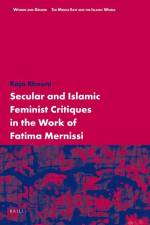
This book presents a detailed critical analysis of the work of Fatima Mernissi. Mernissi is considered to be one of the major figures in Feminist thought for both Morocco and Muslim society in general. This work discusses Mernissi s intellectual trajectory from secular to Islamic feminism in order to trace the evolution of so-called Islamic feminist theory. The book also engages critically with the work of other Muslim feminists, using frameworks and approaches developed in the works of Muslim reformist thinkers, namely Mohammad Arkoun and Nasr Abu Zaid, with the aim of engaging the theorization of this emerging feminism.
Abonner på vårt nyhetsbrev og få rabatter og inspirasjon til din neste leseopplevelse.
Ved å abonnere godtar du vår personvernerklæring.