









Gjør som tusenvis av andre bokelskere
Abonner på vårt nyhetsbrev og få rabatter og inspirasjon til din neste leseopplevelse.
Ved å abonnere godtar du vår personvernerklæring.Du kan når som helst melde deg av våre nyhetsbrev.

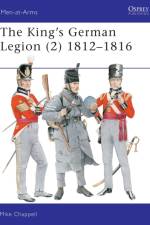
The King's German Legion earned renown as the crack corps of Wellington's army during the Peninsular Wars, including the famous charge at Garcia Hernandez during the Salamanca Campaign. A wide variety of uniforms are illustrated here, including light and heavy cavalry, and artillery.
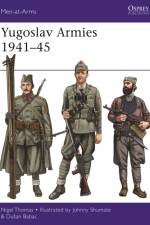
This volume describes, lists, and illustrates the several combatant forces raised in Yugoslavia during World War II.In March 1941, an anti-German coup in the Kingdom of Yugoslavia prompted Hitler to order an invasion using allied Italian, Hungarian, Bulgarian. and Romanian forces. Operation Marita was an invasion of Yugoslavia and simultaneously Greece. At the same time, the constituent region of Croatia broke away from Yugoslavia and joined the Axis powers. Royal Yugoslav armed forces, despite advancing against the Italians in Albania were forced to surrender after 11 days' fighting and some 1,000 soldiers, airmen, and sailors escaped to British-occupied Egypt to form Free Yugoslav units. From there, guerrilla resistance to the Axis occupiers broke out and continued with increasing strength until the end of the war under Mihailovic's royalist 'Chetniks' and Tito's Communist 'Partisans' (both supported by Britain). However, hostilities between the two movements eventually led to the Chetniks entering into local agreements with Italian occupation forces and Britain switching its support entirely to the Partisans. The advance of the Red Army increased Partisan strength and, during 1944-45, they created what could be described as a lightly equipped conventional army.Using meticulously-drawn illustrations of different insignia, uniforms, and equipment from each faction to bring the conflict alive, this volume describes, in detail, both the political and military implications of the war and how it was fought, setting the scene for the subsequent rise of Tito to power within Yugoslavia.
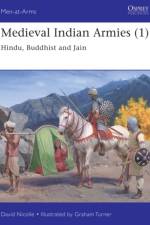
This fully illustrated study explores the armies of the Hindu, Buddhist and Jain states within what are now India, Pakistan, Bangladesh, Sri Lanka and Nepal during the period AD 500ΓÇô1500, as well as Afghanistan until the early 13th century AD.Following the emergence of a distinct ''medieval Indian'' civilization in the Late Classical and Early Medieval periods, there was a prolonged struggle between this civilization and that of the eastern Islamic world, concluding with the rise of the Mughal Empire at the start of the 16th century. In this fully illustrated study, David Nicolle investigates the traditions and enduring conservatism of non-Islamic medieval Indian warfare, notably evident in recruitment patterns and the significance of archery and cavalry. The role and impact of war-elephants, both positive and negative, are also considered, as well as the influence of climate and weather (notably the seasonal monsoon) on warfare in this region. As well as assessing arms and armour ΓÇô contrasting the advanced technology and high status of Indian weapons (especially swords) with the remarkable lack of metallic armour in the region during this period ΓÇô the author also explores siege warfare and riverine and naval warfare in South Asia. This book assesses the contributing factors identified by those who have sought to explain why the huge wealth and substantial populations of the traditional non-Islamic Indian states did not prevent their persistent failure in the face of Islamic invasion and conquest.
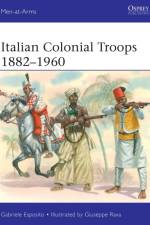
A complete illustrated study of the varied range of Italian colonial units who served in East and North Africa.Italy only unified as a nation in 1870 and was late, and therefore impatient, in the ''scramble'' for Africa. An initial foothold in Eritrea/Somalia, north-east Africa, led to a disastrous defeat in Ethiopia in 1896 at the Battle of Adwa, but Italian Somaliland was later consolidated on the west coast of the Red Sea. During 1911, Italy also invaded Libya, securing the coast, however fighting continued throughout World War I and only ended in the early 1930s. A number of native colonial regiments were raised in both Italian East Africa and Libya (in the latter, even a pioneering paratroop unit), of which most fought sturdily for Italy against the Allies in 1940ΓÇô43. These units had particularly colourful uniforms and insignia. Another small guard unit also served in the Italian concession at Tientsin, China in 1902ΓÇô1943. After World War II, a remnant unit served on in Somalia under a UN mandate until 1960.This intriguing volume describes and illustrates the dress and equipment used by these forces and details how they were deployed to maintain a colonial empire for over half a century.
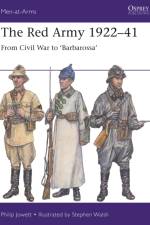
This study explores the organization, history and uniforms of the Soviet Red Army during the 20 years between its victory in the Civil War and the invasion of the USSR by Germany in 1941. The two decades following the Bolshevik victory over the 'Whites' in the Russian Civil War saw widespread and fundamental developments for the Red Army. Nevertheless, these still left it largely unready to face Germany's Operation Barbarossa in June 1941. Having been reduced in size and planning for modernization, the Red Army of the 1920s was employed to ruthlessly crush anti-Bolshevik opposition (real or suspected) in several regions of the USSR, notably Ukraine and Central Asia, and to fight a brief border war against Chinese Manchuria. During the 1930s, Stalin virtually 'beheaded' the army by a needless series of murderous purges of the officer class; despite this, the Red Army was victorious in clashes against Imperial Japan in the Nomonhan region in 1938-39, where General Zhukov earned his spurs. Simultaneously, the Soviet Union sent instructors and pilots to fight for the Republicans in the Spanish Civil War (1936-39). The non-aggression pact with Nazi Germany allowed Stalin to take over half of Poland in September 1939; but a few months later his 'Winter War' against Finland demonstrated serious inadequacies in the Red Army's readiness for modern warfare, which would be shockingly confirmed in the first days of Operation Barbarossa. Using rare photos and detailed colour artwork, this study explores the interwar history of the Red Army, describing its campaigns, organization and uniforms, and focusing on the 20 years between its victory in the Civil War and the invasion of the USSR by Germany in 1941.
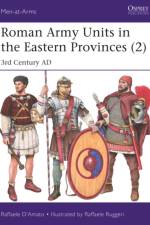
Drawing upon the latest literary and archaeological research, this is an in-depth study of the Roman Army units based in the Eastern Provinces during the turbulent third century of the Roman Empire.In this book, eminent Roman historian, Dr Raffaele D'Amato, looks at the notoriously under-represented history of the Roman armies during the middle 3rd Century whose records have been obscured by the chaotic civil wars of that period between usurpers to the Imperial authority of Rome. Following on from the previous title, MAA 527, Roman Army Units in the Western Provinces (2): 3rd Century AD, this book considers the evidence for troops in the Eastern half of the Empire specifically around the Balkans, Mesopotamia, the Middle East and North Africa and looks at the weakness of Imperial central authority which inevitably led to local particularism and a wide range of appearance in regional commands. Dr D'Amato uses literary, painted, sculptural and archaeological sources to reconstruct this little-understood period of Roman military history and, with the aid of meticulous coloured artwork, photos and detailed charts, reconstructs the appearance and campaigns of the Roman forces stationed in the East.
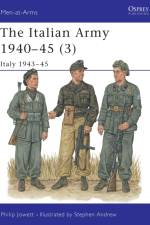
The division of the Italian forces between the Axis and the Allies from 1943 led to a civil war in parallel with the main campaign, and brought into being many interesting units with romantic uniforms and insignia. This title studies organization, uniforms and equipment of the Italian army.
Part of the "Men-At-Arms" series, this book looks at the cavalry forces of the Russian army of the Napoleonic Wars, illustrating their weapons, equipment and uniforms.
The second in a two-part study, this is an exploration of Roman military clothing from the late Republic to the end of the Empire. It draws upon written, pictorial, sculptural and archaeological sources to reconstruct the appearance of the Roman soldier.
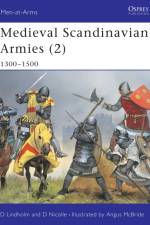
An examination of the colourful mediaeval warfare of Scandinavia in the aftermath of the Viking Age. It shows how armies were of local infantry levies raised by "democratic" methods to defend home territory, and details how the crossbow, ambush tactics and winter campaigning were employed.
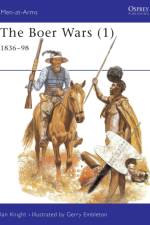
An account of the Boer Wars. Triggered by Cecil Rhodes' failed Jameson raid, the Anglo-Boer war started in 1898. It marked the end of the old wars of empire and the beginning of a recognizably 20th-century style of warfare including the use of concentration camps and "scorched earth" policies.
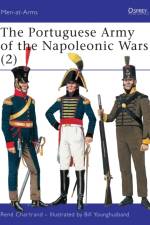
This volume is the first of two covering the organistion, uniforms and weapons of the Portuguese Army in Europe during the Napoleonic Wars. Based on Portuguese as well as British documents, this study comprises a source on the material culture of these forces between 1806 and 1815.
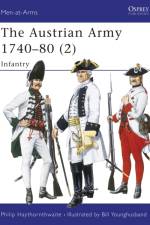
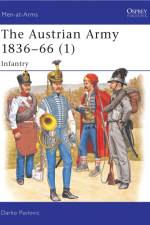
Describes the uniforms, insignia, weaponry, campaigns and military practices of the Infantry of Maria Theresa's Austrian Army between 1740 and 1780, a period when the Austrian forces proved themselves to be one of the best armies in Europe.
Describes the uniforms, weaponry, military practices and tactics of the rebel forces commanded by General Washington during the American War of Independence, an army that became more coherent and organized as the conflict progressed.
This second volume in the history of the Austrian Army during the 19th century focuses on the cavalry, including the famous Hungarian Hussars. It details the armies which fought the French at Magenta and Solferion and the Prussians at Koniggratz.
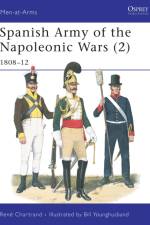
An illustrated military history in the MEN-AT-ARMS series as well as being the first in a three volume set on the subject of the Spanish army of the Napoleonic Wars. It covers the years from 1793 to 1808 and includes the 1801 War of the Oranges in Portugal and the 1808 Spanish victory at Bailen.
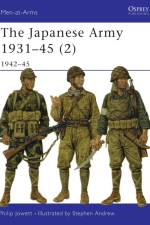
A fully illustrated account of Japanese uniforms and equipment used in World War II. The book features the uniforms worn in such important conflicts as the invasion of Manchuria, the Nomanhan campaign and the "lightning campaign" in the Pacific.
Part of the "Men-at-Arms" series, this book details the various flags used in the American Civil War.
Presenting the history of the Catholic armies of the Habsburg Empire that fought in the Thirty Years' War, this book explores the role of cavalry during the last major religious war in mainland Europe, which saw the end of the large mercenary forces and the beginnings of the well-disciplined national army.
Abonner på vårt nyhetsbrev og få rabatter og inspirasjon til din neste leseopplevelse.
Ved å abonnere godtar du vår personvernerklæring.