








Gjør som tusenvis av andre bokelskere
Abonner på vårt nyhetsbrev og få rabatter og inspirasjon til din neste leseopplevelse.
Ved å abonnere godtar du vår personvernerklæring.Du kan når som helst melde deg av våre nyhetsbrev.

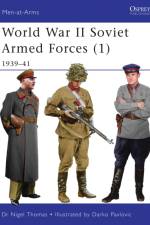
Presents an analysis of the Soviet Army at the outbreak of World War II, including the Red Army's campaigns against Japan on the Manchurian plains as well as in Finland. This book also covers the Red Army's first operations during Operation Barbarossa when the Red Army was forced to defend Mother Russia against the German onslaught.
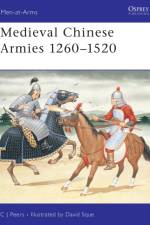
Covers the history of the Chinese army from the accession of the great Mongol Khan, Kublai, to the time when European weaponry was introduced. This volume details the equipment and uniforms during the Yuan dynasty, the civil wars of the 14th century, and the campaigns to expel the Mongols.
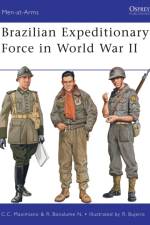
In the English-speaking world, it is generally unknown that a volunteer Brazilian Expeditionary Force (FEB) fought alongside the US Army in Italy from mid-1944 until the end of the war. This was in effect a light infantry division, consisting of three infantry regiments augmented with artillery and light armour.
Details the growth of the European Fur trade in North America and how it drew the Native Americans who lived in the Great Lakes region, notably the Huron, Dakota, Sauk and Fox, Miami and Shawnee tribes into the colonial European Wars.
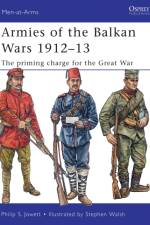
In 1912, the Balkan states formed an alliance in an effort to break free from the crumbling Ottoman Empire. Forming an army of some 645,000 troops from Greece, Bulgaria, Serbia and Montenego, they took on a force of 400,000 Turkish soldiers. This book looks at the diverse and sometimes colourful uniforms worn by both sides.
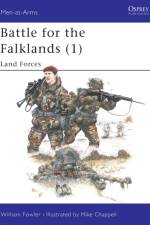
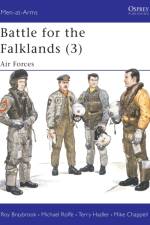
During the Falklands conflict of 1982, aircraft (both fixed and rotary-wing) were of crucial importance to both sides: in moving reinforcements quickly across the sea and over the islands, in attacking surface vessels, and in providing protection against attacks from both above and below the waves. The role of air power was thus to assist friendly surface forces in theirs. Consequently, the air arms of the two antagonists functioned in what was essentially a supporting role, but nevertheless a vital one.
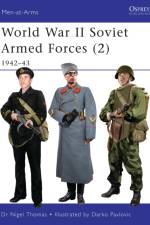
Focusing on the uniforms and organization of Soviet troops during the campaigns of the Caucasus, Stalingrad and Kursk, this book offers a breakdown of the armed forces which conducted the valiant defensive campaigns, including the army, air force, paratroopers, navy and NKVD troops.
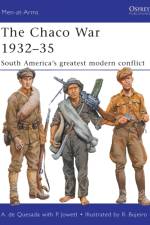
"The Chaco War 1932-35: South America's Greatest War".
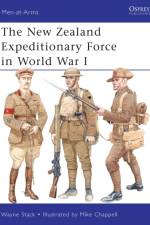
"The New Zealand Expeditionary Force in World War I".
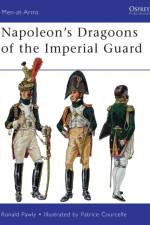
Dressed in distinctive green uniforms and classically inspired copper helmets, the Dragoons of the Imperial Guard were raised in 1806 by the same criteria as other Guard units - by selection of picked, literate veterans from Line regiments who had six to ten years of service, and citations for bravery in at least two campaigns. The following year they were named Dragons de l'Impératrice in a unique compliment to the Empress Josephine. As a ceremonial regiment it enjoyed many privileges, but it also saw combat on a number of occasions, including the battles of Essling and Wagram (1809), the Russian campaign (1812, when it suffered severe losses), at Bautzen, Wachau and Leipzig (1813), in the 1814 Campaign of France, and at Ligny and Waterloo (1815).The unparalleled documentary and pictorial sources to which Ronald Pawly has access inform this, the latest volume in his unique English-language coverage of the cavalry of Napoleon's Imperial Guard. It includes a history of the unit's organisation and service, uniforms and equipment, drawn from the original manuscript correspondence of Napoleon and his senior officers, orders and inspection reports, which survive in the Paris archives to this day. Interspersed with material on the records of particular individuals - their promotions, wounds and deaths in action - and illustrated with uniform prints, photographs of portraits and colour plates covering all ranks and orders of dress, this is the definitive history of a legendary Napoleonic regiment.
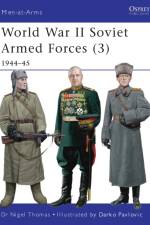
Presents a detailed analysis of the Soviet armed forces during the final days of the war, covering the soldiers that successfully turned the tide against the Nazi onslaught and pushed it back into Germany itself. This book also offers a detailed breakdown of all the armed forces that conducted the offensive campaigns on the Eastern Front.
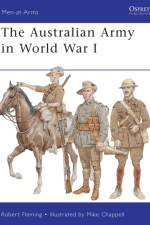
The importance of the Australian contribution to the Allied war effort during World War I should never be underestimated. In particular, their epic endeavour at Gallipoli in 1915 was the nation's founding legend. This book deals with this topic.
Part of the "Men-at-Arms" series, this book details the various flags used in the American Civil War.
This illustrated text describes the uniforms, weaponry, military practices and tactics of the US Dragoons. It looks at the history of the mounted soldiers, covering topics such as: the formation of the first cavalry units; the Mexican-American War; the gold rush to California; and the Indian Wars.
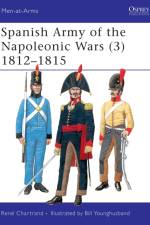
The third and final volume covering the Spanish army during the Napoleanic Wars. It covers the years from 1812 to 1815 when, with massive British assistance, the Spanish once again reorganised and greatly expanded their armies.
The First Carlist War broke out after the death of King Ferdinand VII, the king restored at the end of the Peninsular War thanks to Wellington's victory. The crown was claimed by both his daughter Isabella, backed by the Liberal party and his brother Don Carlos, at the head of northern ultra-conservatives centered in the Basque provinces and Navarre. The Liberals or "Cristinos" were supported by a 10,000-strong British Legion of volunteers led by a former aide to Wellington as well as the British Royal Navy, a Portuguese division, and the French Foreign Legion. With both armies still using Napoleonic weapons and tactics, early victories were won by the Basque general Zumalacarregui. After his death in 1835 a seesaw series of campaigns followed, fought by conventional armies of horse, foot, and guns, supported by many irregulars and guerrillas.This fascinating little known multi-national campaign provides a fascinating postscript to the Peninsular War of 1808-14, and its uniforms present a colorful and varied spectacle.
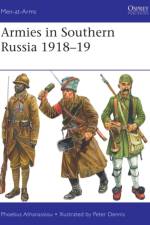
Describes and illustrates a dramatic but little-known Allied intervention in the Russian Civil War by a multi-national expeditionary force.An important aspect of the Russian Civil War were the several Allied expeditions immediately following World War I in support of the disunited Russian ''White'' armies resisting the Bolshevik Revolution. Although they ended in failure, these ventures were long resented, and were the origin of the 70-year-long Soviet suspicion of the Western Allies. British and US expeditionary forces operated in North Russia and Siberia in support of General Yudenich and Admiral Kolchak respectively, and a French and Greek expeditionary force (plus Romanian and Polish elements) operated in Crimea and south-western Ukraine, in support of General Denikin. The situation was further complicated by the presence of strong Imperial German elements still under arms, and by war between various factions in the Ukraine. This Southern theater of the Allied interventions is far less well known than that of the British and Americans in the North and East.Featuring rare photos and new color plates, this fascinating new book describes this major Allied intervention in the Russian Civil War. Dr Phoebus Athanassiou writes a compelling account of how the French and Greeks alongside White Russians were greatly outnumbered by pro-Bolshevik forces and were relentlessly pushed back by the Ukrainian forces. In just over four months, on April 28, 1919, the last of their forces were evacuated by Allied navies from Sevastopol in Crimea.
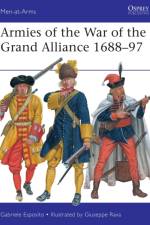
This title explores and illustrates the armies of France, and six countries allied against Louis XIV, in a wide-ranging Continental conflict that ushered in more than a century of European warfare.Formed in 1689, the 'Grand Alliance' or League of Augsburg was a military coalition of the Holy Roman Empire, the Dutch Republic, Britain, Spain and the Duchy of Savoy, to resist Louis XIV's rich, powerful and expansionist France. The first stage of the nine year conflict that followed also coincided with the so-called 'Glorious Revolution' in Britain (1688-91), when the throne passed to the Dutch Protestant leader, William of Orange, the head of a multi-national Dutch, Danish and English army, which finally expelled James II's Jacobite and French forces from Ireland. The long war on the continent was notable for the first widespread use of regimental uniforms and flintlock muskets with bayonets, plus the sophisticated use of siege warfare under the great French engineer, Vauban. The final Treaties of Ryswyck (1697) brought the war to an end and marked Louis XIV's political zenith, and also the ascendancy of both the Dutch and British as first-rate global powers. This fully illustrated title explores the armies which fought the War of the Grand Alliance, examining their strength, organization, uniforms and weapons, and explaining their campaigns and major battles.
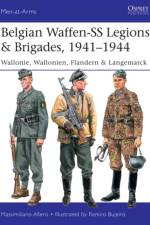
From the German occupation of Belgium in May 1940, Flemish recruits from northern Belgium - considered by the Nazis to be 'Germanic' - were accepted individually into Waffen-SS units. From Hitler's invasion of the USSR in June 1941, additional recruits from the French-speaking south (Wallonia) were drafted. Both communities formed volunteer 'Legions', to fight (according to Goebbels' propaganda machine) 'for European civilization against the Bolshevik threat'; these were a Flemish Legion in the Waffen-SS and a Walloon Legion in the German Army. Both served on the Russian Front in 1942-43; the Walloon Legion was then also transferred into the Waffen-SS, and the decorated Walloon officer Leon Degrelle became a publicized 'poster boy' for foreign SS volunteers. Both Legions were then redesignated as SS Assault Brigades, and thereafter saw extremely hard fighting in the Ukraine and on the Baltic front. In autumn 1944, their survivors were withdrawn from the front and incorporated into two new understrength SS Divisions, 27. 'Langemarck' and 28. 'Wallonien'.This new account, featuring detailed colour plates of uniform and insignia, recounts the battle history of the French and Flemish-speaking Belgian SS, up to their final transformation into full divisions in the winter of 1944/45.
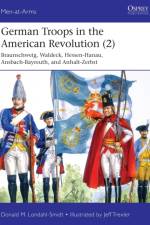
This is the second volume in a highly detailed study of the German auxiliary troops who fought for Britain in the American Revolutionary War and won a distinguished reputation on a host of battlefields.During the American Revolutionary War (1775–83), German auxiliary troops provided a vital element of the British war effort. While the largest body of German troops was from Hessen-Cassel (see the first volume of this study), the first Germans to be contracted by the British were from the Duchy of Braunschweig-Wolfenbüttel -- 4,300 men including dismounted dragoons, artillery and light infantry. Hessen-Hanau initially contributed one infantry regiment and an artillery company, which were also captured at Saratoga; Hessen-Hanau later provided the British with Jäger and light infantry troops. An infantry regiment contributed by the Principality of Waldeck and Pyrmont served alongside the troops of Hessen-Cassel during the New York campaign of 1776–77. The margraviates of Brandenburg Ansbach and Brandenburg-Bayreuth initially sent 1,600 men including a full regiment of Jäger; these troops fought in the Philadelphia campaign of 1777–78 and some were present at the siege of Yorktown in 1781. Finally, the Principality of Anhalt-Zerbst sent two battalions of infantry which served in Canada and New York City. Fully illustrated, this lively study examines the organization, appearance, weapons, and equipment of these German auxiliary troops who fought for King George in the American Revolutionary War.
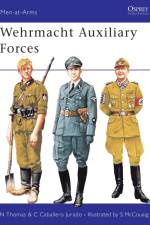
In 1938, Adolf Hitler directed two paramilitary labour organizations - the Reicharbeitsdienst, consisting of recruits, and the Organization Todt, a mobilized force of private construction firms - to assist the military. This book looks at the history, equipment and uniforms of these organizations.
Abonner på vårt nyhetsbrev og få rabatter og inspirasjon til din neste leseopplevelse.
Ved å abonnere godtar du vår personvernerklæring.