











Gjør som tusenvis av andre bokelskere
Abonner på vårt nyhetsbrev og få rabatter og inspirasjon til din neste leseopplevelse.
Ved å abonnere godtar du vår personvernerklæring.Du kan når som helst melde deg av våre nyhetsbrev.

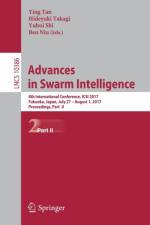
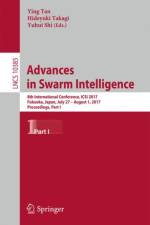
The two-volume set of LNCS 10385 and 10386, constitutes the proceedings of the 8th International Conference on Advances in Swarm Intelligence, ICSI 2017, held in Fukuoka, Japan, in July/August 2017. novel swarm-based optimization algorithms; applications of particle swarm optimization; hybrid optimization algorithms and applications;
The two-volume set of LNCS 10385 and 10386, constitutes the proceedings of the 8th International Confrence on Advances in Swarm Intelligence, ICSI 2017, held in Fukuoka, Japan, in July/August 2017. novel swarm-based optimization algorithms; applications of particle swarm optimization; hybrid optimization algorithms and applications;
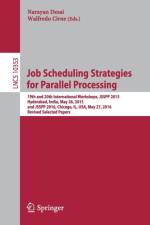
This book constitutes the thoroughly refereed post-conference proceedings of the 19th and 20th International Workshop on Job Scheduling Strategies for Parallel Processing, JSSPP 2015 and 2016, held respectively in Hyderabad, India, on May 26, 2015 and in Chicago, IL, USA, on May 27, 2016.
This book constitutes the refereed proceedings of the 14th International Conference on Logic Programming and Nonmonotonic Reasoning, LPNMR 2017, held in Espoo, Finland, in July 2017. The 16 full papers and 11 short papers presented in this volume were carefully reviewed and selected from 47 submissions.
This book constitutes the refereed proceedings of the 14th European Conference on Symbolic and Quantitative Approaches to Reasoning with Uncertainty, ECSQARU 2017, held in Lugano, Switzerland, in July 2017.
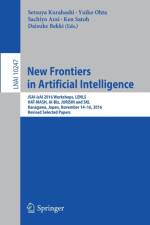
This book constitutes the thoroughly refereed post-conference proceedings of the JSAI-isAI 2016 Workshops, LENLS 13, HAT-MASH, AI-Biz, JURISIN and SKL, held in Kanagawa, Japan, in November 1016.The 22 regular papers presented in this volume were carefully reviewed and selected from 64 submissions. LENLS 13 was the 13th event in the series, and it focused on the formal and theoretical aspects of natural language. LENLS (Logic and Engineering of Natural Language Semantics) is an annual international workshop recognized internationally in the formal syntax-semantics-pragmatics community. It has been bringing together for discussion and interdisciplinary communication researchers working on formal theories of natural language syntax, semantics and pragmatics, (formal) philosophy, artificial intelligence and computational linguistics.HAT-MASH 2016 (Healthy Aging Tech mashup service, data and people) was the second international workshop bridges healthy aging and elderly care technology, information technology and service engineering. The main objective of this workshop was to provide a forum to discuss important research questions and practical challenges in healthy aging and elderly care support to promote transdisciplinary approaches.AI-Biz 2016 (Artificial Intelligence of and for Business) was the first workshop held to foster the concepts and techniques of Business Intelligence (BI) in Artificial Intelligence. BI should include such cutting-edge techniques as data science, agent-based modelling, complex adaptive systems, and IoT. The main purpose of this workshop is to provide a forum to discuss important research questions and practical challenges in Business Intelligence, Business Informatics, Data Analysis and Agent-based Modelling to exchange latest results, to join efforts in solving the common challenges.JURISIN 2016 was the tenth international workshop on Juris-informatics. Juris-informatics is a new research area which studies legal issues from the perspective of informatics. The purpose of this workshop was to discuss both the fundamental and practical issues among people from the various backgrounds such as law, social science, information and intelligent technology, logic and philosophy, including the conventional ΓÇ£AI and lawΓÇ¥ area. SKL 2016 (The Third International Workshop on Skill Science) was aimed to internationalize the research on skill sciences through organizing the meeting. Human skills involve well-attuned perception and fine motor control, often accompanied by thoughtful planning. The involvement of body, environment, and tools mediating them makes the study of skills unique among researches of human intelligence.
This book constitutes the proceedings of the 13th European Conference on Modelling Foundations and Applications, ECMFA 2017, held as part of STAF 2017, in Marburg, Germany, in July 2017. The 18 papers presented in this volume were carefully reviewed and selected from 48 submissions.
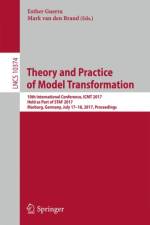
This book constitutes the refereed proceedings of the 10th International Conference on Model Transformation, ICMT 2017, held as part of STAF 2017, in Marburg, Germany, in July 2017. The 9 full papers and 2 short papers were carefully reviewed and selected from 31 submissions.
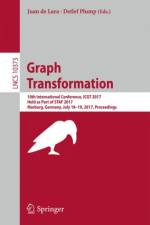
This book constitutes the refereed proceedings of the 10th International Conference on Graph Transformation, ICGT 2017, held as part of STAF 2017, in Marburg, Germany, in July 2017. The 14 papers presented were carefully reviewed and selected from 23 submissions.
This book constitutes the refereed proceedings of the 11th International Conference on Tests and Proofs, TAP 2017, held as part of STAF 2017, in Marburg, Germany, in July 2017. The 9 full papers and 1 invited paper presented in this volume were carefully reviewed and selected from 16 submissions.
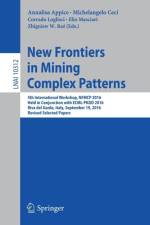
This book features a collection of revised and significantly extended versions of the papers accepted for presentation at the 5th International Workshop on New Frontiers in Mining Complex Patterns, NFMCP 2016, held in conjunction with ECML-PKDD 2016 in Riva del Garda, Italy, in September 2016.
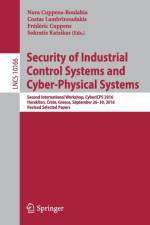
This book constitutes the refereed proceedings of the Second Conference on Security of Industrial Control Systems and Cyber-Physical Systems, CyberICPS 2016, held in Crete, Greece, in September 2016 in conjunction with ESORICS 2016, the 21st annual European Symposium on Research in Computer Security.The 5 revised full papers 2 invited papers presented were carefully reviewed and selected from 18 initial submissions. CyberICPS 2016 focuses on topics related to the management of cyber security in industrial control systems and cyber-physical systems, including security monitoring, trust management, security policies and measures.
The 36 revised full papers presented together with 4 keynotes, 37 poster, presentations, 4 doctoral consortium papers, 5 industry papers, 4 workshop abstracts, and 2 tutorial abstracts were carefully reviewed and selected from 159 submissions.
This book constitutes the refereed proceedings of the 24th International Conference on Analytical and Stochastic Modelling Techniques and Applications, ASMTA 2017, held in Newcastle-upon-Tyne UK, in July 2017.The 14 full papers presented in this book were carefully reviewed and selected from 27 submissions.
The three-volume set LNCS 9900, 9901, and 9902 constitutes the refereed proceedings of the 19th International Conference on Medical Image Computing and Computer-Assisted Intervention, MICCAI 2016, held in Athens, Greece, in October 2016.
The three-volume set LNCS 9900, 9901, and 9902 constitutes the refereed proceedings of the 19th International Conference on Medical Image Computing and Computer-Assisted Intervention, MICCAI 2016, held in Athens, Greece, in October 2016.
The three-volume set LNCS 9900, 9901, and 9902 constitutes the refereed proceedings of the 19th International Conference on Medical Image Computing and Computer-Assisted Intervention, MICCAI 2016, held in Athens, Greece, in October 2016.Based on rigorous peer reviews, the program committee carefully selected 228 revised regular papers from 756 submissions for presentation in three volumes. The papers have been organized in the following topical sections: Part I: brain analysis; brain analysis - connectivity; brain analysis - cortical morphology; Alzheimer disease; surgical guidance and tracking; computer aided interventions; ultrasound image analysis; cancer image analysis; Part II: machine learning and feature selection; deep learning in medical imaging; applications of machine learning; segmentation; cell image analysis; Part III: registration and deformation estimation; shape modeling; cardiac and vascular image analysis; image reconstruction; and MR image analysis.
The four volume set LNCS 9947, LNCS 9948, LNCS 9949, and LNCS 9950 constitutes the proceedings of the 23rd International Conference on Neural Information Processing, ICONIP 2016, held in Kyoto, Japan, in October 2016. big data analysis; neural data analysis; data mining and cybersecurity workshop; data mining;
The four volume set LNCS 9947, LNCS 9948, LNCS 9949, and LNCS 9950 constitues the proceedings of the 23rd International Conference on Neural Information Processing, ICONIP 2016, held in Kyoto, Japan, in October 2016. big data analysis; neural data analysis; data mining and cybersecurity workshop; data mining;
The four volume set LNCS 9947, LNCS 9948, LNCS 9949, and LNCS 9950 constitues the proceedings of the 23rd International Conference on Neural Information Processing, ICONIP 2016, held in Kyoto, Japan, in October 2016. big data analysis; neural data analysis; data mining and cybersecurity workshop; data mining;
The four volume set LNCS 9947, LNCS 9948, LNCS 9949, and LNCS 9950 constitues the proceedings of the 23rd International Conference on Neural Information Processing, ICONIP 2016, held in Kyoto, Japan, in October 2016. big data analysis; neural data analysis; data mining and cybersecurity workshop; data mining;
This book constitutes the refereed proceedings of the 11th Chinese Conference on Biometric Recognition, CCBR 2016, held in Chengdu, China, in October 2016. The 84 revised full papers presented in this book were carefully reviewed and selected from 138 submissions. Fingerprint, Palm-print and Vascular Biometrics;
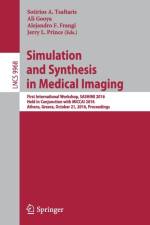
This book constitutes the refereed proceedings of the First International Workshop on Simulation and Synthesis in Medical Imaging, held in conjunction with MICCAI 2016, in Athens, Greece, in October 2016.The 17 revised full papers presented together in this book were carefully reviewed and selected from 21 submissions.The contributions span the following broad categories: fundamental methods for image-based biophysical modeling and image synthesis; biophysical and data-driven models of disease progression or organ development; biophysical and data-driven models of organ motion and deformation; biophysical and data-driven models of image formation and acquisition; segmentation/registration across or within modalities to aid the learning of model parameters; cross modality (PET/MR, PET/CT, CT/MR, etc.) image synthesis; simulation and synthesis from large-scale image databases; automated techniques for quality assessment of simulations and synthetic images; as well as several applications of image synthesis and simulation in medical imaging such as image registration and segmentation; image denoising and information fusion; image reconstruction from sparse data or sparse views; and real-time simulation of biophysical properties. The papers were divided into two general topics named ΓÇ£simulation based approaches for medical imagingΓÇ¥ and ΓÇ£synthesis and its applications in computational medical imagingΓÇ¥.
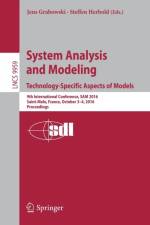
This book constitutes revised papers of the proceedings of the 9th International Workshop on System Analysis and Modeling, SAM 2016, held in Saint-Melo, France, in October 2016.
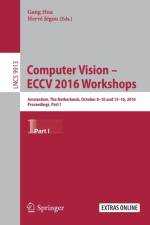
The three-volume set LNCS 9913, LNCS 9914, and LNCS 9915 comprises the refereed proceedings of the Workshops that took place in conjunction with the 14th European Conference on Computer Vision, ECCV 2016, held in Amsterdam, The Netherlands, in October 2016.27 workshops from 44 workshops proposals were selected for inclusion in the proceedings. These address the following themes: Datasets and Performance Analysis in Early Vision; Visual Analysis of Sketches; Biological and Artificial Vision; Brave New Ideas for Motion Representations; Joint Imagenet and MS Coco Visual Recognition Challenge; Geometry Meets Deep Learning; Action and Anticipation for Visual Learning; Computer Vision for Road Scene Understanding and Autonomous Driving; Challenge on Automatic Personality Analysis; BioImage Computing; Benchmarking Multi-Target Tracking: MOTChallenge; Assistive Computer Vision and Robotics; Transferring and Adapting Source Knowledge in Computer Vision; Recovering 6D Object Pose; Robust Reading; 3D Face Alignment in the Wild and Challenge; Egocentric Perception, Interaction and Computing; Local Features: State of the Art, Open Problems and Performance Evaluation; Crowd Understanding; Video Segmentation; The Visual Object Tracking Challenge Workshop; Web-scale Vision and Social Media; Computer Vision for Audio-visual Media; Computer VISion for ART Analysis; Virtual/Augmented Reality for Visual Artificial Intelligence; Joint Workshop on Storytelling with Images and Videos and Large Scale Movie Description and Understanding Challenge.
This book constitutes the refereed proceedings of the 12th International Workshop on Security and Trust Management, STM 2016, held in Heraklion, Crete, Greece, in September 2016, in conjunction with the 21st European Symposium Research in Computer Security, ESORICS 2016.The 13 full papers together with 2 short papers were carefully reviewed and selected from 34 submissions. the focus on the workshop was on following topics: access control, data protection, mobile security, privacy, security and trust policies, trust models.
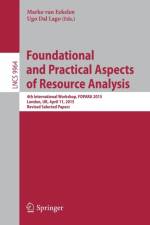
This book constitutes the proceedings of the 4th International Workshop on Foundational and Practical Aspects of Resource Analysis, FOPARA 2015, held in London, UK, in April 2015. The 6 papers presented in this volume were carefully reviewed and selected from 7 submissions.
The two-volume set LNCS 9981 and 9982 constitutes the refereed proceedings of the 15th International Semantic Web Conference, ISWC 2016, which was held in Kobe, Japan, in October 2016. The 75 papers presented in these proceedings were carefully reviewed and selected from 326 submissions.The International Semantic Web Conference is the premier forum for Semantic Web research, where cutting edge scientific results and technological innovations are presented, where problems and solutions are discussed, and where the future of this vision is being developed. It brings together specialists in fields such as artificial intelligence, databases, social networks, distributed computing, Web engineering, information systems, human-computer interaction, natural language processing, and the social sciences. The Research Track solicited novel and significant research contributions addressing theoretical, analytical, empirical, and practical aspects of the Semantic Web. < The Applications Track solicited submissions exploring the benefits and challenges of applying semantic technologies in concrete, practical applications, in contexts ranging from industry to government and science.
This book constitutes the proceedings of the 14th International Symposium on Automated Technology for Verification and Analysis, ATVA 2016, held in Chiba, Japan, in October 2016. The 31 papers presented in this volume were carefully reviewed and selected from 82 submissions. Markov models, chains, and decision processes;
The two-volume set LNCS 9981 and 9982 constitutes the refereed proceedings of the 15th International Semantic Web Conference, ISWC 2016, which was held in Kobe, Japan, in October 2016. The 75 full papers presented in these proceedings were carefully reviewed and selected from 326 submissions. The International Semantic Web Conference is the premier forum for Semantic Web research, where cutting edge scientific results and technological innovations are presented, where problems and solutions are discussed, and where the future of this vision is being developed. It brings together specialists in fields such as artificial intelligence, databases, social networks, distributed computing, Web engineering, information systems, human-computer interaction, natural language processing, and the social sciences. The Research Track solicited novel and significant research contributions addressing theoretical, analytical, empirical, and practical aspects of the Semantic Web. The Applications Track solicited submissions exploring the benefits and challenges of applying semantic technologies in concrete, practical applications, in contexts ranging from industry to government and science. The newly introduced Resources Track sought submissions providing a concise and clear description of a resource and its (expected) usage. Traditional resources include ontologies, vocabularies, datasets, benchmarks and replication studies, services and software. Besides more established types of resources, the track solicited submissions of new types of resources such as ontology design patterns, crowdsourcing task designs, workflows, methodologies, and protocols and measures.
Abonner på vårt nyhetsbrev og få rabatter og inspirasjon til din neste leseopplevelse.
Ved å abonnere godtar du vår personvernerklæring.