










Gjør som tusenvis av andre bokelskere
Abonner på vårt nyhetsbrev og få rabatter og inspirasjon til din neste leseopplevelse.
Ved å abonnere godtar du vår personvernerklæring.Du kan når som helst melde deg av våre nyhetsbrev.

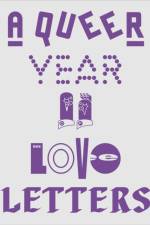
Showcasing a collection of innovative typeface designs alongside the stories of the countercultural queer figures who inspired them This volume, A Queer Year of Love Letters, expands upon the eponymous series of openly downloadable typeface fonts by New York-based designer and alphabet artist Nat Pyper. The letterforms in this collection are each derived from the life stories, printed ephemera and vernacular scripts of a selection of countercultural queer figures, collectives and publications from recent decades. These include Robert Ford of THING magazine, the Chinese American painter Martin Wong, the Third World Gay Revolution collective and the Women's Car Repair Collective, among others. The book showcases the biographies of these figures alongside previously unseen archival materials, as well as digital craft methodology for Pyper's designs inspired by them. Connecting font design to queer culture, this project comes at a critical time of increasing erasure and suppression of trans and queer histories.RISD design professor Paul Soulellis writes in his essay "What Is Queer Typography?," "there is no queer typography, only queer acts of reading and writing." This book proposes a kind of compendium for that concept.>This book was published in conjunction with Library Stack
Peter Cook's drawings project radical possibilities for architecture. Spanning from his student days to the present, this book charts a seven-decade architectural adventure.
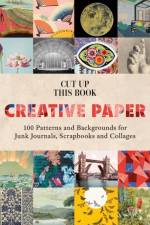
Brilliantly useful for anyone who keeps a junk journal! Steadily growing in popularity since lockdown, junk journalling has become the hottest craft pastime for Gen Z. Filling pages with discovered images, stickers and ephemera, junk-journal keepers create visual stories that range from personal to whimsical. Many journallers look for vintage background images onto which they can layer their ideas. This book supplies a collection of 100 patterns, backdrops, landscapes and scenes, each one a fresh idea for surprising and delightful juxtapositions.
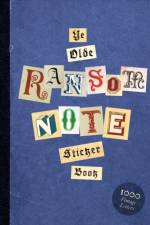
Send mysterious messages, or decorate your journal in a unique vintage style! Organised by letter, with plenty of accents, punctuation marks, numbers and wingdings to pep up your text, this collection of over 1000 letters makes an excellent companion to The Ransom Note Sticker Book, but stands on its own equally well. Peel and spell today!
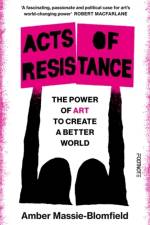
'A fascinating, passionate and political case for art's world-changing power, by a fizzingly good writer' - Robert Macfarlane'A rich and broad overview of socially purposeful art. Everyone interested in social change should read it' - Brian EnoIn Acts of Resistance, Amber Massie-Blomfield writes about the artists who have treated the protest site as their canvas and contributed to movements that have transformed history - from the musicians in Auschwitz to the four-year Siege of Sarajevo, from the to ACT UP's 1989 invasion of the New York Stock Exchange, to the Niger Delta and indigenous communities in Bolivia. Including stories and artists from across the globe, including Susan Sontag, Ken Saro-Wiwa, and Claude Cahun - alongside collectives, communities, amateurs and anonymous creators who have used their art as an expression of resistance - this fascinating book asks what is the purpose of art in a world on fire? Why are artists compelled to paint, write, dance and make music, even when the odds are stacked against them? And how can artistic creation be a genuine form of political resistance?Combining cultural criticism, history and memoir, Acts of Resistance is an urgent reminder that art can make a human life more bearable, and can be a means of building the things that a person needs to survive the bleakest circumstances. It is a testament to that idea, and to the people who have risked their lives to prove it is so. While their stories are remarkable, they are also a reminder that each of us can use creativity in defense of our humanity.
This book explores the future of retail and service design, offering cutting-edge insights from leading researchers. Ideal for researchers, designers, educators, students, and innovation enthusiasts, it delivers fresh perspectives on the rapidly evolving world of retail and service design.
The author analyses architectural preservationists' narrative strategies to remake the histories of what were designed as racialized "European" zones - in opposition to "Indigenous" zones - as part of the documentation, preservation, and addition to the UNESCO World Heritage List.
This book concerns the urgency of thinking and acting in response to climate change through art and education. Events of Art and Education in Post-climate Times will be helpful for students studying art, education, environment and sustainability, and climate change. It will also interest researchers, practicing artists and teachers.
This book concerns the urgency of thinking and acting in response to climate change through art and education. Events of Art and Education in Post-climate Times will be helpful for students studying art, education, environment and sustainability, and climate change. It will also interest researchers, practicing artists and teachers.
This is the first in-depth analysis of Ming palace eunuchs' place in the social history of Chinese art, examining the intricate intersections of art, politics, and palace eunuchs in the Ming dynasty.
How the surge in aerial technologies, such as drones and satellites, influences visual culture beyond the screen.The smooth flight from aerial overview to intimate close-up in Martin Scorsese’s Hugo (2011) exemplifies the concept of proxistant vision: a combination of proximity and distance, close-up and overview, detail, and the big picture in a unified visual form. In Proxistant Vision, Synne Bull and Dragan Miletic develop the concept of proxistant vision and trace its emergence as a visual paradigm of the twenty-first century. As exemplified by Google Earth’s digital swipe between globe perspective and street-level detail, proxistant vision currently proliferates across digital geography, computer games, architectural models, data visualizations, and CGI cinema. It is defined as the combination of proximity and distance in a single image, across a dynamic flight, or zoom. Pointing to the surge in aerial imaging and remote sensing technologies such as drones and satellites, the book moves beyond the screen to include the kinetic architecture of rides and urban observation wheels. The key objective of this study is threefold: to trace the genealogy and understand the technical operation of proxistance as it traveled from periphery to center in the twenty-first century; to explore its alternative potentialities in contemporary art practices; and finally, to reflect critically on the worldviews underpinning different modalities of proxistance in times of environmental crisis. The authors show how the powerful effect of combining proximity and distance, which was already in place with the earliest cartographic inscriptions, has taken precedence on and beyond our screens today.
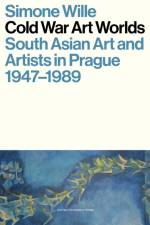
Prague as a vital Cold War hub for South Asian artists. During the Cold War, the Central-European capital of Prague, alongside other locations in the polarized post-war world, emerged as a key site where an art world of particular importance for artists from South Asia developed. By emphasizing cultural mobility as a catalyst for exchange and network building, this book challenges and complicates assumptions about Cold War binaries of East and West and the polarization between so-called totalitarian regimes and free cultures. Positioning Prague as a nexus where South-Asian modernisms intersected with multiple peoples, histories, and ideologies in the post-World War II era, it offers a narrative of decolonization that rejected rigid systemic alignment in favor of participation across blocs by prioritizing migratory aesthetics over nationalist parochialism. Well-researched and rich in archival materials, this book proposes new ways of writing art histories and makes a significant contribution to both Cold War studies and critical global modernism studies.
Abonner på vårt nyhetsbrev og få rabatter og inspirasjon til din neste leseopplevelse.
Ved å abonnere godtar du vår personvernerklæring.