








Gjør som tusenvis av andre bokelskere
Abonner på vårt nyhetsbrev og få rabatter og inspirasjon til din neste leseopplevelse.
Ved å abonnere godtar du vår personvernerklæring.Du kan når som helst melde deg av våre nyhetsbrev.

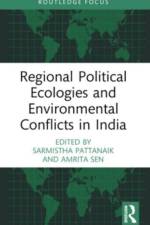
This book focuses on the regional political ecologies (RPEs) of environmental conflicts in India. It will be of great interest to students and scholars of Political Ecology and South Asian Environmental Studies.
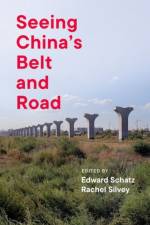
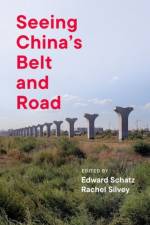
In Seeing China's Belt and Road, editors Edward Schatz and Rachel Silvey assemble the ground-level fieldwork of leading scholars to examine the Belt and Road Initiative (BRI) from different "downstream" contexts, ranging from Central and Southeast Asia to Europe and Africa. Crucially, this book uncovers views of the BRI from Chinese authorities, local businesses, state bureaucrats, expatriated migrants, ordinary citizens, and environmental activists. Through these case studies, the book offers a timely analysis of the dynamic complexity of changes in the world order.
In Seeing China's Belt and Road, editors Edward Schatz and Rachel Silvey assemble the ground-level fieldwork of leading scholars to examine the Belt and Road Initiative (BRI) from different "downstream" contexts, ranging from Central and Southeast Asia to Europe and Africa. Crucially, this book uncovers views of the BRI from Chinese authorities, local businesses, state bureaucrats, expatriated migrants, ordinary citizens, and environmental activists. Through these case studies, the book offers a timely analysis of the dynamic complexity of changes in the world order.
Annabel Keenan's timely and urgent book reviews the work that has been undertaken to date to create a more sustainable art world and proposes the next steps in system-wide change. It identifies the main sustainability issues for the art industry, arguing that artists and art activists have led the way in creating awareness of climate change, and evaluates progress to date on climate-action commitments by the various sectors of the art world, offering examples of best practice. Uncompromising in its messages, Climate Action in the Art World is essential reading for all art professionals, from artists to curators to art handlers, as well as for anyone seeking an accessible entry-point to a topic which is unfortunately only getting (literally) hotter.
How are contemporary artists responding to the climate crisis? Filipa Ramos takes an original approach to the subject by addressing two parallel strands. She looks firstly at pioneering approaches to ecology by key contemporary artists from different generations and cultural backgrounds working in different art media; and she considers the balance between ecology as theme and ecology as practice, underscoring the imperative for both artists and art institutions to adopt responsible environmental positions in their practice. This topical and important book discusses the work of artists who have returned to the land; reviews how questions of shared rights and environmental justice are represented in contemporary artistic practice; highlights the renewed importance of performance and time-based media in ecologically themed art; and looks at artists' and art institutions' complex relationship to environmental action.
Ireland has little left of its original natural habitats. Many species, like the curlew, are under pressure due to intensive practices such as farming, forestry and fisheries and some are threatened with extinction. But given a little help from us, nature has the innate capacity to restore itself.Nature restoration is the positive management of the environment for the benefit of wildlife and people. It looks to the future, by steering natural habitats and wildlife in a better and more sustainable direction.In Future Wild: Nature Restoration in Ireland, Richard Nairn explores numerous active restoration projects around Ireland which show how natural habitats and native species can be restored sustainably for the benefit of everyone. From individual landowners and voluntary organisations to state bodies such as Bord na Móna, he meets the people who are dedicated to nature restoration.By turns shocking, hopeful and finally positive, Future Wild shows that the damage we have done to nature can also be undone by us, and that, with nature restoration, we can create a richer and more diverse environment for generations to come.
By using resources more efficiently, precision agriculture (PA) can make agriculture more productive and sustainable. This new edition of Precision agriculture for sustainability provides a comprehensive review of the key components of PA, from information gathering to delivery systems, as well as the wide range of applications from precision tillage and seeding to site-specific irrigation and nutrition, as well as crop protection and weed management. The book also considers the emergence of new approaches and technologies, including multi-sensor fusion, artificial intelligence and big data. Edited by a world-renowned expert, this book will be a standard reference for university and other researchers working in agriculture, farmers, agronomists, companies involved in precision agriculture technologies, as well as government and private sector agencies supporting sustainable agriculture. Dr John Stafford was formerly a scientist at the internationally-renowned Silsoe Research Institute and is a well-known leader in precision agriculture technologies. He is a Fellow of the Institution of Agricultural Engineers, former Co-Editor of the journal Precision Agriculture and past President of the International Society of Precision Agriculture (ISPA).
The book sets out a workable holistic strategy to address the underlying causes of the illegal wildlife trade and provide policymakers, NGOs and other stakeholders with an action plan to help bring the multi-billion-dollar trade to an end.
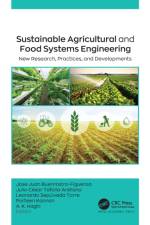
Discusses about sustainable agriculture and food systems engineering. It covers key concepts on sustainable agriculture, food systems engineering for sustainable development, and agroecological transitions as an interdisciplinary field that comprises the concepts of agronomy, economics, and livestock farming sciences.
Presents advanced methods and modern technologies in agri-food sectors for improved environmental health and food security, prioritizing sustainable agriculture and global environment health. It explores the principles of environmental sustainability and explains how these principles can be applied in practice in agri-food systems.
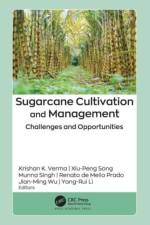
Details sugarcane crop production strategies and related sustainability issues. Details topics such as impact of various stressors along with environment stress management in sugarcane crops, major sugarcane pests and their control, use of plant growth-promoting rhizobacteria (PGPRs) in improving sugarcane yield, and more.
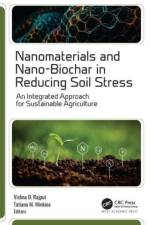
Emphasizes how nano-biochar technology can be implemented to enhance microbial activities and other soil organism functionalities by applying or combining agricultural practices and soil health-improving amendments. Details its role in metal stress reduction, for soil health improvement, in reducing soil stress, and more.
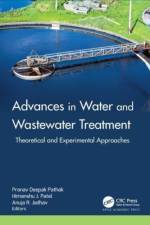
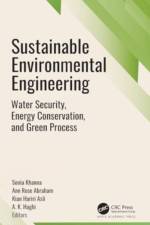
Details techniques and methodologies to use advanced materials for water and wastewater treatment examining their feasibility for sustainable development. Covers various research, reviews, and experimental studies for elimination of several contaminations using advanced techniques like adsorption, electrocoagulation, etc.
Discusses the need for greener environment approaches. Examines advances, developments, and the underlying concepts of a healthy urban environment in the areas of water and wastewater treatment, food supply under sustainable development, and chemical contamination using relevant experimental techniques and case studie
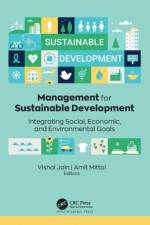
Describes sustainable development along with its challenges and advantages. Looks at sustainability in the interrelationship of business, manufacturing, finance, etc. Explores sustainable finance, role of digitization and AL in sustainability, importance of cultural sustainability, and several sustainability-promoting strategies.
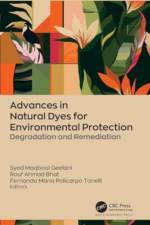
Discusses the environmental pollution caused by dyes, presents advances in natural dyes, considers their advantages over synthetic dyes, and offers solutions to the difficulties related to the use of natural dyes. It also offers effective remediation strategies for the management of both natural and harmful synthetic dyes.
Overviews low-cost, eco-friendly green synthesized nanomaterials for efficient nanoremediation of environmental pollution. Discusses green methods to synthesize nanoremediators; algae-based and plant-based nanomaterials; different types of green nanoparticles to handle environmental pollutants and more.
This book explores the ambivalent relationship between China and the Global South from literary, media and cultural perspectives. It underlines the rich histories and complex processes of cultural exchange, cross-cultural communication, and transcultural understanding at the backdrop of strong political and economic forces.
Central to the book is the presentation of domestic street by street retrofit as an issue with technical, financial, and societal dimensions. A holistic view of the complex, interacting factors that have held back any advance is interspersed with a historical account of retrofit's faltering progress over the last twenty years.
The book provides a social analysis of marriage in contemporary Zimbabwe, highlighting how it is evolving in the face of societal factors such as globalisation, technology, increased migration, religious plurality and shifting cultural systems. Essential reading for students and scholars of Zimbabwean history, culture, gender, and family.
This book explores the ambivalent relationship between China and the Global South from literary, media and cultural perspectives. It underlines the rich histories and complex processes of cultural exchange, cross-cultural communication, and transcultural understanding at the backdrop of strong political and economic forces.
Cinema of/for the Anthropocene sheds light on the question of how films can allow us to resituate ourselves within what is known today as the Anthropocene. The authors address this question through a variety of disciplines and theoretical perspectives.
Abonner på vårt nyhetsbrev og få rabatter og inspirasjon til din neste leseopplevelse.
Ved å abonnere godtar du vår personvernerklæring.