


Gjør som tusenvis av andre bokelskere
Abonner på vårt nyhetsbrev og få rabatter og inspirasjon til din neste leseopplevelse.
Ved å abonnere godtar du vår personvernerklæring.Du kan når som helst melde deg av våre nyhetsbrev.

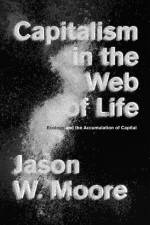
Finance. Climate. Food. Work. How are the crises of the twenty-first century connected? In Capitalism in the Web of Life, Jason W. Moore argues that the sources of today's global turbulence have a common cause: capitalism as a way of organizing nature, including human nature. Drawing on environmentalist, feminist, and Marxist thought, Moore offers a groundbreaking new synthesis: capitalism as a ';world-ecology' of wealth, power, and nature. Capitalism's greatest strengthand the source of its problemsis its capacity to create Cheap Natures: labor, food, energy, and raw materials. That capacity is now in question. Rethinking capitalism through the pulsing and renewing dialectic of humanity-in-nature, Moore takes readers on a journey from the rise of capitalism to the modern mosaic of crisis. Capitalism in the Web of Life shows how the critique of capitalism-in-naturerather than capitalism and natureis key to understanding our predicament, and to pursuing the politics of liberation in the century ahead.
Crafting with Flowers is a stunning book centred around crafting with both fresh and dried flowers, encouraging the reader to connect with nature and create stylish projects for their homes, spaces and to gift to others. The book features 20 practical projects and activities to help readers pause their hectic lives and immerse themselves in a connection to nature and creativity. From simple and cute ideas like pretty framed pressed flowers and garlands, to gorgeous seasonal wreaths and kokedama, all the projects in Crafting with Flowers connect the reader to the outside world, providing them with a beautiful piece to enjoy in their home. Bex gives helpful guidance on the best plants to use for each project and provides tips and techniques to get the most from your creations. With stunning photography and inspiring projects, Crafting with Flowers will give you the confidence and inspiration to bring nature into the home and allow you to find moments of calm and joy.
This wide-ranging, accessible handbook reveals the vital role plants have played in literature for two thousand years around the world. Its sections cover historical periods of plant literature, specific global regions and diverse literary forms.
Originally published in 1938, this book was the first to cover the history of geographical thought. It discusses the development of medieval earth-knowledge as it was affected, on the one hand, by the prevailing Christian and Muslim ideologies and, on the other, by the results of human enterprise on land and sea.
Cultural Ecologies of the Land is a radical and challenging reassessment of the way we relate to the land and to infrastructure. It is a multi-layered account of people and environment shaping each other through cumulative, moment-to-moment, day-to-day change, and a template for thinking about place, locality, belonging, and identity.
As the global pursuit for environmental sustainability and circular water economy grows ever-ambitious, this book explores recent trends, methods, and advancements in industrial wastewater treatment.
Launched in October 2022 in Milan in collaboration with fashion brand Massimo Alba and Portofino Dry Gin, the latest issue of Sali e Tabacchi Journal is dedicated to the theme of Biophilia. Just as archaeologists reconstructed civilizations from individual fragments, Riv. 03: Biophilia seeks to rediscover the worlds of Mediterranean flora and fauna, questioning the ways in which they can be investi- gated and preserved, popularizing and defending traditions and cul- tures. Among other social, geopolitical and ecological manifestations of food, flora and fauna in our society, the issue seeks to approach is- sues related to notions of soil, seeds and access to resources; cultural identity and the ways in which humans, nature and technology can coexist; collective memory and knowledge production; as well as the possibility of allowing oneself to be open to the act of wonder and endless experimentation in an unrelenting approach to the animal and plant world, and its possibilities in the future to come.
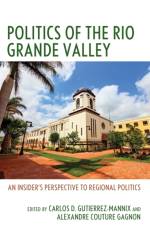
"A regional approach to politics in the U.S., Politics of the Rio Grande Valley: An Insider's Perspective to Regional Politics is the first book of its kind to directly address the intricate factors influencing how southern Texas continues to develop politically"--
Discover the power of our relationship with Y Môr (the sea) along the Wales Coast Path. Matthew Yeomans takes us on journeys along the official walking trail, which in its entirety covers 870 miles (1400 km) of the Welsh coastline. He uncovers how the sea has shaped our lives through history; how Wales's rich mythology, literature and culture has been influenced by this fluid force, and the growing role that the sea plays in our lives. Along the way, Seascape challenges us to face the realities of climate change and how we will need to adapt where and how we live. Only by recovering a healthy relationship with the sea can we meet our future challenges and unlock opportunities for better ways of living.
How do we manage to transition to a more sustainable world without the collapse of the economy?Capitalism has brought about many positive things. At the same time, however, it is ruining the climate and the environment, so that humanity's very existence is now at risk. 'Green growth' is supposed to be the saviour, but economics expert and bestselling author Ulrike Herrmann disagrees. In this book, she explains in a clear and razor-sharp manner why we need 'green shrinkage' instead. Greenhouse gases are increasing dramatically and unchecked. This failure is no coincidence, because the climate crisis goes to the heart of capitalism. Prosperity and growth are only possible if technology is used and energy is utilised. Unfortunately, however, green energy from the sun and wind will never be enough to fuel global growth. The industrialised countries must therefore bid farewell to capitalism and strive for a circular economy in which only what can be recycled is consumed. Herrmann makes a convincing argument that we won't get anywhere without personal restrictions and government planning. Her example for a solution is the British war economy of the 1940s. This is not a utopian scenario, but a comprehensive example of the restrictions and government-led plans needed now and in the future.
Fossils of Arabia explores how Arabian palaeontology has contributed to our understanding the story of life, from its earliest beginnings to the emergence of Homo sapiens. Arabia is one of the hottest and driest regions in the world, but it has not always been this way. Through the depths of geological history - of 'deep time' - its climate has oscillated between wet and dry, and hot and cold periods. The peninsula has witnessed the origins of life, the evolution of earliest land plants and dinosaurs, and has recently played a role in some of the earliest recorded human activity.This groundbreaking work reveals the significance of Arabian fossils in understanding the development of life. It also reveals how large parts of Arabia, particularly surface outcrops, remain largely unexplored and hold untapped potential for fossil discoveries. New evidence now awaits discovery, ranging from the half-a-billion-year-old fossil-bearing rocks to geologically young Pleistocene lake deposits in the deserts of Arabia.Fossils of Arabia illustrates how the next generation of scientists will employ advanced techniques, such as satellite and X-ray imaging, to uncover these fossils. These technologies will help answer key questions about the development of past life and climate, helping us to plan for a more sustainable future.
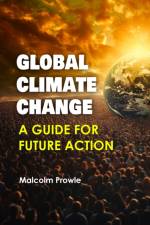
Recently, large parts of the world faced record high temperatures-another item on a long list of warning signs about the climate. This book is for the reader interested in having a better understanding of the nature and causes of climate change and the measures being undertaken.Global Climate Change suggests success is unlikely and to prevent catastrophe, more radical and uncomfortable actions will be needed. Many groups in society (e.g. governments, economies, businesses, public services) will need to undertake such actions to mitigate climate change and deal with its consequences. This book provides guidance about what these actions will involve.
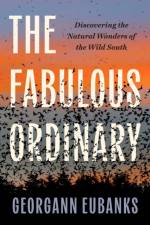
"Georgann Eubanks offers readers a tour of the seasonal joys of ecosystems in the Southeast. The ordinary destinations and events she explores are scattered across seven states and include such wonders as a half-million purple martins roosting on an island in a South Carolina lake, the bloom of thirty acres of dimpled trout lilies in a remote Georgia forest, gnat larvae that glow like stars on the rock walls of an obscure Alabama canyon, and the overnight accumulation of elaborately patterned moths on the side of a North Carolina mountain cabin. These phenomena and others reveal how plants, mammals, amphibians, and insects are managing to persevere despite pressures from human invasion, habitat destruction, and climate change. Their stories also shine a light on the efforts of dedicated scientists, volunteers, and aspiring young naturalists who are working to reverse losses and preserve the fabulous ordinary that's still alive in the fields, forests, rivers, and coastal estuaries of this essential and biodiverse region"--
Abonner på vårt nyhetsbrev og få rabatter og inspirasjon til din neste leseopplevelse.
Ved å abonnere godtar du vår personvernerklæring.