



Gjør som tusenvis av andre bokelskere
Abonner på vårt nyhetsbrev og få rabatter og inspirasjon til din neste leseopplevelse.
Ved å abonnere godtar du vår personvernerklæring.Du kan når som helst melde deg av våre nyhetsbrev.

The book critically examines the epistemological disparities between colonialism and capitalism-critical cultural practices and Western art institutions. It does so through the lens of documenta 15, focusing on ruangrupa's lumbung approach.
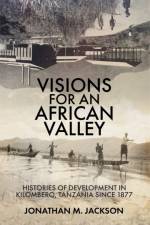
What was the effect of the numerous, albeit often unsatisfied, plans for development on the land and communities of the Kilombero valley throughout the colonial period and into the first decades of independence?
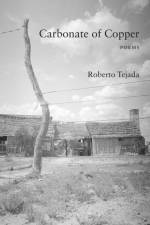
Transformative poetry that illuminates migration and memory, giving voice to the unseen and uncountedWritten during extended periods in Brownsville, McAllen, and Marfa, Texas, in Carbonate of Copper Roberto Tejada gives voice to unsettled stories from the past, as well as to present-day experiences of custody and displacement. The poems stage scenes adjacent to the U.S.-Mexico border and to the realities of migration warped by jarring political vitriol, bearing witness to past and present-day hazards and sorrows wagered by those in search of asylum. So enabled, these poems make visible not only the infrastructure of militarized surveillance and its detention complex but also the aspiration to justice and mercy and the resilient self-organized order of time for migrants seeking human dignity while awaiting passage to the other side of the dividing line.The book's title refers also to a mineral found in azurite and malachite, a color medium that had an impact on art during the first phase of globalization, the ensuing colonial enterprise, and its systems of extraction. Carbonate of copper was less desirable than the deeper ultramarine made from ground lapis lazuli, but Renaissance artists and patrons nonetheless coveted it and prompted a market for the blue derivative used in tempera and oil pigment. The blue powder pigment serves, too, as a form of sorcery: one that would ward off those who deal in injury of the already dispossessed.Turning his attention to the forced relocation of peoples, the COVID-19 death toll, the encroaching dangers of illiberal rule, the meanings of home and eviction, the power of cultural memory, as well as his artistic forebears, Tejada accounts for the uncounted and those excluded from belonging in voices that tell the cruel fortunes and joyful vitality of human and non-human life forms.
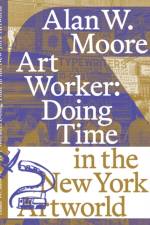
In Art Worker: Doing Time in the New York Art World, Alan W. Moore weaves stories of a New York downtown art scene collectively engaged in provocative anti-curation and television production to bridge boundaries between art and the wider world. On New York in the '70s and '80s, a dense cultural ecology that birthed of video art, punk, hip-hop, anti-curation and so much more. The long rolling crescendo of Art Worker comes in Alan W. Moore's discussion of the expansive art scene around Collaborative Projects (Colab) that had its heyday from 1977 to the mid-1980s. Colab, situated in New York's downtown art scene, was a collective that engaged in provocative anti-curation and television production in efforts to bridge boundaries between art and the wider world. Moore's accounting makes this a very personal story. He allows us alongside him and his friends and comrades as they make things that will eventually be called "historical" - the Real Estate Show, the Times Square Show - exhibitions Colab produced that were key events for some art history. Moore entangles them within an expansive linear narrative that starts with summers of love spent tramping in Europe and days of wonder doing radical cultural programming for the University of California. The book won The Best German Book Design prize in 2023
Presents the 250 texts Alexander von Humboldt (1769-1859), known as the "father of environmentalism," wrote in English, unabridged in their original formAlexander von Humboldt (1769-1859), German geographer and naturalist, is well-known for his explorations of the Americas and of Russia, for his ascension of mount Chimborazo, and for his contributions to the understanding of man-made climate change. Though he is cited today as the "father of ecology or environmentalism," many of his works have not been accessible since his death, especially his numerous papers, articles, and essays published in journals, newspapers, and magazines all over the world. Humboldt's international reception was unparalleled during his time, with publications spanning across five continents in fifteen languages, and his work influenced generations of writers-from Darwin, Poe, Emerson, Thoreau, and Whitman to Carpentier, Reyes, Aira, Galeano, and García Márquez.Humboldt's complete corpus consists of 750 individual texts, published in 3,600 versions and translations across more than 1,200 periodicals during his lifetime, with 250 of theses texts appearing in English, mostly published in the United States and the United Kingdom. This two-volume collection presents these English works unabridged in their original form. Containing groundbreaking scientific insights into tropical ecosystems, postcolonial societies, and the cultural heritage of indigenous peoples, Humboldt's work not only inspired research within the halls of academia but also informed the discourse of thinkers, writers, and natural scientists worldwide. These volumes make a significant portion of the work of one of the most important figures in the history of science accessible and invites readers to engage with these important contributions to science and society.
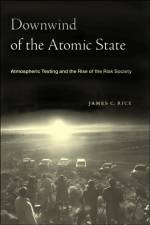
How the scientific community overlooked, ignored, and denied the catastrophic fallout of decades of nuclear testing in the American WestIn December of 1950, President Harry Truman gave authorization for the Atomic Energy Commission to conduct weapons tests and experiments on a section of a Nevada gunnery range. Over the next eleven years, more than a hundred detonations were conducted at the Nevada Test Site, and radioactive debris dispersed across the communities just downwind and through much of the country. In this important work, James C. Rice tells the hidden story of nuclear weapons testing and the negligence of the US government in protecting public health.Downwind of the Atomic State focuses on the key decisions and events shaping the Commission's mismanagement of radiological contamination in the region, specifically on how the risks of fallout were defined and redefined, or, importantly, not defined at all, owing to organizational mistakes and the impetus to keep atomic testing going at all costs. Rice shows that although Atomic Energy Commission officials understood open-air detonations injected radioactive debris into the atmosphere, they did not understand, or seem to care, that the radioactivity would irrevocably contaminate these communities.The history of the atomic Southwest should be a wake-up call to everyone living in a world replete with large, complex organizations managing risky technological systems. The legacy of open-air detonations in Nevada pushes us to ask about the kinds of risks we are unwittingly living under today. What risks are we being exposed to by large organizations under the guise of security and science?
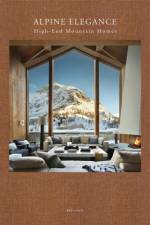
Beautifully presented coffee table book showcasing 14 new mountain residences and retreats from renowned architects and interior designers.
Tenants narrate their struggles for housing justice as the catastrophes of COVID-19, precarity, and racist police violence converge.
Abonner på vårt nyhetsbrev og få rabatter og inspirasjon til din neste leseopplevelse.
Ved å abonnere godtar du vår personvernerklæring.