
Gjør som tusenvis av andre bokelskere
Abonner på vårt nyhetsbrev og få rabatter og inspirasjon til din neste leseopplevelse.
Ved å abonnere godtar du vår personvernerklæring.Du kan når som helst melde deg av våre nyhetsbrev.

On September 24, 1938, Raceway Park officially opened its doors, and the track remained open for over 60 years. The first race was won by Harry McQuinn, who went on to compete in the Indianapolis 500 and become the chief pit steward of the Indianapolis Motor Speedway. In 1948, Raceway Park added stock car races to its regular program, and the track became a popular entertainment venue throughout the 1950s, 1960s, and 1970s as thousands of Chicagoans filled the stands. The track held its last race in 2000 and was torn down the following year. Although Raceway Park is now a part of history, the "World's Busiest Track" is still in the hearts and minds of many Chicagoland race fans.
A Practical Guide to Airline Customer Service is written for airline executives and undergraduate students who are preparing for a career in the airline service industry. Those working in similar functions and fields can also benefit from this book. This book primarily focuses on the importance of customer service in the airline industry. This includes basic airline operations and essential communication skills, and how airline service agents interact with passengers at every contact point of the travel process. This textbook is for anyone seeking a successful and rewarding career in the airline industry.
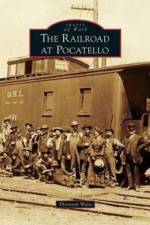
Pocatello was founded as a station on the narrow-gauge Utah and Northern Railway in 1878, and it has been a railroad town ever since. Passenger and freight trains arrived and departed in all four directions of the compass, 24 hours a day. The Union Pacific also built extensive shops at Pocatello, where railroad equipment was serviced, maintained, and repaired. In addition, refrigerator cars were iced from a large icehouse, and railroad ties were treated with preservative at a tie plant. The advent of the automobile, improved roads, new technologies, and the introduction of the diesel-electric locomotives all combined to change the railroad industry, affecting Pocatello in many ways. Passenger trains were discontinued, the steam-locomotive-servicing facilities were closed, and shop buildings were torn down. However, the railroad in Pocatello remains a vital part of the local scene today, with freight trains continuing to run through the city day and night.
Originally incorporated in 1881, the New York, Susquehanna & Western Railroad has had a long history in New Jersey. The railroad expanded by the early 1890s into the thriving Pennsylvania coalfields and eventually grew to over 200 miles of trackage in the northern portion of New Jersey. Always viewed as an underdog in a marketplace surrounded by much larger railroads, the New York, Susquehanna & Western emerged from 40 years of Erie Railroad control; survived several bankruptcies, reorganizations, abandonments, and retrenchments through innovative passenger and freight service offerings; and transformed into today's regional rail carrier with a size far greater than ever imagined.
On July 8, 1929, a Morristown newspaper announced the opening of Morristown Airport on Bernardsville Road. The article stated the airport would be the home of the Country Aviation Club under the supervision of Clarence Chamberlin, the second man to fly across the Atlantic Ocean and the first to take along a passenger. The Great Depression halted any serious development of the airport until 1936, when there was serious talk of the land becoming an East Coast dirigible base for the Hindenburg. However, the destruction of the Hindenburg at Lakehurst, New Jersey, a year later squashed those plans. After World War II, Morristown Airport began to become a reality. General aviation found Morristown convenient and out of the traffic patterns of Newark Airport. The airport grew and prospered, and by July 1966, Morristown Municipal Airport (MMU) was called the "VIP Stop." Today, as a general aviation reliever airport, MMU accepts private, corporate, air taxi, air ambulance, training, and military aircraft and ranks 11th in general aviation operations.
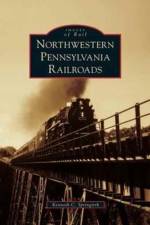
Erie's rail link to Philadelphia was achieved in 1864 with the completion of the Philadelphia and Erie Railroad, which later became part of the Pennsylvania Railroad. By 1869, railroad lines from Buffalo through Erie to Chicago were consolidated into the Lake Shore and Michigan Southern Railway, which later became part of the New York Central Railroad. Completed in 500 days, the parallel New York, Chicago and St. Louis Railroad, commonly known as the "Nickel Plate Road," was a 513-mile, well-designed railroad that emphasized excellent service. South of the lakeshore, the wide-gauge Erie Railroad enhanced east to west connections. Through vintage photographs, Northwestern Pennsylvania Railroads brings to life the history of the railroads that have served the region.
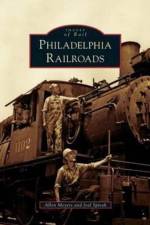
Philadelphia became the railroad capital of the world in the 1830s when 12 distinct lines opened within a 100-mile radius of the city to carry people and freight. The railroad boom in the 19th century was made possible by the development of rural communities surrounding the city, the Industrial Revolution, excellent access to raw materials, and an influx of European immigrants. Philadelphia manufactured locomotives, railroad track, and other rail components and exported them around the world. The ability to move agricultural goods, manufactured products, and people commuting from home to work helped to unite the 27 boroughs, districts, and townships into one metropolis by 1854. Philadelphia Railroads features many unseen images and rare photographs documenting the leaders of Philadelphia's transportation world.
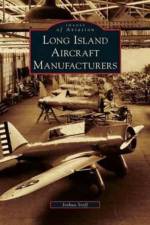
Significant aircraft manufacturing began on Long Island in the early 20th century and boomed during the war years. Long Islanders helped transform aviation from a dangerous sport to a viable means of transportation, while also producing a large portion of the nation's aerial arsenal in times of war. From the first frail biplanes to the warbirds of World War II and the sleek fighters of the jet age, aviation companies on Long Island helped make aviation the integral part of our world that it is today. During the 20th century, over 70 firms came to build aircraft on Long Island. Some of these firms lasted for decades and became famed builders of historic aircraft, such as Grumman, Republic, Curtiss, Fairchild, and Sikorsky.
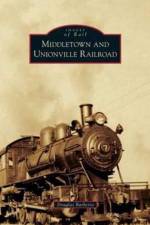
The Middletown and Unionville Railroad, successor to the Middletown, Unionville and Water Gap Railroad, operated from December 1, 1913, until May 31, 1946, when it was reorganized as the Middletown and New Jersey Railway. The railroad's main revenue was derived from the transportation of dairy products, feed, coal, lumber, and passengers along its 14.5-mile right-of-way from the city of Middletown through Slate Hill, Johnson, Westtown, and Unionville in Orange County, New York. It provided a connection between the Erie Railroad in Middletown; the New York, Ontario & Western Railway in Middletown; and the New York, Susquehanna & Western Railroad in New Jersey. All three of these railroads had unique relationships with the M&U during its period of operation.
Teterboro Airport has been in continuous use since 1916 and was once the busiest airport in the country. In 1925, the Fokker Company opened an American subsidiary, the Atlantic Aircraft Corporation, and Teterboro-built Fokker trimotors dominated the industry for a decade. In the 1920s and 1930s, record-setting flights became a national obsession, and many of the flights originated or terminated at Teterboro Airport. In 1939, the Goodyear blimp Mayflower made daily sightseeing flights over the New York City world's fair. In 1952, television personality Arthur Godfrey buzzed the control tower while taking off in his DC-3. The Port Authority of New York and New Jersey purchased the airport in 1949 and made major investments in airport infrastructure. Today the New Jersey Aviation Hall of Fame and Museum is located at the airport.
In 1881, a narrow-gauge railroad was built in southwestern New York, from Attica to Arcade. It was later rebuilt to standard gauge to connect with what became the Pennsylvania Railroad. Concerned that the line would be abandoned, local farmers, merchants, and others raised money to purchase the railroad and formed the Arcade and Attica Railroad. Through vintage photographs, Arcade and Attica Railroad highlights the history of a railroad that, faced with declining revenues, launched steam-powered passenger service in 1962. With a dedicated management team that has taken the time and effort to face obstacles, the pride of loyal employees, and a supportive community, the railroad has endured a variety of herculean challenges to continue passenger and freight service in Wyoming County, New York.
The Illinois Central Railroad (ICRR) operated approximately 600 miles of mainline track throughout the Commonwealth of Kentucky, stretching from the Mississippi River to the central part of the state. In addition to Louisville, the state's largest city, the ICRR also served dozens of small towns. Kentucky's economy was built around coal mining and farming, and the ICRR played a major role in both industries. ICRR's coal trains served as a conveyor for Kentucky coal moving to Midwest factories, and the road hauled a wide variety of agricultural products, including tobacco, grain, and fresh fruit. No mention of the ICRR would be complete without discussing the fleet of fast passenger trains that whisked Kentucky residents to and from distant cities. To maintain the locomotives that hauled all these trains the ICRR operated one of the nation's largest locomotive repair shops in Paducah.
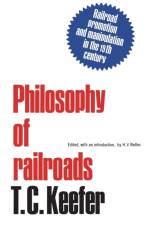
T.C. Keefer's Philosophy of Railroads is one of the greatest hymns of praise to the age of iron and steel ever written in North America. Better than any other document it shows why railroads were seen as the arteries of the Canadian nation during the nineteenth century.
Abonner på vårt nyhetsbrev og få rabatter og inspirasjon til din neste leseopplevelse.
Ved å abonnere godtar du vår personvernerklæring.