























Gjør som tusenvis av andre bokelskere
Abonner på vårt nyhetsbrev og få rabatter og inspirasjon til din neste leseopplevelse.
Ved å abonnere godtar du vår personvernerklæring.Du kan når som helst melde deg av våre nyhetsbrev.

The Sergeant-at-Arms is the guardian of thebylaws, and protector of the brotherhood. Learn the skills necessary to ply your trade as the Sergeant-at-Arms of yourmighty Brotherhood Nation. This handbook is the only one of its kind that will give you the templates, guides, information and direction to quickly get you up and running as a soldier-sergeant. Learn the Sergeant's administrative, law enfor-cement and military duties as an MC leader.Use National President John E. Bunch II's 27 years of experience to learn how to protectyour MC and manage its accountability system..
Prepare yourself to take the helm as President of your mighty motorcycle club chapter or nation by delving into the pages of the President's Bible Chronicle I Principles of Motorcycle Club Leadership. In this book you will learn to advance your skills in applying the fourteen scientific principles of leadership to include justice, judgement, dependability, initiative, decisiveness, tact, integrity, enthusiasm, bearing, unselfishness, courage, knowledge, loyalty, endurance, and much more. Former National President Black Dragon will embark you upon a field of study that will advance your leadership skills and capabilities. This 442-page book is a deep dive filled with 122,297 words of MC presidential leadership, experience, knowledge, and training. There is no other book written for this purpose in the world. Enjoy, glean, and pass it on! Black Dragon has over 32 years' experience in his brotherhood where he served nearly ten years as the National President of the Mighty Black Sabbath Motorcycle Club Nation.
<p>The photos in this edition are black and white.<p>Get a complete look at Ford Big-Block parts interchange and availability from author George Reid, a Ford expert and historian.<p>Engine components covered in <i>Ford Big-Block Parts Interchange</i> include cranks, rods, pistons, camshafts, engine blocks, intake and exhaust manifolds, carburetors, distributors, and more. Expanding from the previous edition of <i>High-Performance Ford Parts Interchange</i> that covered both small- and big-block engines in one volume, this book cuts out the small-block information and devotes every page to the MEL, FE and 385 series big-blocks from Ford, which allows for more complete and extensive coverage.<p>Over the course of performance car history, and specifically muscle car history, big-block engines are particularly beloved, and for good reason. Not only are they the essence of what a muscle car is, but before modern technology and stroker engines, they were also the best way to make a lot of horsepower. All of the Detroit manufacturers had their versions of big-block engines, and Ford was no exception. Actually, Ford was somewhat unique in that it had two very different big-block engine designs during the muscle car era.<p>The FE engine was a design pioneered in the late 1950s, primarily as a more powerful replacement for the dated Y-block design because cars were becoming bigger and heavier, and therefore, necessitated more power to move. What started as torquey engines meant to move heavyweight sedans morphed into screaming high-performance mills that won Le Mans and drag racing championships through the 1960s. By the late 1960s, the design was dated, so Ford replaced the FE design with the "385" series, also known as the "Lima" design, which was more similar to the canted-valve Cleveland design being pioneered at the same time. It didn''t share the 1960s pedigree of racing success, but the new design was better in almost every way; it exists via Ford motorsports offerings to this day.
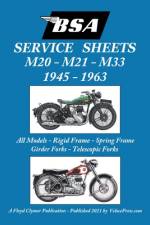
172 pgs, more than 240 illustrations and charts, size 8.25 x 10.75". In 1945, after the war had ended, BSA resumed production of their civilian line of motorcycles. However, they continued their pre-war practice of publishing repair, overhaul and technical information in the form of individual 'Service Sheets'. These sheets were 'dealer only' publications and, as such, the print quality was somewhat questionable. It was not until the early 60's that BSA eventually started publishing model specific workshop manuals that were available to the general public. Consequently, these 'Service Sheets' were the only publications available for the maintenance and repair of BSA models from 1945 through the mid 60's. At some point in the 1930's, BSA began identifying their various model types by 'groups' and the models manufactured from 1945 through the mid 60's were in Groups A, B, C, D and M. The service sheets were identified numerically and while there are some exceptions, the numbers relate to a particular model group. They are as follows: The 200 series of service sheets were applicable to Group A models, the 300 series to Group B, the 400 series to Group C, the 500 series to Group D and the 600 series to Group M. Also, there was a 700 series applicable to mechanical maintenance and an 800 series for electronic service and wiring diagrams. Both the 700 and 800 series of service sheets contained information that was not model specific but was applicable across multiple model groups. Unfortunately, as these service sheets were issued individually and at random times, the numbering sequence within a group is, at times, illogical and not necessarily consecutive. Consequently, assembling those individual sheets into a publication that serves as a model specific workshop manual is a somewhat difficult task and owners of BSA motorcycles are subjected to considerable confusion surrounding the appropriate selection from the multitude of reprints that have recently flooded the on-line marketplace. Many of the reprints found on internet websites are from 'bedroom sellers' at enticingly low prices by individuals that really have no idea what they are selling. Many are nothing more than poor quality comb-bound photocopies that are scanned and printed complete with greasy pages and thumbprints and are deceptively described as 'pre-owned', 'used' or even 'refurbished'! In addition, they are often advertised for the incorrect series and/or model years of motorcycles. The most complete compilation of the 1945 and onwards service sheets was a BSA 'dealer only' ring binder that contained all of the individual service sheets totaling to almost 500 pages. This manual contains 51 service sheets(169 pgs) and includes 14 sheets(62 pgs) from that 'dealer only' publication plus the 37 service sheets(107 pgs) that were published by BSA under part number 00-4021. It covers the S.V. and O.H.V. rigid, spring frame, girder and telescoping fork M20, M21 and M33 models from 1945-63. Obviously, as the M20 and M21 were introduced in 1937, this manual will also be of use to owners of those earlier models. Please note that service sheets other than those in the 600 series that are included in this publication may also contain data that is applicable to 'other' model groups, as that was the original intention. For additional information the reader is directed to 'The Book of the BSA 250cc,350cc,500cc & 600cc OHV&SV singles 1945-1959' (ISBN 9781588502292) which covers the B31, B32, B33, B34, C10, C11, C11DL, M20, M21 & M33 models. The OHV 1955-1958 M33 models are also covered in 'The Book of the BSA OHV Singles 350cc & 500cc 1955-1967' (ISBN 9781588501561)
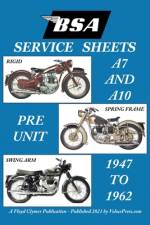
196 pages, and more than 250 illustrations and charts, size 8.25 x 10.75 inches. In 1945, after the war had ended, BSA resumed production of their civilian line of motorcycles. However, they continued their pre-war practice of publishing repair, overhaul and technical information in the form of individual 'Service Sheets'. These sheets were 'dealer only' publications and, as such, the print quality was at times somewhat questionable. It was not until the early 1960's that BSA eventually started publishing model specific workshop manuals that were available to the general public. Consequently, these 'Service Sheets' were the only publications available for the maintenance and repair of BSA models that were manufactured through the early 1960's. At some point in the 1930's, BSA adopted the practice of identifying their various model types by 'groups' and the models manufactured from 1945 through the early 1960's were in Groups A, B, C, D and M. The service sheets that were associated to a particular group were identified numerically and, while there were some exceptions due to overlapping data between models, in general terms the numbers relate to a particular model group. They are as follows: The 200 series of service sheets were applicable to Group A models, the 300 series to Group B, the 400 series to Group C, the 500 series to Group D and the 600 series to Group M. In addition, there were a 700 series applicable to mechanical maintenance and an 800 series for electronic service and wiring diagrams. Both the 700 and 800 series of service sheets contained information that was not model specific but was applicable across multiple model groups. Unfortunately, as these service sheets were issued individually and at random times, the numbering sequence within any group is not necessarily consecutive and, at times, illogical. Consequently, assembling those individual sheets into a publication that serves as a model specific workshop manual is a somewhat difficult task and owners of BSA motorcycles are subjected to considerable confusion surrounding the appropriate selection from the multitude of reprints that have recently flooded the on-line marketplace. Many of the reprints found on internet websites are from 'bedroom sellers' at enticingly low prices by individuals that really have no idea what they are selling. Many are nothing more than poor quality comb-bound photocopies that are scanned and printed complete with greasy pages and thumbprints and, as such, are deceptively described as 'pre-owned', 'used' or even 'refurbished'! In addition, they are often advertised for the incorrect series and/or model years of motorcycles. The most complete compilation of the 1945 and onwards service sheets was issued by BSA in the form of a 'dealer only' ring binder that contained all of the individual service sheets totaling to almost 500 pages. This manual is a compilation of the service sheets that were collated and published by BSA in the late 1950's and early 1960's under part numbers 00-4017 (pre-swing arm) and 00-4047 (swing arm), which excluding duplicates, consisted of 44 service sheets in total. However, an additional 14 sheets from the ring bound 'dealer only' publication have been added to produce a single manual containing 58 service sheets (190 pages) that cover the entire range of pre-unit A7 and A10 models from 1947 to 1962. Please note that service sheets in the 300, 700 and 800 series that are included in this publication will also include data that is applicable to 'other' model groups, as that was the original intention. For additional information the reader is directed to 'The Book of the BSA Twins 650cc & 500cc 1948-1962' (ISBN 9781588500977).
A softback illustrated history of the locomotives to have graced the rails of this North African/Middle Eastern country.
A hardback illustrated album taking the reader on an illustrated journey along this popular heritage railway from Pickering to Whitby. The author is part of the NYMR's Motive Power Department, and consequently has access to views and locations which would not be available to the general public, making this a unique photographic record.
The tragic true story of a mid-air collision in October 1958 that killed thirty-one people
High Quality Art Photography, Informative Text, Useful to Historians, Architects and Designers and useful to Modelmakers
Good Photographic Coverage, Interesting Locations, New Information, Informative Text, Useful to Modellers
A bestselling BBC World Service ten-part series and podcast that celebrates the men and women who built and flew the Second World War's most famous fighter plane - the Spitfire.
A delightfully warm exploration of a very British obsession.
The complete history of Mazda's rotary engine-powered vehicles, from Cosmo 110S to RX-8. Charting the challenges, sporting triumphs, and critical reactions to a new wave of sports sedans, wagons, sports cars ... and trucks!
Abonner på vårt nyhetsbrev og få rabatter og inspirasjon til din neste leseopplevelse.
Ved å abonnere godtar du vår personvernerklæring.