















Gjør som tusenvis av andre bokelskere
Abonner på vårt nyhetsbrev og få rabatter og inspirasjon til din neste leseopplevelse.
Ved å abonnere godtar du vår personvernerklæring.Du kan når som helst melde deg av våre nyhetsbrev.

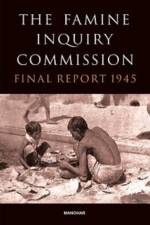
It is in continuation with the first report entitled Report on Bengal and is divided into four parts.
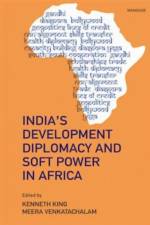
Through research in Ethiopia, Ghana, India, Rwanda, Senegal, South Africa and Tanzania, the contributors explore how India's soft power has been conceptualised and enacted in schemes such as Indian Technical and Economic Cooperation, African scholarships, the Pan-African e-network, Gandhi statuary and India's Covid-19 outreach to Africa.
Independence protests are on the rise across Europe, as Spain, the UK, and other states have faced severe secessionist challenges. The largest wave of these protests swept Catalonia and reached its peak in 2017 when the push for a binding referendum led to an unprecedented secessionist crisis. Organizing for Independence explores the question of how the referendum crisis as a threat and opportunity transformed secessionist protest and its organizational basis. Combining protest event data, qualitative interviews, and network analyses, Hans Jonas Gunzelmann shows how organizational change took place inside, outside, and between formal organizations, and was driven by activists' symbolic constructions of transformative events. The book goes beyond simplistic accounts of secessionist protest by providing a dynamic perspective on strategic interactions between protesters and their opponents and allies. These insights are particularly timely as independence movements all over the world look with great interest at what happened in Catalonia.
This book tells the story of the negotiations between China, Japan, Taiwan, the Philippines, Vietnam and other Southeast Asian countries about the East and South China Sea disputes. Tapping into formerly classified and newly available primary sources, the book meticulously tracks these negotiations and their sudden U-turns. It is a story about the promises and perils of cooperation - as much about pragmatic, gradual and surprisingly resilient approaches to conflict resolution and ocean governance as it is about the expansion of states' bargaining power through institutions. The book hinges on the question of when and why disputing parties reach agreement on joint oil and gas development, fisheries and codes of conduct, and when and why negotiations end in impasse. It is the first comprehensive and theoretically informed study of decades-long dispute settlement efforts in a central region of the Indo-Pacific where the expansion of China challenges the law of the sea and regional security.
Part of the ""Revolutionary War Series"", this work documents a period that includes the Continental Army's last weeks at Valley Forge, the British evacuation of Philadelphia, and the Battle of Monmouth Court House. It begins with George Washington's army at Valley Forge, Pennsylvania, celebrating the alliance between the United States and France.
Public Sector Ethics: Compliance, Integrity, and Comparison presents a comprehensive treatment of the subject of ethics in the public sector. What structural elements are necessary and how to create organizations that make ethics their priority are the questions that this edited volume addresses.
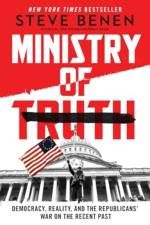
Instant New York Times BestsellerA searing, vital investigation of the Republican Partys dangerous campaign to rewrite recent history in real time, from the Emmy Award-winningRachel Maddow Showproducer and bestselling author ofThe Impostors.There is nobody who is writing in an episodic way who has more influence on the way I think about politics than Steve Benen.Rachel MaddowFor as long as historical records have existed, authoritarian regimes have tried to rewrite history to suit their purposes, using their dictatorial powers to create myths, spread propaganda, justify decisions, erase opponents, and even dispose of crimes.As the Republican Party becomes increasingly radicalized, the GOP is putting their own twist on a similarly despotic script. Indeed, the party is taking dangerous, aggressive steps to rewrite historyand not just from generations past.Unable to put a positive spin on Trump-era scandals and fiascos, GOP voices and their allies have grown determined to rewrite the stories of the last few yearsfrom the 2020 election results and the horror of January 6thto their own legislative recordtreating the recent past as an enemy to be overpowered, crushed, and conquered. The consequences for our future, in turn, are dramatic.Extraordinarily timely and undeniably important, Steve Benens new book tells the staggering chronicle of the Republican partys unsettling attempts at historical revisionism. It reveals not only how dependent they have grown on the tactic, but also how dangerous the consequences are if we allow the party to continue. The stakes, Benen argues, couldnt be higher: the future of democracy hinges on both our accurate understanding of events and the end of alternative narratives that challenge reality.
This timely intervention into the debate about the legacy of the Enlightenment highlights both the plurality and the continuing relevance of Enlightened cosmopolitanism to contemporary global concerns, linking cultural history with the history of ideas and politics, in a global perspective.
Explores the multiple ways in which different conceptions of time and history have been used to understand politics since late antiquity, showing that no conception of politics has dispensed altogether with time, and many have explicitly sought legitimacy in association with forms of history.
This compendium by the Land Body Ecologies collectiveexplores solastalgia, the psychological distress caused by climate change, inland-dependent and Indigenous communities across Uganda, Kenya, Thailand, Indiaand the Arctic.
Analysing the work of Ethiopian-Somali smugglers and return-migrant investors, this study explores the relationship between cities and borders amid Africa's rapid urbanization. Daniel Thompson describes how African city-dwellers' lives are shaped by global border security regimes, and how they contest these borders in daily urban life.
In Policing Show Business, Francis MacDonnell explores the starring role played by J. Edgar Hoover in the development of the Hollywood blacklist in the 1940s and 1950s. As director of the FBI, Hoover poured resources into scrutinizing show business, a policy choice unjustified by any corresponding threat to public security. He detailed agents to write regular reports on actors, screenwriters, lyricists, singers, and studio executives. His frequent handwritten comments on papers inside the files of film industry personalities demonstrate a level of interest bordering on obsession.Policing Show Business is not just another book about the Hollywood blacklist. MacDonnell approaches the Red Scare through biography using FBI records on such luminaries as Marlene Dietrich, Walt Disney, Hedda Hopper, Adolphe Menjou, Lena Horne, Fredric March, Cecil B. DeMille, and Burl Ives to present in unexpected, surprising, and sometimes poignant ways the rich human dramas experienced by both targets of the bureau and its collaborators.MacDonnell's meticulously researched account, drawing on many newly available FBI files, evokes the passions and resentments; the courageous acts and calculated evasions; and the petty tyrannies and self-interested campaigns of an ignominious episode in the annals of American freedom.
"On December 15, 1972, as rumors swirled of a pending peace agreement between the United States and North Vietnam, Governor Jimmy Carter issued an executive order creating the Georgia Advisory Committee on Vietnam Veterans (GACVV). His reasoning was simple: "the citizens of the State of Georgia and of the United States of America owe a debt of gratitude to these veterans who have served the Nation in an unpopular war." Carter's efforts followed trends occurring across the country as a host of states contemplated their responsibilities to Vietnam veterans by considering such benefits as cash bonuses, educational stipends, and free hunting licenses. Through his words and actions, Carter joined this broader debate regarding society's obligation to Vietnam veterans. In A Debt of Gratitude, Glenn Robins examines Carter's role in the creation of Vietnam veterans' issues as a national agenda item. Covering virtually the entire decade of the 1970s, from Carter's single terms as governor and president of the United States, Robins demonstrates that, throughout this period, Carter distinguished himself as one of the country's most important decision-makers concerning Vietnam veterans' policy. By addressing Vietnam veterans' issues and by communicating his positions and views, Carter made a substantial political investment in moving these items from the level of public debate to the level of policy prescriptions, thereby raising awareness, generating concern, and promising government attention to honor and thank Vietnam veterans"--
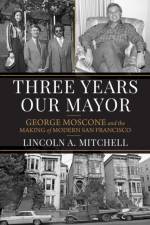
"Through illustrating the life of Mayor George Moscone, author Lincoln A. Mitchell explores how today's San Francisco came into being. Moscone-through his work in the State Senate, victory in the very divisive 1975 mayor's race, and brief tenure as mayor-was a key figure in the city's evolution. The politics surrounding Moscone's election as mayor, governance of the city, and tragic death are still relevant issues. Moscone was a groundbreaking politician whose life was cut short, but his influence on San Francisco can still be felt today"--
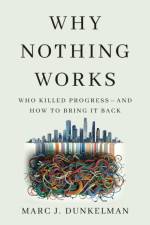
A provocative exploration about the architecture of power, the forces that stifle us from getting things done, and how we can restore confidence in democratically elected government—“the best book to date on the biggest political issue that nobody is talking about” (Matthew Yglesias) America was once a country that did big things—we built the world’s greatest rail network, a vast electrical grid, interstate highways, abundant housing, the Social Security system, the Tennessee Valley Authority, and more. But today, even while facing a host of pressing challenges—a housing shortage, a climate crisis, a dilapidated infrastructure—we feel stuck, unable to move the needle. Why? America is today the victim of a vetocracy that allows nearly anyone to stifle progress. While conservatives deserve some blame, progressives have overlooked an unlikely culprit: their own fears of “The Establishment.” A half-century ago, progressivism’s designs on getting stuff done were eclipsed by a desire to box in government. Reformers put speaking truth to power ahead of exercising that power for good. The ensuing gridlock has pummeled faith in public institutions of all sorts, stifled the movement’s ability to deliver on its promises, and, most perversely, opened the door for MAGA-style populism. A century ago, Americans were similarly frustrated—and progressivism pointed the way out. The same can happen again. Marc J. Dunkelman vividly illustrates what progressives must do if they are going to break through today’s paralysis and restore, once again, confidence in democratically elected government. To get there, reformers will need to acknowledge where they’ve gone wrong. Progressivism’s success moving forward hinges on the movement’s willingness to rediscover its roots.
Thought-provoking analysis of how illiberalism, major crises and digital transformation are changing our politico-administrative systemsWhat does the future hold for the public sector? A convergence of illiberalism, major crises, system quakes and digital transformations are reshaping current politico-administrative systems. How will this challenge the way states and public administrations can and should be managed, and what will be the impact on citizen-administrative relations and our models of democracy? In this book, leading Public Administration scholars reflect on major trends in the public sector and their implications. They offer visions of how the academic field of Public Administration can respond to or anticipate possible futures. Ideal for policymakers, academics, and anyone invested in the future of governance, this compelling work reflects on how the forces transforming our world will impact the public sector.
Abonner på vårt nyhetsbrev og få rabatter og inspirasjon til din neste leseopplevelse.
Ved å abonnere godtar du vår personvernerklæring.