








Gjør som tusenvis av andre bokelskere
Abonner på vårt nyhetsbrev og få rabatter og inspirasjon til din neste leseopplevelse.
Ved å abonnere godtar du vår personvernerklæring.Du kan når som helst melde deg av våre nyhetsbrev.

This book brings together historians, sociologists, political scientists and philosophers to reconstruct how the Paris Commune of 1871 has continued to serve as a source of inspiration to different movements throughout the past 150 years, and how communalist thought and practices help us reimagine what radical democracy may look like today.
This handbook analyses the impact of China's Belt and Road geostrategy in Eurasia. Over the last decade the BRI helped bring China economic and political superpower status, but the Russo-Ukrainian war brought seismic geopolitical and geoeconomic impacts.
This book provides a neorealist explanation of transatlantic relations and explores key issues at the forefront of the relationship between the US and its European allies in the context of the Russia-Ukraine war.
This book explores the topic of architecture as a component of public discourse, focusing on the reception of four high-profile developments in the City of London (the UK capital's financial district) dating from the final years of the twentieth century.
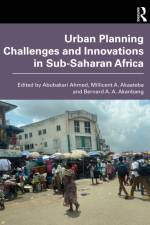
This book explores the unique challenges faced by rapidly growing cities in Sub-Saharan Africa, including urban crime, informality, land governance, development control, and the degradation of green spaces, as well as how these issues are addressed in planning education and emerging innovations.
This book explores the unique challenges faced by rapidly growing cities in Sub-Saharan Africa, including urban crime, informality, land governance, development control, and the degradation of green spaces, as well as how these issues are addressed in planning education and emerging innovations.
This book investigates the framing of the terrorist threat in France from 2015 to 2020 as an 'exceptional' challenge which requires a 'special' public security response.
This volume places scarcity as a defining aspect of minorities' collective experience and as a tool to comprehend ongoing and unresolved societal friction and global environmental challenges, strategies for survival and reproduction of the status quo, as well as aspirational desires for social mobility.
First published in 2003, Decentring the Indian Nation examines the various centrifugal forces apparent in recent Indian politics.
The book examines how early twentieth century Black theatre artists depicted national mythologies of the United States. White-authored pageants and plays written for the 1932 Bicentennial celebration of George Washington's birthday relegated Black Americans to the periphery through racist stereotyping.
What is the nonprofit sector and why does it exist? Some of the most creative minds in the field of nonprofit studies from around the world provide answers to these questions, and critique and expand both existing sector theory and new sector theories.
A major new account of appeasement and the question of whether the Second World War could have been prevented. G. C. Peden provides a comparative analysis of Chamberlain and Churchill's view on foreign policy, how best to deter Germany and explores what deterrence and appeasement meant in the context of the 1930s.
"Before the People's Republic was established in 1949, American missionaries, businessmen, and diplomats sought to remake China in their own image, only to be soundly rejected as capitalists and imperialists after the Communists came to power. What followed was a twenty-year period of mutual hostility and isolation. When China's leaders turned to the West and Japan in the 1980s, their goal was to attract investment and to absorb ideas, methods, and technologies for Chinese purposes. Their goal, as Mao put it, was "to make the foreign serve China." Chinese Encounters with America tells the stories of twelve women and men whose experiences with America transformed their lives and careers. Neither immigrants nor exiles, they came to the United States seeking knowledge and skills that would advance their country's modernization. Upon returning to the People's Republic of China they made significant contributions in the fields of diplomacy, science, business, academia, policy studies, civil society, sports, dance, music, media, and the environment. Each chapter shows how they interpreted and adapted their understanding of America to China's ever-changing social, political, and economic circumstances. Their individual stories, focused mainly on the past fifty years of engagement, offer unique insights on China, the United States, and relations between our two countries. The personalities described in this book are vastly different from the nineteenth-century laborers who came to mine gold and build railroads in America's West and they are unlike those who fled from wars to seek safe haven in the United States during the mid-twentieth century. Neither sojourners nor refugees, the figures in this book are "returnees"--those who went abroad and came back to the People's Republic of China. Each chapter tells the story of one individual and each is informed by several shared questions: Why did these Chinese men and women go the United States and why did they return to China? What were their expectations and how did their perceptions change after seeing the complicated realities of the United States firsthand? What difference did their American encounters make in their lives and professions after went back to China? What do their lives tell us about the complexities of Sino-American relations?"--
"Before the People's Republic was established in 1949, American missionaries, businessmen, and diplomats sought to remake China in their own image, only to be soundly rejected as capitalists and imperialists after the Communists came to power. What followed was a twenty-year period of mutual hostility and isolation. When China's leaders turned to the West and Japan in the 1980s, their goal was to attract investment and to absorb ideas, methods, and technologies for Chinese purposes. Their goal, as Mao put it, was "to make the foreign serve China." Chinese Encounters with America tells the stories of twelve women and men whose experiences with America transformed their lives and careers. Neither immigrants nor exiles, they came to the United States seeking knowledge and skills that would advance their country's modernization. Upon returning to the People's Republic of China they made significant contributions in the fields of diplomacy, science, business, academia, policy studies, civil society, sports, dance, music, media, and the environment. Each chapter shows how they interpreted and adapted their understanding of America to China's ever-changing social, political, and economic circumstances. Their individual stories, focused mainly on the past fifty years of engagement, offer unique insights on China, the United States, and relations between our two countries. The personalities described in this book are vastly different from the nineteenth-century laborers who came to mine gold and build railroads in America's West and they are unlike those who fled from wars to seek safe haven in the United States during the mid-twentieth century. Neither sojourners nor refugees, the figures in this book are "returnees"--those who went abroad and came back to the People's Republic of China. Each chapter tells the story of one individual and each is informed by several shared questions: Why did these Chinese men and women go the United States and why did they return to China? What were their expectations and how did their perceptions change after seeing the complicated realities of the United States firsthand? What difference did their American encounters make in their lives and professions after went back to China? What do their lives tell us about the complexities of Sino-American relations?"--
In this groundbreaking reflection on America's relationship with war in the modern era, Gregory A. Daddis explores the deep-seated tension between faith in and fear of war that has shaped US grand strategy and helped militarize US foreign policy with great costs at home and abroad. How have Americans conceptualized and understood the "promise and peril" of war since 1945? And how have their ideas and attitudes led to theever-increasing militarization of US foreign policy since the end of World War II?In a groundbreaking reassessment of the long Cold War era, historian Gregory A. Daddis argues that ever since the SecondWorld War's fateful conclusion, faith in and fear of war became central to Americans' thinking about the world around them. With war pervading nearly all aspects of American society, an interplay between blind faith and existential fear framed US policymaking and grand strategy, often with tragic results. These inherent tensions--an unwavering trust and confidence in war coupled with a fear that nearly all national security threats, foreign or domestic, are existential ones--have shapedAmericans' relationship with war that persists to the current day.A sweeping history, Faith and Fear makes a forceful argument by examining the tensions between Americans' overreachingfaith in war as a foreign policy tool and their overwhelming fear of war as a destructive force.
Trump's Playbook: Destroy the Deep State, Dossiers & Debriefings will be one of the most important books of 2025. Succinct, fast paced, at times reads more like an action novel or a Hollywood thriller than exclusive insights and analysis from one of the world's foremost experts on US intelligence. Rebekah is as a former U.S. intelligence officer, distinguished author and highly respected media commentator, regularly appearing on major TV networks including Fox News and Newsmax, radio programs and podcasts. She provides readers with an essential guide to Trump's presidency as Trump is making history.
A revealing exposé on how foreign authoritarian influence is undermining freedom and integrity within American higher education institutions.In an era of globalized education, where ideals of freedom and inquiry should thrive, an alarming trend has emerged: foreign authoritarian regimes infiltrating American academia. In Authoritarians in the Academy, Sarah McLaughlin exposes how higher education institutions, long considered bastions of free thought, are compromising their values for financial gain and global partnerships. This groundbreaking investigation reveals the subtle yet sweeping influence of authoritarian governments. Universities leaders are allowing censorship to flourish on campus, putting pressure on faculty, and silencing international student voices, all in the name of appeasing foreign powers. McLaughlin exposes the troubling reality where university leaders prioritize expansion and profit over the principles of free expression. The book describes incidents in classrooms where professors hesitate to discuss controversial topics and in boardrooms where administrators weigh the costs of offending oppressive regimes. McLaughlin offers a sobering look at how the compromises made in American academia reflect broader societal patterns seen in industries like tech, sports, and entertainment. Meticulously researched and unapologetically candid, Authoritarians in the Academy is an essential read for anyone who believes in the transformative power of education and the necessity of safeguarding it from the creeping tide of authoritarianism.
Abonner på vårt nyhetsbrev og få rabatter og inspirasjon til din neste leseopplevelse.
Ved å abonnere godtar du vår personvernerklæring.