


















Gjør som tusenvis av andre bokelskere
Abonner på vårt nyhetsbrev og få rabatter og inspirasjon til din neste leseopplevelse.
Ved å abonnere godtar du vår personvernerklæring.Du kan når som helst melde deg av våre nyhetsbrev.

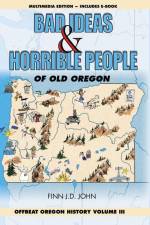
45 monumentally Bad Ideas ... 36 certifiably Horrible People ... one great collection of Offbeat Oregon History stories!
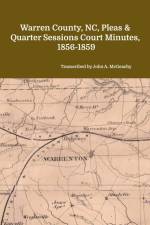
Transcription of 1856-1859 minutes of the Warren County (NC) Court of Pleas & Quarter Sessions; indexed by personal name, business name, geographic name and subject.
This collection of articles weaves extracts from over 30 years of local history research by distinguished historian Dr. Douglas H. Shepard into a single volume, offering a detailed and engaging narrative of Fredonia's development from prehistory to the preservation efforts of the 1990s. Topics range from the physical geography that defines Chautauqua county and places Fredonia in the Lake Erie grape belt, to the many national 'firsts' which occurred in Fredonia: the first march of the Women's Christian Temperance Union in 1873, the first Grange established by the Patrons of Husbandry in 1867, and the first commercial natural gas well established in 1825.
This is a reproduction of Arch Bristow's booklet on the history of Columbus, Pennsylvania, he likely wrote this at about 1930.Arch began in the newspaper business as a cartoonist with the owl character "Zimmie," which started in 1902 and became syndicated nationally.He began the self-published monthly magazine "Hay Rake" in 1920 at the age of 38 in a modest shoemaker's shop in the hamlet of Garland, PA. He grew it to a subscription of 20,000 in a few months and continued to publish it till about 1939.After his hair went gray, he was known as the "Sage of Garland." He continued to write newspaper columns till his death in 1964.
This work has been selected by scholars as being culturally important, and is part of the knowledge base of civilization as we know it. This work was reproduced from the original artifact, and remains as true to the original work as possible. Therefore, you will see the original copyright references, library stamps (as most of these works have been housed in our most important libraries around the world), and other notations in the work. This work is in the public domain in the United States of America, and possibly other nations. Within the United States, you may freely copy and distribute this work, as no entity (individual or corporate) has a copyright on the body of the work.As a reproduction of a historical artifact, this work may contain missing or blurred pages, poor pictures, errant marks, etc. Scholars believe, and we concur, that this work is important enough to be preserved, reproduced, and made generally available to the public. We appreciate your support of the preservation process, and thank you for being an important part of keeping this knowledge alive and relevant.
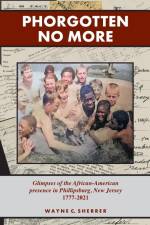
A meticulously researched account that shines a much needed searchlight on the African American experience in Philipsburg, New Jersey. It combines demographic, documentary, and narrative history-writing strategies to hold the reader's interest and suggest new areas for further research. Dr. Paul D. Barclay, Professor of History Lafayette College, Easton, Pennsylvania
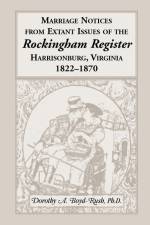
The Rockingham Weekly Register began publication in July 1822. Although not many of the earliest issues have survived, those that have were tracked down by the author in the collections of the University of Virginia, Duke University, historical societies, private collectors, and local family members. During its lifetime, the Rockingham Weekly Register, generally referred to as the Rockingham Register, enjoyed wide circulation throughout the Shenandoah Valley, including parts of what is now West Virginia. The author has arranged all surnames she found in the marriage notices in alphabetical order: the bride's maiden name is followed by a cross-reference to the groom's surname; the groom's name is followed by a transcription of the notice itself. Entries typically give the date and place of the wedding; the name of the priest performing the ceremony; the full name of the groom and his place of residence; the full name of the bride, her place of residence and the full name of her father. The author has added the date the notice appeared in the Register, plus the page and column numbers.
A celebration of CambridgeâEUR(TM)s rich heritage and identity âEUR" its special events, achievements, people, industry and landmarks.
A fascinating tour of Horsham's pub scene, charting the town's taverns, alehouses and watering holes, from past centuries to more recent times.
A fascinating survey of the history of Christianity in Uxbridge from Roman times to the present day.
The military heritage of Plymouth from earliest times to the present day. Will be of interest to all those who would like to know more about Plymouthâ¿s remarkable military history.
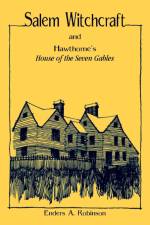
This book offers a detailed and highly readable account of the Salem witchcraft affair of 1692. Its publication coincides with the tercentenary observance of the events that form one of the grimmest chapters in colonial American history. The book has three parts. Part One, "Salem Witchcraft History," provides background information on the Puritan settlement of New England and documents the circumstances which led to the witch hunt of 1692. It identifies the conspirators who accused innocent people by working in collusion with the Puritan old guard authority. It then gives an account of the Andover phase of the witch hunt, with emphasis on the almost forgotten story of the fifty townspeople who were imprisoned for witchcraft in 1692. Nathaniel Hawthorne was a descendant of John Hathorne, one of the most zealous of the Salem witch hunters. Part Two, "The House of the Seven Gables," briefly examines Hawthorne's treatment of the witchcraft events in which his ancestor had played such a central role. It reveals the historical identity of several characters in Hawthorne's novel, including the real-life counterpart of the fictional Matthew Maule, the executed wizard. Part Three, "Salem Witchcraft Genealogy," gives biographies of the accusers and the accused during the latter phase of the Salem witchcraft affair. Genealogical inter-connections are shown that help to explain why certain family groups were targeted for witchcraft accusation. Several hundred people are mentioned in the genealogies, involving many families of the time.
"A shocking and revelatory account of the murder of Emmett Till that lays bare how forces from around the world converged on the Mississippi Delta in the long lead-up to the crime, and how the truth was erased for so long"--
Dr. Max Freiherr von Oppenheim (1860 - 1946) beschreibt sein Elternhaus, dessen Vorgeschichte und Zerstörung. Es wird zudem auf einzelne Persönlichkeiten der Bewohner des Hauses näher eingegangen."Die Glockengasse war in früherer Zeit, so auch noch im 19. Jahrhundert, eine besonders vornehme Straße, in der vorzugsweise der rheinische Adel seine Höfe hatte. Unser Haus lag, nur durch ein kleines Haus von der Ecke der Glockengasse / Herzogstraße getrennt auf der Columbakirche gegenüber befindlichen Seite, also auf derselben südlichen Seite wie das Schauspielhaus und die alte Post."- ohne Bilder -
This work has been selected by scholars as being culturally important, and is part of the knowledge base of civilization as we know it. This work was reproduced from the original artifact, and remains as true to the original work as possible. Therefore, you will see the original copyright references, library stamps (as most of these works have been housed in our most important libraries around the world), and other notations in the work. This work is in the public domain in the United States of America, and possibly other nations. Within the United States, you may freely copy and distribute this work, as no entity (individual or corporate) has a copyright on the body of the work.As a reproduction of a historical artifact, this work may contain missing or blurred pages, poor pictures, errant marks, etc. Scholars believe, and we concur, that this work is important enough to be preserved, reproduced, and made generally available to the public. We appreciate your support of the preservation process, and thank you for being an important part of keeping this knowledge alive and relevant.
Revealing hidden historical tales and lesser-known stories of Adirondack lore alongside hilarious descriptions of battling the elements in an attempt to climb each peak, Hiking History is a thoughtful and fascinating tour of the Adirondacks.
A fabulous collection of ghostly hauntings in Cumbria that will fascinate and intrigue everybody who knows the area.
Exploring a fascinating pictorial local history of Plymouth through the sixties, seventies and eighties.
An imaginative novel about a group of thirty-something friends who still flaunt convention, and who encounter life and death in a surreal manner on the birth of the new millenium. Winner of the Prose Medal at the National Eisteddfod, 1997. First published 1997.
This book looks at the contemporary historical setting, the type of medicine practised by the Beatons, the use they made of herbal treatments (a use which has not disappeared to the present day) and the almost unbelievable survival of Gaelic manuscripts from their library.
Like many American urban waterways, Ken-O-Sha has been in decline for nearly two hundred years. Once life-supporting, the waterway now known as Plaster Creek is life-threatening. In this provocative book, scholars and environmentalists Gail Gunst Heffner and David P. Warners explore the watershed's ecological, social, spiritual, and economic history to determine what caused the damage, and describe more recent efforts to repair it.
Today, as this book reveals, the apple industry continues to evolve in response to shifting consumer demands and accelerating climate change. Yet, through it all, the Washington apple maintains its iconic status as Washington's most valuable agricultural crop.
Abonner på vårt nyhetsbrev og få rabatter og inspirasjon til din neste leseopplevelse.
Ved å abonnere godtar du vår personvernerklæring.