











Gjør som tusenvis av andre bokelskere
Abonner på vårt nyhetsbrev og få rabatter og inspirasjon til din neste leseopplevelse.
Ved å abonnere godtar du vår personvernerklæring.Du kan når som helst melde deg av våre nyhetsbrev.

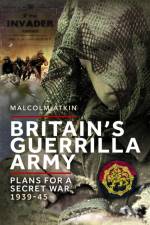
THE MOST COMPREHENSIVE account of Britainâ¿s complex plans to fight a secret war in the event of a Nazi invasion. When Winston Churchill made his â¿we shall never surrenderâ¿ speech in 1940 he was speaking in the knowledge that Britainâ¿s Secret Intelligence Service had already created a civilian guerrilla organisation to oppose any invasion and a separate resistance network to mobilize if the country had been occupied. There then followed a fierce battle between the Secret Intelligence Service and the War Office for the control of guerrilla warfare, and conflicting ideas over the legitimacy of armed civilians. A multi-layered system of secret organizations was the result. The Auxiliary Units are now the best known of these ungentlemanly forces, but in this perceptive new study Malcolm Atkin unravels the considerable mythology that has grown up around them. He explains their origins and how they were never intended as a resistance organization. Instead, the Auxiliary Units patrols were designed as uniformed guerrilla to support an active military campaign, whilst their Special Duties Branch would spy on the British public as much as any Nazi invader. other Home Guard and army units were also preparing to 'go to ground'. Meanwhile, deep in the shadows, was the real resistance organization known only by its cover as Section VII of SIS â¿ so secret that the first detailed account was not published until 2015, by the present author.
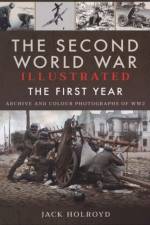
The first volume covers contributory factors leading up to the outbreak of hostilities. Hitler's amazing success in correcting the real and perceived insults to the German nation resulting from the Great War and the Treaty of Versailles is acknowledged. There followed a military operation – Blitzkrieg – which rocked the world as two super powers, France and Great Britain, were soundly thrashed on the battlefield of Europe by Nazi Germany. With the skin of their teeth the British Expeditionary Force fled across the Channel from Dunkirk, leaving most of their equipment behind. The invasion of Kent in the south of England by a triumphant enemy equipped with a cruel and oppressive regime replete with Gestapo, concentration camps and policies of racial and political persecution presented a spine-tingling threat to the British people. With Winston Churchill at the helm disparaging peace treaties with the Nazi regime, the fight back began. A few thousand fighter pilots of the RAF defeated the Luftwaffe by a very narrow margin and Hitler looked to the east for his further bullying of national groups. The first year of the war ended, in September 1940, with Mussolini threatening Egypt and the Suez Canal.
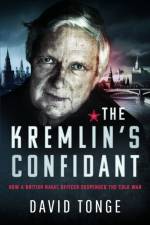
_Martin Packard is an extraordinary man who has led an extraordinary life. An idealist and a man of liberal instincts, his enthusiasms resulted in him having an inside track in several major events of recent decades, including the coup and bloody dictatorship in Greece and the unravelling of the Soviet Union. Easy going, warm and generous with his friendship, his life story is a ripping read_.â¿ **Peter Murtagh, journalist and author of The Rape of Greece (Simon & Schuster, London, 1994)**_His story needed telling_ â¿ **Peter Preston, ****editor of The Guardian 1975-1995**_This gripping biography is a classic tale of fact being stranger than fiction. Martin Packard was an incurable romantic who thought he could do ethical business in the chaos of Gorbachev's perestroika Russia, but was constantly thwarted by more ruthless rivals or incompetent partners. He was a Don Quixote of the Cold War. His story is a fascinating, alternative and very personal view on the confrontations of his times, from the cynical US and UK policies towards Greece and Cyprus, to the chaotic collapse of the USSR. His tale suggests that cock-up, not conspiracy, is usually the most plausible explanation of history._ - **Quentin Peel, former Moscow Correspondent and Foreign Editor of the Financial Times.**_Wonderful. They donâ¿t make men like that anymore._ - **Helena Smith, Correspondent of The Guardian for Greece and Cyprus.**This biography describes how a British naval officer became a Kremlin favourite and CIA target as Gorbachevâ¿s Moscow tried to open its economy to the West. He would gear the riches of Siberia and they would gain technology and foreign exchange. But, as the Communist Party imploded, this previously-undescribed offer turned into a Faustian bargain, and his life became a captivating saga of rags-to-riches-to-rags. In 1985, Gorbachevâ¿s Kremlin decided to open the Soviet economy to the west. It reached out to Martin Packard, a retired British naval commander, who rose briefly to become to some Russians the most important foreign businessman in the Soviet Union, but then precipitously collapsed. This book describes his rise, the details of his freelancing for Gorbachev - and his fall. A former intelligence analyst at the British Mediterranean command in Malta, Packardâ¿s role as Scarlet Pimpernel of the Greek Colonels saw him forced out of the Royal Navy. He then became one of the largest jeans manufacturers in Europe. In this capacity, the insiders of Gorbachevâ¿s perestroika made him a focus of their efforts to lift the life of the Soviet peoples, an unlikely partnership of the Kremlin and a quintessential Briton, a scion of Empire, Church and Navy, but a non-conformist in every sense. It is a political tale, where Packard finds himself at odds with the British Foreign Office and the CIA in Cyprus and the Colonelsâ¿ Greece. Forced out of the Navy, he begins to head the English Cell of the Greek resistance, shipping printing presses, passports and petards across Europe to Athens. He then becomes an intimate of the wayward but brilliant Dom Mintoff and survives a mysterious poison attempt by âEricaâ? at a Moscow airport. It is also a deeply human tale, of a charismatic figure who rose so high, mingled with the mighty of East and West, and then lost it all.
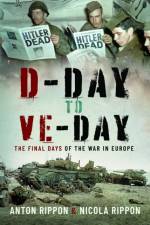
On the evening of Monday, 5th June 1944, the people of Britain went to bed with a sense of great events impending. They knew that any day now would come news of the battle that would forever alter the course of their lives, and the lives of their children and their grandchildren. The following dayâ¿s morning newspapers and early radio news bulletins were full of the fall of Rome to the Allies, which had been announced the day before. But then, at 9.33 am on that Tuesday, came the brief announcement: Allied naval forces, supported by strong air forces, had begun landing Allied armies on the coast of France.â¿ D-Day had finally dawned. _D-Day to VE Day_ tells the story of the last year of the Second World War in Europe, from the Normandy landings and on through the hard slog to that long-awaited day â¿ 8th May 1945 â¿ when Britain broke out the bunting, rolled out the barrel, and celebrated victory over Hitler. The air-raid sirens were silenced, the lights could be switched on again, and the boys would be coming home. In many homes, festivities were muted because the war in the Far East was still to be won, but for a few short hours at least, the nation could afford to let its hair down and dance in the streets. Using contemporary accounts â¿ interviews, newspaper reports and official documents â¿ of those final months, _D-Day to VE Day_ looks at life in Britain during those vital months, at the events that brought an end to war in Europe, and at the redrawing of national borders that would shape a new world order.
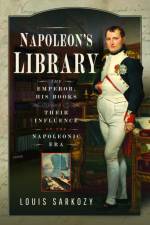
Napoleon Bonaparte held absolute political power in France and his influence stretched across Europe and beyond. Yet he remained â¿ between leading his armies and ruling over a vast empire â¿ an indefatigable reader who even carried libraries into battle. Bonaparteâ¿s love of the written word, birthed in childhood and nurtured as an adolescent and young adult, never left him. He was a lover of literature for its own sake â¿ often swooning over melodramatic love stories â¿ but he also understood the value of books as instruments of power. Before his campaigns, he poured over dozens of texts relating to the relevant theatresâ¿ geography, population, trade, and history. When contemplating grave decisions, such as his divorce to Empress Josephine, he consulted the historical record for useful precedents to justify and inform his actions. To bolster his troopâ¿s morale during challenging times, he constantly referenced history in his proclamations, making his contemporaries feel as if they were actively shaping history. They were. The library of an individual is the key to his mind. Behind the grandiose paintings of the victorious conqueror and the constructions of the propagandist, stands the reader. This book is an attempt to glimpse Napoleonâ¿s character without the veneer of imperial glory. What was he like, alone at night by his fireplace? What thoughts percolated in the mind of the ambitious 20-year-old, isolated in a little room while theorizing about manâ¿s happiness? Who are the literary and historical figures which can claim to have had impacted his life? Who were his favourite authors?Through this book the reader will embark on a literary promenade with the great general and statemen. In these pages are found the emperorâ¿s favourite authors. And with them, the key to understanding his mind.
Commemorating its 80th anniversary, this book tells the full story of a crucial late campaign in the Second World War. Drawing on a variety of sources, the authors shine a light on an area that General Eisenhower said 'experienced some of the fiercest fighting of the whole war'.
This volume examines the South China Sea's regional security dynamics, highlighting the challenges and opportunities for both littoral and non-littoral states.
This book investigates to what extent UNSCR 1325/WPS agenda has functioned in practice, to advance women's equality and empowerment in the peacekeeping context and beyond.
This book offers an analysis of naval constabulary operations, in particular Australian fisheries patrols, and challenges the widely accepted Anglo-American school of maritime thought.
This book offers a radically new approach to the study of Tuscan history.
Geography & Ethnic Pluralism (1984) examines the debate around pluralism - the segmentation of population by race and culture - as a social and state issue, and explors the significance of racial and cultural diversity in colonial, post-colonial and metropolitan situations.
Jamaican Migrant (1965) is the honest and moving recollection of a Jamaican cabinet-maker who emigrated to a new life in Britain. This is the book of a man who has been through the whole story in his own life - from childhood in Jamaica, to the problems and sophistication of girls and jobs and solitude in a London winter.
Labouring Children (1980) is a study of child immigrants apprenticed as agricultural labourers and domestic servants in rural Canada, based on numerous original sources, and presents new views on childhood, social work and Canadian rural communities.
Ugandan Asians in Great Britain (1975) examines the impact of the 1972 immigration of 28,000 Asians expelled from Uganda, looking at the impact on both the immigrants themselves and the British host community. It attempts to understand some of the dynamics of forced migrant transition from one society and culture to another.
Asia's Population Problems (1967) features papers written by specialists - demographers, economists and sociologists - examining the various population issues facing different Asian countries in the decades following the Second World War.
Migration and Mobility (1984) examines the biological aspects of population movement, including genetic, anthropometric and psychological aspects. Other contributions deal with geographical and demographic features of human migration.
The Development of British Immigration Law (1986) examines the policies and laws of immigration law in the UK. Particular aspects of the subject are examined in depth to illustrate the attitudes of government, the courts and civil servants.
Immigration in Post-War France (1987) presents a collection of articles, illustrations and other documents, covering everything from politics and education to religion and rock music, that examine the experience of North African immigrants to France.
One Way Ticket (1983) examines the 'hidden armies' of migrant women workers who have fulfilled a demand for low-skilled, low paid and insecure work in both the formal and informal economies of Western Europe. It presents a new focus for the examination of labour migration and of the specific character of female employment.
The Absorption of Immigrants (1954) examines the assimilation of immigrants in the Yishuv (the Jewish Community in Palestine) and in the State of Israel. It provides a historical analysis of the social structure of the Yishuv and of the development of the new Israeli society.
Healing Multicultural America (1993) looks at a group of Mexican immigrants who managed to understand and use the US democratic system to gain access to the 'American Dream'. The book aims to assist its readers to understand the significance of the politics of education for ethnic minorities.
The Americanization Syndrome (1987) examines the historical role of education in the process of 'Americanization'. It argues that the pattern has been not the promotion of a blend of different cultures but the indoctrination of norms of belief of religion, politics and economics and an explicit discouragement of cultural variety.
Cultural Conflict and Adaptation (1990) examines the alienation and cultural conflicts faced at school by the children of a small group of Hmong who have settled in La Playa, California. The educational process for these children is an example of cultural conflict and adjustment patterns, a common immigrant experience.
Crossing Cultural Borders (1991) examines the day-to-day interaction of immigrant children with adults, siblings and peers in the home, school and community at large as these families demonstrate their skill in using their culture to survive in a new society.
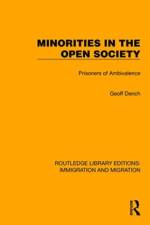
Minorities in the Open Society (1986) challenges optimistic assumptions regarding race relations in western nations, namely that social justice will prevail without much effort. It examines the interests behind public affirmations of commitment to integration.
Lost Illusions, first published in 1988, analyses the differing experiences of Caribbean migration to Britain and the Netherlands, both from the perspectives of the countries and from the migrants themselves. The in-depth articles from experts provide an essential examination of Caribbean migration to Europe.
Abonner på vårt nyhetsbrev og få rabatter og inspirasjon til din neste leseopplevelse.
Ved å abonnere godtar du vår personvernerklæring.