





Gjør som tusenvis av andre bokelskere
Abonner på vårt nyhetsbrev og få rabatter og inspirasjon til din neste leseopplevelse.
Ved å abonnere godtar du vår personvernerklæring.Du kan når som helst melde deg av våre nyhetsbrev.

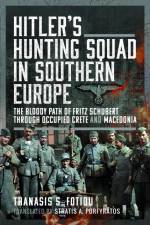
'The book relates in wonderful detail the tragedy of an era through the dreadful actions of a war criminal' - Nikos MarantzidesHitler's Hunting Squad in Southern Europe traces the violent path of Fritz Schubert and his Greek 'hunting squad' across occupied Crete and Macedonia, offering a complete translation of Thanasis Fotiou's comprehensive study on the German Lieutenant during World War II.The author's research reveals previously unknown aspects of Schubert's life and his actions as an officer, including the murder and torture of civilians, and the looting and burning of homes.Fritz Schubert, born in 1897, joined the German Forces in 1914 and concluded his service in Turkey, where he settled and married. By 1934, he had joined the National Socialist Party, influenced by Nazi ideology and propaganda. Fluent in several languages, he trained at the School of Interpreters under the reserve army's administration, attaining the rank of Unteroffizier. Hitler intended for Crete to play a significant role in the Middle East and Egypt due to its strategic oil reserves.In 1947, a special commissioner's report on Schubert's hunting squad stated, 'They murdered, they tortured in the most brutal ways numerous civilians, they looted and burned many homes. Generally, the arrival of Schubert's gang signaled unrelenting plunder, marked by tears, pain, and bloodshed.'
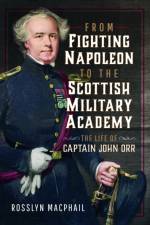
Based on Captain John Orr's previously unseen campaign diary and personal documents, this is the first biography of the man who would become Superintendent of the Scottish Naval & Military Academy (SNMA). We follow John during his eighteen months in Portugal and Spain informed by his first-hand accounts of the Battle of Salamanca, the siege of Burgos and fighting in the Pyrenees. Later he fought at Quatre Bras and was wounded at Waterloo. He was retired on full pension in 1821. Ten years later, aged 41, resigning himself that he would no longer be commissioned into a regiment, he enrolled as a captain in the Edinburgh Militia. Almost immediately he was asked to become the Superintendent of the Scottish Naval & Military Academy which was situated in Edinburgh. It had been established six years earlier and was struggling after the Directors had made a number of bad decisions.John's appointment stabilised the SNMA and the enrolment started to grow. He had enthusiasm for his job and managed to mix discipline with affection for the boys. In 1832 the Duke of Wellington became President. By the mid-1840s it had become a successful military college. It sent over a thousand young men into the services, including over a hundred who fought in the Crimean War. Nearly every British army regiment had at least one officer who had studied at the SNMA. Through John's letters, the history of the Academy is interwoven with a description of the Orr family. John died in 1879, aged 89 years old. He was the last surviving member of the Black Watch who had fought at Waterloo. The book is brought to life with paintings and photographs of John, his family, his uniform and pages from his Peninsular War diary. It is an intimate portrait of a soldier who served his country on and off the battle field.
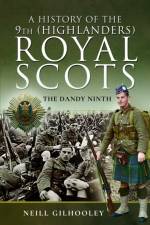
Edinburgh is forever bound to The Royal Scots, the oldest regiment in the British Army and now part of The Royal Regiment of Scotland. For a period in the early twentieth century, it also had a Highland battalion, the kilted 9th Royal Scots, which became affectionately known as the Dandy Ninth. The battalion was formed in the aftermath of the Boer War's Black Week. It sent volunteers to South Africa and established itself as Edinburgh's kilted battalion, part of the Territorial Force. Mobilised in 1914 as part of the Lothian Brigade, they defended Edinburgh and environs from the threat of invasion, and constructed part of the landward defences around Liberton Tower. They were part-time soldiers and new recruits, drawn from the breadth of society but with a strong representation of lawyers, rugby players and artists such as the Scottish Colourist F.C.B. Cadell, and William Geissler of the Edinburgh School. A remarkably high proportion of the battalion received commissions and served in many branches of the armed forces, and in many theatres. In the Great War they mobilised to France and Flanders and served in many of the major actions: in Ypres in both the Second and Third (Passchendaele) Battles of Ypres as well as on the Somme 1916 at High Wood and the Ancre (Beaumont Hamel), at Arras 1917 (Vimy Ridge); at Cambrai 1917 (Fontaine); and during the 1918 German Spring Offensive at St Quentin and at the Battle of Soissonais-Ourcq. They were with the 15th (Scottish) Division in the Advance to Victory. Some 6,000 men passed through the ranks of the Dandy Ninth and over a thousand never returned.
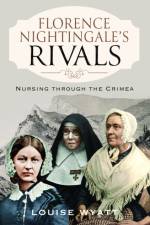
Florence Nightingale is synonymous with nursing in the Crimean War of 1854 -1856. There were, however, many other women who contributed to nursing at this time. Martha Clough, who dismissed the rule of Nightingale and took charge of nursing the Highland Regiments; Eliza Roberts, an experienced hospital surgical nurse who became Nightingale's aide-de-camp, nursing Nightingale when she fell ill with Crimean Fever and those with a wider scope of caring, such as Mary Seacole, whose nutritious supplements and caring demeanour meant everything to the soldiers. This book focuses on the relationship between Nightingale and two very interesting characters: the irascible Betsy Cadwaladyr and the equally strong-willed Mother M. Francis Bridgeman, head of the nursing Irish Sisters of Mercy in the Crimea. Bridgeman came from a similar social standing as Nightingale but whose pathway saw her leaving society lifestyle as a young girl and following the convent life. Cadwaladyr earned Nightingale's respect towards the end of her time in the Crimea due to her care of soldiers and her ability to run the kitchen at Balaklava, but nothing would change her stubborn dislike of Nightingale. The Sisters of Mercy, much overlooked in nursing history, were clinically nursing the victims of cholera and dysentery (two of the biggest killers in the Crimea) in their localities long before their journey to the battlefront. Betsy Cadwaladyr preferred domestic service and cooking to nursing, whilst Nightingale had the unenviable task of proving the nursing experiment to those watching from Westminster, trying not to upset the medical men as well as trying to filter out the best women to nurse with her, which was a nightmare in itself.
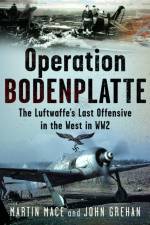
Hitler's Ardennes Offensive, his last great throw of the dice, was stagnating. After the initial German successes, the Allies had rallied. In a desperate bid to recover the momentum, the Luftwaffe aimed to gain control of the air by launching a major attack upon Allied airfields in the Low Countries - Operation Bodenplatte. On 1 January 1945, more than 800 fighters and fighter-bombers, predominantly Focke-Wulf Fw 190s and Messerschmitt Bf 109s, were despatched in this low-level, dawn raid on Allied airfields in Belgium and the Netherlands. The object was to destroy or cripple as many Allied aircraft, hangars and airstrips as possible. Generalleutnant Adolf Galland, the man in charge of Germany's fighter force and responsible for the original plans for Operation Bodenplatte, saw that the Allies had accumulated such a strong force of aircraft that there must be heavy congestion on the airfields used by the Allies. As the Luftwaffe rarely risked daylight raids, he hoped to take the Allies by surprise and catch their aircraft on the ground in a single massive strike. Galland's plan worked. Surprise was complete, and many Allied aircraft were destroyed before they could be scrambled. Allied pilots and aircrew ran or dived for cover as the German fighters swept over the airfields of Duerne at Antwerp, Evere in Brussels, Eindhoven, Ghent and another twelve bases of the RAF's 2nd Tactical Air Force, and the American Eighth and Ninth Air Forces. But not all the attacks were as successful as Galland had hoped. At some airfields the Allied squadrons were absent, already engaged in operations and at others powerful anti-aircraft batteries took a heavy toll of the attackers. As Galland, explained: 'In Unfamiliar conditions and with insufficient training and combat experience, our numerical strength had no effect. It was decimated while in transfer, on the ground, in large air battles ... and was finally destroyed.'Figures vary enormously, though it has been recorded that 224 Allied aircraft were destroyed (of which 144 were RAF) with a further eighty-four damaged beyond unit repair. For its part, the Luftwaffe lost sixty-two aircraft to Allied fighters and 172 to anti-aircraft guns - losses that it never really replaced, particularly in terms of aircrew. In Galland's words, the Luftwaffe 'received its death blow at the Ardennes offensive'. Told through a detailed narrative and a unique collection of dramatic photographs, the story of the last major air battle of the Second World War, is portrayed in vivid detail allowing the reader to see the destruction and devastation of the German attacks - and the crippling losses the Luftwaffe sustained.
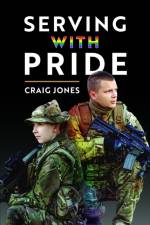
In January 2000, the ban on LGBTQ servicemen and women being in the British Armed Forces was finally lifted after a fierce battle at the European Court of Human Rights, by veterans who won freedoms for others that they were themselves denied.. To mark the event's 25th anniversary, this book shares the stories of LGBTQ Armed Forces veterans who have lived remarkable lives. Their stories are profoundly moving testaments to their loyalty, their courage on the battlefield, and their unswerving sense of right and wrong. This book celebrates the lives of servicemen and women who have stood tall and taken their place with pride and dignity in the fighting units of the Royal Navy, Royal Marines, Royal Air Force and the British Army. These are inspiring stories of people who created amazing careers in their service in the United Kingdom's Armed Forces, but so many of these careers would ultimately fall victim to the 'gay ban'.
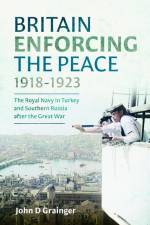
The end of the Great War in the Near East began with the Turkish Armistice but was not complete until the final peace treaty in 1923. During that five-year period the British Navy dealt with the overspill from the Russian Revolution in the Caucasus, the Caspian Sea and Central Asia as well, and then in the Aegean Sea and the Straits confronting the resurgent Turkish forces under Mustafa Kemal. The British in India were very concerned about Bolshevik activities in Central Asia and had sent two battalions of Indian troops under a British general to attempt to cope with it. They were successful in battle against larger forces, but politically they were unable to reach any sort of settlement. They were withdrawn when an Afghan war broke out. A second expedition was sent early in 1918 from Iraq through Persia to gain control of the oil fields at Baku in Azerbaijan. The object here was to prevent the oil falling into German or Turkish hands. This was an expedition at the limit of military capabilities, but it did succeed in seizing Baku and preventing a German conquest. In the process ships in the Caspian Sea were captured and turned into a Caspian Sea flotilla to fight Russian Bolshevik advances. These adventures happened before the Turkish Armistice. Constantinople had been occupied, but holding it became increasingly difficult and required the use of considerable forces, mainly British. The other allies gradually faded away or adopted the Turkish side. The resurgence of Turkish power in Anatolia eventually led to a tense confrontation between British and Turkish forces at Chanak on the Dardanelles and a difficult negotiation between generals. The result was a truce, British withdrawal from all occupied areas, and the collapse of the Lloyd George government in Britain, which was prepared to indulge in another war over the issues.
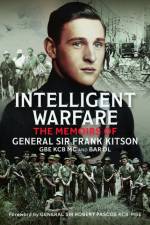
As this superb memoir bears out, General Sir Frank Kitson's 41-year career ranks among the most distinguished and eventful of the post-1945 era. Commissioned into the Rifle Brigade at the end of the Second World War, he distinguished himself during the vicious Mau Mau campaign. His highly innovative tactics and personal courage earned him his first Military Cross. The second quickly followed in Malaya at the height of the Emergency. In typically understated style, the Author describes his role planning the fight against communist aggression in Oman and his two tours in Cyprus, the second when commanding 1st Battalion The Royal Green Jackets. His effective uncompromising approach while commanding 39 Infantry Brigade in Belfast in the early 1970s was to have life-long security implications for Kitson and his family. Despite controversy he was marked out for high command. As GOC 2nd Armoured Division in BAOR and Commandant of The Staff College, his forensic brain and experience made a significant impact at a time of change. His final appointment was Commander-in-Chief UK Land Forces. How fortunate that this gifted, gallant and inspiring leader was persuaded by his ever-supportive wife Elizabeth to record his career and military thinking, albeit on the condition it would only be published after his death. The result is a highly readable, wide-ranging work which will appeal to all interested in late 20th Century military history.
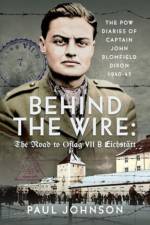
Diaries and letters from service personnel who were held captive throughout the Second World War survive in quite large numbers, but rarely are they so detailed as those of John Blomfield Dixon, whose home was in the Hertfordshire town of Ware. Having joined the Territorial Army in 1938, he soon found himself hurried through officer training and, with the outbreak of the Second World War, being commissioned as a subaltern, attached to the East Riding Yeomanry. Following his death in 2013, his family were bequeathed a series of scrapbooks, folders, maps, photographs and documents, along with a small pile of well-worn booklets, revealing his voracious appetite in describing his training, life and death during the retreat to Dunkirk, his humiliating capture by the enemy at the culmination of the Battle of Cassel and the long arduous journey through a series of 'Offizierslagers', which would, ultimately, lead him to Oflag VIIB, which was located in the Bavarian town of Eichstätt. Complimented by a series of annotated photographs, some of which have not been seen before, this book provides an insight to the long tedious days, miserable food shortages, his thoughts for home, the woman he desperately loved, his hatred for both captors and captives, the killing of his comrades both on and off the battlefield, the tireless efforts and disasters of escape, and his passion for the theatrical life, which was borne out on dusty prison camp stages, all of which provide a picture of his experiences and emotions. His views and opinions on the wild and inaccurate rumours, as well as propaganda relayed through both the German and Allied press, paint an oft distorted picture of the war's progression at that time. The Normandy landings in June 1944 brought a sudden realisation that freedom may soon become a reality. However, the frustration and anxiety of anticipated release culminate in a terrible disaster at the very moment liberty appears upon the horizon. This was on 14 April 1945, when the prisoners were machine-gunned by U.S. aircraft as they moved to Moosburg. Fifteen were killed and a further forty-one were wounded. Liberation too brings its own frustrations, borne out in the final diary entries and supplemented by a post-war summary of his long journey home. Combined with a narrative lifted from both official records of the period, and the recollections of men who served or were imprisoned with him, the carefully selected entries not only provide one of the most detailed pictures of life at Oflag VIIB, but also serve to memorialise the service of John Blomfield Dixon and those with whom he shared his incarceration.
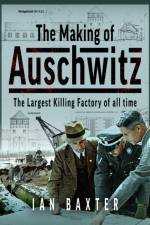
Commemorating 80 years since the liberation of Auschwitz-Birkenau, this book tells the story of the camp's construction and its evolution into the largest mass murder factory of all time. Using hundreds of captured German documents and architectural plans, the book is a unique historical source of how the architects came to plan and accomplish the horror we now call Auschwitz. Drawing on key documents from the Building Office archive, this in-depth study uses plans, letters, telegrams, worksite labour reports and minutes of meetings. It reveals how the SS needed civilian knowledge to install electrical, sewage and heating systems, and build chimneys and other structures. It explains how various outside contractors were involved in cooperating in genocide and shows just how eager they were to produce goods for the SS for financial reward. Just after the construction had begun on Birkenau in 1941, architectural plans were presented to include new crematoria and gas chambers. By the summer of 1943 Birkenau had been transformed into a murder camp but building and planning to further extend the site continued. In November 1944 Himmler gave the order to halt and dismantle the extermination facilities to conceal their murderous activities. When the Red Army arrived on 27 January 1945, most of the camp was still intact. Although the SS had incinerated the camps' archives they forgot to destroy the construction archive, which was kept in another building. As a result, the Russians found many of the technical drawings including construction blueprints that clearly detailed the extermination facilities. With detailed captions and text together with a plethora of rare photographs, the book is an important study into those that masterminded the murder of over 1 million people.
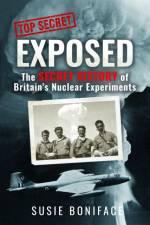
Once upon a time, it was necessary to have a weapon that could unleash hell. Britain hand-picked its healthiest and cleverest men to undertake a truly terrifying mission: to create and detonate an atomic bomb. Somehow, a country beset by post-war rationing and isolated from her allies created the most devastating weapons known to man, on the cheap and at the hurry-up. But it came at a horrifying price for them - and their families. The race to build a nuclear bomb sucked thousands into its vortex, who are still dealing with the effects of radiation today: veterans, widows, children, scientists and indigenous people, all subjected to fear, radiation, and experimentation. A black cloud still hangs over those who survive, and their descendants who fear the consequences of every fresh pregnancy. Exposed tells the complete story of the Cold War arms race, from inception to fallout, and for the first time reveals the blood-stained truth at the heart of the British state's longest criminal cover-up. Today, the UK's nuclear deterrent is a theoretical shield that shelters millions worldwide, protects it from aggressors, and guarantees its Prime Minister a seat at the top table. But for seven decades the veterans who created it have been denied truth and justice. As the handful of survivors launch a last-ditch legal bid for the answers, Exposed reveals the full price they paid for our peace and prosperity.
So much has been written, and is still being written, about the Wars of the Roses - both in print and on the internet - that the interested student of history is in grave danger of being utterly overwhelmed. The key players in the conflict are very interesting personalities but they have become so distorted by caricature that they now appear as a procession of heroes and villains rather than living, breathing people. The aim of A Guide to the Wars of the Roses is simple: to help the reader understand what happened and why during the great political upheaval of the fifteenth century. It describes the origins, nature and aftermath of the wars in short, accessible chapters and explains how the period can be divided into three separate, though related, political crises. In describing the rise of Richard, Duke of York, in the mid-fifteenth century, the Guide traces how his rivalry with Edmund Beaufort, Duke of Somerset, ultimately led to the deposition of the hard-pressed, and wholly unsuitable, King Henry VI. It also explains how the accession of a new king from the House of York failed to solve England's political problems. The triumphant Yorkist faction is examined to chart how the fears and jealousies of its leading figures eventually led to a fatal instability at the heart of government. By putting the wars firmly in their medieval context, the Guide seeks to strip away the hype of half a millennium to examine objectively the roles and motives of those involved, without seeking either to exonerate, or demonise, any particular individual. While the Guide is intended to be comprehensive, it is also an easy-to-follow manual for a subject which has often been dismissed as 'too complicated'.
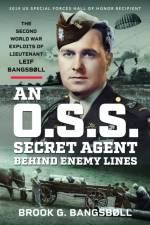
More than a Viking call to arms, An O.S.S. Secret Agent Behind Enemy Lines chronicles the incredible life of Leif Bangsboll up to and including the Second World War. Compiled by Bangsboll's son, this book explores the life of, variously, a Danish sailor, Norwegian aviator, American airborne serviceman, Green Beret soldier, and secret agent with the Office of Strategic Services. Brook G. Bangsboll heard his father's stories told and retold around the dinner table as far back as he could remember. He recalled his father talking of his christening at five weeks old aboard His Danish Majesty's Ship Grønsund in the middle of the North Sea during the First World War; about his attendance as a young man at German Chancellor Adolf Hitler's 50th birthday celebration in Berlin; and about his unplanned role in a rescue mission off the embattled shores of Dunkirk. Invigorated by the heroic efforts of the Allies at Dunkirk, Leif then joined the Norwegian Air Force and was trained as a pilot in Canada as part of the British Commonwealth Air Training Plan. Prior to being assigned to an operational squadron, Flight Sergeant Bangsboll was recruited into the United States Army by Colonel William 'Wild Bill' Donovan to become a field agent for the Office of Strategic Services, or O.S.S.. After completing his O.S.S. training at the top-secret facility known as Camp X, located on the shores of Lake Ontario, Second Lieutenant Bangsboll was sent to the United Kingdom to work with the O.S.S.' counterparts at Special Operations Executive. In October 1944 Lieutenant Bangsboll was parachuted into in the dark skies over occupied Denmark to lead the Danish Resistance forces in the central region of Jutland, operating out of the city of Aarhus. Operating under the field name of Mr. Jorgen Bech, ostensibly a Danish Maritime Engineer and businessman, Bangsboll trained Danish resistance fighters, planned and led sabotage missions against the German occupation forces and hunted down and eliminated known collaborators. For ten months he played a dangerous and daring game of cat and mouse with the Gestapo. In the spring of 1945, Lieutenant Bangsboll was reassigned by the O.S.S. to Copenhagen where during the final days of the war, he led an assault to capture the fortified German garrison at Ryvangen. His efforts in this assault would earn him the United States Distinguished Service Cross as well as the Danish Royal Knights Order of King Christian X - sighted for 'courage and selfless bravery in the face of the enemy'.
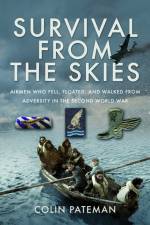
Many are the remarkable stories of the men who, through good fortune or sheer determination, survived the loss of their aircraft in the Second World War. Depending on the circumstances, these aircrew often became members of the Caterpillar, Goldfish or Late Arrivals clubs, as well as the famous Guinea Pig Club where membership was reserved to aircrew who were operated on by the legendary plastic surgeon Sir Archibald McIndoe. Such individuals include Captain R.L. Morrison who was injured when his Curtiss P-40 Tomahawk was shot down over North Africa; he was one of six aircraft brought down by the Luftwaffe Ace Hans-Joachim Marseille in just eleven minutes. Having survived his crash landing, Morrison was eventually picked up by a South African armoured car unit operating behind enemy lines. He finally reached Tobruk, gaining membership of the Late Arrivals Club in the process, from where he was evacuated just two days before the port-city was taken by Rommel's Afrika Korps. Then there is the story of Flight Lieutenant Charles Parish, who was the sole survivor of the crew of a Wellington bomber which was shot down in the English Channel. In pitch darkness, Parish swam seven miles to reach the English coast supported only by his Mae West life-preserver. For this remarkable achievement Parish was admitted into the hallowed ranks of the Goldfish Club. Other airmen who became a member of the Goldfish Club include rear-gunner Sergeant Frederick Price, who had been adrift at sea for six days before being rescued, and navigator Brian Beecroft, who survived not one, but two ditchings at sea. After parachuting to safety over France, and in so doing gain membership of the Caterpillar Club, Flight Engineer Kenneth Board evaded capture with the help of the Resistance. Some, however, survived the horror of the downing of their aircraft only to land in the hands of the enemy. Sergeant John Lord, who became a member of the Caterpillar Club, was one of these men; he was killed in error while a prisoner of war. Sergeant Cecil Room, meanwhile, had been adrift for three days before he was rescued by the Luftwaffe. Often these men received gallantry awards, and all have fascinating experiences to relate but their tales have not been told - until now. This collection of more than twenty accounts covers several theatres of war and deals with a wide variety of escapes following the disastrous loss of an aircraft over land or sea in the Second World War.
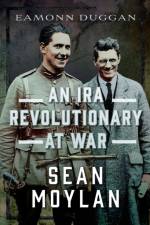
This book details the extraordinary life of Sean Moylan. Moylan became a major and very influential character in the war against the British during the years 1919 to 1921. Moylan, and the men he commanded, fearlessly confronted the enemy and managed to claim a string of notable IRA victories against all the odds which, to this day, are embedded in local and national folklore. The purpose of this book, based on the author's very extensive research into the Bureau of Military History's Witness Statement archive, is to revisit the life of a true Irish hero whose exploits during the War of Independence contributed, in no small way, to bringing the British to the negotiating table. Moylan graduated from being captain of the Newmarket Volunteers Company to Commanding Officer of the IRA's Cork No 2 Brigade by the time he was captured by the British in May 1921. During the War of Independence he also led a very effective Active Service Unit which inflicted major damage on the forces of the Crown at places like Clonbanin and Tureengarriffe. Such was his military prowess he had the distinction of not losing even one of his men in the many engagements he oversaw with the enemy. During the conflict he became a legendary and influential figure among his own people in Cork, not only because of his military activities but also because of his political work as a Sinn Fein member of the Dail. In May 1921, Moylan was eventually captured by the British but because of an extraordinary set of circumstances he narrowly avoided the death penalty. He went on to oppose the Anglo-Irish Treaty because it failed to deliver the Irish Republic he had gallantly fought for. During the Civil War he spent many months in the United States of America, at the behest of Eamon de Valera, raising money for the Republicans and championing the anti-Treaty cause. After the Civil War, Moylan was eventually coaxed back into politics by de Valera who saw in him a potential to contribute to the emerging Ireland under the stewardship of Fianna Fail. Moylan went on to become a popular and influential member of Dail Eireann and, in due course, was elevated to cabinet level. As a government minister in the Departments of Lands, Education and Agriculture he made very valuable and progressive economic and social contributions to the process which saw Ireland remove the shackles of the Anglo-Irish Treaty and assert herself as a truly independent nation.
The Knights Templar have fascinated us for centuries. They were holy warriors who fought with incredible bravery in the Crusades but were then destroyed by their own side. In battle they were the bravest knights - first on the battlefield and the last to quit. Charging towards the enemy with their white cloaks emblazoned with the red cross of martyrdom. Every young man in medieval Europe yearned to be a Knight Templar. The reality, though, could be tough. Battles fought against fearsome foes sometimes resulted in terrible defeat with a huge loss of life. The Templars were always the target of jealousy and hatred because of their military prowess, financial acumen, and strict organisation. Eventually, their enemies got the better of them. Not the Saracens they had fought in the Holy Land, but kings and bishops back home. The Templars were accused of bizarre initiation rituals and heretical beliefs. Many were executed for the sole crime of being a Templar. But their memory was not extinguished. It has endured. Today, millions of people still want to understand the history and mystery of the Knights Templar. Is it true they possessed the Holy Grail? Why were they destroyed so brutally?This book sets out to find the answers.
"The peerless musicians of the Royal Marines Band Service are no strangers to war, as the Author, Brian Short, himself a musician, reminds us in his book. Brian Short has an engaging style, and sense of humour, combined with a shrewd assessment of his fellow human beings. His description of his training and early years in the Band Service provide a vivid and necessary prelude to what follows, setting the scene and introducing the reader to aspects of life in the Royal Marines Band Service and the Band's experiences at war. From time to time the future existence of Royal Marines Bands is questioned by politicians. They should read this book; perhaps they will come to appreciate what a splendid contribution the Royal Marines Band Service has made to our country, by land and sea, and will continue to do so." **- Major General Julian Thompson Royal Marines**The Royal Marines Band Service are well known for their professional musical performances around the world and at all Royal and major high profile public engagements in the UK. Arguably one of the finest military bands, perhaps they are less well known for their military deployments in war zones around the globe, along with their humanitarian work in times of need. These fine musicians, can turn their talented hands to a multitude of non musical taskings, bringing enthusiasm and 'musical intellect' to whatever is asked of them. Held in high regard by Royalty, the Royal Marines and the anyone in the public who has seen them perform; the book 'Royal Marines musicians at war' shows them in a different light as they show their worth in the likes of Afghanistan, Kosovo, The Falklands and many more areas of conflict besides.
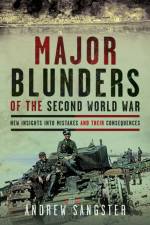
A mistake is an error of judgement, a blunder is a mistake caused by carelessness or ignorance, implying incompetence. Blunders are not always the result of incompetence; a chess player may give a critical piece away being distracted by noise, but in war it results in death with serious repercussions. This book explores such errors during the Second World War, some hardly known, a few contentious, many embarrassing. An American destroyer which fired a live torpedo at a battleship carrying Roosevelt, an American officer who unintentionally passed British information to Rommel, and a German plane crash-landing in neutral territory with plans for invasion are some little-known incidents. Overconfidence resulted in a Luftwaffe raid hitting exposed American gas shells killing Italian civilians, British and American military. Self-assurance led to an American general who lost men and tanks failing to rescue his son-in-law from a PoW camp. Inadequate planning brought disaster in the raid on Dieppe. Poor tactics deployed in the bombing of Monte Cassino was bad propaganda for the Allies but assisted the German defence. There are some issues which remain disputed, as with the British sinking the French Fleet, but whether it was a blunder remains questionable. There is the issue of the abdicated King Edward often accused of being a traitor, which may not have stood a court case but possibly a Judas caused by immature naivety. Finally, Dönitz was condemned at Nuremberg, but his U-boat warfare was no different from the Allies and at times almost chivalrous.
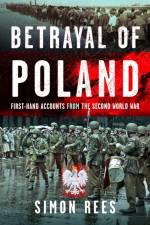
Hitler's Third Reich and Stalin's Soviet Union invaded Poland in September 1939 and the two autocracies proved utterly ruthless in their efforts to subjugate the Polish people. The resultant loss of life was almost unimaginable in scale but Poles from all walks of life refused to submit, either at home or abroad. Germany turned on its Soviet ally in June 1941, with Britain, the USA and the USSR eventually becoming partners in the war against Hitler. At various meetings and conferences, the 'Big Three' agreed post-war Poland would fall into the Soviet sphere of influence and Poles fighting for a free and independent country found themselves cut adrift. They had a stark choice after VE Day: live in Poland dominated by Stalin's puppets or face a life in exile. Betrayal of Poland is the first major English-language compendium of Polish first-hand accounts from the Second World War. Two of the witnesses flew over the Third Reich and faced the deadly threat of night fighters and flak. One fought at Hill 262 in Normandy, joining the effort to close the Falaise Gap, while another was parachuted into the Arnhem campaign. Two saw the horrors of Auschwitz: one from behind the wire and the other outside it. Others detailed the hell of being deported into Stalin's Soviet Union and their daily struggle to survive. Departing the USSR and joining what became the Polish II Corps, many went onto to fight at Monte Cassino. Finally, several witnesses recalled life under German Occupation and how they joined the Warsaw Uprising - the unequal and ultimately doomed battle against some of Hitler's most-murderous units. Backed by comprehensive appendices and several never-seen-before photographs, this work is a must-have for anyone interested in Polish history or the Second World War.
The stories of Ukrainians who stood up to defend their country during the Russian invasion of Ukraine. Some of the storytellers had never held a weapon before the full-scale invasion, while for others it was a profession.These stories are not just about war, but about who they are besides being ordinary people, students, workers, priests, teachers and doctors, professors, managers, actors, artists and musicians, pensioners, parents, and children, and so on.In addition to the reconstruction of events, here is also the comprehension of events by the people who are active creators of the history. They talk about the biggest terrorist attacks not only as military men, but also as ordinary people with their own experiences. The narrators talk about different periods of the war in different cities and have different views of what is happening. Their views combine to create a picture of the war's world and the image of a human who stood up to defend his country during the bloodiest war of our time.
Peredur, The Undiscovered Truth of the Nazi Grail Quest is written in two parts.The first part of the book charts the life and adventures of Otto Rahn, the man tasked by the Nazis, in the 1930s, with finding and getting his hands on the Holy Grail for them. The Nazis were hell bent on finding the Grail and reuniting it with the Holy Lance in a bid to create a mythical past of the Aryan race. Rahn believed that by uncovering the truth behind the Germanic saga of Parzival he would discover the whereabouts of the Grail. Parzival had, according to legend, successfully completed a quest to find the Grail, while being a knight in the court of King Arthur. In dissecting the story of Parzival, Rahn concluded that the Grail had been held by the Cathars, a heretical Christian sect, in their fortress at Montsegur. He believed that the Grail was still there, waiting for him to find it and based his quest around this belief. Unfortunately, after chasing round Europe in his efforts to find the Grail, and coming within touching distance of finding the truth, the Nazis patience with him ran out with him, and Rahn came to a sticky end, without ever having found the Grail. Rahn was the real-life figure who inspired the fictional movie character Indiana Jones.The second part focusses on Peredur, a British knight hailing from York, and the true hero of the original Grail Story. By examining the life of Peredur and the Grail Story, Peredur, the Son of Evrawc, written about him, we are able to reach the truth of the Grail Rahn and the Nazis never found. Rahn came very close to uncovering this, but the Nazis had lost faith in him, and casting him as a charlatan, hounded him to his death. Much of the story of Peredur, the Son of Evrawc is played out in the ancient British kingdom of Elmet, encompassing much of what we now call South Yorkshire, and whose southern border lay along the line of the River Don. As the story is unpicked, the truth of the Grail, is unraveled, leading to some astonishing findings.
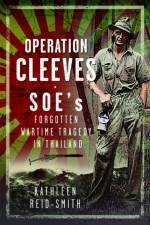
Southern Thailand, 1941. This is the story of Operation Cleeves. A daring and long forgotten SOE Far East mission, where a handful of tin miners risked their lives fighting against the onslaught of Japan on the eve of World War Two in Southeast Asia. Using declassified documents, previously undiscovered records and extensive original research, Kate Reid-Smith provides an intimate yet harrowing look into a most secret and turbulent operation shrouded in mystery. Where vivid and powerful accounts of tremendous courage in the face of resilience and redemption, uncovers how an eclectic mix of European civilians and Indian soldiers all marooned amid danger, violence and bloodshed, were suddenly confronted by unspeakable survival choices, as the circumstances of war catapulted them into an unimaginable world of horrific atrocities. Some of their stories are told for the very first time in this revelatory book, uncovering perilous undertakings requiring daring and sang-froid bravery, and how using only their wits for survival, all bore the full brunt of Japan's initial invasion.
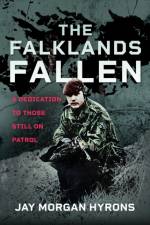
The Falklands War of 1982 was a brief 74 days of intense warfare resulting in the losses of 255 British Service personnel and just three civilians. Many books have been written with varying accounts about the military action, this book is the personal stories of the men behind the uniforms, the untold details of the three civilians who died towards the end of the war. Whilst researching the backgrounds of the fallen links to other military campaigns come to life through the personal stories of these brave men and their forebears. These stories are often unknown even to family members but ensure their immortality. We say 'Lest We Forget' this book is a stark reminder of how easy it is to lose history should we not document it.
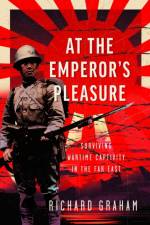
At the Emperors Pleasure follows the young couple Christopher and Topsy Man through the savage battle for Hong Kong and the years of enforced separation, she interned in Stanley Camp, Hong Kong, he as a prisoner of war and forced labourer in Kobe, Japan. The book is not about Christopher and Topsy Man alone but also of friends and colleagues close to them forced to endure the cruel torture and execution by the Kempeitai. Amongst those close to them some of Topsy's friends and colleagues were raped and murdered, one was imprisoned within shouting distance of her husband being tortured then executed by the Kempeitai, while another died when their camp was mistakenly bombed by the Allies. Topsy was herself the reluctant witness to ritual executions. Christopher lost brother officers and many of the Cockney soldiers under his command in the battle for Hong Kong. Others drowned in the East China Sea, victims of a barbaric but little-known mass war crime, the sinking of the Lisbon Maru. Still others survived the sinking only to succumb to the harsh regime of the POW camp in Japan. Perhaps most tragic of all, four of Christopher's men came through the battle, the Lisbon Maru sinking and cruel imprisonment only to die when the aircraft carrying them to freedom crashed into the sea during a typhoon. Like many of their generation who suffered at the hands of the Japanese during the second world war, Christopher and Topsy Man rarely spoke of their experience, and when they did, they were guarded in what they chose to share of it, even with those closest to them in their post-war lives. With privileged access to personal letters, diaries and records from the wartime years, from memories exchanged with Christopher's and Topsy's contemporaries and from knowledge shared by other historians, the author has written a compelling and moving account of the young couple's lives being torn apart by world events in late 1941.
When Napoleon overreached himself by usurping the Burbon throne of Spain in early 1808, the resulting Spanish resentment and the brutal suppression of the Dos di Mayo Rebellion in Madrid turned Spain, a long-term enemy of Britain, into an ally. Sir Arthur Wellesley's expedition to South America was promptly cancelled and redirected to the Peninsular. Eventually landing in Portugal at the mouth of the Rio Mondego, the army found itself with little transport, but by keeping close to the coast and with logistical support from the Royal Navy, Wellesley set off south to confront Marshal Junot and liberate Lisbon. The first clash of arms was at Obidos and, days later, at the Combat of Roliça, Wellesley achieved his first victory in battle against the willey General Delaborde. With word that reinforcements were expected to arrive at Maceira Bay, the army was deployed at Vimiero to protect their landing. Meanwhile, Junot had assembled his army and decided to attack at Vimiero. In a short but hard-fought battle, Wellesley was victorious, however an opportunity for total defeat of the French was squandered in succession by generals Burrard and Dalrymple, who instead accepted an armistice. This eventually became the notorious Convention of Cintra.
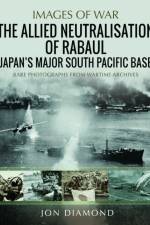
Fierce Pacific ground, sea, and aerial combat raged between the Allies and Imperial Japan to halt the latter's inexorable advance in 1942-1943. After the American victory at Guadalcanal in February 1943, Admiral Halsey's South Pacific Area (SPA) naval and amphibious forces battled through the Solomon Islands building new and acquiring extant Japanese airfields. Simultaneously General Douglas MacArthur's Southwest Pacific Area (SWPA) Australian-American ground forces, supported by General George Kenney's US Fifth Air Force and other Allied air squadrons, captured Japanese installations in Papua New Guinea before campaigning along Northeast New Guinea's northern coast ousting or bypassing enemy installations there. Using newly-built Papuan airfields, the Allies gained air superiority over New Guinea and also interdicted Japanese maritime supply lines. Yet, the main Japanese southwest Pacific bastion at Rabaul on the northeastern tip of New Britain, the largest island of the Bismarck Archipelago, remained. In March 1943, realizing an amphibious assault and ground campaign against Rabaul's naval and army bases would be too costly, the US Joint Chiefs of Staff decided to neutralise Rabaul with a joint SPA and SWPA aerial siege rather than capture it. This IOW volume recounts this strategy during 1943 and 1944 and the December 1943 amphibious landings by the US 1st Marine Division and US Sixth Army units at Cape Gloucester and Arawe, respectively, which successfully isolated the Japanese fortress and satellite bases.
This book describes, in great detail, the second year of Putin's 'Special Operation' to obliterate Ukraine. General (Ret) Harrel's previous book, entitled The Russian Invasion of Ukraine, February - December 2022, described the initial invasion, identifying the units and weapons on the battlefield with military precision. Now he continues the story of Ukrainian resistance in the face of overwhelming odds. The author knowledgeably reports on twenty-first century mechanized warfare, and how drones and unmanned aerial vehicles (UAVs) have evolved to dominate the tactical, operational, and strategic levels of war. The year 2023 saw the dawn of drone warfare as combatants on both sides of the conflict at first tinkered with the use of civilian hobby-type machines but then, having had great success, rushed forward to design, purchase (often with crowd funding) and deploy drones through all domains of the battlefield. Drones performed reconnaissance, targeting for artillery and direct attacks, seeking, identifying, and striking targets not only on the battlefield but in the Black Sea and deep inside Mother Russia. As the fighting raged, Russia successfully continued its worldwide cyber campaign to influence elections, divide allies and undercut support for Ukraine. The Pyrrhic Russian victories at Bakhmut and Avdviika were offset by Ukrainian victories in the Black Sea, after its failed counteroffensive in the Summer of 2023. Finland and Sweden joined NATO, while US support was stymied and delayed by internal politics. NATO clearly assumed its place as the bastion of Western freedom as the war continued into 2024.
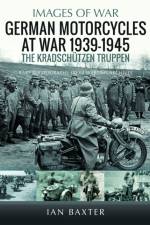
The success of fast-moving Blitzkrieg tactics by the Nazi war machine depended on high mobility. With their on- and off-road capabilities, motorcycles became an important component of the Nazi war machine's arsenal making a particularly significant impact in French and Russian campaigns.The motorcycles were used in a variety of roles including patrolling, intelligence gathering, and police duties in occupied Europe. Motorcyclists could be found in every unit of an infantry and Panzer division including headquarters which had a motorcycle messenger platoon. Their versatility also enabled them to survey enemy positions until coming under fire before reporting back with vital intelligence relating to enemy locations and strengths.The German industry produced wide range of motor-bikes for military use. By 1938 some 200,000 motorcycles were produced in Germany and occupied territories. The principal makes included BMW, DKW, NSU, Triumph, Victoria, and Zundapp. Sidecar combinations, often mounted with an MG34/42 machine gun, also made the bike a very effective weapon.By describing in words and contemporary images the role of the German motorcycle and motorcyclists during the Second World War, this Images of War book fills an overlooked gap in coverage of Nazi military capability. It emphasizes that the German military perfected the use of motorcycles and employed them more widely than any other army.
Abonner på vårt nyhetsbrev og få rabatter og inspirasjon til din neste leseopplevelse.
Ved å abonnere godtar du vår personvernerklæring.