





Gjør som tusenvis av andre bokelskere
Abonner på vårt nyhetsbrev og få rabatter og inspirasjon til din neste leseopplevelse.
Ved å abonnere godtar du vår personvernerklæring.Du kan når som helst melde deg av våre nyhetsbrev.

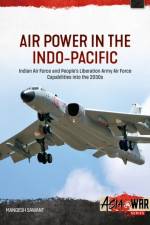
A study of the last 100 years of conflict suggests that air power dominates warfare. Air power was successfully applied in the Spanish Civil War, First and Second World Wars, Vietnam War, Six Day War, Yom Kippur, Gulf War, Operation Iraqi Freedom, Afghanistan 2003 and Libya. John Warden, asserts 'Those who have air power overwhelm those who do not; those who do not have it spend their energies trying to get it, thwart it or escape it.' Air power will be a decisive factor in the outcome of future wars. As China flexes its muscles an understanding of the challenges facing the PLAAF is crucial for India and the world at large. A study of the operational capabilities of the IAF and the PLAAF has not previously received a systematic and a rigorous assessment.The literature on the operational dynamics of PLAAF and IAF during a war remains sparse and underdeveloped despite a large and growing volume of work on overall Chinese military capabilities. Understanding both the IAF's and the PLAAF's history, organisation, culture and weapons systems and their trajectory into the near future are important for assessing their capabilities for fighting wars.In the context of the escalating Sino-Indian rivalry, this work sets out to examine how the PLAAF and IAF would perform in a conflict; the nature of air power disparity between India and China, and whether the existing numerical disparity between India and China give China a clear and incontestable advantage.Air Power in the Indo-Pacific sets out to understand the interaction between the crucial determinants of modern warfare such as technology, strategic advantage in high altitude warfare, streamlined organisation, leadership, weapons platforms, combat experience, force structures, doctrinal and operational concepts, training, geography, weather and distance to better understand the war fighting capabilities of the IAF and PLAAF.Air Power in the Indo-Pacific: Indian Air Force and People's Liberation Army Air Force Capabilities into the 2030s brings about an understanding of China's past and present approaches to air power and provides a crucial baseline for assessing future challenges. It provides a qualitative assessment of the IAF and PLAAF weapons systems and platforms and battle preparedness. Rare historical anecdotes and insights pertaining to air power and China are examined. The book's comprehensive assessment of the forces that drive the PLAAF is a critical reading for anyone trying to understand air power in the Indo Pacific region and aims to change the way the world looks at the PLAAF.This volume is illustrated throughout with original photographs, and specially commissioned colour artworks and maps.
King George's Army: British Regiments and the Men who Led Them 1793-1815 will contain five volumes, with coverage given to army administration and cavalry regiments (Volume 1), infantry regiments (Volumes 2, 3 and 4), and ordnance (Volume 5). It is the natural extension to the web series of the same name by the same author which existed on the Napoleon Series from 2009 until 2019, but greatly expanded to include substantially more biographical information as well as biographies of leading political figures concerned with the administration of the army as well as commanders in chief of all major commands.Volume 4 covers in great detail the 61st to 104th Regiments of Foot within the army of King George the Third for the period of the Great War with France; and the men who commanded them. Regimental data provided includes shortform regimental lineages, service locations and dispositions for the era, battle honours won, tables of authorised establishments, demographics of the field officer cohorts and of the men, even sources of recruits from the militia. But the book is essentially concerned with the field officers, the lieutenant colonels and majors who commanded the regiments, and Volume 4 alone contains around 1,000 mini-biographies of men who exercised such command, including their dates of birth and death, parentage, education, career (including political), awards and honours, and places of residence. Volume 5 will extend the coverage to ultimately record over 4,500 biographies across more than 200 regiments.These biographies will show the regimental system in action, officers routinely transferring between regiments for advancement or opportunity, captains who were also (brevet) colonels, many who retired early, some who stayed the distance to become major generals and beyond. Where it has been possible to accurately ascertain, advancement by purchase, exchange or promotion has also been noted.Readers with military ancestors will no doubt find much of interest within, and the author hopes that the work will allow readers to break down a few 'brick walls'; either through connecting to the officers recorded, or through an understanding of the movements of the regiments around the world, or from the volunteering patterns of the militia regiments into the regular army.Encyclopaedic in scope, and aimed to be a lasting source of reference material for the British army that fought the French Revolution and Napoleon between 1793 and 1815, King George's Army: British Regiments and the Men who Led Them will hopefully be a necessary addition to every military and family history library for years to come.
The events of the 1798 Rebellion are still very much all around us. In many ways, the Rebellion, its campaign and aftermath, set the tone for political relations on the island of Ireland for centuries to come. It has been seen as a formative event in the creation of the Irish Republic and has been used as a 'rallying cry' within nationalism - and a 'cautionary tale' within unionism - ever since.Yet, it was so much more than this. It was a seemingly localised insurrection, but it came at a perilous time when Britain seemed almost alone in combating the ideals and war aims of Revolutionary France. The danger of an independent republican Ireland on its doorstep, spreading radicalism across the British landscape, became obviously apparent as similar organisations (such as the United Englishmen and United Scotsmen) appeared. Consequently, the 1798 Rebellion is a vitally important campaign, not only in an Irish national context but from a pluralistic British perspective as well.Whilst the actual rebellion was brutal and short, it had long-lasting repercussions. For some involved, their campaign ended in transportation to the colonies or on scaffolds, whilst others found themselves in redcoats, fighting alongside their former enemies - or in other nation's armies continuing their own personal war.Using exciting and gripping primary sources and accounts, combined with existing archaeological and topographical evidence, With Deadly Slaughter hopes to place a fresh perspective on, as Thomas Paine called it, the '...times that try men's souls'.
Britain carried out many amphibious operations during the long-eighteenth century, ranging from raids to the landing of whole armies. British Amphibious Warfare 1739-1815 provides case-studies of some of these operations, and explores why their outcomes ranged from great successes to major disasters, with no obvious long-term learning curve. Many of the mistakes at Cartagena in 1741 were replicated at Walcheren in 1809, condemning soldiers in both campaigns to lingering deaths from fever. Between the two we find successes including Louisbourg (twice), Quebec, Belleisle, and Charleston, and the textbook landings at Aboukir Bay in 1801 that delivered Abercromby's army to Egypt, but also failures at Lorient, St Cast, Ostend, New Orleans and elsewhere. What factors ensured that some expeditions succeeded where others failed? What lessons were learned along the way, and why were they not consistently applied thereafter?British Amphibious Warfare 1739-1815, built on papers presented at the 2023 From Reason to Revolution conference but also bringing in additional contributors and material, provides an overview of Britain's amphibious operations from the early part of the eighteenth century to the close of the Napoleonic era, an examination of the earliest attempts to develop amphibious doctrine by Thomas More Molyneux, and a series of case-studies that examine both successes and failures. Case studies include: Cartegena 1741, Louisbourg 1745, Lorient 1746, Belleisle 1761, the Delaware River 1777, Charleston 1780, Ceylon 1795-1796, Aboukir Bay 1801, Walcheren 1809, and amphibious raiding in the Adriatic during the Napoleonic Wars.
The strong survived. Nearly 800 men followed the famous 'fighting parson, ' Colonel Peter Muhlenberg, into the Continental Army in 1776. Few of them remained at the end of the war. Meticulously researched and accurately told, this is the story of the Last Men Standing.In colonial times, thousands of German and Irish immigrants settled in Virginia's western reaches. The 8th Virginia Regiment was conceived as a way to recruit them. Men from Pittsburgh to Tennessee were collected into ten rifle companies and sent into some of the hardest service of the war. Only a few remained for the final victory at Yorktown.Historians once said The Last Men Standing could not be written. Neville was challenged by a librarian at the David Library of the American Revolution to uncover the story. 'It's out there, ' the librarian said. 'You just have to find it.' The Last Men Standing is the result of many years of research in distant archives, small museums, private collections, and other sources. Neville likens the project to a jigsaw puzzle or a treasure hunt. The Last Men Standing traces the lives of immigrant children from the terrors of the French and Indian War, through the Revolution, to the settlement of the American frontier. Historians will appreciate Neville's use of little-known sources, attention to neglected incidents, and reinterpretation of major events at Sullivan's Island, Germantown, and Monmouth. Every reader will enjoy the story.
Generals Auchinleck, Slim and Savory and their role in the campaigns in Northeast India and Burma (Myanmar) have been largely forgotten in the historiography of the Second World War. Prime Minister Winston Churchill sacked General Claude Auchinleck as Commander-in-Chief (C-in-C) in the Mediterranean and Middle East theatre after the First Battle of Alamein. However, Auchinleck became C-in-C India for the remainder of the Second World War. In this role, he was essential in making sure the Indian Army was geared towards jungle warfare, but also improved the lot of both Indian officers and men not least by improving pay and conditions.General William Slim is perhaps better known as the successful commander of the 14th Army who also wrote one of the best books on the war: Defeat into Victory, an apt description of the campaign in Burma. He was a popular commander and referred to as General 'Bill' Slim by the British and Indian soldiers who served under him. Auchinleck and Slim both became Field Marshals after the war. Major General Reginald Savory played an essential role as the Director of Infantry from 1943 until the end of the war. He made sure that all infantry battalions and training establishments across India were trained for jungle warfare. His was a forgotten role that until now has not been documented. He retired as a Lieutenant General having been Adjutant General until the Independence of India and Pakistan in 1947.The appointments of Auchinleck, Slim and Savory in 1943 were an important factor in the eventual defeat of the Imperial Japanese Army in Burma. It helped that the key figures in Indian military affairs were, for the first time in the war, all drawn from the Indian Army and thus understood the traditions and ways of the Indian Army.
The year 1918 was the most dramatic of the entire First World War. It was defined by vast battles that put the British Army under enormous pressure. In March, the army found itself fighting for survival in the face of the massive German Spring Offensive. After immense Allied efforts the assault was halted by the summer, at which point the British Army switched to a sustained offensive of its own in the Hundred Days Campaign.This book brings together leading historians of the First World War to consider the British Army in the final year of the conflict. It includes essays that examine strategy, key commanders, logistics, training, tactics, airpower and armoured warfare. Lavishly illustrated and with full colour maps, this book provides many new insights that will be of great interest to any student of the First World War.
The first English edition of a legendary journalist’s eyewitness account of the near-bloodless coup and the Carnation Revolution that ended fascism in Portugal
Explores the work of interpreters and translators at the First Frankfurt Auschwitz Trial.
This book has it all ... like reading an After the Battle and Panzerwrecks combined ... highly recommended! --Chuck Aleshire, AMPS Chicagoland
Abonner på vårt nyhetsbrev og få rabatter og inspirasjon til din neste leseopplevelse.
Ved å abonnere godtar du vår personvernerklæring.