



Gjør som tusenvis av andre bokelskere
Abonner på vårt nyhetsbrev og få rabatter og inspirasjon til din neste leseopplevelse.
Ved å abonnere godtar du vår personvernerklæring.Du kan når som helst melde deg av våre nyhetsbrev.

This edited volume offers a new interpretation of the historically momentous 1952 Wassenaar negotiations between representatives of the Federal Republic of Germany, Israel, and the Jewish Claims Conference to negotiate reparations, compensation, and restitution in the aftermath of the Holocaust.
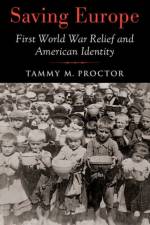
Saving Europe offers a transnational and intersectional history of American food, war relief, and intervention in Europe between 1914 and 1924, a period when the United States simultaneously tightened its borders and expanded its reach. In that crucial decade after the outbreak of World War I, Americans saw themselves in a novel role as protectors of European cultural heritage and as rescuers of vulnerable populations, making them worthy successors to earlier global powers and serving as a harbinger for the later US global presence.
Survival, the IISS's bimonthly journal, challenges conventional wisdom and brings fresh, often controversial, perspectives on strategic issues of the moment.
Faith of the Fathers provides a captivating collective biography of the Catholic priests who served in America's most deadly war.Faith of the Fathers brings to light the forgotten stories of courageous chaplains whose commitments to faith and to men at war during America's most divisive conflict have long been overlooked. The Reverend Robert J. Miller provides a comprehensive and compelling portrait of the 126 priest-chaplains who served during the Civil War and reflects on the importance of religion and faith in nineteenth-century America. As a culture of death and horror raged around them, Catholic priest-chaplains met the needs of soldiers and officers alike, providing years of faithful and dedicated service in hospitals, prisons, battlefields, and camps.Whether ministering to Union or Confederate soldiers (or both), in eastern or western theaters, in battle or camp, these priests risked their lives to bring faith and hope to one of the darkest and most devastating periods of American history.
"The chapters in this book build on a growing body of scholarly literature that challenges the traditional temporal and geographic frameworks of World War II, expanding the timeline to include a series of regional wars and revolutions that precede (from 1931) and follow (to the mid 1950s) the "central paroxysm" defined by the active participation of the United States. This approach works to decenter US- and Europe-centric accounts of the war and to highlight "bottom-up" agency in ways that destabilize conventional narratives"--
On the centenary of the signing of the Lausanne Convention, the American School of Classical Studies at Athens presented an exhibition highlighting a monumental humanitarian undertaking etched in the memory of history: the American relief aid offered to Greece from 1918 to 1929. The exhibition brought to light the tireless efforts of diverse individuals, ranging from political appointees and philanthropoic leaders to educators and dedicated relief workers. Motivated by a sense of duty rooted in their Christian, patriotic or personal beliefs, they collectively played a pivotal role in reshaping Greece after 1922. The exhibition drew on a rich array of sources, including correspondence, official documents, rare publications, photographs, artifacts, posters, and short films. These treasures, which come from the important collections of the American School of Classics in Athens, but also from various institutions, are presented here for the first time, weaving a fascinating narrative with special significance.
This second edition of Crisis and Crossfire traces the origins of the contemporary challenges the United States faces in the Middle East by analyzing the broad contours of U.S. policy in the region since the government’s first involvement there in the 1940s.
Based on a massive array of overlooked primary sources, The Skeptic Isle presents a fast-paced narrative of the British attempt to sell World War II to its citizens. It weaves together government public relations, media reporting, political maneuvering, and the public's response to reinterpret some of the most famous moments of British history, from Chamberlain and appeasement to Churchill's great speeches, from the Battle of Britain to the military campaigns in the Mediterranean and Western Europe, from food rationing to the Beveridge Report.
This book chronicles the final conflict over the now almost forgotten "Schleswig-Holstein Question", once a pivotal issue for the great powers of Europe. The campaign of Schleswig and Jutland was also the first of Otto von Bismarck's Wars of German Unification, which together created a united German Empire under Prussian leadership. The detailed story of this, the last of the "Cabinet Wars", is told here for the first time in English, compiled from numerous published and unpublished sources, including many contemporary and first hand accounts, as well as official reports. This is an invaluable resource for any student of the mid 19th Century.
Abonner på vårt nyhetsbrev og få rabatter og inspirasjon til din neste leseopplevelse.
Ved å abonnere godtar du vår personvernerklæring.